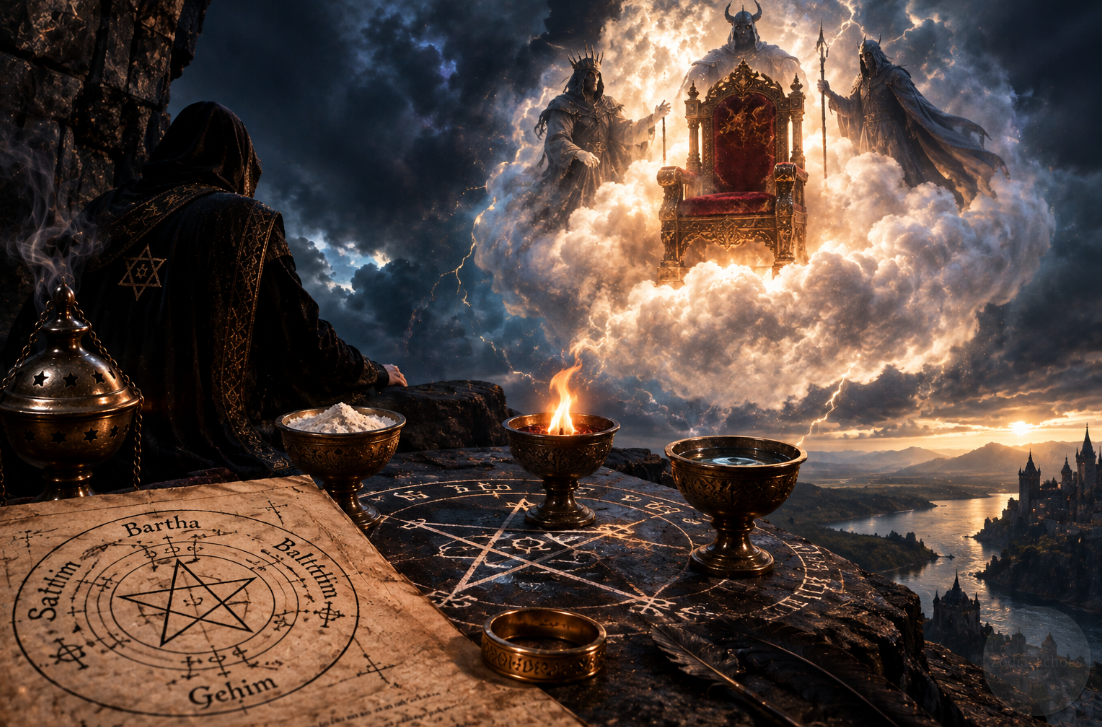
A horse that could travel over mountains and water was apparently not ambitious enough. Neither was a magically summoned ship. The anonymous compiler of the fifteenth-century Munich Manual of Demonic Magic preserved another possibility for anyone who wanted to travel somewhere quickly: sit on a chair inside a cloud and fly there.
The operation is known today simply as “For Obtaining a Flying Throne.”
And unlike a vague legend about medieval sorcerers flying through the sky, this is an actual surviving ritual. The manuscript describes the circle, names the spirits supposedly responsible for the journey and even explains what the magician should do if somebody attacks the throne while it is travelling.
Three Pots Around a Magical Circle
The operation begins in an isolated, elevated place during calm weather. The magician prepares a circle and positions three vessels around it. One is associated with the north, another with the east and another with the west. The manuscript assigns different substances to them, including ashes and flour, fire and salt, and water and lime.
The magician then sits in the center facing north. This is where the surviving diagram becomes important.
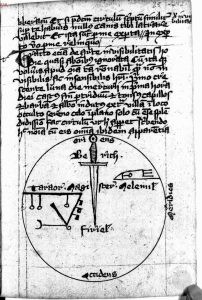
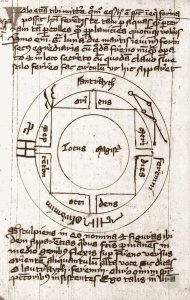
The ritual figure associated with “Summoning a Flying Throne” in the fifteenth-century Munich Manual of Demonic Magic, Clm 849.
The historical figure is reproduced among the surviving signs and sigils of the manuscript as Spell 15: Summoning a Flying Throne.
Summoning the King of the Clouds
Once inside the circle, the magician addresses a being named Bartha, described as the king of the clouds. Bartha is asked to send three guides possessing power over clouds and winds. Their names are given as variants of Saltim, Balthim and Gehim in the surviving material.
Their task is remarkably straightforward: transport the magician safely to wherever he wants to go. Then the spectacle is supposed to begin. The manuscript claims that a small cloud will appear. Three manifestations emerge in connection with the three vessels and announce that the magician should ascend. And then something appears inside the cloud. A chair.
Sit Down. Tell It Where You Want to Go.
The magician is instructed to sit on the newly appeared throne and command Bartha and his guides to carry him to a specified destination. The text repeatedly emphasizes that the journey should happen gently, without fear and without injury to either body or soul.
It is essentially a supernatural transportation request wrapped inside an elaborate Christian-demonic conjuration. The manuscript claims that the spirits will then carry the traveller wherever he wishes. Even companions could apparently come along.
There was one wonderfully specific condition. The travelling party was supposed to contain an odd number of people. Apparently even a fifteenth-century flying demonic taxi had passenger restrictions.
What If Someone Attacks Your Flying Chair?
This is where the ritual becomes genuinely bizarre. The manuscript anticipates the possibility that somebody might attempt to attack the magician during the journey. And it provides countermeasures depending on which direction the attacker approaches from.
An enemy approaching from one direction could supposedly be met with a storm. Another could be overwhelmed by rain and clouds. From another direction, the magician could call for thunder, clouds and lightning. The throne therefore was not merely supernatural transport. According to the manuscript’s internal logic, it came with its own atmospheric defensive system.
Snakes, Birds and Horrors in the Sky
There was another problem. The journey might apparently contain things capable of frightening the passenger. The manuscript specifically anticipates storms, snakes, birds and other terrifying appearances.
If these appeared, the traveller was instructed to call upon King Bartha again and command the frightening visions to disappear. The text promises that they would immediately vanish and the journey could continue safely. That detail provides an important clue to how historians interpret rituals like this one.
The Munich Manual contains several experiments involving impossible transportation—supernatural horses, ships and the flying throne. Kieckhefer groups such material among its illusionist experiments.
The experience envisioned by the text may therefore belong more naturally to medieval traditions of magical vision and perceived supernatural travel than to a literal claim that physical furniture was cruising across fifteenth-century Europe.
READ THE HISTORICAL RITUAL
A modern transcription/translation of the Munich Manual preserves the Flying Throne as Spell 15.
The Flying Throne Was Not an Isolated Idea
The really interesting part is that supernatural transportation appears repeatedly in this manuscript. Experiment No. 8 promises a magically produced ship. Several others promise horses or spirits in the form of horses capable of extraordinary journeys. And experiment No. 15 simply eliminates the horse altogether.
The magician gets a throne. Kieckhefer notes that these transportation experiments belong to the manuscript’s illusionist material and compares its magical flight traditions with ideas that later appeared in accounts of witches’ supernatural journeys.
The manuscript therefore preserves something stranger than a single eccentric spell. It preserves an entire medieval fantasy of instant supernatural travel.
THE SCHOLARLY EDITION
The ritual can also be examined in Richard Kieckhefer’s scholarly edition of Clm 849:
This is useful alongside the manuscript imagery because Kieckhefer provides the historical context for the Munich Manual and its illusionist experiments.
A Fifteenth-Century Flying Machine Made From a Cloud
There is no evidence that Bartha existed or that anyone actually crossed Europe sitting on a supernatural chair. But that is almost beside the point. Someone in the fifteenth century thought this operation worth copying into a serious magical manuscript.
He recorded the circle.
He recorded the names.
He recorded the three vessels.
He explained how the cloud was supposed to arrive.
He explained how to board the throne.
He even preserved procedures for dealing with hostile encounters during the flight.
And after all those precautions, the final promise is wonderfully simple: go peacefully and do not be afraid. According to the grimoire, they would take you wherever you wanted to go.
FAQ
Is the Flying Throne a genuine medieval ritual?
Yes. “For Obtaining a Flying Throne” appears as experiment/spell No. 15 in material from the fifteenth-century Munich Manual of Demonic Magic, Clm 849.
Who is Bartha?
Within this ritual, Bartha is described as the king of the clouds and is petitioned to provide supernatural guides capable of transporting the magician.
Did a chair really appear inside a cloud?
That is what the ritual claims. There is no reliable evidence that such supernatural transportation actually occurred. Kieckhefer treats this broader group of magical transportation operations as illusionist experiments.
Could other people travel on the throne?
According to the text, companions could accompany the magician, with the curious instruction that the travelling group should contain an odd number of people.
Why does the ritual mention lightning and storms?
The text provides different responses if somebody threatens the traveller during the journey, including supernatural storms, rain, clouds, thunder and lightning.
Does the original ritual diagram survive?
Yes. A figure for Spell 15: Summoning a Flying Throne survives among the diagrams reproduced from the Munich Manual.
✨ Explore More from Zodiac Echoes ✨Explore More from ZE
Choose your zodiac sign to explore daily, weekly, monthly, and yearly horoscopes.