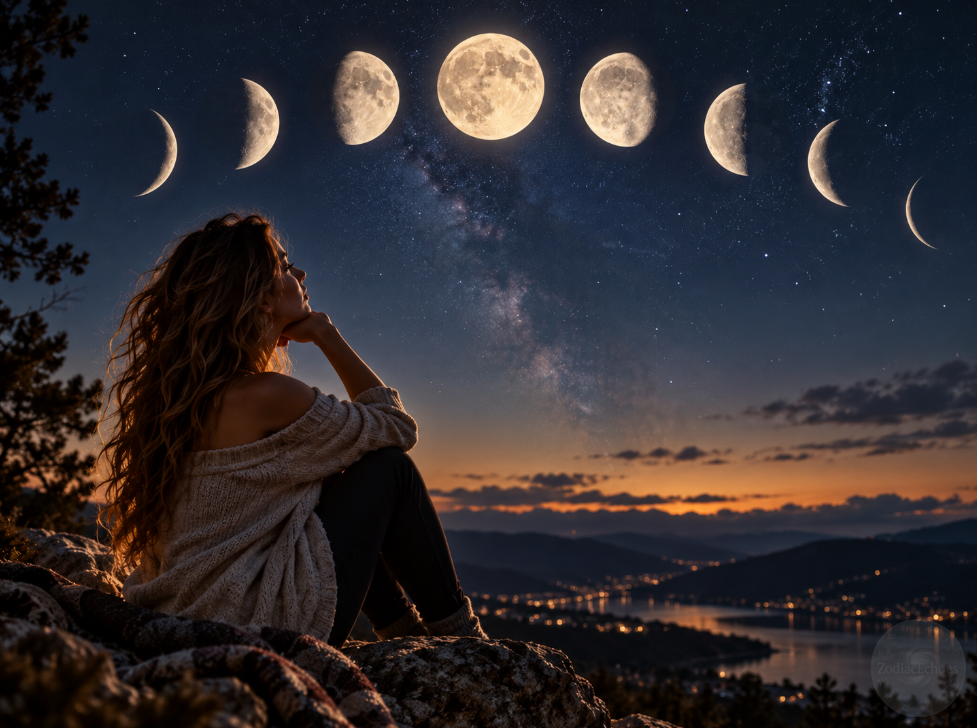
Look at the Moon on different nights and it can seem like an entirely different object. Sometimes it’s a brilliant circle, sometimes only half is visible, and on other nights there’s nothing more than a delicate crescent hanging in the sky.
But the Moon itself isn’t changing shape. The explanation is surprisingly simple: we’re seeing different portions of its sunlit half as it travels around Earth.
Half of the Moon Is Always Lit
The Sun always illuminates approximately half of the Moon, just as it illuminates half of Earth. What changes is how much of that illuminated side we can see from our position.
During a New Moon, the Moon is positioned roughly between Earth and the Sun. Its illuminated side faces mostly away from us, making the Moon difficult or impossible to see. As the Moon continues along its orbit, a thin waxing crescent appears.
The illuminated portion grows until we reach the First Quarter, Waxing Gibbous, and eventually the Full Moon. At Full Moon, Earth is roughly between the Sun and Moon, so the lunar hemisphere facing us appears almost completely illuminated.
Then the process reverses. The Moon becomes waning gibbous, reaches the Last Quarter, shrinks into a waning crescent, and finally returns to New Moon. The entire cycle from one New Moon to the next takes about 29.5 days.
Earth’s Shadow Isn’t Causing the Phases
One surprisingly common misconception is that Earth’s shadow creates the Moon’s phases. It doesn’t.
Earth’s shadow normally misses the Moon because its orbit is tilted relative to Earth’s orbit around the Sun. Only when the Sun, Earth, and Moon align closely enough does Earth’s shadow actually fall across the lunar surface.
That’s when we get a lunar eclipse. Ordinary Moon phases are simply the result of viewing the Moon’s illuminated half from changing angles as it orbits our planet.
Conclusion
The next time you see a crescent Moon, imagine the rest of the lunar sphere still sitting there in the darkness. The Moon hasn’t lost part of itself—we simply can’t see the unilluminated portion clearly.
It’s an incredibly simple interaction between the Sun, Earth, and Moon, yet from our perspective it creates one of the most recognizable cycles in the night sky.
Cosmic Highlights

FAQ
How long does a complete Moon phase cycle take?
From one New Moon to the next takes approximately 29.5 days.
Does Earth’s shadow cause Moon phases?
No. Earth’s shadow causes a lunar eclipse when the alignment is right. Regular Moon phases are caused by our changing view of the Moon’s sunlit half.
Is half of the Moon always illuminated?
Yes. Except during special circumstances such as eclipses, sunlight illuminates approximately half of the Moon at any given moment. We simply see different amounts of that illuminated hemisphere from Earth.
✨ Explore More from Zodiac Echoes ✨Explore More from ZE
Choose your zodiac sign to explore daily, weekly, monthly, and yearly horoscopes.