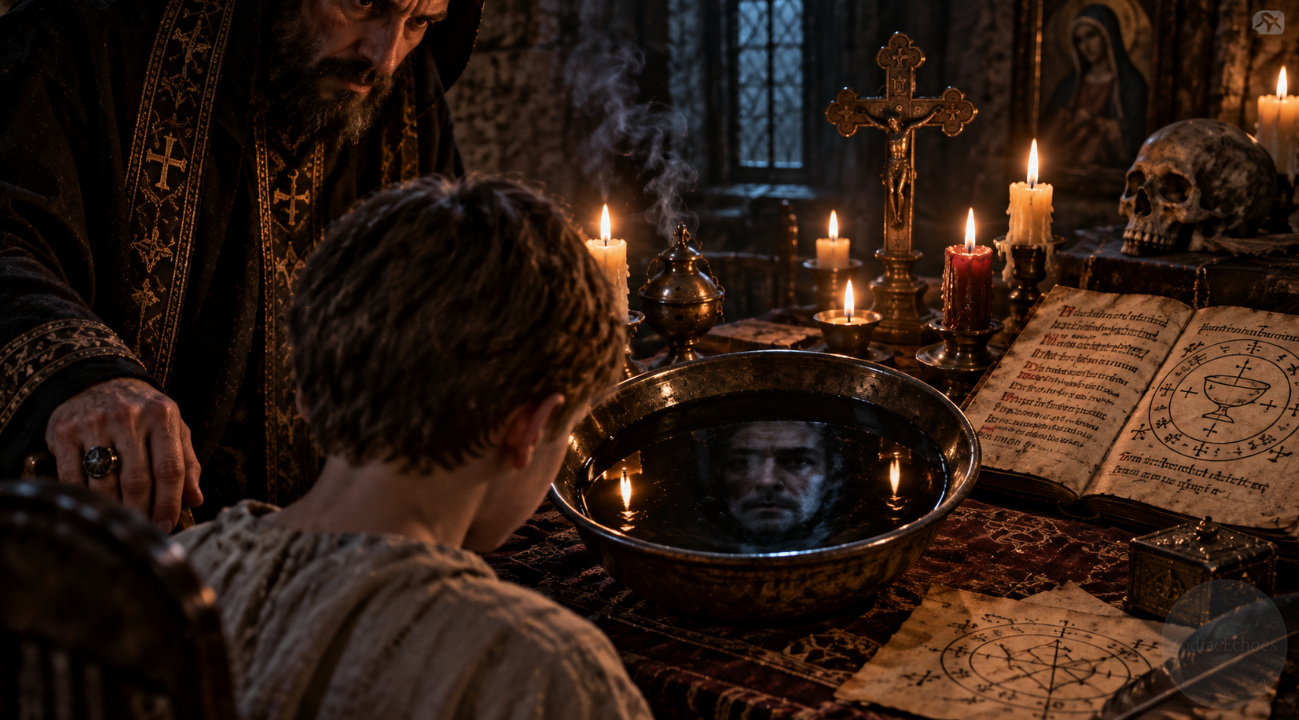
A murder has happened. There are no cameras, fingerprints or forensic laboratories. The killer is unknown. A fifteenth-century magician opens a manuscript and finds another proposed solution: make the murderer appear in a vessel.
That is essentially the promise behind experiment No. 22 in the manuscript now known as the Munich Manual of Demonic Magic. The operation does not merely ask supernatural forces for vague information.
The surviving text repeatedly mentions theft and homicide, asking that the person responsible be revealed to the visionary participating in the experiment. It is medieval occult detective work—and the original instructions are still sitting on the page.
A Bowl for Finding a Killer
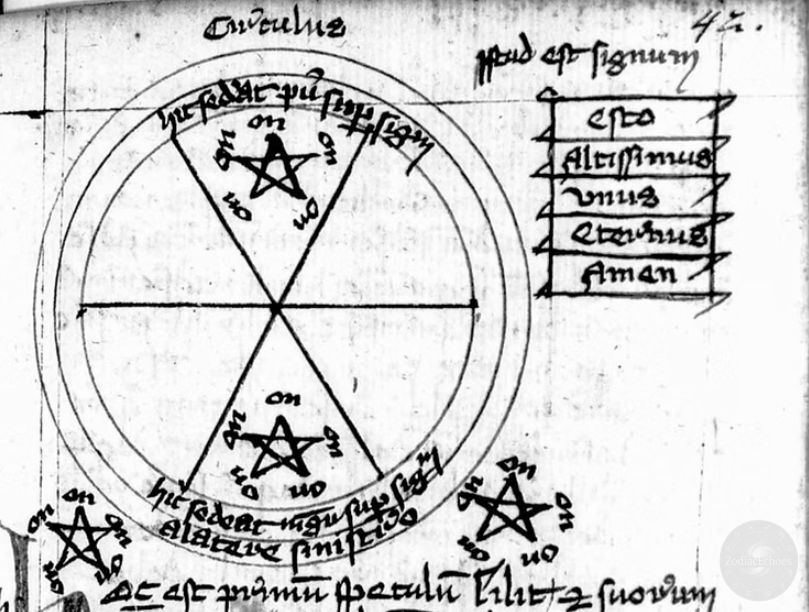
The experiment begins on folio 41r. Its structure belongs to a much wider family of medieval scrying practices in which reflective surfaces were treated as gateways to hidden information. Elsewhere in Clm 849, spirits supposedly appear in mirrors, crystals and even polished fingernails.
Here, the target is considerably darker. The magician wants to know who committed a crime.
A vessel is prepared as the focus of the vision, while a young visionary participates in the operation. The manuscript surrounds the procedure with sacred language: Adonay, Emmanuel, Elyon, Sabaoth, Alpha and Omega appear alongside prayers invoking Mary, Michael, Raphael, John the Baptist and other Christian figures.
That combination is one of the strangest characteristics of the entire manuscript. The practitioner is attempting forbidden divination while simultaneously demanding supernatural assistance through the authority of Christianity.
The Child Was Supposed to See What the Magician Could Not
One of the more disturbing features is the use of a young visionary. This was not unique to this particular experiment. Medieval ritual magic sometimes treated children as especially suitable intermediaries for scrying because they were considered ritually purer than adults. Clm 849 repeatedly employs young visionaries in its divinatory operations.
In experiment No. 22, the manuscript asks God to grant the boy knowledge and understanding so that he can report the truth. And then it states what truth is being sought. The surviving text asks that he reveal information concerning thefts or homicides.
The magician therefore does not necessarily expect to see the killer himself. The visionary does. He looks. The magician asks questions. And whatever appears is supposed to provide the answer.
“Who Committed the Homicide?”
The wording becomes particularly stark on folio 41v. After a long sequence invoking apostles, evangelists, saints and heavenly powers, the text asks that what is seen be truthfully revealed so that those present can know who committed the theft and the homicide.
Another prayer asks the Creator to give the boy sufficient knowledge to announce the truth about thefts or killings. Then Jesus is invoked so that the visionary may reveal the truth about what the magician asks. This is what makes the ritual more interesting than a generic medieval fortune-telling spell.
Its imagined function resembles an investigation. There is a specific event. There is an unknown perpetrator. And somewhere inside the prepared vessel, the manuscript promises that the missing information can become visible.
READ THE ORIGINAL RITUAL
Read the original fol. 41r–42r with English translation
A Christian Prayer Inside a Necromantic Manual
Perhaps the most unsettling part is how religious the text sounds. There is no dramatic declaration that Christianity has been rejected. Quite the opposite. Mary is invoked. Saints are invoked. Christ is invoked. The Trinity is invoked.
The visionary is surrounded by language that could superficially resemble legitimate medieval devotion. Yet the purpose is divination through a magical vessel.
This contradiction is central to Clm 849. Historians generally place it within a learned clerical tradition in which people familiar with Christian liturgy repurposed its language to summon, constrain or question supernatural entities.
The magician did not necessarily imagine himself asking demons politely for assistance. He was attempting to force the supernatural world to answer under divine authority.
What Was Supposed to Appear?
Unfortunately—or perhaps appropriately—the surviving text does not give us a neat cinematic description of a murderer’s face slowly forming on black water. Parts of the manuscript are difficult to read.
What it does say is more historically valuable: the visionary is instructed to look into the vessel until he sees information concerning the theft, homicide or other doubtful matter being investigated.
That ambiguity probably made the experience more powerful for someone who believed in it. A shape could become a person. A reflection could become a face. A meaningless movement could become evidence. And once the visionary announced a name, the ritual had potentially transformed an occult vision into an accusation against a real human being.
THE COMPLETE MANUSCRIPT
Download Munich Manual, Clm 849
Look for fols. 41r–42r. The same page also includes a direct link to the digitized original held by the Bayerische Staatsbibliothek.
The Most Dangerous Part Wasn’t the Demon
There is no reliable evidence that a vessel could reveal a murderer. But imagine the social consequence if someone believed that it could. A killing occurs. A magician prepares the experiment. A child stares into the vessel. Something appears—or the child believes something appears. Then a name is spoken.
At that moment, the supernatural claim has crossed into the real world. Someone has effectively been accused of murder on the testimony of an occult vision. That may be the darkest aspect of experiment No. 22. Not whatever the magician believed was hiding inside the bowl. But what could happen after somebody looked into it and said they recognized a face.
FAQ
Is this really a medieval ritual for identifying a murderer?
Yes. Richard Kieckhefer’s catalogue identifies experiment No. 22 of Clm 849 as an operation for discovering a thief or murderer by gazing into a vessel. It occupies folios 41r–42r.
Does the original manuscript survive?
Yes. Clm 849 is held by the Bayerische Staatsbibliothek, and its facsimile is available digitally. Grimorium provides the folios alongside Latin transcription and English translation.
Did the magician see the murderer?
The ritual uses a young visionary as the principal observer. The surviving text asks that the visionary truthfully reveal information concerning theft or homicide.
Why are Jesus and Christian saints mentioned in a magical ritual?
Clm 849 belongs to a tradition of learned medieval ritual magic that reused Christian liturgical and exorcistic language while pursuing practices condemned by the Church.
Does the ritual actually reveal murderers?
There is no reliable evidence that scrying can identify a murderer or provide supernatural information. What is authentic is the fifteenth-century manuscript and its recorded claim.
Can we see the original ritual today?
Yes. Folios 41r–42r can be examined online with the manuscript image, Latin transcription and English translation.
✨ Explore More from Zodiac Echoes ✨Explore More from ZE
Choose your zodiac sign to explore daily, weekly, monthly, and yearly horoscopes.