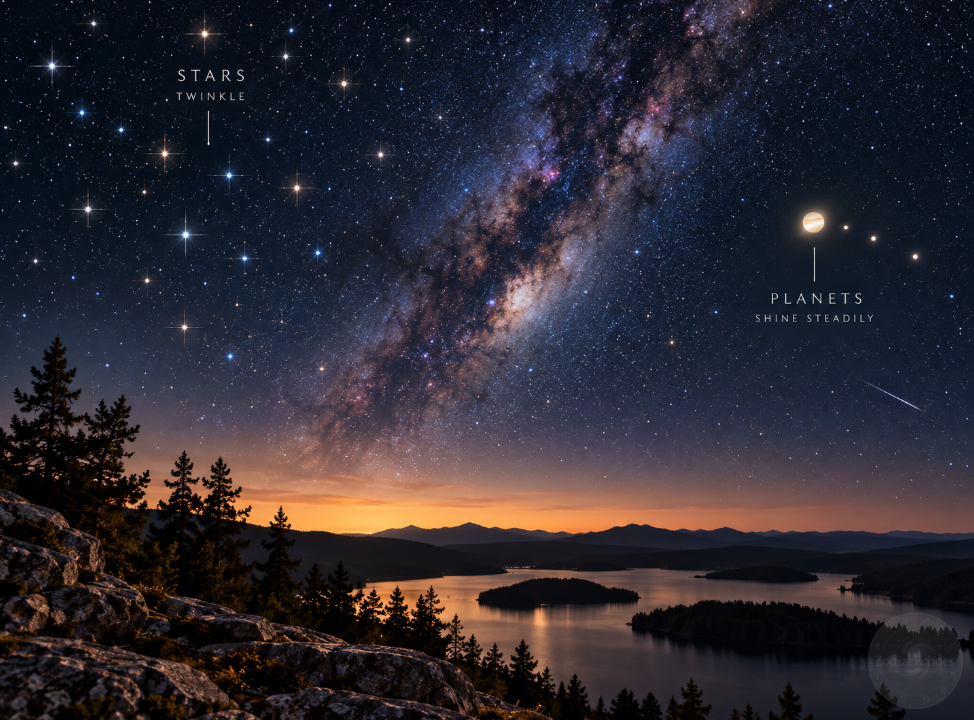
Look at a clear night sky and you’ll notice something strange. Some bright objects seem to flicker, pulse, and occasionally even flash different colors, while others shine with a surprisingly steady light. There’s a simple reason: stars twinkle, but planets usually don’t. And the stars themselves aren’t responsible.
Earth’s Atmosphere Makes Stars Twinkle
Light from a distant star has already traveled through space for years—or much longer—before reaching Earth. During almost all of that journey, its path through space is relatively undisturbed. The trouble begins during the final stretch.
Before reaching your eyes, starlight has to pass through Earth’s turbulent atmosphere. Different layers of air have slightly different temperatures, densities, and movements. As the light travels through them, its path is repeatedly bent by tiny amounts. Astronomers call this effect atmospheric scintillation.
Because stars are extraordinarily distant, they appear to us essentially as tiny points of light. Small atmospheric disturbances can therefore noticeably change their apparent brightness and position from moment to moment. To us, the star appears to twinkle.
Why Don’t Planets Twinkle as Much?
Planets are much closer to Earth than stars. Although they still look like points to our naked eyes, they actually have a small apparent disk in the sky. Light therefore reaches us from slightly different parts of that disk simultaneously.
Atmospheric turbulence still affects the light, but the distortions from different parts tend to average one another out. As a result, planets such as Venus, Jupiter, and Saturn usually appear steadier than surrounding stars.
It’s not an absolute rule. Under turbulent atmospheric conditions—particularly close to the horizon—even a bright planet can appear to flicker.
Why Do Stars Twinkle More Near the Horizon?
Watch a bright star shortly after it rises and the effect can become spectacular. That’s because its light must travel through more of Earth’s atmosphere than when the star is high overhead. More atmosphere means more opportunities for moving layers of air to bend and distort the incoming light.
You may even notice flashes of red, blue, green, or orange. The star isn’t suddenly changing color. Earth’s atmosphere is refracting different wavelengths of its light slightly differently.
Conclusion
Twinkling is therefore something created surprisingly close to home. Stars shine steadily through space, but Earth’s moving atmosphere turns their distant light into the sparkling points we associate with the night sky.
Without an atmosphere, the view would be different. Astronauts observing stars from space don’t see the familiar atmospheric twinkle we see from Earth’s surface. Beautiful as it is, the sparkle is essentially an optical side effect of looking at the universe through a constantly moving ocean of air.
Cosmic Highlights

FAQ
What is the scientific name for star twinkling?
The effect is known as atmospheric scintillation.
Why do stars sometimes flash different colors?
Earth’s atmosphere can refract different wavelengths of starlight differently, especially when a star is close to the horizon, producing rapid apparent color changes.
Do planets ever twinkle?
They can, particularly when they’re low above the horizon or atmospheric conditions are turbulent. However, they generally appear much steadier than stars.
Can twinkling help identify a planet?
Sometimes. A very bright object that shines steadily among noticeably twinkling stars may be a planet, although this isn’t a foolproof identification method.
Do stars twinkle in space?
Not because of Earth’s atmosphere. The familiar twinkling seen from the ground is produced as starlight passes through turbulent layers of air.
✨ Explore More from Zodiac Echoes ✨Explore More from ZE
Choose your zodiac sign to explore daily, weekly, monthly, and yearly horoscopes.