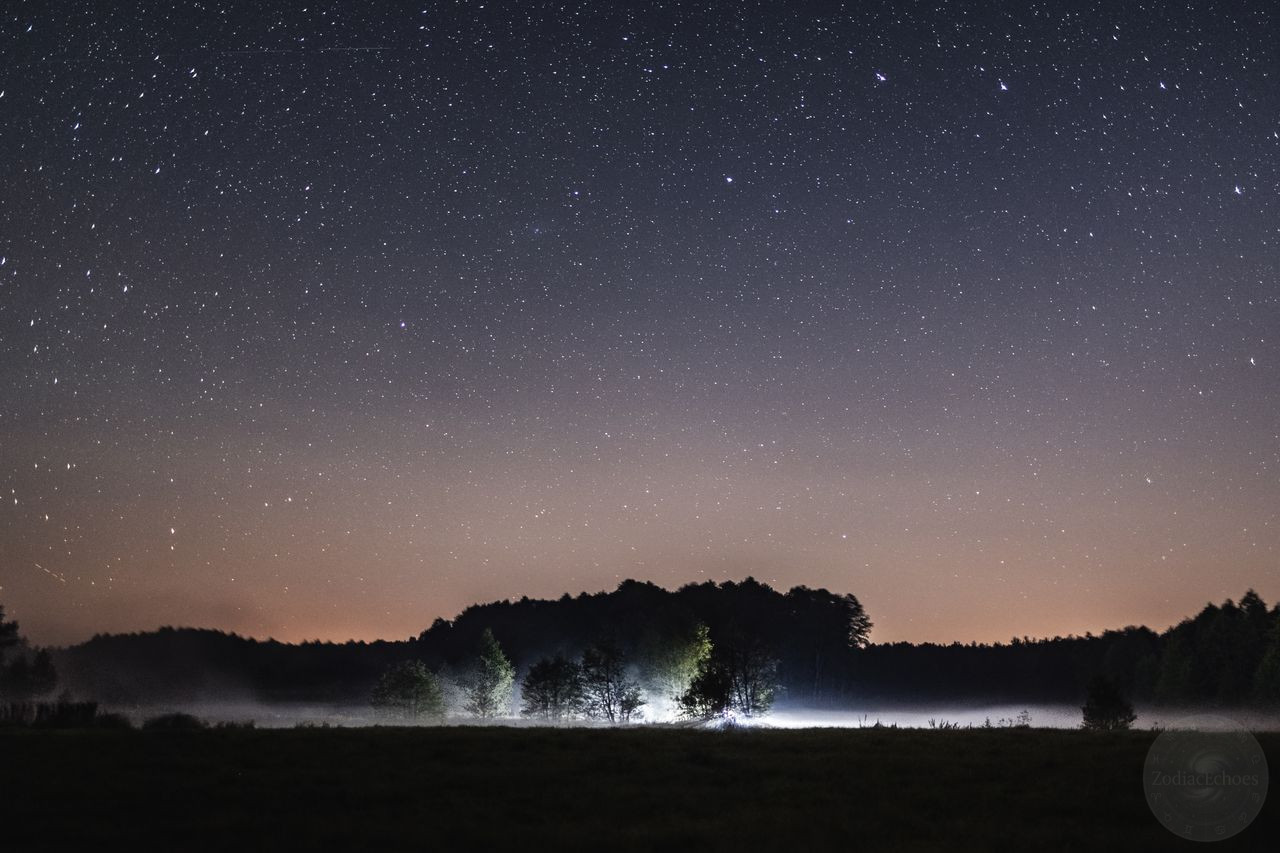
Step outside on a clear night and most of the sky looks black. Stars appear as scattered points of light separated by enormous areas of darkness. That seems perfectly normal—until you think about it.
The universe contains an extraordinary number of stars. If stars continued in every direction through an infinitely old and unchanging universe, shouldn’t virtually every line of sight eventually end at the surface of a star?
If so, the entire night sky should be bright. This puzzle became known as Olbers’ paradox, and its solution tells us something surprisingly profound about the universe itself.
Why Should the Night Sky Be Bright?
Imagine standing in a gigantic forest. Nearby trees look large, while distant trees appear smaller. But if the forest extended endlessly in every direction and contained enough trees, eventually every gap in your field of view would be blocked by a tree. Something similar happens in the classic version of Olbers’ paradox.
Individual stars become fainter with distance, but increasingly large regions of space contain increasingly many stars. In a universe that was infinitely old, static, and populated relatively uniformly with stars, their combined light would create a serious problem for a permanently dark night sky. Yet darkness is exactly what we observe.
The Universe Hasn’t Existed Forever
One crucial part of the answer is time. The universe is about 13.8 billion years old, and light travels at a finite speed. We can therefore only observe objects whose light has had enough time to reach us.
There simply hasn’t been infinite time for light from an infinite succession of increasingly distant stars to arrive at Earth. The observable universe has a horizon. Beyond it, light hasn’t had enough time to reach us since the early history of the cosmos.
The Universe Is Also Expanding
There’s another important piece of the puzzle: the universe expands. As space expands, light traveling across enormous cosmic distances is stretched to longer wavelengths. This phenomenon is known as cosmological redshift.
Radiation that may originally have been emitted at shorter wavelengths can therefore reach us greatly shifted and reduced in energy. The universe isn’t completely dark between the stars, either. Space contains faint background radiation, most famously the cosmic microwave background, but our eyes aren’t capable of seeing microwave radiation.
Conclusion
The darkness of the night sky isn’t simply an empty background behind the stars. It’s connected to fundamental properties of our universe: it has a finite age, light has a finite speed, and space itself is expanding.
So the next time you look into the black spaces between the stars, you’re seeing more than darkness. In a strange way, the fact that the night sky is dark is itself evidence that the universe has a history.
Cosmic Highlights

FAQ
What is Olbers’ paradox?
Olbers’ paradox asks why the night sky is dark if the universe contains an enormous number of stars in every direction.
Would the night sky be bright in an infinitely old static universe?
Under the assumptions of the classic paradox—an eternal, static universe with stars distributed throughout space—the combined starlight would make a dark night sky difficult to explain.
How old is the universe?
Current cosmological measurements place the age of the universe at approximately 13.8 billion years.
Does the expansion of the universe affect starlight?
Yes. Cosmic expansion stretches light traveling through space toward longer wavelengths, an effect known as cosmological redshift.
Is space actually completely dark?
No. The universe contains radiation that human eyes cannot see, including the cosmic microwave background.
✨ Explore More from Zodiac Echoes ✨Explore More from ZE
Choose your zodiac sign to explore daily, weekly, monthly, and yearly horoscopes.