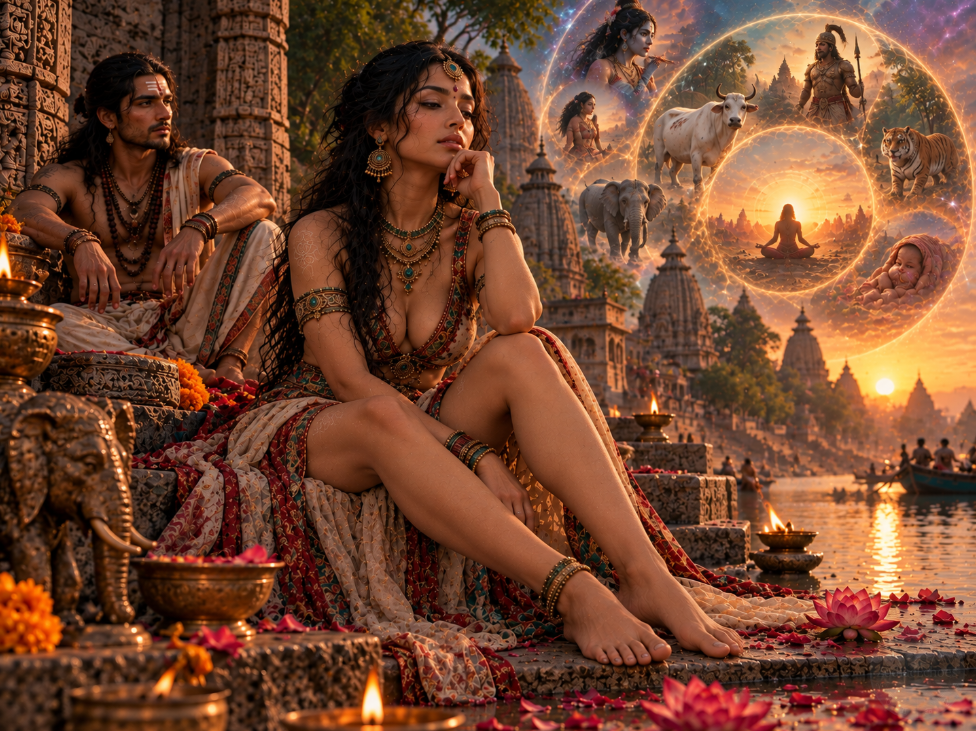
What if death isn’t considered the end of the journey? Across Hindu philosophical and religious traditions, human existence has often been understood within a much larger cycle. Birth leads to life, life to death, and death can be followed by another birth. This continuing process is known as samsara.
But rebirth isn’t simply imagined as repeatedly returning to Earth and beginning again at random. Ideas about karma, dharma, attachment, knowledge, action, and ultimately moksha are deeply connected with the cycle.
That makes the Hindu concept of rebirth considerably more complex than the popular question: Who was I in a past life? The more important question may be what keeps the cycle moving at all.
What Is Samsara?
Samsara is the cycle of birth, death, and rebirth. Rather than viewing one lifetime as an isolated event, many Hindu traditions place individual existence within a much longer spiritual process. Life becomes one chapter within a journey whose causes and consequences can extend beyond a single incarnation.
Rebirth, however, shouldn’t necessarily be understood as a reward system in which good people automatically receive glamorous future lives and bad people receive unpleasant ones. The concept is tied much more closely to karma and attachment. Patterns continue because their causes continue.
What Does Karma Actually Mean?
In everyday English, karma is often reduced to something like cosmic revenge: do something bad and something bad will eventually happen to you. The Hindu concept is much richer.
Karma is fundamentally connected with action and its consequences. Actions, intentions, desires, and habitual ways of responding can create momentum that shapes future experience. A useful traditional framework distinguishes several forms of karma.
Sanchita karma refers broadly to accumulated karma. Prarabdha karma is karma already bearing fruit within the circumstances of the present life, while Agami karma concerns karma being generated through actions now and capable of producing future consequences.
This introduces an important idea: the past matters, but so does what you’re doing right now. Karma isn’t simply something happening to you. Your present actions are part of the process too.
Why Does Attachment Matter?
Imagine someone whose entire identity depends on achievement. Ambition itself doesn’t necessarily have to be the problem. The attachment may appear when success becomes necessary for that person to feel valuable, secure, or complete.
Another person might become attached to being needed. Someone else may constantly chase pleasure, novelty, knowledge, control, status, or recognition. The object changes, but the underlying mechanism can remain surprisingly similar.
This is why Hindu philosophical traditions frequently pay attention not only to what you do, but also to your relationship with action, desire, and its results. The same quality can sometimes become either a strength or a source of bondage.
What Is Dharma?
If karma describes action and its consequences, dharma introduces questions of right conduct, responsibility, order, and the path one is called to follow. It’s an enormous concept with meanings that vary according to philosophical, religious, and historical context, so translating it simply as “life purpose” loses much of its depth.
For personal reflection, however, one useful question is: How can you use what you naturally possess without becoming controlled by it?
Courage can become constructive action rather than domination. Loyalty can become service without self-destruction. Intelligence can become wisdom that participates in life rather than merely observing it. Dharma isn’t necessarily about becoming somebody else. Sometimes it’s about using what is already present in a different way.
Sattva, Rajas and Tamas: The Three Gunas
Another concept found in Hindu philosophy is that of the three gunas: Sattva, Rajas, and Tamas.
Sattva is associated with qualities such as clarity, harmony, balance, and illumination. Rajas is connected with activity, passion, movement, desire, and restlessness. Tamas is associated with inertia, heaviness, obscurity, and resistance.
They shouldn’t simply be treated as three permanent personality types. A person can experience all three. Different circumstances can bring different tendencies to the surface, and their relative influence can change.
This makes the gunas particularly interesting as a framework for self-observation. Are you seeing clearly? Constantly chasing something? Or refusing to move at all? The answer may change from one moment of life to another.
Four Different Paths Through the Same Human Problem
There is no single Hindu spiritual path followed identically by everyone. Different traditions emphasize different approaches, and several well-known yogic paths reflect this diversity.
Karma Yoga emphasizes disciplined action without attachment to its fruits. Bhakti Yoga centers devotion and loving relationship with the divine. Jnana Yoga pursues knowledge and insight, while Raja Yoga is associated with disciplined spiritual and meditative practice.
The approaches differ, but each confronts the relationship between the individual, action, attachment, and liberation in its own way. This is also why two people struggling with very different patterns may not find the same spiritual language equally meaningful.

Does Hinduism Say What You Will Be Reborn As?
This is where modern “past life” and “next life” quizzes can easily become misleading. Hindu traditions contain extensive and diverse teachings about karma and rebirth, but a simple questionnaire cannot determine with religious authority exactly what your next incarnation will be.
Nor can a quiz calculate someone’s spiritual worth or determine whether they will achieve liberation. That’s why our Hindu Rebirth Journey deliberately uses symbolic rebirth archetypes instead.
A symbolic “next birth” can be treated as a thought experiment: if your strongest unresolved pattern continued, what kind of experience would force you to confront it again? The interesting part isn’t predicting a body, country, century, or social position. It’s identifying the lesson that keeps returning.
What Is Moksha?
If samsara is the cycle, moksha is liberation from it. And that changes the entire way rebirth should be viewed. Within Hindu traditions that emphasize moksha, the ultimate spiritual objective isn’t accumulating enough points to earn an increasingly impressive incarnation. Liberation means becoming free from the conditions that keep samsara going.
The destination isn’t the “best next life.” It’s freedom from the necessity of another one. That can involve profound philosophical and theological ideas concerning the self, ultimate reality, ignorance, knowledge, devotion, and liberation, with significant differences among Hindu schools.
But even at a simple reflective level, it creates a powerful question: What would remain of your behavior if you stopped needing it to prove who you are?
Could Relationships Carry Karma Too?
Relationships provide some of the clearest environments in which recurring patterns become visible. One person may fear abandonment. Another may need control. Someone may constantly sacrifice themselves, while someone else runs whenever intimacy becomes uncomfortable.
Put two such patterns together and they can reinforce each other—or force both people to grow. Hindu traditions connect karma with rebirth, but that doesn’t mean a modern questionnaire can prove that two specific people were lovers in a previous incarnation or will meet again in another.
A more useful symbolic interpretation is simpler. A relationship remains “karmic” for as long as the underlying pattern keeps demanding repetition. Change the pattern, and the same lesson may no longer need to return in the same form.
Your Next Life May Be the Wrong Question
Rebirth naturally makes us curious. Will I return as another person? Will I meet the same people? Where will I live? What will my life look like? But those questions can distract from the one lifetime in which we can actually make choices: this one.
If actions create karma, then every present decision matters precisely because it isn’t merely the consequence of what came before. It’s also part of what comes next. In that sense, exploring rebirth doesn’t have to become an attempt to predict the future. It can become a way of noticing what you’re repeatedly creating now.
Conclusion
Hindu ideas about rebirth form part of a much larger philosophical landscape connecting karma, samsara, dharma, the gunas, spiritual practice, and moksha. The cycle isn’t simply a supernatural conveyor belt carrying the same personality from one body to another. It raises deeper questions about action, desire, attachment, responsibility, knowledge, and liberation.
And perhaps the most useful question isn’t What will I become in my next life? It may be: What pattern am I strengthening in this one?
Want to explore which patterns may be keeping your own karmic wheel turning? Try our free Hindu Rebirth Journey to discover your symbolic karma pattern, rebirth archetype, guna tendency, dharma theme, yogic path, and the lesson your next chapter may be asking you to learn.
Explore the patterns that may keep you moving through samsara, the dharma that calls you forward, and the symbolic direction of your next chapter.Hindu Rebirth Journey
FAQ
What does samsara mean?
Samsara refers to the continuing cycle of birth, death, and rebirth found in Hindu and several other Indian religious traditions.
Does karma mean punishment?
Not simply. Karma concerns action and its consequences. Reducing it to supernatural punishment or “what goes around comes around” misses much of the philosophical concept.
What are the three gunas?
The three gunas are Sattva, Rajas, and Tamas, broadly associated with clarity and harmony, activity and desire, and inertia or obscuration respectively. They are qualities of nature rather than simple fixed personality signs.
What is dharma?
Dharma is a broad Hindu concept involving ideas such as right conduct, duty, order, responsibility, and the appropriate path of action. Its meaning depends heavily on context and tradition.
What is moksha?
Moksha is liberation from samsara—the cycle of rebirth. It shouldn’t be confused with receiving a particularly desirable future incarnation.
Can anyone predict my next reincarnation?
A personality quiz cannot establish someone’s literal future incarnation. Modern rebirth tools are better treated as symbolic or reflective experiences rather than religious verdicts.
What is a karmic relationship?
The phrase is used differently in modern spirituality. Rather than claiming two people definitely shared another incarnation, it can be used symbolically for a relationship that repeatedly exposes powerful habits, attachments, conflicts, or lessons.
✨ Explore More from Zodiac Echoes ✨Explore More from ZE
Choose your zodiac sign to explore daily, weekly, monthly, and yearly horoscopes.