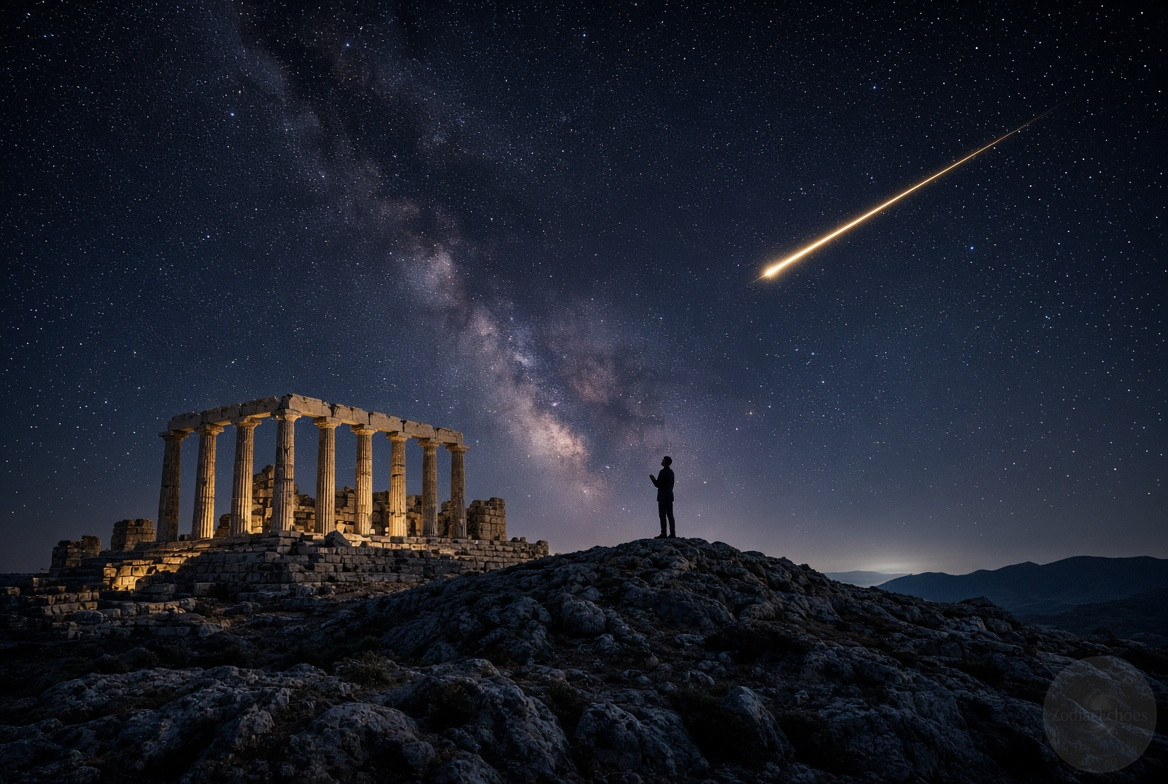
- A Fleeting Moment: Shooting stars appear suddenly and disappear within seconds.
- Ancient Symbolism: Unusual events in the night sky were often interpreted as messages or signs.
- A Wish in Secret: Tradition says the wish should be made immediately—and kept to yourself.
- Not Really a Star: The glowing streak has nothing to do with a star falling from the sky.
You see a streak of light race across the night sky and almost instinctively think: make a wish.
It’s one of the most familiar traditions connected with the stars. Yet the object disappearing above you isn’t actually a star, and the idea of attaching wishes to these brief flashes of light reaches back to a time when people interpreted unusual events in the heavens very differently.
Why Did Shooting Stars Become Associated With Wishes?
For ancient cultures, the night sky wasn’t simply something beautiful to look at. Celestial events could be interpreted as omens, messages from the gods, or signs that something important was about to happen.
A meteor was especially striking because it appeared without warning. Unlike the familiar stars, planets, and Moon, it suddenly crossed the heavens and vanished seconds later.
Over time, shooting stars became associated with extraordinary moments when the normal order of the sky seemed briefly interrupted. That made them perfect objects for wishes, prayers, and hopes.
The exact origin of today’s familiar wishing tradition is difficult to pin down to one moment or culture. Stories commonly connect it with ancient ideas that sudden celestial events represented a moment of unusual contact between the human and divine worlds. The later folk tradition turned that mysterious moment into something much simpler: see the shooting star, think of something you desperately want, and make your wish before the light disappears.
But a Shooting Star Isn’t a Star
The reality is just as fascinating.
A “shooting star” is actually a meteor. Small pieces of rock or other material in space are called meteoroids. When one enters Earth’s atmosphere at high speed and produces the brilliant streak of light we see in the sky, it becomes a meteor. If part of the object survives and reaches the ground, that surviving material is called a meteorite.
Meteor showers happen when Earth passes through streams of debris left behind by comets or, in some cases, asteroids. The famous Perseid meteor shower, for example, is produced by debris associated with Comet Swift-Tuttle.
So no distant sun is actually falling from the heavens.
Why Does the Tradition Still Feel Magical?
Part of the answer may simply be rarity and timing. A meteor can appear without warning and vanish almost immediately. NASA notes that although meteors occur regularly, darkness, weather, city lights, geography, and the fact that someone has to be looking in the right direction at exactly the right moment make seeing one feel special.
And perhaps that’s why the old tradition survives. For a few seconds, something unexpected cuts across an otherwise familiar sky. Science can explain exactly what produced the light—but it doesn’t prevent you from making a wish.
Conclusion
A shooting star won’t magically guarantee that your wish comes true. In fact, it isn’t a star at all.
But humans have looked toward the sky for signs, meaning, and hope for thousands of years. Turning one of its most fleeting sights into an opportunity to make a wish fits perfectly into that tradition.
So the next time a meteor suddenly flashes overhead, you’ll know what’s really happening. You can still make the wish.
Cosmic Highlights

FAQ
Is a shooting star really a star?
No. A shooting star is a meteor—the visible phenomenon produced when a meteoroid enters Earth’s atmosphere at high speed.
Why do people wish on shooting stars?
The custom developed from older traditions that treated unusual celestial events as meaningful or extraordinary. The precise origin of the modern wishing ritual isn’t certain.
Do shooting stars actually grant wishes?
There is no scientific evidence that wishing on a meteor affects what happens afterward. It is a cultural tradition and superstition.
What causes meteor showers?
Meteor showers occur when Earth travels through streams of debris left in space, commonly by comets. Many particles then enter the atmosphere and become visible as meteors.
What happens if a meteor reaches the ground?
Any surviving piece that reaches Earth’s surface is called a meteorite.
✨ Explore More from Zodiac Echoes ✨Explore More from ZE
Choose your zodiac sign to explore daily, weekly, monthly, and yearly horoscopes.