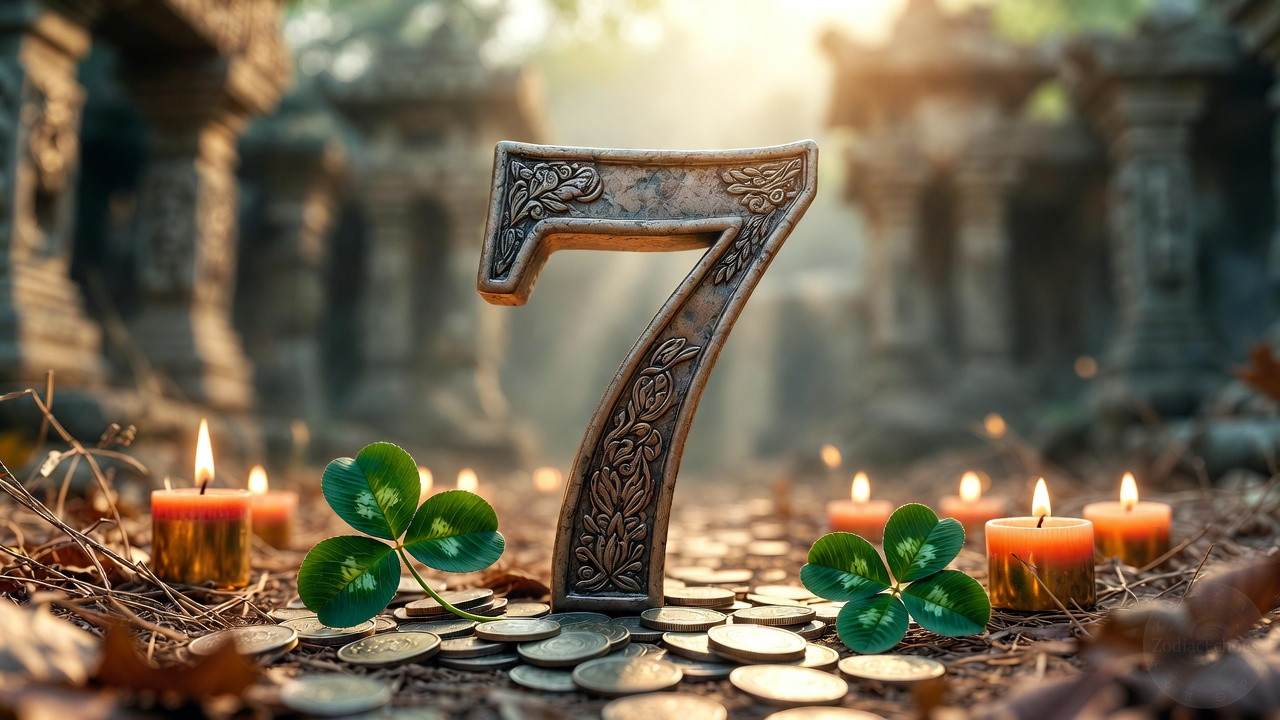
- An Ancient Favorite: The number 7 has carried special meaning across cultures and religions for thousands of years.
- Written in the Sky: Ancient observers knew seven celestial bodies that appeared to move across the heavens.
- Seven-Day Rhythm: Our familiar seven-day week is closely connected with this ancient view of the sky.
- Luck Came Later: Seven’s reputation as a lucky number grew from layers of religious, cultural, and symbolic meaning.
Ask someone to choose a lucky number and there is a good chance they’ll say 7. It appears on slot machines, lucky charms, sports jerseys and countless lists of supposedly fortunate numbers. But seven’s unusual reputation began long before modern ideas about luck.
The number has fascinated people for thousands of years, appearing repeatedly in astronomy, religion, mythology and everyday life. No single tradition created the idea of “lucky seven.” Instead, its special status seems to have grown gradually as different cultures repeatedly gave the number important meanings.
Seven Was Written in the Ancient Sky
One of the most interesting explanations begins above our heads.
Ancient skywatchers could identify seven objects that appeared to move against the background of fixed stars: the Sun, Moon, Mercury, Venus, Mars, Jupiter and Saturn. Uranus and Neptune were too faint to be recognized as planets without telescopes.
These seven celestial “wanderers” became extremely important in ancient astronomy and astrology. Their influence can still be seen in the traditional seven-day week, with different days historically associated with different celestial bodies.
For societies that carefully watched the heavens for signs and cycles, seven therefore wasn’t simply another number. It was connected with the structure of the visible cosmos.
Religion Made Seven Even More Powerful
Seven also appears repeatedly in major religious traditions.
In the biblical creation story, creation takes place over six days followed by the seventh day of rest. The Bible contains many other groups and cycles involving seven, helping give the number associations with completion and divine order within Jewish and Christian traditions.
Seven also has important roles in Islam, while other religious and philosophical systems developed their own sets of seven. Buddhism, Hindu traditions and numerous ancient cultures all contain prominent examples, although their meanings are not necessarily connected to one another.
Repeated appearances like these helped make seven feel like a number that represented something complete, sacred or significant.
Seven Is Everywhere Around Us
Once you start looking for it, seven seems to appear constantly. We traditionally speak of the seven colors of the rainbow, the Seven Wonders of the Ancient World, seven notes in the familiar Western diatonic scale and seven days of the week.
Some of these systems are cultural classifications rather than mysterious natural rules. A rainbow, for example, contains a continuous spectrum of colors rather than exactly seven separate bands. Nevertheless, generations grew up surrounded by groups of seven. That repetition helped strengthen the number’s special place in popular imagination.
So Why Is Seven Lucky?
There isn’t a scientific reason why choosing 7 should improve your chances of something good happening. Its reputation is cultural. Seven accumulated powerful associations with the heavens, religion, completeness and familiar cycles. Over centuries, those associations gradually blended with ideas of fortune and good luck.
Modern culture reinforced the connection even further. Perhaps the most recognizable example is the 7-7-7 jackpot imagery associated with slot machines, where three sevens have become an instant visual symbol of extraordinary luck.
Numerology gives seven another layer of meaning. In modern numerological traditions, 7 is commonly associated with introspection, wisdom, spirituality, analysis and the search for deeper truth. That doesn’t make seven objectively luckier than six or eight. But it does explain why this particular number has acquired an extraordinary amount of symbolism.
Conclusion
Seven didn’t become lucky because of one ancient event or forgotten superstition. Its reputation was built over thousands of years. Seven celestial wanderers crossed the ancient sky. Seven days shaped the week. Religions repeatedly gave the number important roles, and cultures continued surrounding themselves with groups of seven.
Eventually, a number associated with the heavens, completion and sacred order also became associated with good fortune. There may be nothing mathematically lucky about 7—but culturally, few numbers can compete with it.
FAQ
Is 7 really the luckiest number?
There is no scientific evidence that 7 produces better luck. Its reputation comes primarily from cultural, historical and religious traditions.
Why was 7 important in ancient astronomy?
Ancient observers recognized seven major moving celestial objects visible without telescopes: the Sun, Moon, Mercury, Venus, Mars, Jupiter and Saturn.
Why are there seven days in a week?
The seven-day week has ancient roots and became connected with the seven classical celestial bodies. It was subsequently reinforced by religious and cultural traditions.
What does 7 mean in numerology?
In modern numerology, 7 is generally associated with introspection, knowledge, spirituality, intuition and searching beneath the surface for deeper meaning.
Is 7 lucky everywhere in the world?
Not universally. Ideas about lucky numbers vary considerably between cultures. For example, 8 has particularly strong associations with prosperity and good fortune in Chinese culture.
✨ Explore More from Zodiac Echoes ✨Explore More from ZE
Choose your zodiac sign to explore daily, weekly, monthly, and yearly horoscopes.