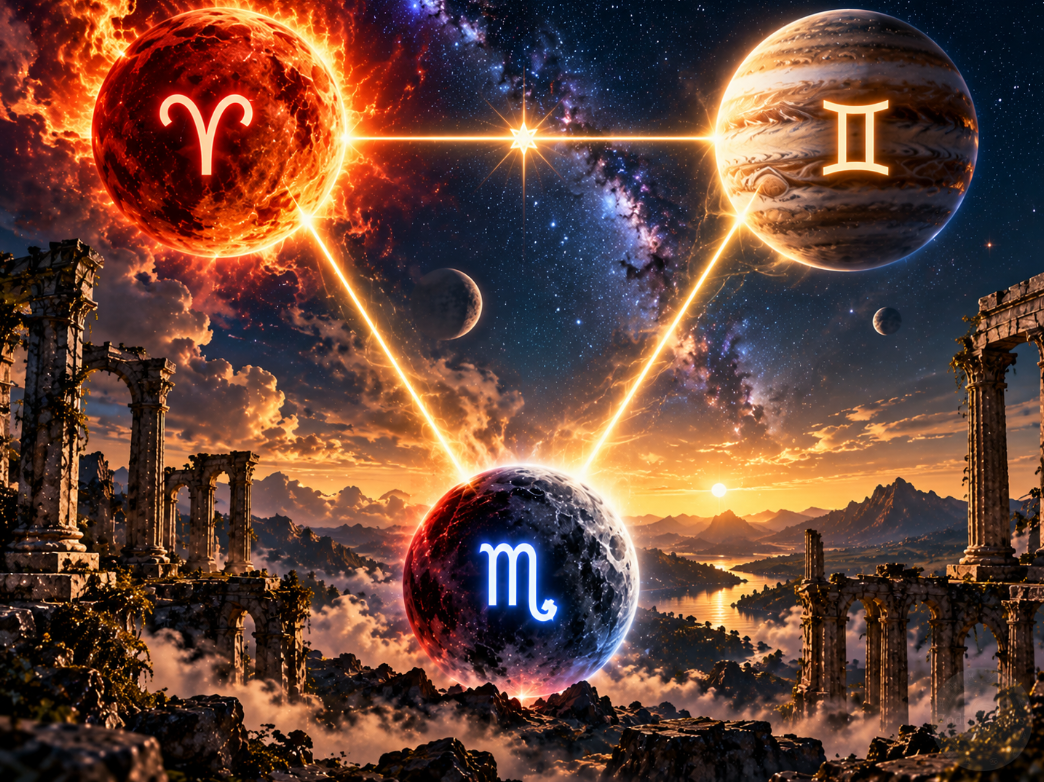
- A Yod, also known as the Finger of God, is an unusual aspect pattern involving three planets or important chart points.
- It consists of two quincunxes (150°) and one sextile (60°).
- The configuration creates a narrow, elongated triangle pointing toward one planet.
- The planet at the tip is called the apex planet and becomes the main focus of the pattern.
- Yods are traditionally associated with adjustment, difficult choices, unusual circumstances, and personal development.
- The two planets forming the sextile create the base of the Yod.
- The planets, signs, houses, and aspect orbs determine how the configuration is interpreted.
Some planetary patterns are easy to recognize. A Grand Trine creates a large triangle, while a Grand Cross divides the Natal Chart into four opposing points. The Yod, however, looks completely different. Its two long sides converge toward a single planet, creating a narrow triangle that resembles a pointing finger.
This distinctive geometry explains its traditional nickname: the Finger of God. Despite the dramatic name, a Yod does not automatically indicate destiny, supernatural intervention, or an extraordinary life. Its significance comes from the unusual relationship between three planetary functions that must continually find ways to cooperate.
What Is a Yod in Astrology?
A Yod forms when two planets are connected by a sextile (60°), while both make a quincunx (150°) to a third planet. The third planet becomes the apex.
| Part of the Yod | Angle | Function |
|---|---|---|
| Sextile | 60° | Connects the two base planets |
| Quincunx 1 | 150° | Creates a need for adjustment |
| Quincunx 2 | 150° | Adds another adjustment |
| Apex Planet | — | Concentrates the pattern’s focus |
The geometry matters because the three planets are not connected through ordinary squares, oppositions, or trines. Instead, the configuration combines one relatively cooperative aspect with two relationships that traditionally require ongoing adjustment. This creates a distinctive dynamic: two planets can work together, but their combined expression may be difficult to reconcile with the third.
Why Is the Yod Called the Finger of God?
The expression Finger of God comes from the configuration’s unusual shape and its traditional association with significant turning points. Some astrologers interpret Yods as indicators of a special calling, an unusual life direction, or circumstances that repeatedly push someone toward change. However, the name is symbolic rather than literal.
A Yod does not prove that someone has a predetermined mission. Instead, it highlights a configuration in which adjustment, compromise, and redirection may become recurring themes. The more useful question is not whether the pattern represents fate, but how its planets interact.
What Is the Apex Planet in a Yod?
The apex planet receives both quincunxes from the sextile planets. It occupies the pointed end of the triangle and is usually considered the most sensitive part of the configuration. For example, if Saturn is the apex, themes involving responsibility, structure, boundaries, discipline, and long-term commitments may become particularly important.
A Venus apex would introduce different themes, including relationships, values, attraction, and personal priorities. The apex planet does not operate independently. Its interpretation depends on the two planets at the base, their signs, and the houses involved.
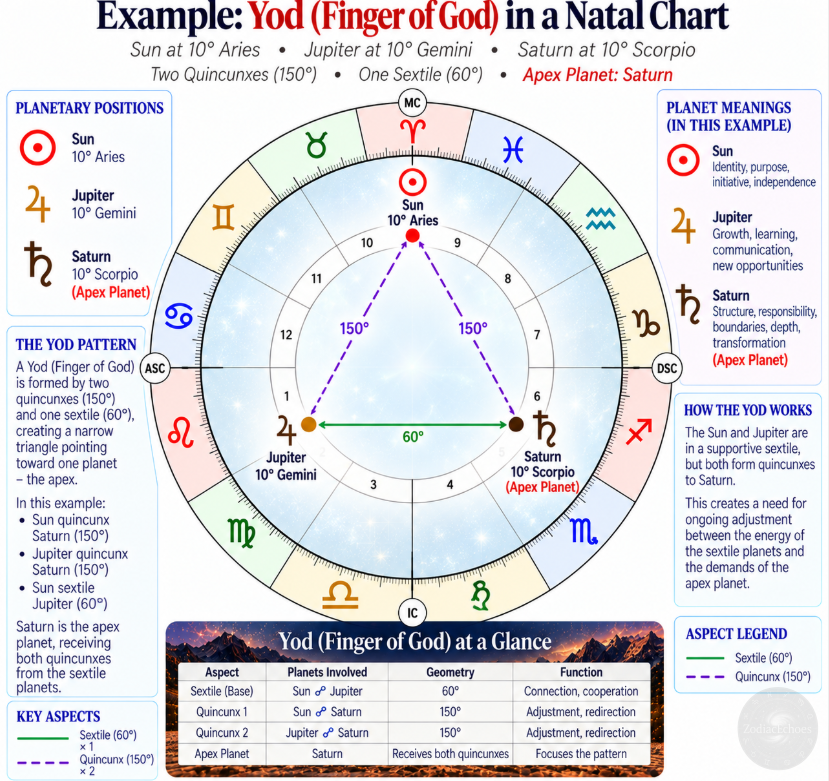
Example: Sun–Jupiter–Saturn Yod
Consider this hypothetical Natal Chart configuration:
- Sun — 10° Aries
- Jupiter — 10° Gemini
- Saturn — 10° Scorpio
These positions create three exact aspects:
- Sun ⚹ Jupiter — 60°
- Sun ⚻ Saturn — 150°
- Jupiter ⚻ Saturn — 150°
The Sun and Jupiter form the base of the Yod, while Saturn in Scorpio becomes the apex planet.
The Sun in Aries represents identity, initiative, independence, and personal direction. Jupiter in Gemini emphasizes curiosity, communication, intellectual exploration, and expanding possibilities through information. Their sextile suggests that initiative and curiosity may cooperate relatively easily. Saturn in Scorpio introduces a different set of priorities: emotional depth, control, responsibility, boundaries, and confronting complicated realities.
Both the Sun and Jupiter form quincunxes to Saturn, creating a recurring need to reconcile freedom and exploration with responsibility and deeper commitments. Someone with this configuration might find that new opportunities repeatedly require difficult adjustments to existing plans.
Alternatively, the same pattern could encourage the development of patience, strategic thinking, and the ability to make decisions under complicated circumstances. The Yod does not determine which outcome will occur. It describes the relationship between these planetary themes.
Why Houses Matter in a Yod
The signs explain how the planets express themselves, while the houses reveal which areas of life may be involved. A Yod connecting the 2nd, 6th, and 11th Houses could involve personal resources, daily responsibilities, work routines, friendships, and long-term ambitions.
The same planets in the 1st, 5th, and 10th Houses would introduce different concerns involving identity, creativity, self-expression, and career direction. This is why identifying the three planets is only the beginning of interpreting a Yod.
How Important Are Orbs?
Orbs are particularly important when identifying Yods. Unlike some major aspect patterns, Yods are commonly interpreted using relatively tight orbs, especially for their two quincunxes.
Many astrologers prefer approximately 2°–3° for these aspects, although different traditions use different allowances. Wider orbs can make a configuration less clearly defined, so it is important to examine the actual planetary degrees rather than relying entirely on a chart’s automatic pattern labels.
Yod vs. Grand Trine, T-Square, and Grand Cross
Each major aspect pattern has a different geometric structure.
| Aspect Pattern | Geometry | Main Theme |
|---|---|---|
| Grand Trine | Three trines (120°) | Natural flow |
| T-Square | Two squares + opposition | Concentrated pressure |
| Grand Cross | Four squares + two oppositions | Competing pressures |
| Yod | Two quincunxes + sextile | Adjustment and redirection |
Unlike a T-Square or Grand Cross, a Yod does not depend on multiple squares or oppositions. Its distinctive quality comes from the two quincunxes converging on a single apex planet.
Understanding a Yod in Your Birth Chart
A Yod in Astrology is one of the most distinctive configurations in a Natal Chart, combining a cooperative sextile with two demanding quincunxes. Its unusual geometry directs attention toward the apex planet, where the pattern’s competing influences converge.
Although its nickname, the Finger of God, suggests something mysterious or predetermined, the configuration is better understood through the practical relationships between its planets, signs, and houses. The defining feature of a Yod is not unavoidable destiny, but the recurring need to adjust, reconsider, and discover a workable direction.
FAQ
What does a Yod mean in Astrology?
A Yod is an aspect pattern formed by two quincunxes and one sextile. It is traditionally associated with adjustment, redirection, and the need to reconcile different planetary functions.
Why is a Yod called the Finger of God?
The nickname refers to its narrow, pointing shape and traditional associations with significant life developments or an unusual sense of direction.
Is a Yod rare in a Birth Chart?
Yods require three planets to occupy specific angular relationships, making them less common than individual major aspects. Their frequency also depends on the orbs used.
What is the most important planet in a Yod?
The apex planet is generally considered the focal point because it receives both quincunxes from the planets forming the sextile.
Is having a Yod good or bad?
Neither automatically. A Yod may describe recurring challenges involving adjustment, but those same dynamics can encourage flexibility, awareness, and personal development.