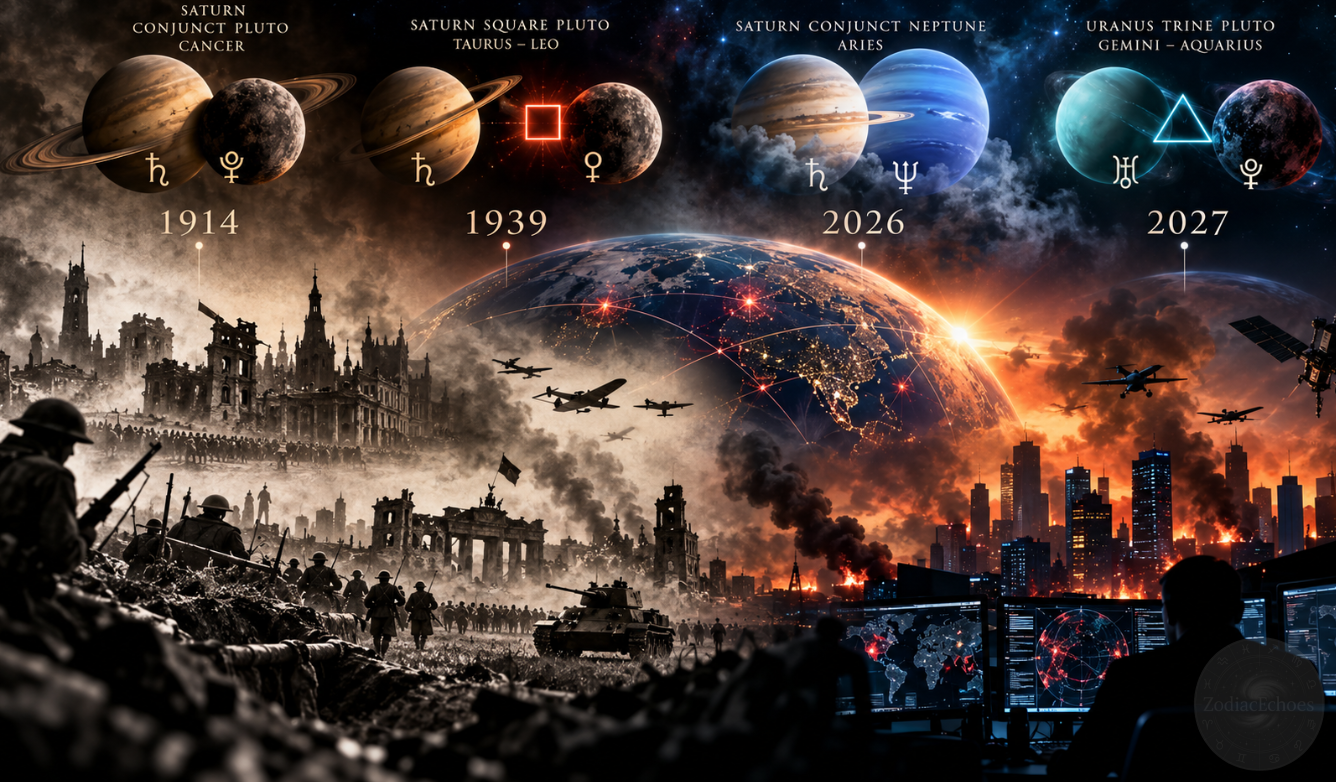
- 1914 Pattern: Saturn and Pluto approached a powerful conjunction as World War I began.
- 1939 Pattern: Saturn squared Pluto as Germany invaded Poland.
- 2026 Turning Point: Saturn and Neptune formed a conjunction at 0° Aries on February 20.
- 2027 Focus: Uranus and Pluto continue a series of trines associated with technological and political transformation.
- Central Question: Do the planetary configurations of 2026–2027 resemble those surrounding the two world wars?
Two world wars began just 25 years apart, transforming international borders, destroying empires, and changing the balance of global power. Yet the planetary configurations surrounding those conflicts reveal an intriguing astrological connection.
Saturn and Pluto formed major hard aspects during both historical periods. In 1914, the planets approached a conjunction in Cancer. In September 1939, they formed a tight square between Taurus and Leo.
In mundane astrology, which examines planetary cycles in relation to nations and world events, Saturn represents institutions, authority, restrictions, and established structures. Pluto symbolizes concentrated power, destruction, transformation, and struggles for control. Their difficult aspects have traditionally attracted attention from astrologers studying periods of political upheaval.
Now, as the world moves through 2026 and approaches 2027, another series of powerful planetary alignments is unfolding. Saturn has joined Neptune at the beginning of Aries, Uranus has entered Gemini, and Pluto continues its long journey through Aquarius. Are these the same warning signs that appeared before the world wars, or is a different historical cycle beginning?
World War I: Saturn and Pluto in Cancer, 1914
The assassination of Archduke Franz Ferdinand on June 28, 1914, triggered a diplomatic crisis that rapidly escalated into war. Austria-Hungary declared war on Serbia on July 28, setting off a chain of mobilizations and military declarations across Europe. At the time, Saturn and Pluto were moving toward a conjunction in Cancer.
Their first exact conjunction occurred on October 4, 1914, at approximately 2° Cancer, after the conflict had already begun. Additional conjunctions followed on November 1, 1914, and May 19, 1915.
This distinction is important: the planets were approaching their conjunction during the outbreak, rather than forming an exact conjunction on the day war was declared. In mundane astrology, Cancer symbolizes homeland, national identity, territory, ancestry, and collective security.
The Saturn–Pluto conjunction in this sign presents a striking symbolic picture of a conflict driven by competing empires, territorial commitments, and national survival. What began as a regional confrontation expanded into a war that destroyed four major imperial systems: the German, Austro-Hungarian, Russian, and Ottoman empires.
The conjunction did not merely accompany military destruction. It coincided with the beginning of a fundamental transformation of political power in Europe.
World War II: Saturn Square Pluto in September 1939
On September 1, 1939, Germany invaded Poland, beginning World War II in Europe. Britain and France declared war on Germany two days later. The planetary configuration was different from 1914, but Saturn and Pluto were again connected through a major hard aspect.
On September 1, Saturn stood at approximately 0°59′ Taurus, while Pluto occupied 2°06′ Leo. The planets formed a square with an orb of approximately 1°07′.
| Planet | Position on September 1, 1939 |
|---|---|
| Saturn | 0°59′ Taurus |
| Pluto | 2°06′ Leo |
| Mars | 24°25′ Capricorn |
| Uranus | 21°58′ Taurus |
| Neptune | 22°30′ Virgo |
In traditional astrological symbolism, Taurus governs material security, resources, and possessions. Leo represents sovereignty, leadership, royal authority, and the expression of power. A Saturn–Pluto square between these signs can be interpreted as a struggle involving established political structures, resources, and competing claims to authority.
The wider planetary picture also included Mars opposing Pluto within an orb of approximately eight degrees, while Mercury formed a tight square with Uranus.
Mars, traditionally associated with warfare and military action, adds another confrontational element to the chart. By the end of September, Mars and Pluto reached an exact opposition, as the conflict entered a new phase. The combination of Saturn, Pluto, Mars, and Uranus makes September 1939 particularly notable within mundane astrology.
What Did the Two World Wars Have in Common Astrologically?
Although the planetary arrangements were not identical, both periods featured a significant connection between Saturn and Pluto.
| Astrological Factor | World War I | World War II |
|---|---|---|
| Historical outbreak | July–August 1914 | September 1, 1939 |
| Saturn–Pluto aspect | Applying conjunction | Close square |
| Zodiac signs | Cancer | Taurus and Leo |
| Principal symbolism | National security and collapsing empires | Power, resources, and political authority |
| Historical outcome | Collapse of major empires | Restructuring of the international order |
The common feature is the relationship between Saturn’s symbolism of established authority and Pluto’s symbolism of concentrated power and transformation.
However, these planetary cycles also occur outside world wars. Saturn and Pluto form major aspects repeatedly, including during periods of political restructuring, economic crises, and institutional change.
The historical comparison becomes more interesting when the broader planetary configurations are examined rather than treating one aspect as a universal signal of war.
2026: Saturn and Neptune Meet at the Beginning of Aries
The defining planetary event of early 2026 was not a Saturn–Pluto conjunction or square. Instead, Saturn and Neptune formed an exact conjunction on February 20, 2026, at approximately 0°45′ Aries. This is an entirely different planetary combination.
Saturn represents structure, authority, boundaries, and institutions. Neptune symbolizes ideals, collective beliefs, uncertainty, and the dissolution of established boundaries. Aries, the first sign of the zodiac, is traditionally ruled by Mars and associated with initiative, confrontation, independence, and new beginnings.
In mundane astrology, this combination raises questions about the relationship between political authority and collective ideology. Could established institutions face challenges from new political movements? Could ideological conflicts intensify as governments attempt to redefine their authority?
The conjunction also occurs near the Aries Point, the beginning of the tropical zodiac, which some mundane astrologers associate with events that acquire international visibility. Unlike the Saturn–Pluto configurations of 1914 and 1939, the Saturn–Neptune conjunction places greater symbolic emphasis on the tension between established systems and competing visions of the future.
Uranus in Gemini and Pluto in Aquarius: A Different Kind of Global Conflict?
Another important feature of 2026–2027 is the relationship between Uranus and Pluto. Uranus entered Gemini in April 2026, beginning a longer period associated astrologically with changes in communication, transportation, information systems, and technology.
Meanwhile, Pluto continues its journey through Aquarius, a sign connected with collective organization, technological systems, social movements, and networks. The two planets formed an exact trine on July 18, 2026, at approximately 4°30′ Gemini and Aquarius. Further exact trines are scheduled for November 29, 2026, and June 15, 2027.
Unlike a square or opposition, a trine is traditionally interpreted as an aspect of cooperation and relatively unobstructed expression. However, harmonious aspects do not necessarily mean that the developments they symbolize will be universally beneficial.
Uranus and Pluto together emphasize technological transformation, collective power, and the restructuring of systems that influence entire populations. For mundane astrologers, this creates an interesting framework for examining the future of artificial intelligence, cyber capabilities, communication infrastructure, and political influence.
If international conflict changes during this planetary cycle, its most distinctive characteristics may involve technology and information rather than the territorial warfare that defined much of the twentieth century.

Why 2027 Deserves Particular Attention
The year 2027 continues several planetary developments established during 2026. Saturn remains in Aries, extending the themes of authority, military organization, leadership, and the restructuring of institutions. Neptune also continues through Aries, maintaining the broader tension between political realities and ideological ambitions. Meanwhile, Uranus in Gemini and Pluto in Aquarius reach another exact trine on June 15, 2027, at approximately 6°52′.
This alignment reinforces the technological and institutional themes associated with the wider Uranus–Pluto cycle. The distinction between these configurations and those of 1914 or 1939 is significant. The 2027 planetary picture emphasizes Saturn–Neptune and Uranus–Pluto dynamics rather than a close Saturn–Pluto hard aspect.
From an astrological perspective, this suggests a different symbolic emphasis: changing ideologies, competing models of authority, and technological transformation. The central question is whether these changes will produce cooperation, fragmentation, or a more confrontational international environment.
Could the Next World War Begin Without a Traditional Battlefield?
The historical comparison raises another possibility: a future global confrontation might not resemble the opening stages of either world war. In 1914, armies mobilized across national borders. In 1939, Germany’s invasion of Poland initiated a conventional military conflict that expanded across continents.
Today, international power also depends on digital infrastructure, satellites, communications networks, financial systems, and advanced technology. The Uranus–Pluto trines of 2026–2027 provide an astrological framework for examining these newer dimensions of geopolitical competition.
Uranus in Gemini symbolizes rapid developments in communication and information. Pluto in Aquarius emphasizes the concentration and transformation of power within collective systems.
Together, they suggest that control over information, technology, and interconnected infrastructure could become increasingly important to international power struggles.
This does not necessarily imply a third world war. The same planetary symbolism can describe technological breakthroughs, new alliances, or the restructuring of global institutions. Nevertheless, it represents a distinctly different configuration from those surrounding the world wars of the twentieth century.
What Would Be the Strongest Astrological Warning Signs?
Within mundane astrology, several configurations traditionally receive particular attention when analyzing international tensions.
- Saturn–Pluto hard aspects symbolize confrontations involving established authority, concentrated power, and institutional survival.
- Mars–Pluto hard aspects emphasize struggles for control, forceful action, and intense confrontations.
- Mars–Saturn hard aspects are associated with restrictions, military discipline, frustration, and conflict between opposing forces.
- Uranus hard aspects can symbolize sudden disruption, rebellion, technological shocks, and unexpected changes to established systems.
- Yet the meaning of these configurations depends on the wider planetary environment.
An astrologer examining a specific country’s future would also consider its national horoscope, planetary transits, eclipses, and relevant timing techniques. A global planetary alignment alone does not identify which country might initiate a conflict or when a particular geopolitical event will occur.

Conclusion
The astrology of World War I and World War II reveals a notable historical parallel: Saturn and Pluto formed major hard aspects during both periods, accompanying conflicts that fundamentally transformed international power.
The planetary picture of 2026–2027 is different. Saturn’s conjunction with Neptune in Aries and the continuing Uranus–Pluto trines point toward themes of ideological change, institutional restructuring, and technological transformation. Rather than repeating the exact configurations of 1914 or 1939, the current cycle presents a new astrological landscape.
If the coming years reshape the global balance of power, the most revealing question may not be whether history repeats itself, but how differently the next transformation unfolds.
Cosmic Highlights
FAQ
What planetary alignment occurred during World War I?
Saturn and Pluto were approaching a conjunction in Cancer when World War I began in 1914. Their first exact conjunction occurred on October 4, 1914, followed by additional conjunctions in November 1914 and May 1915.
What was the most important astrological aspect when World War II began?
Saturn formed a close square with Pluto on September 1, 1939. Mars was also moving toward an opposition with Pluto, adding another confrontational configuration to the wider planetary picture.
Are the planetary alignments of 1914 and 1939 returning in 2026?
Not in the same form. The major 2026 configuration is the Saturn–Neptune conjunction in Aries, accompanied by Uranus–Pluto trines. These differ from the Saturn–Pluto hard aspects associated with the outbreaks of the two world wars.
What does Saturn conjunct Neptune in Aries mean for world predictions?
In mundane astrology, Saturn represents institutions and authority, Neptune represents ideals and uncertainty, and Aries symbolizes initiative and confrontation. Their conjunction can be interpreted as a period when established political structures confront competing visions of the future.
Could Uranus in Gemini influence future international conflicts?
Astrologically, Uranus in Gemini is associated with rapid developments in communication, transportation, and information systems. Its trines with Pluto in Aquarius during 2026–2028 highlight technological transformation and changes in collective power.
Does astrology predict World War III in 2027?
The planetary configurations of 2027 can be interpreted in relation to geopolitical tensions and institutional change, but they do not establish a specific date or certainty of a third world war.