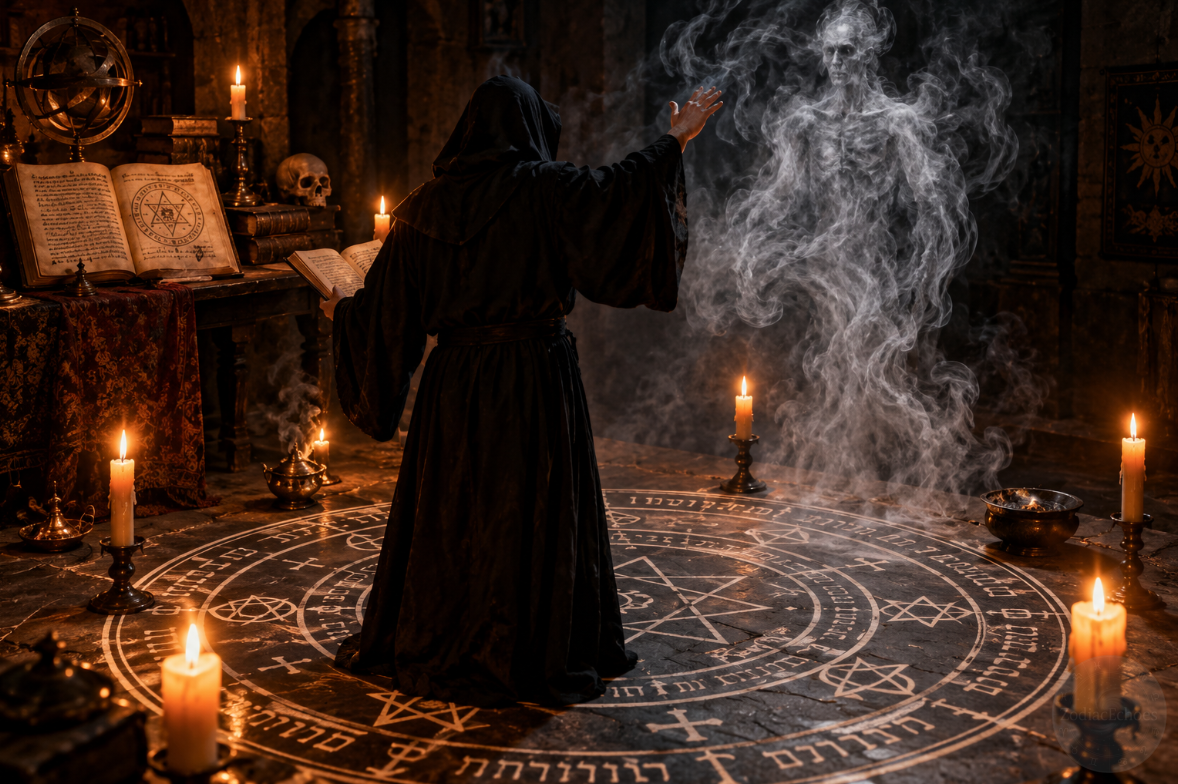
- Historical Grimoire: The Heptameron, published in 1565 and traditionally attributed to Pietro d’Abano.
- Ritual: The ceremonial summoning of spirits through a protective magic circle.
- Original Diagram: A surviving illustration from the 1565 edition shows the arrangement of the circle and its sacred inscriptions.
- Seven-Day System: Different angels, spirits, divine names, and directions govern each weekday.
- Protective Formula: The operator uses divine authority to command spirits and prevent them from crossing the circle.
- Original Source: The historical ritual text, including its conjurations and ceremonial instructions, is available as a PDF.
A magician stands within a circle inscribed with divine names. Beyond its boundary lies an invisible world inhabited by spirits, angels, and supernatural rulers. According to a sixteenth-century grimoire, the circle is the only barrier separating the magician from the forces he intends to summon.
The Heptameron, one of the most influential manuals of European ceremonial magic, describes how to construct this boundary, invoke the appropriate spiritual authorities, and command entities associated with particular days of the week.
Unlike grimoires that promise vague supernatural powers, the Heptameron presents a structured ceremonial system. Its instructions specify the arrangement of the circle, the names to be written within it, the prayers to be spoken, and the formulas used to dismiss the summoned spirits.
The book’s central claim is extraordinary: a properly prepared magician could supposedly summon invisible beings while remaining protected by sacred names.
The Forbidden Grimoire Attributed to Pietro d’Abano
The Heptameron is traditionally attributed to Pietro d’Abano, an Italian physician, philosopher, and astrologer who lived around 1257–1316. However, the surviving work appeared centuries after his death, and modern scholarship generally treats the attribution as pseudonymous.
The text was printed in 1565 alongside other works of ceremonial magic. Its title refers to seven days, reflecting the grimoire’s organization around the weekly cycle.
Each day is associated with particular angels, spirits, planetary influences, and ritual conditions. The magician was expected to select the appropriate ceremony rather than use the same formula for every operation.
Sunday belongs to the Sun, making it a particularly revealing example of the grimoire’s system. Its ceremony combines solar symbolism, angelic names, and the invocation of spirits associated with that day.
The Heptameron became influential because it offered something more precise than supernatural speculation: a repeatable ceremonial framework built around a magic circle and spoken conjurations.
The Original Heptameron and Its Ritual Instructions
The document contains the Heptameron’s descriptions of magical circles, ceremonial preparations, weekday spirits, conjurations, and the dismissal of summoned entities.
The text begins its practical instructions with the construction of the circle. This is significant because the circle is not merely a decorative symbol. It establishes the ceremonial space from which the magician claims authority over the spirits.
The grimoire describes the circle as a kind of fortress. Its purpose is to separate the operator from hostile or deceptive supernatural beings while allowing communication across its boundary. The instructions also reveal that no single circle was considered universally correct. Its inscriptions were supposed to change according to the chosen day, hour, and season.
The Original Magic Circle from 1565
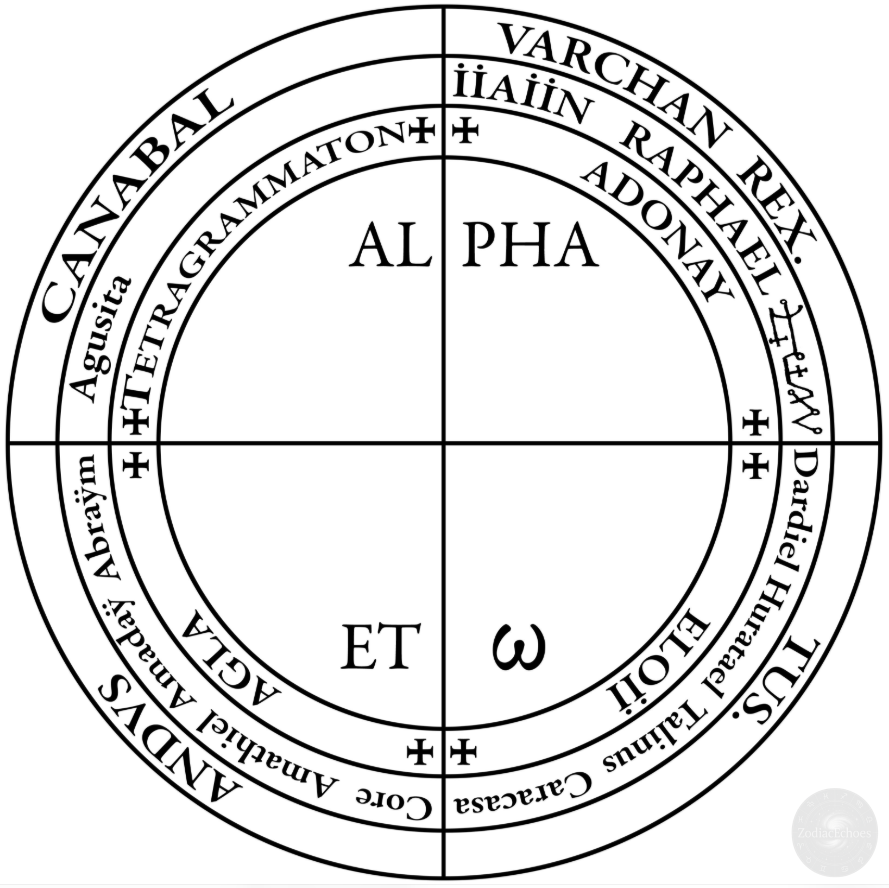
The historical diagram reveals a complicated arrangement of concentric boundaries, inscriptions, and geometric figures. At first glance, the circle resembles a magical seal. However, its individual elements perform different symbolic functions.
- The outer boundaries establish separation. They distinguish the protected interior from the surrounding space where summoned spirits were expected to appear.
- The sacred inscriptions establish authority. Divine and angelic names identify the powers through which the magician claims protection and the right to command.
- The geometric figures reinforce the ceremonial structure. Their arrangement turns the circle into a symbolic enclosure rather than an ordinary line drawn on the ground.
The diagram is therefore both a protective design and a visual statement of spiritual hierarchy.
How the Heptameron Describes Drawing the Circle
The grimoire begins with a simple but essential instruction: a circle must be constructed before the conjuration begins. Its exact inscriptions depend on the circumstances of the operation. The magician must account for the weekday, the hour, the season, and the spiritual names associated with those conditions.
Step 1: Establish the Circular Boundary
The text calls for a protective enclosure marked on the ground. The historical illustration shows multiple circular boundaries rather than a single unbroken line.bFor a modern reconstruction of the diagram, the basic geometry can be reproduced on paper before attempting a full-size layout. The purpose of the boundary, according to the grimoire, is to establish a place from which the operator may safely address spirits.
Step 2: Add the Appropriate Divine Names
The Heptameron instructs the magician to include sacred names corresponding to the ritual’s conditions. These names are not presented as decorative inscriptions. They are the source of the circle’s supposed protective authority. The operator is expected to invoke the power of God and the relevant angels rather than rely solely on personal magical ability.
Step 3: Identify the Day and Its Spiritual Rulers
The chosen weekday determines which spiritual authorities are addressed. For Sunday, the text associates the ceremony with solar influences and the angel Michael. It also identifies particular spirits and directions connected with the day. Other weekdays require different names and associations. This is why the historical circle cannot simply be copied without understanding its context. The grimoire treats its inscriptions as variable parts of a larger ritual system.
Step 4: Prepare the Ceremonial Space
The Heptameron also describes ritual preparations involving purification, prayers, and ceremonial materials. The operator is expected to enter the circle with the appropriate religious formulas and remain within its boundary during the conjuration. The ceremonial space becomes the center of the operation: the place where divine protection is invoked and from which commands are issued.
The Sunday Conjuration and the Spirits of the Sun
The Sunday ceremony draws upon a combination of Christian and planetary symbolism. The magician invokes divine names and angelic authority, demanding that the spirits associated with the day appear and obey. The Heptameron describes spiritual rulers according to the day, the planetary hour, and the region from which they are summoned.
The spirits are not approached as equals. The conjuration assumes that supernatural beings can be compelled through higher divine authority. The operator therefore speaks in commanding language, invoking sacred names as the justification for demanding an appearance.
This structure resembles other European grimoires, but the Heptameron is distinctive in its systematic organization. Each day has its own correspondences, giving the magician a ceremonial calendar rather than a single universal invocation.
The Conjuration: Calling Spirits Beyond the Circle
Once the circle has been established, the grimoire provides formulas intended to summon the spirits. These conjurations begin by appealing to divine authority. The magician invokes the names of God and commands the spirits to appear in an acceptable form. The text repeatedly emphasizes obedience and protection.
The summoned beings are expected to appear without deception, avoid harming the magician, and respond to the demands made within the circle. This requirement reflects a persistent concern in historical ceremonial magic: spirits might be dangerous, deceptive, or unwilling to cooperate.
The grimoire’s answer is not negotiation. It is the use of increasingly authoritative religious formulas. The magician claims to speak through powers greater than those of the summoned entities. The circle and the conjuration therefore work together. One establishes the boundary; the other establishes the command.
What Happens When the Spirit Appears?
According to the grimoire’s supernatural framework, the summoned spirits may manifest in different forms depending on their nature and the conditions of the ceremony. The operator is instructed to maintain control of the encounter and demand obedience through the sacred names already invoked. The appearance itself is not the final objective.
The purpose of the ritual is to obtain answers, assistance, or the fulfillment of a particular request. The grimoire presents these encounters as structured exchanges in which the magician issues commands and expects the spirits to comply. Its language repeatedly insists that the operator must retain authority throughout the operation.
Why the Spirits Must Be Dismissed
The Heptameron does not end its ceremonies with the appearance of a spirit. It also includes a formal dismissal, often called the license to depart. This final formula releases the summoned beings and commands them to leave peacefully, without harming the magician or others. The dismissal matters because the grimoire treats the ritual as a controlled encounter with a definite beginning and end.
Summoning without dismissal would leave the ceremony symbolically unfinished. The operator is therefore expected to close the encounter through the same divine authority used to begin it. This final stage completes the ceremonial sequence: preparation, protection, invocation, command, and departure.
The Circle That Promised Protection from Invisible Powers
The Heptameron survives as one of the clearest examples of structured European ceremonial magic.
Its historical diagram and detailed ritual formulas show how sixteenth-century occult authors imagined communication with invisible beings. The circle was not merely an emblem of mystery. It was presented as the essential boundary between human authority and supernatural danger.
The grimoire’s claims of actual spirit manifestation are not historically verifiable. Its importance lies in the survival of a detailed magical system, complete with illustrations, inscriptions, planetary correspondences, and ceremonial formulas.
For readers interested in reconstructing historical occult practices, the original circle and its accompanying instructions provide an unusually direct connection to the world of Renaissance ritual magic.
Cosmic Highlights
FAQ
What is the Heptameron?
The Heptameron is a sixteenth-century grimoire describing ceremonial magic organized around the seven days of the week. It includes instructions for magic circles, conjurations, planetary correspondences, and the dismissal of spirits.
Is the original Heptameron magic circle still available?
Yes. A historical diagram from the 1565 edition survives and is reproduced on Wikimedia Commons. It shows the concentric structure and inscriptions associated with the grimoire’s ceremonial system.
Can the Heptameron magic circle be drawn today?
The geometric design can be reproduced using the surviving illustration. However, the historical text specifies that certain inscriptions vary according to the day, hour, and season, so the illustration should not be treated as a universal arrangement for every ritual.
Which angel rules Sunday in the Heptameron?
Sunday is associated with the Sun and the angel Michael within the grimoire’s planetary system.
Why does the Heptameron use divine names to summon spirits?
The text presents divine names as sources of spiritual authority. The magician supposedly invokes them to compel spirits to appear, obey commands, and refrain from causing harm.
What is the license to depart?
The license to depart is the closing formula used to dismiss summoned spirits. It marks the end of the ceremonial encounter and commands the entities to leave peacefully.
Where can I read the original ritual instructions?
The linked Heptameron PDF contains the historical ritual text, including the construction of magical circles, weekday conjurations, and dismissal formulas.