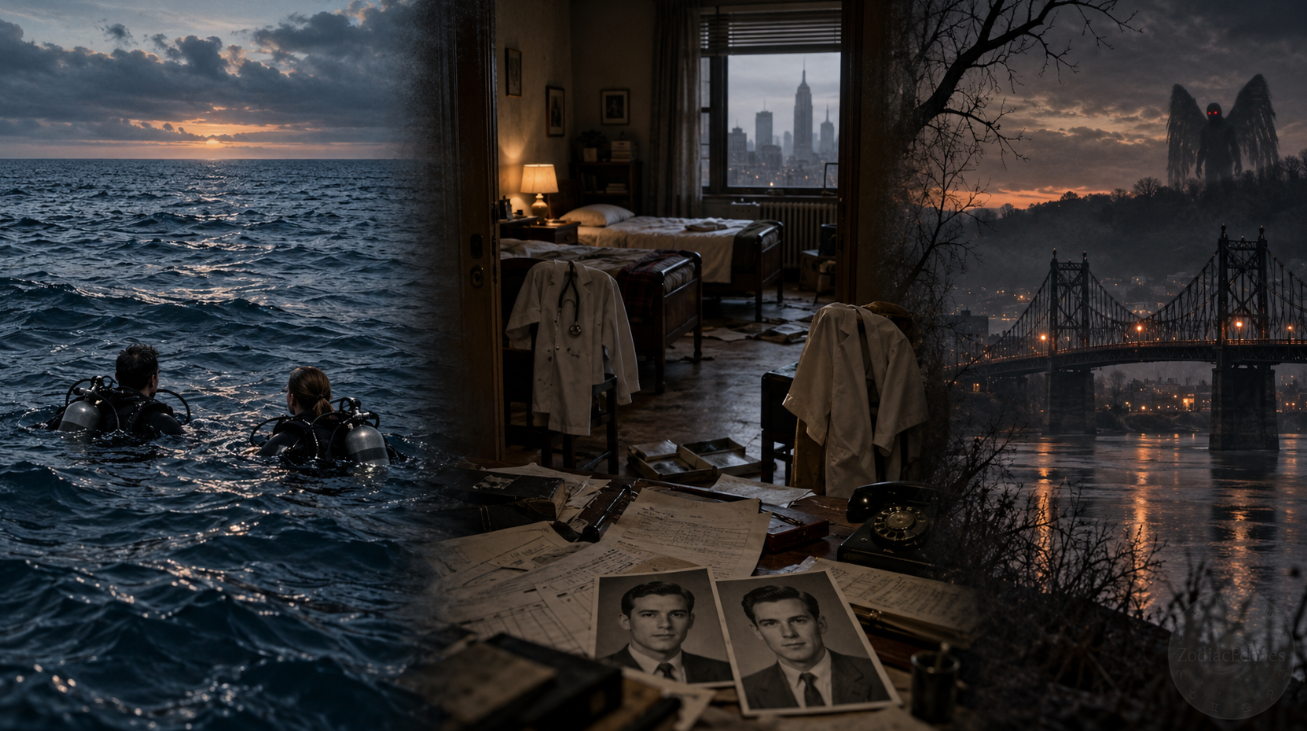
- Open Water draws on the disappearance of two divers left behind on Australia’s Great Barrier Reef.
- Dead Ringers has roots in the disturbing deaths of twin doctors in a New York apartment.
- The Mothman Prophecies connects reported sightings with a real bridge disaster whose structural cause was established.
- Each film gives a different shape to the gaps between recorded events and what remains unknown.
Two divers surface to discover their boat has gone. Two successful doctors are found dead in an apartment, leaving investigators to reconstruct their final days. Residents of a West Virginia town report a winged creature before a bridge collapses. These stories reached the screen through different routes, but each began with events that generated questions beyond the immediate headlines.
Following the killers and disappearances explored in Part 1, this instalment turns to Open Water, Dead Ringers and The Mothman Prophecies. Their real histories contain missing evidence, conflicting accounts and discoveries that changed earlier explanations. The films supply scenes and endings; the surviving records do not always offer that certainty.
Open Water: What Happened After the Boat Left?
The disappearance associated with Open Water began on January 25, 1998, when American couple Thomas and Eileen Lonergan joined a diving excursion from Port Douglas, Australia. They entered the water at the Great Barrier Reef, but their boat, Outer Edge, returned without them. More than 48 hours passed before their belongings aboard the vessel prompted the alarm.
That delay defined the search. The couple were already missing at sea while the boat’s return had given no outward indication that anything was wrong. Contemporary Associated Press reporting described a large search of the ocean and coastline, with police warning that currents could have carried them far from the dive site. Neither diver was recovered.
At the inquest, coroner Noel Nunan concluded that the couple had been accidentally left behind and probably died from drowning or a shark attack. He could not establish precisely how they died. Contemporary Reuters reporting also records his rejection of suggestions that the Lonergans staged their disappearance or that their deaths resulted from murder-suicide.
The missing final hours gave filmmakers room to imagine an experience nobody could reconstruct in full. Open Water follows fictional characters, and its depiction of their ordeal is not eyewitness evidence about the Lonergans. Reporting around the release also revealed the family’s distress: Tom’s mother, Betsy, said she had not authorized the film, while relatives faced renewed questions about the disappearance.
The enduring mystery is the couple’s fate after abandonment, rather than whether they were left behind. The boat’s departure and delayed alarm were investigated; the sea did not yield a complete account of what followed.
Dead Ringers: The Doctors Behind the Fiction
David Cronenberg’s Dead Ringers traces its origins through Bari Wood and Jack Geasland’s novel Twins to Stewart and Cyril Marcus, twin gynaecologists found dead in New York in 1975. The American Film Institute documents that connection through the production history. Cronenberg changed the setting and developed fictional brothers, Elliot and Beverly Mantle, rather than presenting a biography.
The original investigation was complicated even by identification. In their March 1976 Esquire report, Ron Rosenbaum and Susan Edmiston described how the bodies were initially assigned the wrong names. Dental examination corrected the error, but confused accounts had already entered newspaper coverage. Some apparent contradictions in the story began with that mix-up.
The toxicology findings also changed. Initial tests appeared to find no barbiturates, prompting a theory of fatal withdrawal. Further testing detected drugs in Stewart’s tissue, and the report describes his eventual classification as an overdose under undisclosed circumstances. Evidence placed Cyril outside the apartment after his brother’s death, raising another question: why did he return and remain there?
These details make the case more specific than a story of twins dying simultaneously. The brothers died at different times, and contemporary reporting followed an evolving investigation. The unanswered personal circumstances should not erase the medical findings that emerged. The uncertainty lies in the sequence, intentions and decisions surrounding their final days, not in a documented supernatural event.
Cronenberg’s film turns that history into psychological and bodily horror. Its fictional procedures and final confrontation belong to the screenplay; they do not explain what happened inside the Marcus apartment.
The Mothman Prophecies: Sightings Before a Disaster
Reports of the creature later called Mothman gathered around Point Pleasant, West Virginia, beginning in November 1966. Witnesses described a large winged figure with glowing red eyes, often near a former ammunition complex known locally as the TNT area. The West Virginia Encyclopedia records 26 sightings over approximately a year, alongside proposed explanations including a misidentified bird.
Writer John Keel gathered the sightings with accounts of strange communications, UFOs and mysterious visitors. His 1975 book, The Mothman Prophecies, also connected this material with the December 15, 1967 collapse of the Silver Bridge. The book became the source for the 2002 film starring Richard Gere.
The catastrophe itself was not unexplained. Forty-six people died, and the National Transportation Safety Board traced the initial structural failure to a fracture in a particular suspension-chain eyebar. Its investigation identifies the component and failure sequence; it does not establish a connection with the reported creature.
That distinction leaves two histories running alongside one another: an engineering investigation into a fatal collapse and a body of unusual witness reports that became regional folklore. Keel brought them together in his account. The film’s suggestion of warnings before catastrophe comes through that interpretation, rather than a finding that the bridge fell for an unknown reason.
Three Films, Three Different Gaps in the Record
The Lonergans’ final hours were never witnessed, the Marcus investigation changed as evidence developed, and the Mothman story joined sightings to a disaster with an established physical cause. Their differences are what make them worth exploring together. Behind each film is a more complicated record than the phrase “based on true events” can convey.
Cosmic Highlights

FAQ
Were the real Open Water divers ever found?
Thomas and Eileen Lonergan were not recovered. The inquest concluded that they had been accidentally left at sea, but could not determine exactly how they died.
Were the doctors in Dead Ringers real people?
The Mantle brothers are fictional. Their origins lie in a novel inspired by the lives and deaths of Stewart and Cyril Marcus.
Was the Silver Bridge collapse ever explained?
Yes. The NTSB identified a fracture in a suspension-chain eyebar as the initial structural failure. The Mothman connection belongs to the surrounding legend.
Sources
- Associated Press, via Cayman Compass — Australia Dive Couple Left at Sea
- Reuters, via Cayman Compass — Missing Divers Manslaughter Charge
- The Spokesman-Review — Open Water Brings Kin’s Pain to Surface
- American Film Institute — Dead Ringers
- Esquire — Dead Ringers, March 1976
- West Virginia Encyclopedia — Mothman
- American Film Institute — The Mothman Prophecies
- National Transportation Safety Board — Collapse of U.S. 35 Highway Bridge