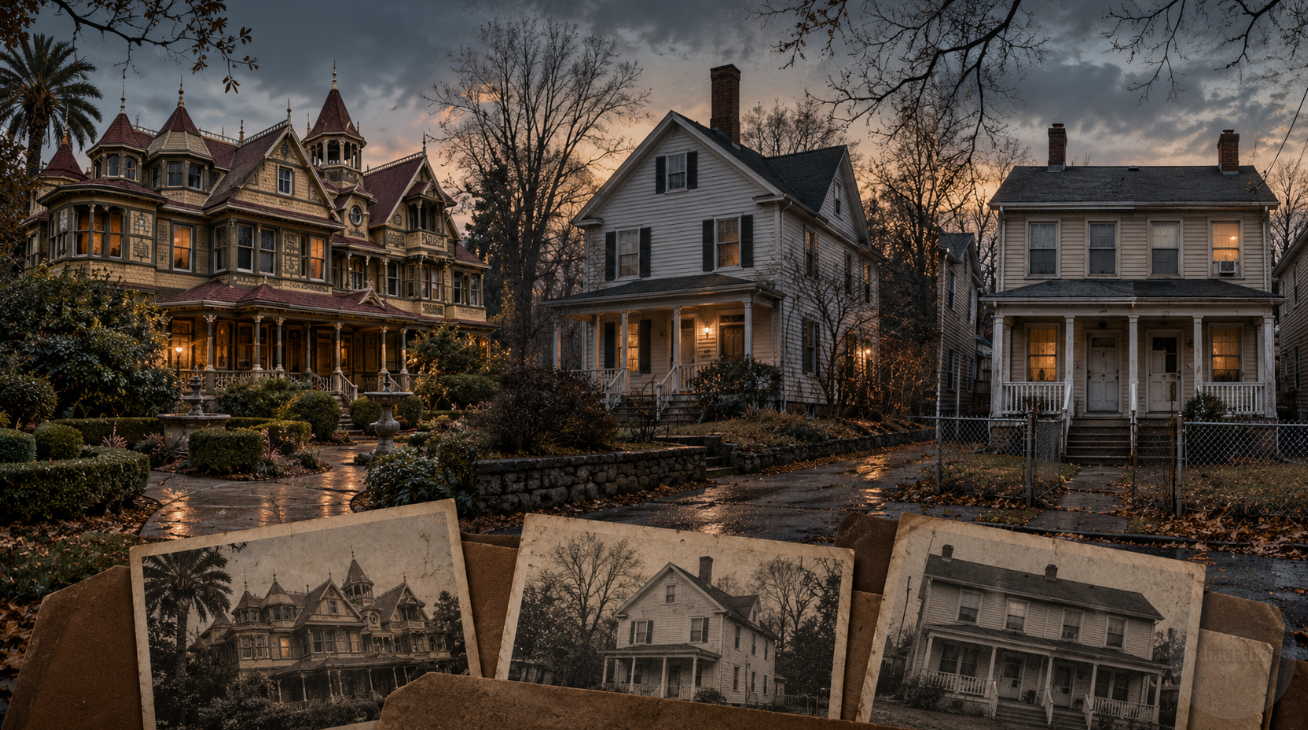
- Winchester draws on Sarah Winchester’s extraordinary mansion and the legends surrounding its construction.
- The Haunting in Connecticut connects to the Snedeker family’s experiences in a former funeral home.
- The Haunted dramatized the Smurl family’s claims about their Pennsylvania duplex.
- The properties’ histories include architectural change, conflicting testimony and the practical consequences of a haunted reputation.
A sprawling mansion, a former funeral home and a Pennsylvania duplex offered filmmakers three very different settings. One had already welcomed generations of visitors before its feature film appeared. The other two became famous through families who said something terrifying had entered their homes.
After Amityville, the Perron farmhouse and Enfield in Part 1, this instalment follows Winchester, The Haunting in Connecticut and The Haunted. Their histories extend beyond the films: an earthquake reshaped a mansion, an author challenged the account he had written, and a new landlord discovered that a supernatural reputation could make an ordinary property difficult to rent.
Winchester: The Mansion Was Famous Long Before the Film
Sarah Winchester purchased a residence in San Jose in 1886, beginning the long development of the property associated with the 2018 film Winchester. The resulting mansion contains an extraordinary collection of rooms, stairways and architectural changes. Its official history lists 160 rooms and approximately 24,000 square feet.
The familiar legend says Sarah built to appease people killed by Winchester firearms, following instructions from a medium. That story gives the house a supernatural purpose, but historian Mary Jo Ignoffo has challenged its foundations. In an interview with KQED, she described family circumstances, bereavement and Sarah’s architectural interests as important parts of the history obscured by the ghost narrative.
The building also changed for reasons that can be dated. The 1906 earthquake damaged the mansion, after which its seven-storey tower and much of the fourth floor were demolished. Not every strange feature in the surviving house can therefore be understood without considering damage, alteration and removal.
Sarah died in 1922, and public tours began in 1923. John and Mayme Brown had initially considered developing an amusement attraction on the grounds, but existing interest in the house helped turn tours into the central business. Its mysterious reputation became part of the visitor experience decades before Helen Mirren portrayed Sarah on screen.
The mansion’s afterlife as an attraction is a major part of its story. KQED’s historical reporting reproduces a 1929 advertisement presenting its builder as spirit-guided—evidence of how early the legend became a selling point. The film entered a narrative that tourism had already helped establish.
The Haunting in Connecticut: A Former Funeral Home and Conflicting Accounts
In 1986, Allen and Carmen Snedeker’s family moved into a house in Southington, Connecticut, previously used as a funeral home. The building retained remnants of that business in its basement. Their subsequent accounts of apparitions and disturbing experiences became the story associated with The Haunting in Connecticut.
The publishing history is unusually important here. Horror writer Ray Garton, who wrote In a Dark Place, later disputed its presentation as nonfiction. In a 2009 interview, he said family members’ accounts did not agree and alleged that Ed Warren encouraged him to invent material where necessary. That allegation comes from Garton’s description of his own involvement.
The same publication interviewed Nancy Boucher, Allen Snedeker’s sister, who said she had stayed in the house. She defended the family’s experiences and rejected Garton’s criticisms. Yet she also objected to the film’s changes, explaining that many things depicted on screen had not happened. Her position supported the family while distinguishing their account from the adaptation.
Garton supplied another detail about the property after the alleged events: he said he could not inspect it while researching because its later occupants wanted nothing to do with the story and reported no problems. That is his account of their response, not a comprehensive record of every later resident’s experience.
The house’s history consequently includes more than a haunting claim. It also records disagreement between a family member, the writer hired to tell the story and the version eventually presented to cinema audiences.
The Haunted: When the Smurl Duplex Became a Public Spectacle
The Smurl family’s claims made national news in August 1986. Jack and Janet Smurl and their four daughters occupied one half of a West Pittston duplex; Jack’s parents lived in the other. The family reported noises, foul smells, moving objects and physical attacks attributed to an unseen presence.
Publicity brought its own disturbance. A contemporary UPI report described television crews, journalists and onlookers arriving in such numbers that the family asked reporters to make appointments. Jason Miller, who played Father Karras in The Exorcist, also visited. The connection between a claimed haunting and the horror-film world was already visible before The Haunted was made.
Robert Curran’s book, written with contributions from the Smurls and the Warrens, appeared in 1988. Its bibliography confirms that date, although some later accounts give 1986, the year the story reached national attention. The television adaptation The Haunted followed in 1991.
Meanwhile, the property changed hands. Richard Bridle bought the duplex in December 1987, and by January 1988 he was telling UPI that its reputation was discouraging prospective tenants. For the new owner, the immediate problem was finding renters willing to move into a building they had heard described as demon-infested.
That report captures an aftermath rarely central to the screen version: the people change, but the address keeps the reputation. The Smurl duplex became a rental property carrying a story that its next owner could neither control nor easily remove.
What Remains After the Film?
Winchester’s legend helped sustain a visitor attraction, the Snedeker story produced competing accounts of how a haunting became a book, and the Smurl case affected the next owner’s ability to rent his property. These are tangible parts of the houses’ histories. They show how a frightening account can continue shaping a building’s future long after the original residents and filmmakers have moved on.
Cosmic Highlights

FAQ
Was Sarah Winchester’s house already an attraction before Winchester?
Yes. Public tours began in 1923, long before the 2018 film.
Was the Snedeker house really a former funeral home?
Yes. Its earlier use is documented in reporting on the property. The family’s supernatural claims and the film’s scenes are separate questions.
Did the author of In a Dark Place question the story?
Yes. Ray Garton publicly challenged its presentation as nonfiction and described problems he encountered while gathering accounts.
What happened to the Smurl house after the family’s publicity?
It was sold. In January 1988, its new landlord told UPI that the haunted reputation was making it difficult to attract tenants.
Sources
- Winchester Mystery House — History
- Winchester Mystery House — Sarah Winchester’s Timeline
- Society of Architectural Historians — Winchester Mystery House
- KQED — After 100 Years, the Mysteries of the Winchester House Endure
- Joe Nickell, Skeptical Inquirer — Demons in Connecticut
- Damned Connecticut — Interview With Ray Garton
- Damned Connecticut — Interview With Snedeker Family Member Nancy Boucher
- UPI — The Smurl Family’s Claims, August 1986
- UPI — Haunted Family Overwhelmed by Attention
- Indiana University Libraries — The Haunted, 1988 Bibliographic Record
- Times Leader — The Smurl Case and The Haunted
- UPI — Duplex for Rent; Exorcist Not Included