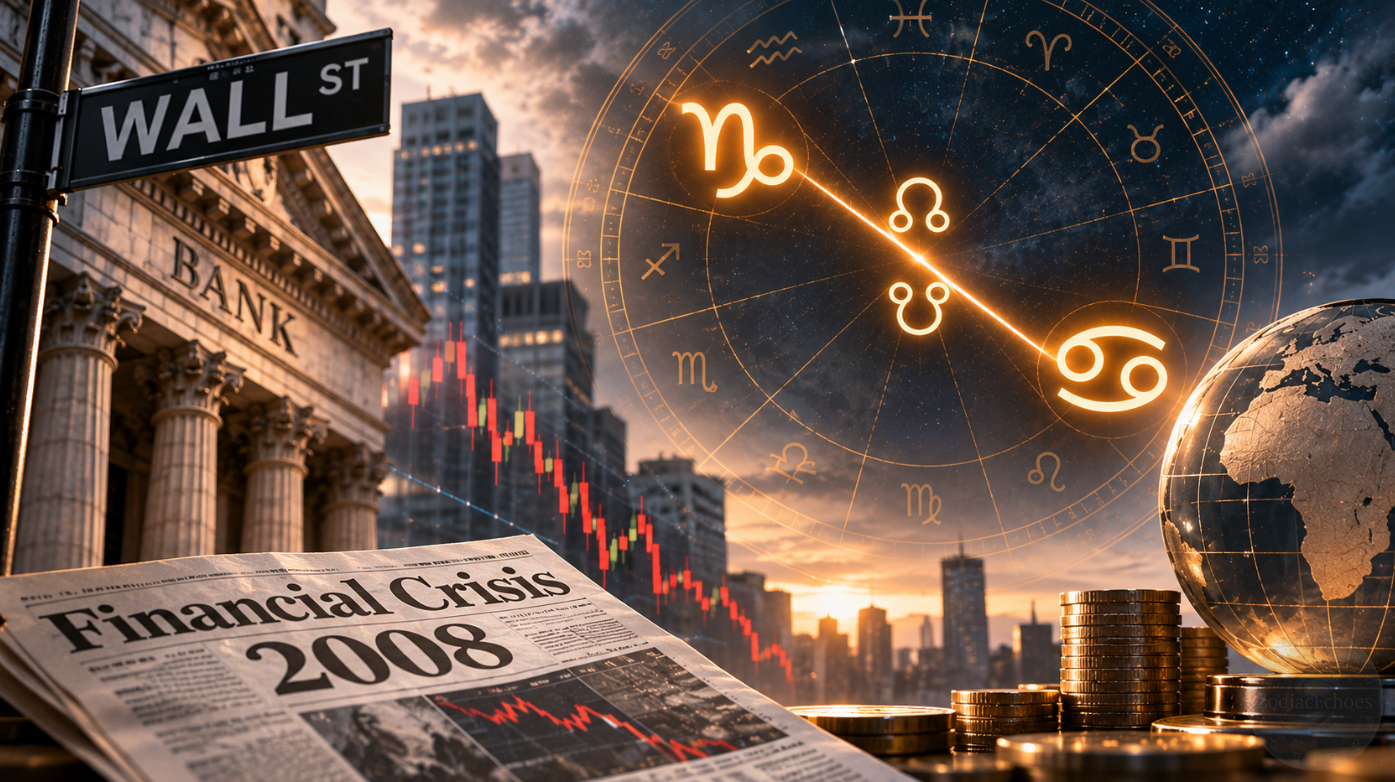
- A Historic Return: Rahu enters sidereal Capricorn and Ketu enters Cancer in late November or early December 2026, revisiting the same zodiac axis active during the 2008 financial crisis.
- Two Calculation Methods: The true lunar node changes signs on November 25, while the mean node crosses on December 5, 2026, at approximately 17:02 UTC.
- The 2008 Connection: The previous transit, from April 2008 to November 2009, coincided with the collapse of Lehman Brothers, emergency bank rescues and major changes in financial regulation.
- A New Financial Cycle: The approaching transit places the astrological focus on government debt, banking institutions, public security and the distribution of economic power.
- The Central Question: Could the return of the Rahu–Ketu axis symbolize another period in which governments and financial institutions must reconsider how economic stability is maintained?
The Astrological Axis of the 2008 Financial Crisis Returns
In September 2008, the collapse of Lehman Brothers became one of the defining moments of the global financial crisis. Credit markets were under extraordinary pressure, governments intervened to support financial institutions, and the stability of the international banking system became a central political concern.
Nearly nineteen years later, an intriguing astrological pattern is returning. Between November 25 and December 5, 2026, Rahu will enter Capricorn and Ketu will enter Cancer in the Vedic sidereal zodiac, recreating the same nodal axis that was active during the most turbulent months of the 2008 financial crisis.
In traditional Jyotisha, Rahu represents ambition, expansion, unconventional forces and the pursuit of power. Ketu symbolizes separation, detachment and the weakening of established attachments.
Their placement across Capricorn and Cancer creates a symbolic confrontation between institutional authority and the economic security of ordinary people. Could the 2026–2028 transit become another important chapter in the relationship between governments, financial markets and public trust?
November–December 2026: The Exact Rahu–Ketu Transit Dates
Rahu and Ketu are not physical planets. They are the northern and southern lunar nodes, the two opposing points where the Moon’s orbital plane intersects the ecliptic. Their movement through the zodiac creates an approximately 18.6-year nodal cycle, bringing them back to similar zodiacal positions at intervals of roughly nineteen years. The approaching transit has two commonly published ingress dates because Vedic astrologers use different methods to calculate the lunar nodes.
| Calculation | Date and time (UTC) | New sidereal positions |
|---|---|---|
| True Node | November 25, 2026, approximately 12:16 | Rahu in Capricorn, Ketu in Cancer |
| Mean Node | December 5, 2026, 17:02 | Rahu in Capricorn, Ketu in Cancer |
Both calculations use the Lahiri sidereal zodiac. The mean node represents the averaged movement of the lunar nodes, while the true node incorporates variations in their actual motion. The mean-node transit continues until approximately June 24, 2028. True-node calculations place the following sign change earlier, in May 2028. This distinction is important when comparing historical transits. For consistency, the following comparison with 2008–2009 primarily uses the mean lunar node.
April 2008–November 2009: What Happened During the Previous Transit?
The previous mean-node passage of Rahu through sidereal Capricorn began on April 30, 2008, with Ketu simultaneously entering Cancer. The configuration continued until November 17, 2009. This period coincided with some of the most consequential events in modern financial history.
September 2008: The Collapse of Lehman Brothers
On September 15, 2008, Lehman Brothers filed for bankruptcy, intensifying an already severe financial crisis. The collapse contributed to extraordinary instability in global financial markets. Banks faced liquidity pressures, confidence in financial institutions deteriorated, and governments were forced to confront the possibility of broader systemic failures.
From the perspective of Vedic mundane astrology, the event provides a striking historical parallel to Rahu in Capricorn, a placement symbolically associated with ambition, institutional hierarchy and the concentration of authority. The crisis exposed vulnerabilities within organizations that had previously appeared powerful and secure.
October 2008: Governments Intervene to Rescue Banks
In October 2008, the United States introduced the Troubled Asset Relief Program, or TARP, as part of its response to the financial crisis. Other governments also implemented emergency measures to stabilize banks, protect deposits and restore confidence. These interventions raised fundamental questions about the relationship between public money and private financial institutions.
Who should bear the cost when major financial organizations fail? Should governments protect institutions considered too important to collapse? Those questions fit the symbolic relationship between Capricorn, associated with institutional responsibility, and Cancer, traditionally connected with the protection of households and communities.
November 2008: The G20 Begins Reshaping Financial Governance
In November 2008, leaders of the G20 met in Washington to coordinate responses to the crisis and establish principles for reforming the international financial system. The meeting marked an important stage in the development of post-crisis financial governance.
The International Monetary Fund identifies the summit as a foundation for subsequent reforms intended to strengthen the global financial system. In astrological terms, the period illustrates a broader theme: when existing financial structures come under pressure, political authority becomes increasingly involved in determining how economic power is organized.

Rahu in Capricorn: Ambition, Institutions and Financial Power
Capricorn, known as Makara Rashi in Vedic astrology, is ruled by Saturn. It is associated with hierarchy, discipline, government, responsibility, long-term planning and the structures through which authority is exercised. Rahu introduces a contrasting influence. It represents intense ambition, unconventional methods, expansion and the desire to acquire influence beyond established limits.
When Rahu enters Capricorn, these qualities combine within a sign traditionally connected with institutional power. In mundane astrology, this placement may be interpreted through the ambitions of financial institutions, competition for economic influence, government authority and the restructuring of established hierarchies.
Rahu does not necessarily symbolize institutional collapse. It can also represent rapid expansion, innovation and the emergence of previously unconventional forms of power. The central issue is how ambition interacts with responsibility.
During the 2008 crisis, the relationship between financial expansion, institutional risk and government intervention became a defining economic question. The return of Rahu to Capricorn invites astrologers to revisit that same relationship in a different historical environment.
Ketu in Cancer: The Economic Security of Ordinary People
While Rahu moves into Capricorn, Ketu enters the opposite sign of Cancer, or Karka Rashi. Cancer is ruled by the Moon and traditionally represents home, family, emotional security, collective welfare and the needs of the population. Ketu introduces themes of detachment, disruption of familiar patterns and the reconsideration of established dependencies.
In mundane astrology, Ketu in Cancer may symbolize changes in the relationship between households and the institutions expected to provide economic security. This interpretation makes housing, household debt, public spending, social protection and financial confidence particularly relevant subjects.
During the previous transit, the global financial crisis had consequences extending far beyond banking institutions. Employment, housing markets, retirement savings and household finances were affected across numerous countries.
The Capricorn–Cancer axis therefore provides a compelling symbolic framework for examining the relationship between financial decision-makers and the people who experience the consequences of their decisions.

Could 2026–2028 Bring a Different Kind of Financial Crisis?
The global economy of 2026 is not the economy of 2008. The earlier crisis developed through vulnerabilities involving mortgage lending, securitized debt, excessive leverage and interconnected financial institutions. The present financial system operates under a different regulatory environment, while governments and businesses face new technological and economic challenges.
For astrologers examining the Rahu–Ketu return, the most interesting question is therefore not whether the events of 2008 will repeat exactly. It is whether similar themes of institutional responsibility, concentrated financial power and public economic security could become prominent again. Several areas provide particularly relevant subjects for observation.
Government Debt and Public Spending
Capricorn’s association with authority and long-term obligations makes sovereign debt and fiscal policy natural themes for this transit. Governments must balance competing demands involving public services, borrowing, taxation and economic stability. A mundane astrologer might interpret Rahu in Capricorn as highlighting tensions between institutional ambitions and financial limitations.
Banks and the Changing Financial System
The banking sector has undergone substantial changes since 2008, while financial technology and digital payment systems have created new relationships between traditional institutions and emerging competitors.
Rahu’s symbolism of innovation and unconventional expansion can be applied to these developments. The question of who controls financial infrastructure may become as significant as the question of who controls capital itself.
Housing and Household Security
Ketu’s placement in Cancer draws attention to the domestic consequences of economic decisions. Housing affordability, mortgage obligations, household borrowing and social protection all fit the traditional symbolism of Cancer. This creates an important contrast between the priorities of financial institutions and the economic security of the wider population.
The Historical Cycle: Why the Return Matters
The lunar nodes complete a revolution through the zodiac in approximately 18.6 years. Their return to the Capricorn–Cancer axis in 2026 therefore represents a genuine recurring astronomical pattern.
However, the surrounding planetary configurations are different from those of 2008. Jupiter, Saturn and the other planets occupy different positions, and the broader historical circumstances have changed considerably.
In traditional astrology, a nodal return is interpreted as the reappearance of related symbolic themes rather than the automatic repetition of specific historical events. This distinction makes the comparison more interesting.
The 2008–2009 transit coincided with a period when governments intervened to stabilize financial institutions and international leaders began developing new regulatory responses.
The 2026–2028 transit may instead invite attention to how those institutions have evolved, which forms of economic power have become more influential and how public expectations of financial security have changed.

Three Developments Mundane Astrologers May Watch
1. Changes in Global Financial Governance
Rahu in Capricorn highlights the relationship between ambition and established authority. International banking regulation, government intervention and the role of major financial institutions provide relevant areas for observing this symbolism.
2. The Balance Between Public and Private Financial Risk
The 2008 crisis demonstrated how problems within private financial markets could create enormous public consequences. The returning Capricorn–Cancer axis invites renewed attention to the distribution of financial responsibility between governments, businesses and households.
3. The Emergence of New Economic Power Structures
Rahu is traditionally associated with unconventional forces and rapid expansion. Its passage through Capricorn may be interpreted through changes in financial technology, digital infrastructure and the organizations that exercise influence over economic systems.
Conclusion
Rahu’s return to Capricorn and Ketu’s return to Cancer in late 2026 recreates the same Vedic zodiac axis that was active during the global financial crisis of 2008–2009. The earlier transit coincided with bank failures, government rescues and major reforms of international financial governance. As the lunar nodes revisit these signs through 2028, their traditional symbolism raises compelling questions about institutional ambition, public economic security and the distribution of financial power.
Whether the coming period brings reform, instability or a different transformation, the historical parallel offers an intriguing framework for examining how the world’s financial institutions respond to new challenges.
FAQ
When does Rahu enter Capricorn in 2026?
Rahu enters sidereal Capricorn on November 25, 2026, according to the true-node calculation, or December 5, 2026, at approximately 17:02 UTC according to the mean-node calculation. Both dates use the Lahiri sidereal zodiac.
When was Rahu last in Capricorn?
Using the mean lunar node, Rahu last occupied sidereal Capricorn from April 30, 2008, to November 17, 2009. Ketu occupied the opposite sign of Cancer during the same period.
Was Rahu in Capricorn during the 2008 financial crisis?
Yes. Rahu was in sidereal Capricorn and Ketu in Cancer during the collapse of Lehman Brothers in September 2008 and the subsequent period of emergency financial intervention.
What does Rahu in Capricorn mean in Vedic astrology?
Rahu in Capricorn is traditionally associated with ambition, institutional authority, hierarchy and the pursuit of influence through established structures. In mundane astrology, these themes can be applied to governments, financial organizations and political power.
Does the Rahu–Ketu transit predict another financial crisis?
The transit provides a symbolic historical comparison, not a reliable forecast of a specific economic event. Mundane astrologers may examine the recurring themes of institutional responsibility, financial power and public security.
How long will Rahu remain in Capricorn?
Under the mean-node calculation, Rahu remains in sidereal Capricorn until approximately June 24, 2028. The true-node calculation places the next sign change in May 2028.
Sources and References
Astronomical and Astrological Data
- Astro Scorpio – Rahu and Ketu Transit 2026 — True-node and mean-node dates using the Lahiri sidereal zodiac.
- VedicMarga – Rahu in Capricorn — Historical and upcoming Rahu transits, including 2008–2009 and 2026–2028.
- Swiss Ephemeris – Astrodienst — Astronomical ephemerides and planetary calculation methods.
- NASA – Eclipses and the Moon’s Orbit — Background on the lunar orbital nodes and eclipse geometry.
Historical and Economic Sources
- International Monetary Fund – IMF Timeline — Lehman Brothers, the global financial crisis and the November 2008 G20 summit.
- Federal Reserve History – Lehman Brothers Bankruptcy — Historical background on the September 2008 collapse.
- U.S. Treasury – Troubled Asset Relief Program — The American government’s financial stabilization program.
- Financial Stability Board – History of the FSB — The development of international financial stability cooperation after the crisis.