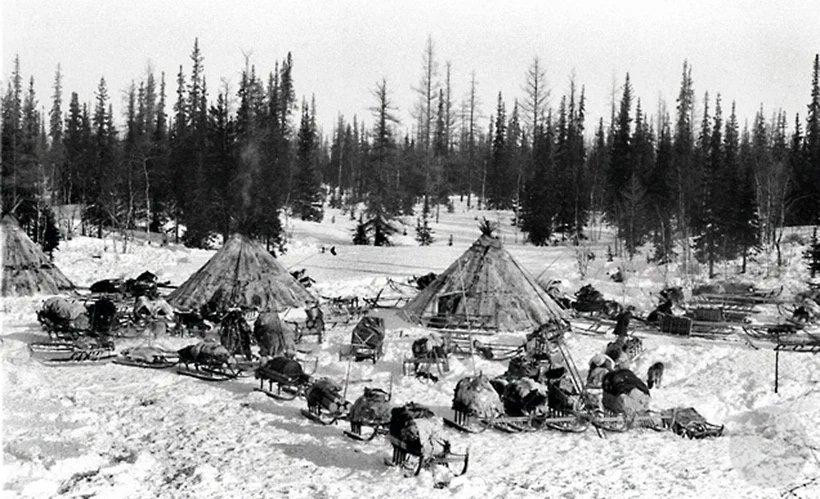
- In November 1930, newspapers reported that an entire Inuit settlement had mysteriously disappeared near Angikuni Lake in northern Canada.
- A fur trapper named Joe Labelle allegedly discovered six abandoned tents containing clothing, cooking equipment, and personal belongings.
- Later versions introduced dead sled dogs, disturbed graves, strange lights, and even UFOs, transforming the original account into a supernatural legend.
- A contemporary police inquiry reportedly found no evidence supporting the disappearance, and the Royal Canadian Mounted Police subsequently rejected the story.
Imagine traveling through the freezing wilderness of northern Canada and arriving at a familiar settlement, expecting shelter and human company. Instead, you discover abandoned tents, cooking utensils, clothing, and personal belongings. Everything suggests that people lived there recently, yet not a single person can be found.
According to a story published in 1930, this was the terrifying discovery made by a fur trapper named Joe Labelle near Angikuni Lake, a remote body of water in what is now Nunavut, Canada.
Over the following decades, the incident became one of North America’s most disturbing disappearance legends. Some versions claimed that hundreds or even thousands of people had vanished overnight, leaving behind their possessions and starving dogs.
But the mystery becomes even stranger when the original newspaper reports are compared with the later stories. Was an entire community really erased from the wilderness, or did a sensational newspaper report create a legend that refused to die?
The Trapper Who Found an Empty Settlement
The earliest traceable newspaper accounts appeared in late November 1930. Journalist Emmett E. Kelleher described a fur trapper named Joe Labelle who supposedly encountered an abandoned Inuit camp near Angikuni Lake. One version, published in Virginia’s Danville Bee on November 27, 1930, described a settlement consisting of six tents and approximately 25 inhabitants.
According to the report, Labelle approached the camp expecting to find its residents. Instead, he discovered deserted shelters containing everyday possessions. Cooking utensils, clothing, boots, and a rifle reportedly remained behind.
The account also mentioned dogs in distress, some apparently dead and others severely weakened. The scene suggested that something unusual had happened, although the report offered no reliable explanation for where the inhabitants had gone.
Why would an entire group abandon useful equipment and leave their dogs behind in such an unforgiving environment? That question became the foundation of the Angikuni Lake legend.
The Terrifying Details That Appeared Later
As the story spread through books, magazines, and paranormal publications, its details became increasingly dramatic. Some versions claimed that meals had been left cooking over extinguished fires. Others described unfinished clothing with sewing needles still attached, suggesting that the villagers had disappeared in the middle of ordinary activities.
One particularly disturbing addition involved graves that had supposedly been opened, with their occupants mysteriously missing. Another described strange lights appearing above the settlement around the time of the alleged disappearance.
The number of missing people also changed dramatically. The original report mentioned approximately 25 inhabitants. Later accounts increased the figure to hundreds, then more than a thousand, and eventually as many as 2,000 missing villagers.
These increasingly elaborate details were not established by the earliest newspaper coverage. They developed through later retellings, making the story more frightening but considerably less reliable.
The 1931 Police Investigation
The original newspaper reports attracted enough attention that Canadian authorities received questions about the supposed disappearance. In January 1931, Royal Canadian Mounted Police Sergeant J. Nelson reportedly examined the story and found no factual foundation for its central claims.
According to later historical investigations describing Nelson’s findings, Joe Labelle was a real trapper, but his experience and movements did not match the newspaper’s dramatic account. The police also questioned the photographs accompanying the story. At least one image was reportedly an older archival photograph rather than evidence of a recently abandoned settlement.
Most importantly, investigators could not establish that the alleged missing community had existed or that a mass disappearance had occurred. The RCMP has subsequently maintained that there is no evidence supporting the story of an entire Inuit village disappearing near Angikuni Lake.
How a Forgotten Newspaper Story Became a Worldwide Mystery
The legend might have faded permanently if it had not been revived by American writer Frank Edwards in his 1959 book Stranger Than Science.
Edwards presented the disappearance to a new generation of readers fascinated by unexplained phenomena. His version helped establish the spelling Anjikuni, which remains common in discussions of the mystery, although the geographical name is Angikuni Lake.
Later paranormal writers expanded the narrative further. The missing population increased, disturbing supernatural details accumulated, and the story became associated with extraterrestrial activity.
By the late 20th century, some accounts were suggesting that an unidentified flying object had removed an entire community without leaving any trace. Yet the most extraordinary elements had little connection with the original newspaper story. They reflected decades of embellishment rather than newly discovered evidence.
Could the Village Have Been Abandoned Naturally?
Even if a trapper had encountered an empty camp in northern Canada, abandonment would not necessarily indicate a mysterious disappearance. Inuit communities in the region historically traveled according to seasonal conditions, hunting opportunities, and the availability of resources. Temporary camps could be occupied and abandoned as families moved across the landscape.
However, this explanation does not establish that Labelle actually discovered the settlement described in the newspaper. The central problem remains the absence of independent evidence for the alleged event. No reliable contemporary record confirms that 25 people vanished, and there is no documented mass disappearance corresponding to the increasingly dramatic later accounts.
The Real Mystery Behind Angikuni Lake
Perhaps the most fascinating aspect of this case is not the supposed disappearance itself, but the transformation of a single newspaper story into an internationally recognized mystery.
The original account was comparatively modest: six tents, approximately 25 people, and a trapper who allegedly found an abandoned camp. Decades later, the story had acquired thousands of missing inhabitants, disturbed burial sites, unexplained lights, and extraterrestrial theories.
Yet there is one important historical detail that cannot be dismissed: the story really was circulating in newspapers in 1930. It was not invented entirely by later paranormal authors, even though the underlying disappearance remains unsupported. That distinction reveals how easily an extraordinary claim can survive long after its original credibility has been challenged.
Conclusion
The Angikuni Lake disappearance remains one of Canada’s most famous vanishing-village legends. Its remote setting, abandoned possessions, and unanswered questions create the atmosphere of a supernatural mystery. Historical investigation, however, reveals something equally intriguing: a newspaper report that grew increasingly elaborate with every generation of storytelling.
There is no credible evidence that an entire Inuit settlement vanished without a trace. But the original 1930 reports, the police response, and the later embellishments offer a remarkable example of how an apparent mystery can develop into modern folklore.
Perhaps the greatest mystery of Angikuni Lake is not where the villagers went, but how a story with so little supporting evidence became so widely believed.
Cosmic Highlights

FAQ
Did an entire Inuit village really disappear at Angikuni Lake?
There is no reliable evidence confirming a mass disappearance. Although newspapers reported the story in 1930, the Royal Canadian Mounted Police subsequently rejected its central claims.
Who was Joe Labelle?
Joe Labelle was the fur trapper named in the original newspaper reports. He allegedly discovered an abandoned settlement, but the circumstances of his supposed discovery have never been independently verified.
How many people supposedly vanished?
The earliest newspaper account described approximately 25 inhabitants. Later versions increased the number to hundreds or thousands, without providing supporting evidence.
Were UFOs involved in the Angikuni Lake disappearance?
UFO explanations appeared in later paranormal retellings. There is no credible evidence connecting extraterrestrial activity to any disappearance at the lake.
Where is Angikuni Lake located?
Angikuni Lake is located in Nunavut, northern Canada, in the remote region associated with the Kazan River. The name is also frequently written as Anjikuni Lake in popular accounts of the legend.
Sources and Further Reading
-
Randy Freeman — Roswell North, Up Here Magazine. A detailed investigation of the original newspaper accounts, the police inquiry, and the legend’s later development. Read the historical investigation
-
Mental Floss — The Strange Story of the Village That Supposedly Vanished Without Any Explanation. Examines the disappearance narrative and evidence against it. Read the investigation
-
Emmett E. Kelleher — Vanished Eskimo Tribe Gives North Mystery Stranger Than Fiction (1930). The early newspaper report associated with the legend, published in The Danville Bee on November 27, 1930. View the historical newspaper references