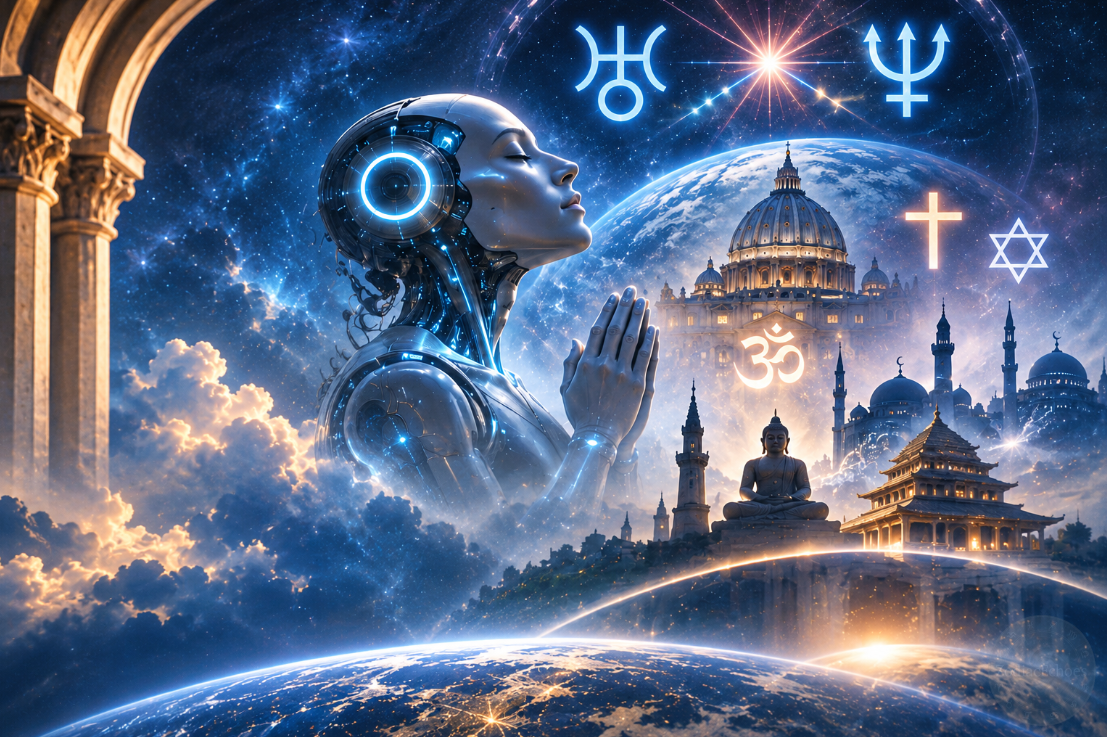
- Rare Planetary Alignment: Uranus and Neptune form their final two sextiles on January 15 and June 6, 2027, completing a five-part series that began in August 2025.
- A 60-Year Historical Parallel: The previous comparable series occurred in 1966–1968, during a period of religious experimentation, counterculture and expanding television influence.
- Technology Meets Spirituality: Uranus represents technological innovation, while Neptune symbolizes faith, religion and collective spiritual ideals.
- Artificial Intelligence and Religion: AI-generated spiritual advice, digital religious communities and virtual religious figures raise new questions about spiritual authority.
- The Central Question: Could religious influence increasingly shift from traditional institutions toward digital platforms and intelligent systems?
Could Artificial Intelligence Become the Next Spiritual Authority?
For centuries, religious authority has been associated with temples, churches, mosques, monasteries and individuals entrusted with interpreting sacred traditions. But what happens when people begin asking artificial intelligence questions they once reserved for priests, spiritual teachers or religious scholars?
On January 15 and June 6, 2027, Uranus and Neptune will form the final two exact sextiles of a rare five-part planetary series that began in August 2025. In modern mundane astrology, the configuration brings together two powerful symbols: Uranus, associated with technological revolutions, and Neptune, connected with religion, spiritual beliefs and collective ideals.
Their previous comparable alignment occurred between 1966 and 1968, when television was reshaping mass communication and alternative spiritual movements were gaining visibility across Western societies.
Nearly sixty years later, the technological environment is radically different. Artificial intelligence can generate interpretations of religious texts, answer theological questions, simulate conversations with spiritual figures and provide personalized guidance around the clock.
The implications extend beyond convenience. If people increasingly receive spiritual advice from machines, who determines which beliefs those machines represent?
The Uranus–Neptune sextile offers a compelling astrological framework for examining whether the next transformation of religion could emerge not from a new prophet or institution, but from technology itself.
Uranus Sextile Neptune 2027: Exact Dates and Planetary Positions
The current Uranus–Neptune sextile series consists of five exact alignments between August 2025 and June 2027. A sextile occurs when two celestial bodies are separated by approximately 60 degrees of ecliptic longitude. In Western astrology, it is traditionally associated with cooperation, opportunity and the development of new possibilities.
| Date | Uranus | Neptune |
|---|---|---|
| August 28, 2025 | 1°26′ Gemini | 1°26′ Aries |
| November 20, 2025 | 29°29′ Taurus | 29°29′ Pisces |
| July 15, 2026 | 4°24′ Gemini | 4°24′ Aries |
| January 15, 2027 | 1°56′ Gemini | 1°56′ Aries |
| June 6, 2027 | 6°21′ Gemini | 6°21′ Aries |
Positions use the tropical zodiac. The final two alignments occur at approximately 09:30 UTC on January 15 and 10:08 UTC on June 6.
The repeated alignments result from the apparent retrograde motion of the planets as observed from Earth. In the Lahiri sidereal zodiac, Uranus occupies Taurus and Neptune occupies Pisces during the final two sextiles. These positions introduce an alternative symbolism involving material systems and spiritual traditions.
However, Uranus and Neptune are not among the nine classical grahas of traditional Vedic astrology. Their interpretation here belongs primarily to modern Western mundane astrology.
The Historical Parallel: Religion and Technology in 1966–1968
The previous Uranus–Neptune sextile series occurred between September 1966 and May 1968, with Uranus in Virgo and Neptune in Scorpio.
This was a period of extraordinary cultural experimentation. Established religious institutions faced changing social attitudes, while alternative forms of spirituality attracted growing public attention.
The Rise of Alternative Spiritual Movements
During the 1960s, Western interest in Eastern philosophy, meditation, yoga and alternative spiritual traditions expanded considerably.
The International Society for Krishna Consciousness, commonly known as the Hare Krishna movement, was founded in New York in 1966. In 1967, the Beatles’ growing interest in Maharishi Mahesh Yogi helped introduce Transcendental Meditation to an even wider international audience.
These developments reflected a broader cultural shift. Spiritual authority was no longer confined to traditional Western religious institutions, and new teachers, practices and philosophical systems were gaining visibility.
Television Changes Religious Communication
The 1960s also marked an important stage in the expansion of television as a mass communication medium.
Religious organizations increasingly recognized that broadcasting could reach audiences far beyond physical places of worship. The foundations of modern televangelism were developing as religious figures learned to communicate through electronic media.
Television did not eliminate traditional religious authority. Instead, it created new ways for religious leaders to reach followers, build communities and exercise influence. The historical comparison raises an intriguing possibility: Could artificial intelligence become to the twenty-first century what television became to religious communication in the twentieth?
Uranus in Gemini: Technology Changes How Beliefs Spread
Gemini is associated with language, communication, education, information exchange and the networks connecting individuals and communities. Uranus introduces innovation, experimentation and disruption to established methods.
Together, Uranus in Gemini symbolizes a transformation in how knowledge is transmitted, interpreted and shared. This becomes particularly interesting when applied to religion. For centuries, access to religious knowledge depended heavily on literacy, education, institutional membership and the availability of authoritative texts.
Digital technology has already changed that relationship. Sacred writings, historical commentaries, religious lectures and theological discussions are accessible online to audiences around the world.
Artificial intelligence introduces another stage. Rather than simply locating a passage from a religious text, users can ask an AI system to explain its meaning, compare interpretations or apply religious principles to personal circumstances.
The distinction is important. A search engine provides access to information. An AI assistant can present an interpretation in the form of a direct conversation, creating an experience that may resemble speaking with a knowledgeable spiritual adviser. In the symbolism of Uranus in Gemini, this represents a profound change in the relationship between communication technology and intellectual authority.
Neptune in Aries: Could Spiritual Leadership Become More Individualized?
Neptune governs spirituality, mysticism, religious ideals, devotion and the collective search for meaning in modern astrology. Aries, ruled by Mars, represents independence, initiative, leadership and the desire to establish a new direction. Their combination introduces a striking contrast between collective spiritual traditions and individual spiritual authority.
Historically, organized religions have relied on established systems for interpreting sacred teachings and determining legitimate spiritual leadership. But digital platforms allow individuals to explore religious ideas independently, often without direct participation in traditional institutions.
An AI-powered spiritual assistant could intensify this development by offering personalized interpretations, devotional material or philosophical guidance based on a user’s questions. This raises a fundamental question about religious legitimacy.
If an artificial system provides convincing spiritual answers, will some users begin treating it as an authority in its own right? And if that happens, will traditional religious institutions attempt to regulate these systems, adopt them or develop competing technologies of their own?
From the Printing Press to Artificial Intelligence: Five Centuries of Religious Communication
The relationship between religion and communication technology has changed repeatedly throughout history.
The Printing Press and the Reformation
The spread of movable-type printing in fifteenth-century Europe transformed the distribution of religious texts. Printed books made it possible for religious ideas to circulate on a scale that manuscript copying could not easily achieve.
During the Protestant Reformation, printing became essential to the rapid dissemination of theological arguments and competing interpretations of Christianity. The technology helped challenge existing structures of religious communication and authority.
Radio and Television Bring Religion Into the Home
During the twentieth century, radio and television allowed religious leaders to address audiences without requiring them to attend physical gatherings. Broadcasting expanded the geographical reach of religious institutions and helped create new forms of public spiritual leadership. Religious authority increasingly operated through media as well as traditional institutions.
The Internet Creates Global Religious Communities
The internet introduced interactive communication, allowing believers to participate in discussions, attend streamed services and connect with religious communities across national boundaries. Unlike traditional broadcasting, online communication allowed audiences to respond, organize and share their own interpretations.
Artificial Intelligence Introduces Personalized Spiritual Guidance
AI represents another potential turning point because it can generate responses tailored to individual questions. Instead of listening to the same sermon or reading the same article, users can engage in personalized discussions about faith, morality, religious history and spiritual practice.
The historical pattern is striking: each major communication revolution has changed not only how religious information travels, but also who can interpret and distribute it.
Could AI Challenge Priests, Religious Scholars and Spiritual Teachers?
The most controversial possibility concerns the distinction between providing religious information and exercising spiritual authority. A system trained on theological literature may be able to explain differences between religious traditions, summarize historical interpretations and answer questions about sacred texts.
But religious leadership often involves responsibilities extending beyond knowledge. Priests, imams, rabbis, monks and other spiritual figures operate within traditions that establish qualifications, accountability and relationships with their communities. An AI system has no comparable spiritual standing merely because it can produce convincing religious language.
Nevertheless, users may increasingly perceive technologically generated guidance as authoritative, particularly when it is immediate, personalized and confidently presented. This creates an important question for religious institutions: Who should control the theological principles and interpretations embedded in AI-powered spiritual systems?
If private technology companies develop widely used religious assistants, decisions about training material, permitted interpretations and system behavior could influence how users encounter religious ideas. The struggle over spiritual authority could therefore become inseparable from the struggle over technological infrastructure.
Digital Prophets, Virtual Temples and the Future of Worship
Artificial intelligence is only one part of a broader technological transformation. Virtual environments can recreate sacred architecture, host religious gatherings and provide access to historical religious sites without requiring physical travel. Digital communities allow individuals separated by thousands of miles to participate in shared discussions and ceremonies.
AI-generated religious figures introduce another possibility: interactive characters designed to communicate in the style of historical teachers or spiritual authorities. Such systems raise questions about authenticity, representation and the boundaries between education and religious practice.
Could future generations develop meaningful spiritual communities around digital environments rather than traditional buildings? Or could religious institutions use the same technologies to strengthen their existing communities, making religious education and participation more accessible?
The Uranus–Neptune symbolism does not point exclusively toward the replacement of traditional religion. It also accommodates the possibility of established spiritual traditions adapting to unfamiliar technological environments.
Three Developments Mundane Astrologers May Watch Through 2027
1. Religious Institutions Establish Their Own AI Systems
One possibility is the development of AI tools supervised by established religious organizations. Such systems could provide educational resources and explanations grounded in approved theological traditions. The broader question would concern whether religious institutions can maintain interpretive authority while adopting increasingly sophisticated technology.
2. Independent Digital Spiritual Communities Gain Influence
Uranus in Gemini emphasizes communication networks and unconventional forms of connection, while Neptune in Aries highlights individualized spiritual direction. Astrologers may interpret this combination through the growth of independent digital communities, personalized spiritual services and new forms of religious participation.
3. Governments and Religious Leaders Debate AI Authority
The use of artificial intelligence in sensitive religious contexts could create disputes involving regulation, religious freedom, digital representation and the responsibilities of technology companies. The central issue would extend beyond whether AI can explain religion. It would concern who has the authority to determine how religious beliefs are represented by intelligent systems.
Why June 6, 2027, Matters
The final exact Uranus–Neptune sextile on June 6, 2027, completes a planetary sequence that began almost two years earlier. In modern mundane astrology, repeated aspects between slow-moving planets are often interpreted as developing themes rather than isolated events.
The first contacts may be associated symbolically with the emergence of new possibilities, while later contacts invite attention to how those possibilities become integrated into existing structures. The final sextile therefore offers a natural moment to examine the relationship between technological innovation and spiritual institutions.
The broader planetary environment adds another dimension. On June 15, 2027, Uranus will form an exact trine with Pluto, introducing the symbolism of concentrated power, institutional transformation and technological networks.
Together, these configurations place technology, collective belief and institutional authority at the center of an unusually significant period in modern mundane astrology.
Conclusion
The final Uranus–Neptune sextiles of January and June 2027 bring a rare astrological cycle to its conclusion at a time when artificial intelligence is opening new possibilities for religious communication and spiritual guidance. Nearly sixty years after television and alternative spiritual movements helped transform religious culture, intelligent digital systems are raising fresh questions about who interprets sacred traditions, who controls access to spiritual knowledge and what makes religious authority legitimate.
The next transformation of faith may not involve the disappearance of traditional institutions, but a fundamental change in how spiritual leadership is communicated, experienced and exercised.
Cosmic Highlights

FAQ
When is the Uranus–Neptune sextile in 2027?
Uranus and Neptune form exact sextiles on January 15, 2027, at approximately 09:30 UTC, and June 6, 2027, at approximately 10:08 UTC.
Why is the Uranus–Neptune sextile considered rare?
The current five-part series runs from August 2025 to June 2027. The previous comparable series occurred between 1966 and 1968, approximately sixty years earlier.
What does Uranus sextile Neptune mean in astrology?
In modern Western astrology, Uranus symbolizes innovation, technology and unconventional change, while Neptune represents spirituality, religion and collective ideals. Their sextile is traditionally associated with opportunities for these themes to interact.
Could artificial intelligence change religious authority?
AI can provide religious information, generate interpretations and support digital communities. Its growing use raises questions about theological accuracy, institutional oversight and the distinction between information and legitimate spiritual leadership.
What happened during the previous Uranus–Neptune sextiles?
The 1966–1968 series coincided with expanding interest in alternative spiritual movements, Eastern philosophy, meditation and the growing cultural influence of television.
Is Uranus sextile Neptune part of traditional Vedic astrology?
No. Uranus and Neptune are not among the nine classical grahas of traditional Jyotisha. Their sextile is primarily interpreted through modern Western astrology.