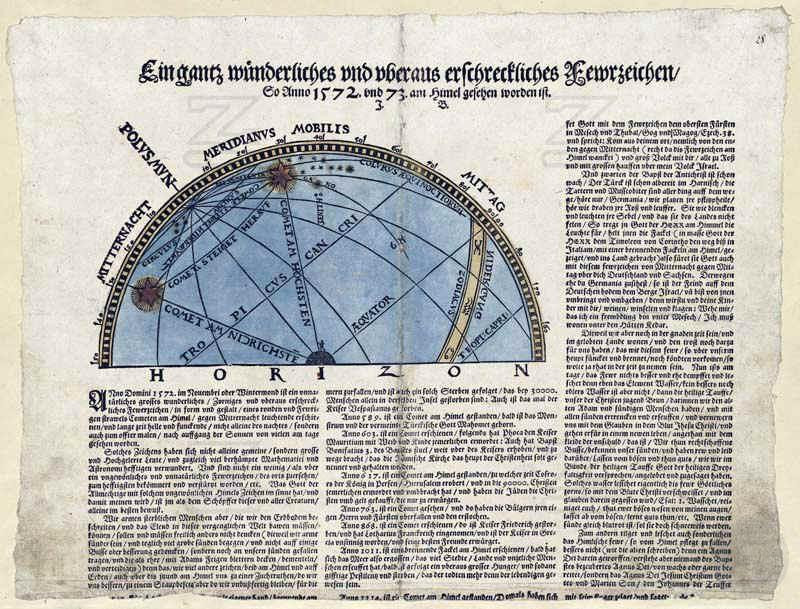
- In November 1572, an extraordinarily bright new star appeared in the constellation Cassiopeia.
- The mysterious object was visible even during daylight and remained observable for approximately sixteen months.
- Astrologers interpreted the phenomenon as a possible warning of political upheaval, religious conflict, and major historical changes.
- Tycho Brahe’s observations helped overturn the ancient belief that the heavens beyond the Moon were unchanging.
On a cold November evening in 1572, people across Europe witnessed something that seemed impossible. A brilliant new star had appeared in the constellation Cassiopeia, shining where no such star had been visible before.
It was so bright that observers could sometimes see it during daylight. For a society accustomed to interpreting extraordinary celestial events as messages from heaven, the sudden appearance of a new star raised unsettling questions about the future.
Some astrologers searched for warnings of wars, religious upheavals, and political disasters. Others wondered whether the appearance of the star challenged everything they understood about the universe.
The Night Tycho Brahe Saw the Impossible
On November 11, 1572, Danish astronomer Tycho Brahe observed the mysterious object while staying near Herrevad Abbey. He was astonished by its brilliance. The star appeared brighter than familiar stars and rivaled the brightest planets.
Brahe carefully examined its position relative to the stars of Cassiopeia. Over subsequent months, he continued observing its brightness and location.
His measurements revealed something extraordinary: the new star did not move against the background of fixed stars as a nearby object should. In 1573, he published his findings in De Nova Stella, helping establish his reputation as one of Europe’s most important astronomical observers.
Why Did a New Star Threaten Ancient Beliefs?
For centuries, European scholars had been influenced by Aristotle’s description of the heavens. According to this worldview, the region below the Moon was subject to change, decay, and destruction. The celestial realm beyond it was supposed to be perfect and essentially unchanging.
Stars were expected to remain fixed in their positions, preserving the eternal order of the cosmos. Yet the mysterious object in Cassiopeia appeared to contradict that assumption.
Brahe found no detectable parallax that would place it close to Earth. His observations indicated that it existed far beyond the Moon. If a new star could suddenly appear in the supposedly eternal heavens, perhaps the universe was not as immutable as generations of philosophers had believed.
Did Astrologers Believe the Star Predicted Disaster?
During the sixteenth century, astronomy and astrology were closely connected. Many scholars studied planetary positions while also attempting to interpret their significance for human affairs. Unusual celestial phenomena were especially important because they appeared to interrupt the established order of the sky.
The new star arrived during an era of intense religious and political tension. Europe was experiencing the consequences of the Protestant Reformation, while conflicts between Catholic and Protestant powers continued. Against this background, some astrologers interpreted the star as a possible sign of coming upheaval.
Tycho Brahe himself explored its astrological implications, connecting the extraordinary appearance with broader expectations about historical and religious change. Such interpretations reflected contemporary beliefs, not evidence that the star actually influenced events on Earth.
The Star That Slowly Disappeared
Despite its extraordinary brightness, the mysterious object did not remain unchanged. Throughout 1573, Brahe recorded its gradual fading. It became increasingly difficult to distinguish from ordinary stars before disappearing from naked-eye visibility around March 1574.
For observers who had regarded it as a supernatural warning, its disappearance added another layer of mystery. What had appeared so suddenly was now gone.
Today, astronomers identify the event as SN 1572, a Type Ia supernova, caused by a thermonuclear explosion involving a white dwarf star. The expanding remains can still be studied with modern telescopes, providing a physical connection to the event witnessed more than four centuries ago.
Conclusion
The mysterious star of 1572 became one of the most important celestial events in the history of astronomy. For astrologers, it offered an extraordinary omen during a turbulent period of European history. For Tycho Brahe, it provided evidence that the supposedly unchanging heavens could undergo dramatic transformations.
What some contemporaries interpreted as a warning of earthly catastrophe was actually the light from a distant stellar explosion. And the most remarkable detail is that this ancient cosmic event helped transform humanity’s understanding of the universe itself.
Cosmic Highlights

FAQ
What was the mysterious star seen in 1572?
It was SN 1572, also known as Tycho’s Supernova, a Type Ia supernova that appeared in the constellation Cassiopeia.
Was the supernova visible during daylight?
Yes. Historical observations indicate that the star was bright enough to be seen in daylight under favorable conditions.
Why did astrologers consider the star an omen?
Many sixteenth-century astrologers believed unusual celestial events could signal major political, religious, or social changes.
What did Tycho Brahe discover?
His observations showed that the object lay beyond the Moon, challenging the traditional belief that the distant heavens were unchanging.
Can astronomers still observe the supernova today?
Yes. Although the original bright star is no longer visible, telescopes can observe the expanding supernova remnant.
Sources