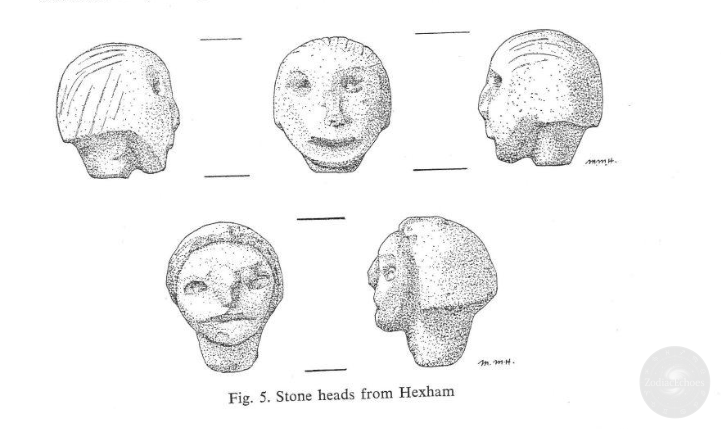
- Two mysterious stone-like heads were discovered by brothers Colin and Leslie Robson in Hexham, England, in 1971.
- After the discovery, witnesses reported unexplained disturbances and sightings of a frightening half-human creature.
- Celtic scholar Anne Ross claimed that similar phenomena followed the objects into her own home.
- A former resident said he had made the heads from artificial stone in 1956, but the original objects later disappeared.
In 1971, two young brothers digging in their garden in northern England uncovered something that would become one of Britain’s strangest supernatural mysteries.
Buried beneath the soil were two small, crudely fashioned heads, each measuring approximately six centimeters in height. Their distorted faces appeared ancient, almost as though they had been carved for a forgotten ritual.
But according to the families who encountered them, the discovery was followed by something far more disturbing than an archaeological puzzle: unexplained movements, frightening apparitions, and a creature resembling a werewolf.
The Strange Discovery in Hexham
Brothers Colin and Leslie Robson discovered the heads in the garden of their family home on Rede Avenue in Hexham, Northumberland. The objects had roughly human features, including eyes, noses, and mouths. Their unusual appearance encouraged speculation that they might be ancient Celtic artifacts.
Hexham lies close to Hadrian’s Wall, in a region rich in Roman remains and older traditions. The possibility of an archaeological discovery attracted considerable attention. However, the heads soon became associated with events that had little to do with conventional archaeology.
Objects That Apparently Moved by Themselves
According to the Robson family’s accounts, the heads sometimes appeared to change position when nobody was watching. Other disturbances reportedly followed. Household objects moved unexpectedly, and bottles were said to have been thrown across rooms. The neighboring Dodd family also reported unusual experiences.
One account described a child whose hair was apparently pulled during the night. Another involved Nellie Dodd, who claimed to have encountered a frightening figure that appeared partly human and partly animal.
The creature was sometimes described as resembling a sheep-like humanoid, although later versions of the legend increasingly emphasized a wolf-like appearance. These were witness reports, not independently verified supernatural events. Nevertheless, they transformed the two small objects into the center of a growing local mystery.
The Terrifying Experiences of Anne Ross
The heads eventually came into the possession of Dr. Anne Ross, a scholar specializing in Celtic culture and archaeology. Ross initially considered whether the objects might have connections to ancient Celtic religious traditions, in which representations of human heads held particular significance.
But she later described frightening experiences inside her own home in Southampton. According to her account, she awoke one night and saw a dark figure moving through her bedroom doorway. It appeared to be part human and part animal.
Her daughter Bernice reportedly encountered a similarly frightening creature on the staircase. She described it leaping over the banisters before disappearing. Ross also reported unexplained sounds, sudden movements of doors, and an oppressive feeling of coldness. She came to suspect that the disturbances were somehow connected to the mysterious heads.
Were the Heads Ancient Celtic Artifacts?
The supernatural stories became even stranger when a former resident of the Robson family’s house came forward. His name was Desmond Craigie, and he claimed that he had manufactured the heads himself in 1956.
Craigie explained that he had worked with artificial stone and had fashioned several small heads to amuse his young daughter. According to his account, the objects were ordinary homemade toys that had eventually been abandoned in the garden. Geological examination subsequently provided support for this explanation.
Analysis indicated that the heads contained artificial cement-like material rather than being carved from an ancient block of stone. Although Ross remained unconvinced that Craigie’s explanation settled every question, the findings seriously weakened the argument that the objects were ancient Celtic relics.
The Final Mystery: Where Did the Heads Go?
During the 1970s, the Hexham Heads passed between researchers and people interested in investigating their origins. The story received national attention when the BBC’s Nationwide programme featured the case in 1976. Yet the strangest development came afterward.
The original heads disappeared from the documented chain of custody around 1978. Their present whereabouts remain unknown. Without the objects, modern researchers cannot repeat the original examinations or investigate their manufacture using contemporary methods.
Conclusion
The Hexham Heads mystery combines a genuine discovery, extraordinary witness testimony, scientific investigation, and the unexplained disappearance of two unusual objects. The evidence suggests that the heads were probably modern creations rather than ancient ritual artifacts. The reported supernatural encounters remain unverified.
But one detail continues to distinguish this story from countless other haunted-object legends: the very objects at the center of the controversy have vanished, leaving behind only photographs, drawings, testimony, and an enduring mystery.
Cosmic Highlights

FAQ
What are the Hexham Heads?
The Hexham Heads were two small human-like objects discovered in a garden in Hexham, Northumberland, in 1971. They became associated with reports of paranormal disturbances.
Were the Hexham Heads genuinely ancient?
Although initially considered possible Celtic artifacts, later material analysis supported the conclusion that they were manufactured using artificial cement-like material.
Did people really see a werewolf?
Several witnesses reported frightening half-human, half-animal apparitions. However, no independent evidence establishes that a supernatural creature was present.
Who was Anne Ross?
Anne Ross was a scholar of Celtic culture who examined the heads and subsequently described unusual experiences that she associated with them.
Where are the original Hexham Heads today?
The original objects disappeared from the documented chain of custody around 1978, and their current location is unknown.