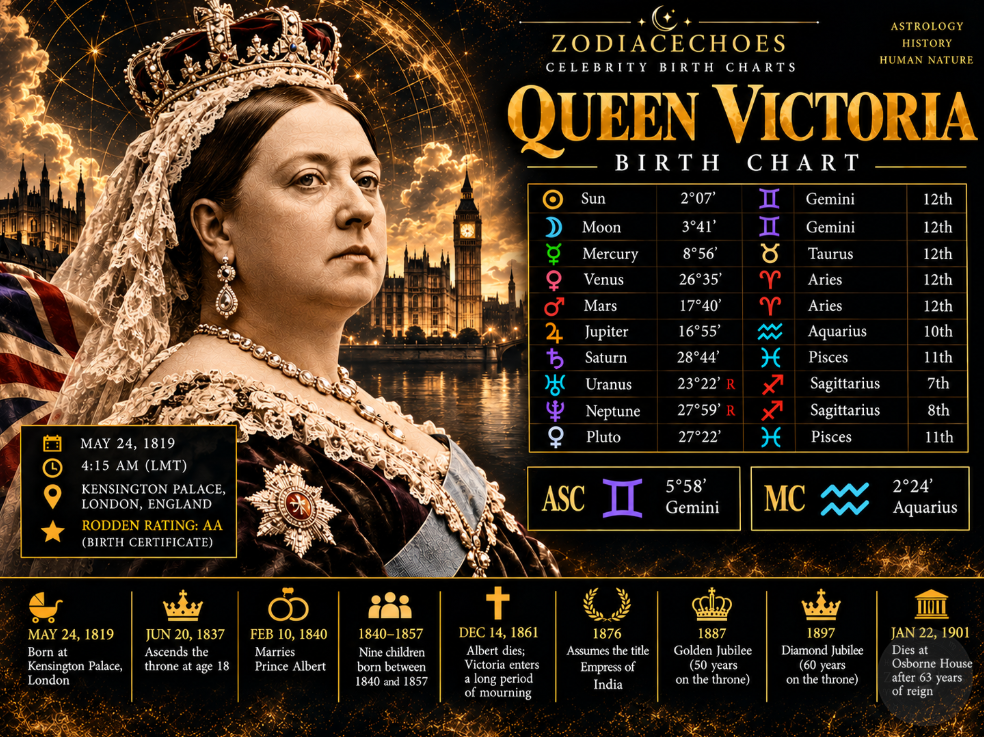
- Queen Victoria was born on May 24, 1819, at 4:15 AM in Kensington Palace, London, with a Rodden Rating of AA.
- Her Sun, Moon, and Ascendant were all in Gemini, creating an unusually strong emphasis on communication, intellectual curiosity, and personal identity.
- Five personal planets occupied her 12th House, traditionally associated with isolation, privacy, sacrifice, and life behind closed doors.
- The Sun and Moon formed a conjunction in Gemini, reflecting the symbolic connection between her private emotional world and public identity.
- Saturn conjunct Pluto in Pisces introduces themes of institutional power, responsibility, control, and profound transformation.
- Jupiter in Aquarius in the 10th House offers an intriguing astrological parallel with her public prominence and the expansion of the British Empire.
- Venus and Mars in Aries provide a contrasting picture of the passionate, independent woman behind the formal royal portraits.
Queen Victoria ruled Britain for more than 63 years, gave her name to an entire historical era, and became one of the most recognizable monarchs in the world. Yet behind the elaborate dresses, royal ceremonies, and carefully constructed public image was a woman whose life was shaped by childhood isolation, passionate love, devastating grief, family conflicts, and an extraordinary sense of duty.
Her reign witnessed the Industrial Revolution, the expansion of the British Empire, technological transformation, and profound social change. But Victoria herself was far more complicated than the stern elderly widow remembered from photographs.
She was an enthusiastic diarist, an affectionate yet demanding mother, a passionate wife, and a monarch who could be both determined and emotionally vulnerable. She enjoyed music, dancing, painting, and the company of people who treated her as a person rather than merely a sovereign.
Her birth chart offers a fascinating symbolic reflection of these contradictions.
Born with the Sun, Moon, and Ascendant in Gemini, Victoria possessed a horoscope strongly associated with communication, curiosity, and adaptability. More surprisingly, five of her personal planets occupied the 12th House, traditionally connected with solitude and private experience.
How could a woman whose life became so publicly significant have such an extraordinary concentration of planets in astrology’s most private house? The answer becomes particularly interesting when we examine her childhood, her relationship with Prince Albert, and the decades she spent balancing royal responsibility with personal loss.
Queen Victoria’s Birth Data and Natal Chart
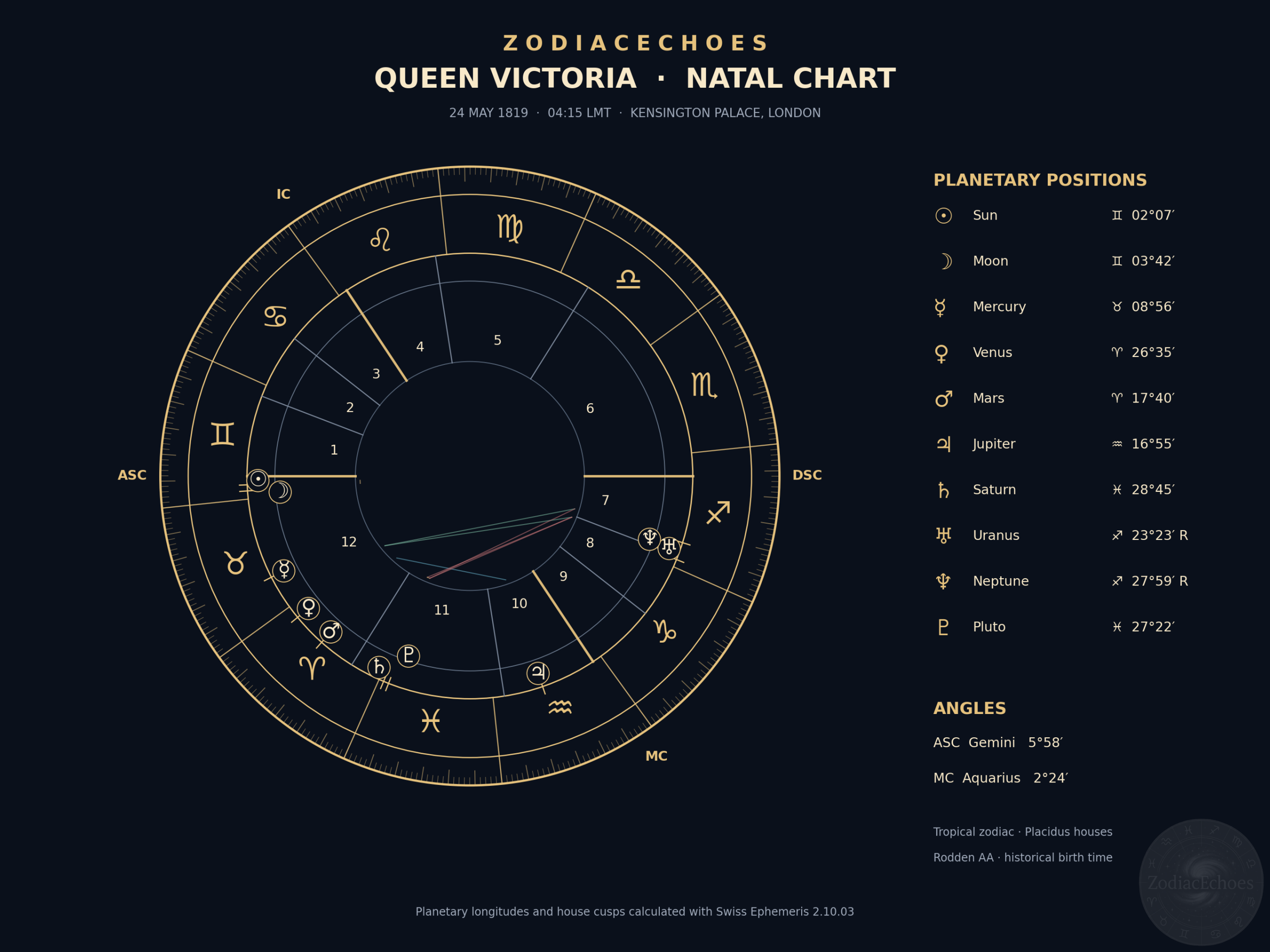
Queen Victoria was born on May 24, 1819, at 4:15 AM, in Kensington Palace, London. Her recorded birth time carries a Rodden Rating of AA, indicating a highly reliable historical source. The following positions use the tropical zodiac and Placidus house system.
| Planet | Zodiac Position | House |
|---|---|---|
| Sun | Gemini 2°07′ | 12th |
| Moon | Gemini 3°42′ | 12th |
| Mercury | Taurus 8°56′ | 12th |
| Venus | Aries 26°35′ | 12th |
| Mars | Aries 17°40′ | 12th |
| Jupiter | Aquarius 16°55′ | 10th |
| Saturn | Pisces 28°44′ | 11th |
| Uranus | Sagittarius 23°22′ R | 7th |
| Neptune | Sagittarius 27°59′ R | 8th |
| Pluto | Pisces 27°22′ | 11th |
Ascendant: Gemini 5°58′
Midheaven (MC): Aquarius 2°24′
Birthplace: Kensington Palace, London, England
Rodden Rating: AA
Gemini Sun: A Curious Mind Behind the Crown
Gemini is ruled by Mercury, the planet traditionally associated with language, learning, communication, and intellectual curiosity. Victoria’s Sun at 2°07′ Gemini provides an interesting starting point because one of her most remarkable personal habits was her lifelong commitment to writing.
She began keeping a journal as a young girl and continued throughout her reign. Her surviving journals and correspondence provide an unusually intimate record of royal life, revealing everything from political discussions to domestic disagreements and personal affection.
Writing was not simply a royal obligation for Victoria. It became a way of recording, understanding, and preserving her experiences.
She was also interested in art, music, languages, and the changing world around her. Her education had been carefully controlled, but once she became queen, she developed relationships with politicians, advisers, artists, and intellectual figures who broadened her understanding of public affairs.
The Gemini symbolism becomes especially relevant when considering how Victoria communicated with her ministers. Although Britain was a constitutional monarchy, she took a serious interest in political correspondence and frequently expressed strong opinions about government decisions.
Her relationship with Prime Minister Benjamin Disraeli, for example, was characterized by mutual appreciation and an understanding of how personal communication could influence royal politics.
Yet Victoria’s Sun was located in the 12th House, introducing a very different theme: the tension between public responsibility and a private inner world. This combination becomes especially meaningful when we examine her childhood.
The 12th House: A Princess Raised in Isolation
Victoria’s birth chart contains one of its most striking features in the 12th House, occupied by the Sun, Moon, Mercury, Venus, and Mars. Traditionally, this house is associated with seclusion, restrictions, hidden experiences, and circumstances that limit personal freedom.
For Victoria, the connection with her early life is particularly compelling. After the death of her father in 1820, she was raised at Kensington Palace under the supervision of her mother, the Duchess of Kent, and the influential household official John Conroy. Their strict upbringing arrangement became known as the Kensington System.
Victoria’s daily activities were closely supervised. She was rarely permitted to be alone, had limited contact with the wider royal court, and lived under rules intended to control her upbringing and future political influence.
The future ruler of a global empire spent much of her childhood without the freedom to make ordinary personal decisions. She later expressed deep resentment toward Conroy and the restrictions imposed on her.
The symbolism of five planets in the 12th House creates an extraordinary contrast: a young woman destined for immense public visibility whose earliest experiences were defined by privacy, surveillance, and confinement.
When King William IV died on June 20, 1837, Victoria became queen at just eighteen. One of her first priorities was establishing her independence from the household arrangements that had governed her childhood. The young queen finally had authority over her own life.
Gemini Moon: The Emotional World of a Young Queen
Victoria’s Moon at 3°42′ Gemini formed a close conjunction with her Sun, with an orb of approximately 1°35′. In astrology, the Moon represents emotional needs, instinctive responses, and personal security. Gemini introduces themes of communication, mental activity, and the need to understand experiences through words.
Victoria’s diaries reveal a woman who frequently expressed intense feelings, whether excitement, frustration, affection, jealousy, or sorrow. Her emotional life was not as restrained as the familiar image of the Victorian monarchy might suggest. She could be enthusiastic, impatient, affectionate, stubborn, and deeply attached to the people closest to her.
The Sun–Moon conjunction symbolically suggests a close relationship between identity and emotional experience. In Victoria’s case, being queen was never entirely separate from being a daughter, wife, mother, or widow. Her private feelings repeatedly influenced how she approached public responsibilities.
The Moon’s placement in the 12th House adds another dimension. Although Victoria recorded her feelings extensively, much of her emotional world remained inaccessible to the public. The woman behind the crown was considerably more expressive than the official royal image allowed people to see.
Gemini Rising: A Young Woman Who Changed the Monarchy
With an Ascendant at 5°58′ Gemini, Victoria’s chart contains a remarkable concentration of Gemini energy. The Ascendant traditionally describes the manner in which a person approaches the world and presents themselves to others.
When Victoria became queen, Britain was emerging from a period in which the monarchy had suffered considerable reputational difficulties. Her youth, enthusiasm, and determination helped establish a different public image.
At her first Privy Council meeting, the eighteen-year-old monarch impressed experienced statesmen with her composure. The transition from a closely supervised princess to an independent sovereign happened almost overnight. nHer Gemini Ascendant offers a symbolic connection to this adaptability.
Over the following decades, Victoria’s public identity continued to evolve. She was first celebrated as a young queen, then as a wife and mother, later as a grieving widow, and eventually as the elderly monarch associated with Britain’s imperial power.
Few historical figures underwent such dramatic changes in public perception while remaining continuously in the same position of authority.
Venus in Aries: The Passionate Marriage to Prince Albert
Victoria’s Venus at 26°35′ Aries provides a striking contrast to the conventional image of Victorian emotional restraint. Venus represents love, attraction, affection, and personal values. Aries is traditionally associated with directness, passion, independence, and initiative.
Victoria’s relationship with Prince Albert of Saxe-Coburg and Gotha illustrates these themes particularly well. Although their families encouraged the match, Victoria developed genuine romantic feelings for Albert. When they met again in 1839, she became convinced that she wanted to marry him.
Because she was the reigning monarch, Victoria herself proposed marriage on October 15, 1839. They married on February 10, 1840. Her journals describe their relationship with remarkable emotional intensity. She admired Albert’s appearance, intelligence, and companionship, and their marriage became central to her personal life.
Yet their relationship was not free from conflict. Victoria initially guarded her royal authority, while Albert sought a more substantial role in political and domestic affairs. Their disagreements sometimes reflected the unusual circumstances of a marriage in which the wife possessed the sovereign authority.
Venus in Aries symbolizes a woman who could love passionately without surrendering her strong personal will. The placement also connects naturally with her decision to pursue the relationship actively rather than simply accept a marriage arranged by others.
Mars in Aries: Determination Beneath Royal Etiquette
Mars occupied 17°40′ Aries, a sign it traditionally rules.This placement is associated with initiative, courage, assertiveness, and a willingness to confront opposition. Victoria’s early reign provides several examples of her determination.
She resisted attempts to control her household, defended her preferences, and frequently expressed strong opinions about political and personal matters. Her relationship with Lord Melbourne, her first prime minister, was especially influential. He helped guide the inexperienced queen through the early challenges of constitutional government.
But Victoria did not remain a passive observer. As her reign progressed, she developed firm political preferences and could be remarkably persistent when she disagreed with her ministers.
Mars in the 12th House adds a symbolic tension between assertiveness and restriction. Victoria’s authority was substantial, but it operated within a constitutional system that increasingly limited the monarch’s direct political power.
She could influence, advise, question, and sometimes resist, but she could not govern Britain as an absolute sovereign. This distinction is important to understanding her historical position.
Mercury in Taurus: The Queen Who Remembered Everything
Victoria’s Mercury at 8°56′ Taurus introduces a more deliberate quality into a chart otherwise dominated by Gemini and Aries. Mercury governs communication and thought, while Taurus is associated with persistence, consistency, and the preservation of what is valued.
Victoria’s extensive correspondence and journals demonstrate a remarkable commitment to maintaining personal and historical records. She recorded family events, political discussions, travels, and emotional experiences across decades.
Her written record became one of the most valuable historical sources for understanding nineteenth-century British royalty. Her attachment to memory became even more pronounced following Albert’s death.
She preserved objects associated with him, maintained commemorative practices, and continued to treat his memory as a central part of royal family life. Mercury in Taurus offers a symbolic connection between communication and permanence: the desire not merely to experience events, but to preserve them.
Saturn Conjunct Pluto: The Weight of Institutional Power
One of the chart’s most significant configurations is Saturn at 28°44′ Pisces conjunct Pluto at 27°22′ Pisces, with an orb of approximately 1°22′. Saturn represents structure, authority, duty, and limitations. Pluto is associated in modern astrology with power, transformation, and institutional change.
Both planets occupied Victoria’s 11th House, traditionally linked with social groups, collective structures, and long-term aspirations. Her reign coincided with profound changes in Britain’s political and economic institutions.
Industrialization transformed cities, employment, transportation, and communication. Parliamentary reforms gradually expanded political participation, although voting rights remained unequal and restricted for much of the period.
Meanwhile, Britain’s global imperial power expanded dramatically. The Saturn–Pluto conjunction symbolically brings together established authority and far-reaching transformation.
Victoria became a figure of continuity during an era when the society around her was changing at extraordinary speed. However, her reign also coincided with imperial conquest, colonial exploitation, racial inequality, and resistance to British rule. The symbolism of institutional power must therefore be considered alongside the real human consequences of empire.
Jupiter in Aquarius: The Monarch Who Became a Global Symbol
Victoria’s Jupiter at 16°55′ Aquarius in the 10th House is especially relevant to her public identity. Jupiter traditionally represents expansion, influence, and the growth of institutions. The 10th House is associated with career, reputation, and public standing.
Aquarius introduces themes of society, collective organization, technological progress, and large-scale change. During Victoria’s reign, Britain experienced enormous industrial and technological development. Railways expanded, telegraph networks transformed communication, and manufacturing reshaped economic life.
The Great Exhibition of 1851, strongly supported by Prince Albert, became an international showcase for industrial achievement and innovation. Jupiter in Aquarius in the 10th House offers a striking symbolic parallel with a monarch whose public identity became inseparable from an age of technological expansion.
Her imperial status also increased. In 1876, Victoria formally received the title Empress of India, with its imperial proclamation celebrated in India in 1877.
The title reinforced the monarchy’s connection to British colonial rule. It represented prestige and authority for the imperial establishment, but also a political system in which millions of colonized people lacked equal rights and self-government.
Jupiter’s symbolism of expansion provides an interesting interpretive theme, but the historical expansion of empire resulted from political, military, and economic forces rather than planetary influence.
Uranus in Sagittarius: Unconventional Relationships and Personal Loyalty
Victoria’s Uranus at 23°22′ Sagittarius, retrograde in the 7th House, introduces the symbolism of unconventional relationships and unexpected changes in personal alliances. The 7th House traditionally governs marriage, partnerships, and important one-to-one relationships.
After Albert’s death, Victoria developed a close friendship with her Scottish servant John Brown. Brown became an important source of companionship and support during her prolonged mourning.
Their relationship attracted gossip and criticism, partly because of the social distance between a reigning monarch and a household servant. Later, Victoria formed another important attachment to Abdul Karim, an Indian attendant who became her teacher and confidant.
She promoted Karim within her household and defended him despite hostility from courtiers and members of her family. Uranus in the 7th House symbolically reflects relationships that challenge established expectations and social conventions. Both friendships reveal a side of Victoria that could resist the rigid hierarchies surrounding her when personal loyalty was involved.
Neptune in Sagittarius: Idealism, Empire, and Contradiction
Neptune occupied 27°59′ Sagittarius, retrograde in Victoria’s 8th House. In modern astrology, Neptune represents idealization, imagination, spiritual aspirations, and the tension between perception and reality. Sagittarius is associated with philosophy, belief systems, distant cultures, and expansive worldviews.
Victoria lived during an era when British imperial ideology frequently presented colonial expansion as a civilizing mission. Such narratives often concealed the violence, economic exploitation, and political domination experienced by colonized populations.
Neptune in Sagittarius provides a symbolic framework for examining the distance between imperial ideals and historical realities. Victoria’s own relationship with India was complex. She never visited the country, yet developed a personal interest in Indian culture and language, particularly through her relationship with Abdul Karim.
Her private curiosity and personal loyalties did not erase the unequal political structure of the empire over which she reigned. This contradiction is central to understanding Victoria as both a historical individual and a symbol of imperial power.
Prince Albert’s Death: The 12th House Becomes Impossible to Ignore
On December 14, 1861, Prince Albert died at Windsor Castle, aged forty-two. His death transformed Victoria’s life. She lost not only her husband but also her closest adviser and emotional companion.
For years afterward, Victoria withdrew from many public appearances and increasingly preferred the privacy of Windsor, Balmoral, and Osborne. She continued to perform important constitutional duties, including correspondence with ministers, but her reduced public presence attracted criticism.
The woman who had once embraced her royal position with youthful enthusiasm became increasingly associated with absence, mourning, and seclusion. Here, the symbolism of her heavily occupied 12th House becomes particularly striking.
The same house traditionally connected with childhood restrictions and private emotional experience now offers a symbolic connection to her prolonged withdrawal from public life. Victoria wore mourning clothes for the remainder of her life and preserved Albert’s memory through monuments, rituals, and personal possessions.
Yet her story did not end in isolation. Gradually, she returned to greater public visibility, culminating in the grand celebrations of her Golden Jubilee in 1887 and Diamond Jubilee in 1897.
The Sun Trine Midheaven: A Life That Became an Era
Victoria’s Sun at 2°07′ Gemini formed an exceptionally close trine to her Midheaven at 2°24′ Aquarius, with an orb of approximately 0°17′. In astrology, the Midheaven represents public identity, achievement, and one’s place in the wider world.
A close Sun–MC trine is traditionally interpreted as a harmonious connection between personal identity and public purpose. For Victoria, the historical parallel is unmistakable. Her name became the name of an age.
The Victorian era remains associated with industrialization, scientific progress, changing social values, imperial expansion, and the transformation of Britain into a modern industrial society.
Victoria did not personally direct every development of her reign. Britain was governed through Parliament and its ministers, while technological and social changes arose from countless individuals and institutions.
Nevertheless, she became the enduring public symbol of those transformations. Her Sun–Midheaven trine offers a particularly compelling astrological image of a life whose public significance extended far beyond the individual.
Conclusion
Queen Victoria’s birth chart reveals an extraordinary contrast between public power and private emotional experience.
Her Gemini Sun, Moon, and Ascendant symbolize curiosity, communication, and an evolving personal identity. Five planets in the 12th House introduce themes of restriction, isolation, and a rich private life, while Venus and Mars in Aries reflect the passionate and determined woman behind the formal royal image.
The Saturn–Pluto conjunction offers a symbolic connection to institutional authority and historical transformation, while Jupiter in the 10th House and the close Sun–Midheaven trine resonate with her remarkable public legacy.
But Victoria’s historical significance cannot be reduced to planetary placements. She was a woman shaped by her upbringing, relationships, responsibilities, political environment, and personal choices.
The most fascinating aspect of her story may be that a monarch who became the face of an entire century spent so much of her life struggling to protect, recover, or preserve her private world.
Cosmic Highlights

Frequently Asked Questions
What was Queen Victoria’s zodiac sign?
Queen Victoria was a Gemini, born on May 24, 1819. Her Sun was positioned at approximately 2°07′ Gemini in the tropical zodiac.
What was Queen Victoria’s Moon sign?
Her Moon was also in Gemini, at approximately 3°42′. It formed a close conjunction with her Sun.
What was Queen Victoria’s Rising sign?
Queen Victoria had Gemini Rising, with her Ascendant at approximately 5°58′ Gemini.
What was Queen Victoria’s birth time?
She was born at 4:15 AM on May 24, 1819, at Kensington Palace in London. Her birth data carries a Rodden Rating AA.
Why is Queen Victoria’s 12th House significant?
Her Sun, Moon, Mercury, Venus, and Mars were all located in the 12th House. In astrology, this house is associated with privacy, isolation, and hidden experiences, themes that can be symbolically connected to her restricted childhood and later withdrawal from public life.
What was Queen Victoria’s most significant planetary conjunction?
Two important conjunctions were Sun conjunct Moon in Gemini, with an orb of approximately 1°35′, and Saturn conjunct Pluto in Pisces, with an orb of approximately 1°22′.
What was Queen Victoria’s Midheaven sign?
Her Midheaven was at approximately 2°24′ Aquarius, forming a very close trine to her Gemini Sun.
Did Queen Victoria have retrograde planets?
Yes. Uranus and Neptune were retrograde at the time of her birth.
Historical and Astrological Sources
- Astrodienst – Queen Victoria Natal Chart – planetary positions, birth time, Ascendant, and house placements.
- Historic Royal Palaces – Queen Victoria – childhood, Kensington System, marriage, mourning, and imperial history.
- The Royal Family – Queen Victoria – reign, family, political role, and personal life.
- Royal Collection Trust – Queen Victoria – historical portraits, documents, and royal collections.
- The Royal Family – Victoria and Albert Timeline – major events and extracts from Victoria’s journals.
- Oxford Dictionary of National Biography – Victoria – scholarly historical biography.
- English Heritage – Queen Victoria – marriage, widowhood, public reputation, and later reign.