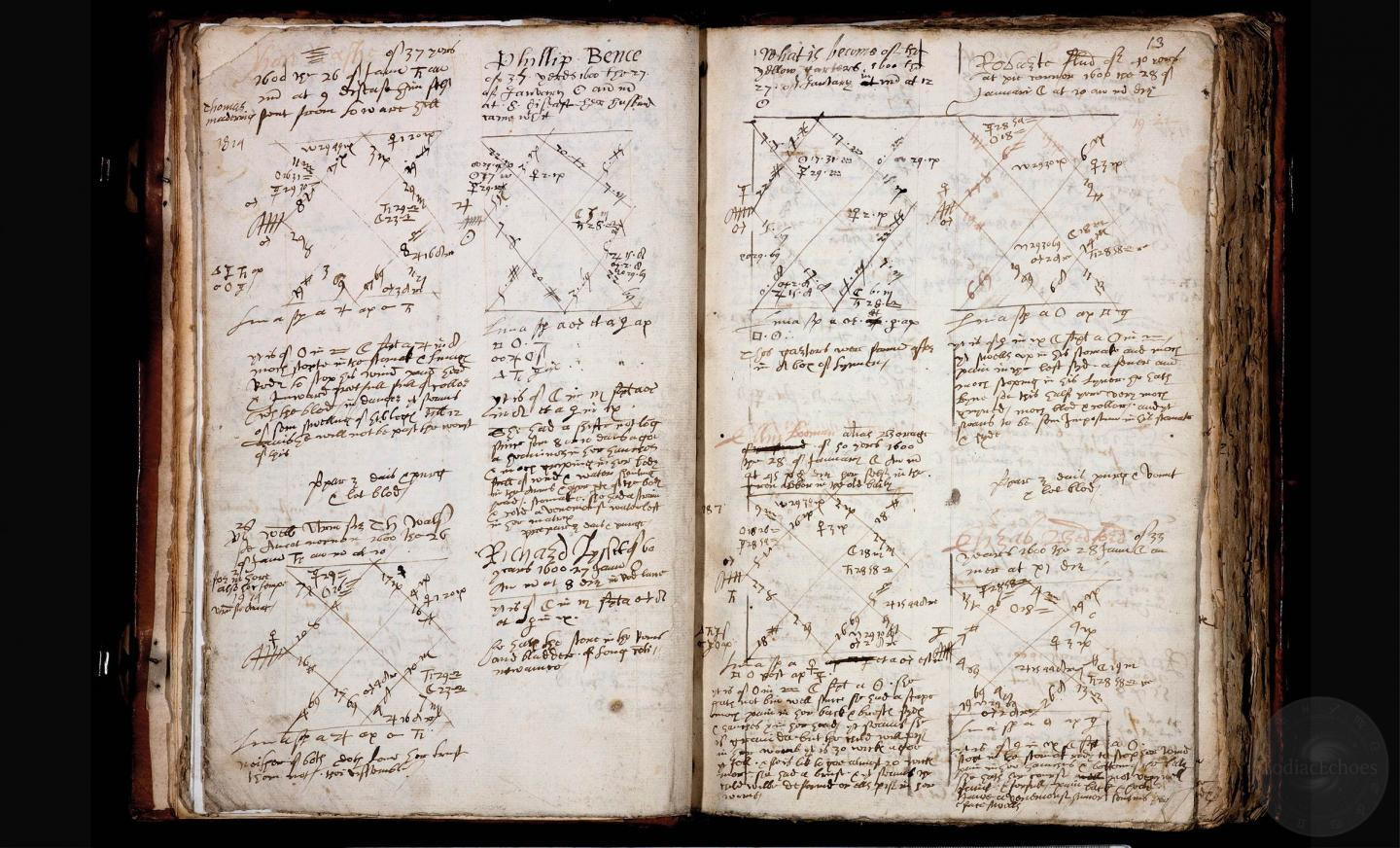
- Simon Forman recorded more than 10,000 astrological consultations in Elizabethan England between 1596 and 1603.
- His clients sought answers about death, witchcraft, missing possessions, suspicious illnesses, and secret enemies.
- Forman and his successor Richard Napier used horary astrology, casting charts for the precise moment a question was asked.
- Their surviving records contain approximately 80,000 consultations, including chilling accounts of alleged curses, spirits, and unexplained deaths.
Imagine entering a dimly lit room in Elizabethan London, where an astrologer sits surrounded by manuscripts, planetary tables, and strange symbols. You have come with a question that nobody else can answer: Is someone trying to kill you? Has your family been cursed? Will a missing person ever return?
For thousands of people in late sixteenth-century England, such questions were not merely hypothetical. They were brought to Simon Forman, one of London’s most notorious astrologers, whose surviving notebooks reveal an extraordinary world of fear, suspicion, and supernatural belief.
More than four centuries later, his records offer something almost as remarkable as the mysteries themselves: a written archive of the secrets ordinary people once entrusted to the stars.
The Astrologer Who Knew Everyone’s Secrets
Born in 1552, Simon Forman became a prominent astrologer and medical practitioner in Elizabethan London. His methods attracted wealthy patrons, desperate families, and the hostility of the city’s established physicians.
Forman claimed that planetary configurations could reveal hidden influences affecting human affairs. His clients asked about illness, marriage, betrayal, missing valuables, and suspected witchcraft.
Between 1596 and 1603 alone, he recorded more than 10,000 consultations, preserving names, personal circumstances, questions, and astrological diagrams. His notebooks were not simply collections of predictions. They were intimate records of anxieties that people rarely discussed openly.
How the Stars Were Used to Investigate Secrets
Forman practiced horary astrology, a technique that interprets the positions of celestial bodies at the moment a question is asked. Unlike natal astrology, which begins with a person’s birth, horary astrology creates a chart for a particular question. The astrologer examined the twelve houses, planetary rulers, and relationships between planets to reach a judgment.
The eighth house was traditionally associated with death, the twelfth with hidden enemies, and the seventh could represent an adversary or another person involved in a dispute.
In this system, a question about a stolen object, a suspected witch, or an absent relative could become an elaborate investigation of celestial symbolism. To Forman’s clients, the resulting horoscope might reveal what ordinary witnesses could not.
The Woman Who Feared She Had Been Cursed
One particularly disturbing consultation survives from April 18, 1603. Seventeen-year-old Lettice Ball of Nash sought help because she feared that an evil influence had power over her. She was unable to sleep, appeared confused, and sometimes spoke incoherently.
The astrologer’s record contains a devastating final detail: she died that same day. The manuscript does not establish what caused her death, and there is no evidence that supernatural forces were involved. Yet the entry reveals the terrifying uncertainty surrounding illness in an age when medical knowledge, astrology, and beliefs about curses frequently overlapped.
When a Suspected Witch Was Sent to Prison
The surviving records of Forman’s successor, Richard Napier, contain equally disturbing accounts. On June 7, 1619, a consultation concerned a 25-year-old woman identified as Mistress Audley of Sandy. She had recently given birth and was suffering frightening episodes that affected her senses and behavior. People around her suspected witchcraft.
According to the casebook, her hair and nail clippings were burned in an attempt to identify the supposed witch. Mistress Audley died two days later. The record also states that the woman suspected of witchcraft was subsequently imprisoned in Bedford.
What makes the case so unsettling is not evidence of a curse, but the consequences of believing one existed. Fear could transform an unexplained illness into an accusation capable of destroying another person’s life.
The Astrologer Who Predicted His Own Death
Forman’s reputation acquired another strange dimension in September 1611. According to an account preserved in his biographical tradition, he predicted his own sudden death shortly before it occurred.
He died that month, leaving behind thousands of pages of astrological writings and personal observations.
The precise circumstances of the alleged prediction remain difficult to verify independently. Nevertheless, the story became part of Forman’s enduring reputation as a man who believed the heavens could reveal even his own fate.
After his death, his papers passed to Richard Napier, helping preserve the remarkable collection for later generations.
Conclusion
Today, the University of Cambridge’s Casebooks Project has made these extraordinary records accessible to researchers and the public. Approximately 80,000 consultations involving more than 60,000 people survive across the combined archive of Forman, Napier, and their associates.
The manuscripts do not prove that astrology uncovered supernatural secrets. They reveal something equally fascinating: how deeply people once believed that the positions of the planets could expose hidden enemies, explain death, and reveal the unseen forces shaping their lives.
And perhaps the greatest mystery is how many forgotten human stories remain concealed within those thousands of handwritten pages.
Cosmic Highlights
FAQ
Who was Simon Forman?
Simon Forman (1552–1611) was an English astrologer and medical practitioner who became famous for using astrology to investigate illnesses, relationships, suspected witchcraft, and personal mysteries.
What are the Simon Forman Casebooks?
They are surviving records of astrological consultations, preserved alongside those of Richard Napier and their associates. The combined archive contains approximately 80,000 consultations.
Did Simon Forman use horary astrology?
Yes. Forman regularly cast horary charts based on the moment a client asked a question, interpreting planetary positions and astrological houses to produce a judgment.
Did Simon Forman predict his own death?
Historical accounts associate Forman with a prediction of his sudden death in September 1611. He did die that month, although the precise details of the alleged prediction are not independently established.
Where can the original astrological manuscripts be viewed?
The manuscripts are preserved primarily in the Bodleian Library at Oxford. The University of Cambridge’s Casebooks Project provides a searchable digital edition with access to manuscript images.