Few names represent artistic genius as completely as Wolfgang Amadeus Mozart. More than two centuries after his death, his music continues to fill concert halls, inspire filmmakers, and influence composers around the world.
His extraordinary ability emerged almost unbelievably early. Before most children learned to read fluently, Mozart was already performing before European royalty and composing works that astonished experienced musicians.
Yet behind the image of effortless brilliance stood a remarkably complex individual. Mozart was witty, rebellious, emotionally expressive, endlessly curious, and often unwilling to conform to expectations.
His career was marked by spectacular artistic achievements, but also by financial difficulties, conflicts with authority, and a constant search for creative freedom. The Wolfgang Amadeus Mozart Birth Chart offers a fascinating symbolic perspective on one of history’s greatest composers.
While astrology cannot explain genius, it can highlight recurring personality themes that appear remarkably often throughout Mozart’s extraordinary life.
Why Mozart Still Fascinates the World
Born in Salzburg on 27 January 1756, Wolfgang Amadeus Mozart displayed astonishing musical talent almost from infancy. His father, Leopold Mozart, himself an accomplished musician and teacher, quickly recognized his son’s exceptional abilities.
By the age of five, Wolfgang was already composing simple pieces, and within only a few years he was touring Europe alongside his sister Maria Anna, performing before kings, emperors, and aristocrats.
Throughout his childhood, Mozart experienced cultures, languages, and musical traditions that few people of his era would ever encounter. These journeys shaped both his personality and his musical imagination, exposing him to Italian opera, German church music, French elegance, and countless regional styles that later blended into his own unmistakable voice.
As an adult, Mozart rejected the traditional role of a court musician. Instead of remaining permanently employed by a royal household, he attempted something remarkably modern: building an independent career based on commissions, concerts, teaching, and publishing.
This decision gave him unprecedented artistic freedom but also exposed him to financial uncertainty throughout much of his life. Despite periods of debt and personal struggle, Mozart’s productivity never slowed.
During only thirty-five years, he composed more than six hundred works, including symphonies, operas, piano concertos, chamber music, sacred compositions, and some of the most influential masterpieces in Western music. Operas such as The Marriage of Figaro, Don Giovanni, and The Magic Flute remain central to the classical repertoire today.
His death in December 1791, while still working on the unfinished Requiem, created one of music history’s greatest legends. Stories surrounding his final months, mysterious commissions, and rumors of poisoning have fascinated historians for generations, even though many popular myths have since been challenged by modern scholarship.
More than two hundred years later, Mozart continues to symbolize creative brilliance itself. His music feels timeless, his personality remains endlessly intriguing, and his life still raises one of history’s most fascinating questions: how could one individual accomplish so much in such a short lifetime?
Birth Data
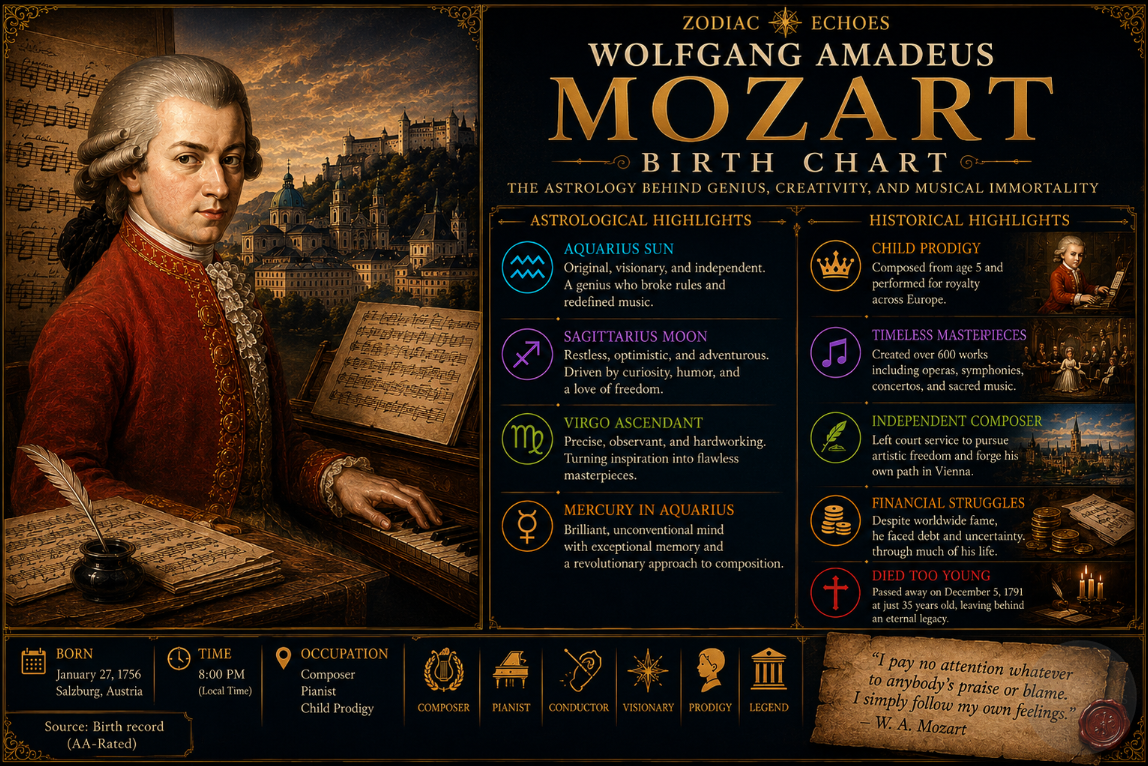
- Birth Date: January 27, 1756
- Birth Time: 8:00 PM (AA-rated historical record)
- Birth Place: Salzburg, Archbishopric of Salzburg (present-day Austria)
- Sun: Aquarius
- Moon: Sagittarius
- Ascendant: Virgo
Unlike many historical figures, Mozart’s birth time is exceptionally well documented through historical records. This allows astrologers to interpret not only his Sun and Moon signs but also his Ascendant and house placements with a high degree of confidence.
Aquarius Sun: A Mind That Refused to Follow Tradition
At the heart of Mozart’s birth chart stands an Aquarius Sun, a placement frequently associated with originality, intellectual independence, and the desire to challenge convention. While Aquarius is often described as innovative today, in the eighteenth century this symbolism appeared in a far more remarkable way.
Mozart respected the great composers who came before him, but he rarely accepted that tradition should limit creativity. Throughout his career he absorbed existing musical styles before transforming them into something unmistakably his own.
His operas combined humor with psychological depth, his symphonies expanded emotional expression, and his piano concertos elevated the relationship between soloist and orchestra to an entirely new level. His independent spirit extended beyond music.
Rather than remaining comfortably employed at the Salzburg court under Archbishop Colloredo, Mozart chose the uncertain path of a freelance composer in Vienna. This decision shocked many contemporaries, as stable court positions were considered the safest route for professional musicians.
Aquarius is also associated with friendship, ideas, and intellectual freedom. Mozart surrounded himself with artists, philosophers, performers, and members of Vienna’s cultural elite. He was fascinated by Enlightenment thinking and eventually joined the Freemasons, whose emphasis on reason, equality, and human progress reflected many values often connected symbolically with Aquarius.
His Sun placement suggests a man driven less by status than by creative independence. Looking at Mozart’s life, that symbolism appears repeatedly. He did not simply write beautiful music—he redefined what classical music could become.
Sagittarius Moon: Endless Curiosity and Joy
Mozart’s Moon in Sagittarius introduces a completely different layer to his personality. While Aquarius supplied originality, Sagittarius brought optimism, curiosity, humor, and an almost childlike enthusiasm for discovering new experiences. From an early age, Mozart spent years traveling across Europe.
Few children of his era experienced such an extraordinary education. Performing in Munich, Paris, London, Vienna, Milan, and countless other cities exposed him to different cultures, musical traditions, languages, and audiences. These journeys did far more than develop his technical skills—they shaped his worldview.
The Moon governs emotional needs and instinctive reactions. Sagittarius often seeks freedom rather than routine, exploration rather than security. Mozart’s letters reveal a man full of jokes, playful language, practical humor, and infectious energy. Even during difficult periods, he rarely lost his curiosity or enthusiasm for new musical ideas.
This placement also reflects his refusal to remain artistically confined. Mozart composed operas, symphonies, chamber music, sacred works, concertos, dances, and piano sonatas with remarkable ease. Rather than mastering only one style, he constantly explored new forms of expression.
Emotionally, Sagittarius prefers possibility over limitation. That outlook may partly explain why Mozart repeatedly accepted financial risks in pursuit of artistic freedom. Security mattered less to him than the opportunity to create without restrictions.
Virgo Rising: Precision Behind the Genius
If Aquarius provided vision and Sagittarius supplied imagination, Virgo Rising reveals the extraordinary discipline that transformed inspiration into masterpieces. Publicly, Mozart often appeared energetic, witty, and spontaneous. Yet behind every effortless performance stood years of meticulous practice and astonishing technical precision.
His surviving manuscripts demonstrate an almost unbelievable command of harmony, orchestration, and musical structure. Virgo is frequently associated with craftsmanship, refinement, and attention to detail. Mozart’s compositions rarely relied on complexity for its own sake. Instead, every phrase feels purposeful, balanced, and remarkably clear.
Even his most joyful works display extraordinary architectural precision beneath their apparent simplicity. Virgo Rising may also explain Mozart’s reputation as an obsessive perfectionist. He constantly revised scores, refined melodies, and sought greater clarity in musical expression.
His genius was not simply inspiration—it was the ability to shape ideas into works of lasting perfection. This placement creates an interesting contrast with his personal life. While his finances often appeared chaotic, his music reveals almost unparalleled order.
That difference reminds us that astrology reflects personality tendencies rather than every practical outcome. In Mozart’s case, Virgo Rising symbolizes the craftsman behind the legend—the disciplined artist capable of transforming imagination into timeless masterpieces.
Mercury in Aquarius: The Mind of a Revolutionary Composer
Mercury governs thought, communication, learning, and intellectual processes. In Aquarius, it often produces unconventional thinking and an ability to recognize possibilities others overlook. Mozart seemed to hear music differently from almost everyone around him.
Contemporary accounts describe his remarkable musical memory and his ability to compose entire works mentally before writing them down. Whether these stories have been slightly romanticized or not, there is little doubt that his intellectual approach to composition was exceptional.
Mercury in Aquarius thrives on experimentation. Mozart continuously explored new harmonic ideas, unexpected orchestral colors, and dramatic contrasts that expanded the emotional possibilities of classical music. His operas gave each character a unique musical personality, while his instrumental works blended technical brilliance with emotional accessibility.
This placement also reflects extraordinary speed of learning. Mozart absorbed influences from every composer he encountered, yet his mature works never feel derivative. Instead, they demonstrate an ability to synthesize diverse traditions into something completely original.
His letters reveal another side of Mercury in Aquarius: intelligence mixed with humor. Mozart could be surprisingly playful, sarcastic, and even irreverent. This combination of brilliance and wit made him as memorable in conversation as he was at the keyboard.
For many astrologers, Mercury represents the signature of a person’s mind. In Mozart’s chart, it symbolically reflects one of history’s most extraordinary creative intellects.
The Child Prodigy Who Changed Music Forever
Mozart’s extraordinary childhood remains one of the greatest stories in the history of music. Before reaching his teenage years, he had already achieved a level of fame that most composers never experienced during an entire lifetime.
Beginning at the age of six, Mozart traveled thousands of miles across Europe with his father Leopold and his sister Maria Anna, performing before kings, queens, emperors, and aristocrats. These tours were physically exhausting and often lasted for months, yet they provided the young composer with an education unlike any other.
He absorbed Italian opera, German sacred music, French elegance, and countless regional traditions that later became part of his own musical language. Astrologically, the combination of Aquarius Sun, Sagittarius Moon, and Virgo Ascendant creates a fascinating balance between originality, curiosity, and technical precision.
Aquarius constantly searches for new ideas. Sagittarius embraces exploration and learning through experience. Virgo patiently refines raw talent into exceptional craftsmanship. That combination helps explain why Mozart’s genius never remained static. He did not simply display remarkable ability as a child—he continued evolving throughout his life.
Every major period introduced new ideas, greater emotional depth, and increasing compositional sophistication. History remembers him as a prodigy, but his greatest achievement was becoming far more than one. He transformed childhood brilliance into artistic maturity, something very few gifted children ever accomplish.
Why Mozart’s Music Still Feels Modern
Many composers were celebrated during the eighteenth century. Few continue to feel as fresh today as Mozart. Part of that timelessness comes from his extraordinary understanding of human emotion. His music can move effortlessly between joy and sorrow, comedy and tragedy, intimacy and grandeur, often within a single composition.
Rather than writing only for courts or churches, Mozart composed music that continues to resonate with audiences regardless of culture or generation. This emotional flexibility reflects the symbolic relationship between his Aquarius Sun and Sagittarius Moon.
Aquarius contributes originality and intellectual imagination, while Sagittarius adds warmth, optimism, humor, and an enduring sense of adventure. Together they create works that are technically brilliant without ever feeling emotionally distant.
His operas demonstrate this particularly well. Characters such as Figaro, Don Giovanni, and Papageno are not simply musical roles—they are psychologically believable individuals whose hopes, fears, weaknesses, and humor remain instantly recognizable today.
Mozart also understood balance. Even the most complex orchestral passages maintain remarkable clarity, allowing listeners to appreciate both technical sophistication and emotional beauty simultaneously.
This ability to unite structure with feeling is one reason his compositions continue to inspire performers, filmmakers, educators, and composers more than two centuries after his death. Perhaps that is Mozart’s greatest legacy. He did not simply compose for his own era. He created music capable of speaking to every generation that followed.
What Astrology Cannot Explain
Although Mozart’s birth chart reveals fascinating symbolic themes, astrology cannot explain genius. No planetary placement automatically creates extraordinary intelligence, artistic brilliance, or lasting historical influence. Thousands of people share similar natal placements without becoming revolutionary composers.
Talent develops through a combination of natural ability, education, opportunity, discipline, environment, and personal determination. Mozart benefited from exceptional musical education provided by his father, extensive travel throughout Europe, exposure to diverse artistic traditions, and an almost unimaginable work ethic.
Those historical realities remain far more important than any astrological symbolism. Astrology is best understood as a language of recurring personality patterns rather than a system capable of predicting greatness.
In Mozart’s case, his birth chart reflects themes of originality, curiosity, craftsmanship, and creative independence. The music itself, however, remains the result of a lifetime devoted to artistic excellence.

Conclusion
More than two centuries after his death, Wolfgang Amadeus Mozart continues to represent the very definition of musical genius. His extraordinary life demonstrates how creativity, discipline, curiosity, and relentless dedication can transform natural talent into timeless achievement.
His birth chart symbolically reflects many of the qualities historians have long associated with his personality: intellectual independence, emotional enthusiasm, remarkable precision, and an endless desire to explore new creative possibilities. While astrology cannot explain genius, it offers another perspective through which we can appreciate one of history’s most influential composers.
The Wolfgang Amadeus Mozart Birth Chart is ultimately more than an astrological interpretation. It is a reminder that behind every masterpiece stands a unique individual whose personality, experiences, and choices shaped the legacy the world continues to celebrate.
Every legendary composer has a unique astrological blueprint—and so do you. Create your free Natal Chart and discover the planetary placements that shape your own personality, talents, and life journey.
Cosmic Highlights
FAQ
When was Wolfgang Amadeus Mozart born?
Wolfgang Amadeus Mozart was born on 27 January 1756 at 8:00 PM in Salzburg, Austria. His birth time is well documented through historical records, allowing astrologers to calculate a reliable natal chart.
What zodiac sign was Mozart?
Mozart was born under the sign of Aquarius. His chart also includes a Sagittarius Moon and a Virgo Ascendant, creating a unique combination of originality, curiosity, and precision.
Why is Mozart considered a musical genius?
Mozart displayed extraordinary musical ability from early childhood, composed more than 600 works, and transformed nearly every genre he touched. His influence on classical music remains unmatched, with masterpieces that continue to be performed around the world.
Did Mozart really compose music as a child?
Yes. Mozart began composing simple works around the age of five and soon performed before European royalty. His childhood tours introduced him to different musical traditions that profoundly influenced his later compositions.
Did Mozart struggle financially?
Despite his enormous reputation, Mozart experienced recurring financial difficulties throughout much of his adult life. His independent career offered creative freedom but often lacked the financial security enjoyed by court-employed musicians.
Can astrology explain Mozart’s genius?
No. Astrology cannot create or predict genius. It provides symbolic insights into personality traits and recurring life themes, while Mozart’s extraordinary achievements resulted from exceptional talent, education, discipline, opportunity, and lifelong dedication to music.