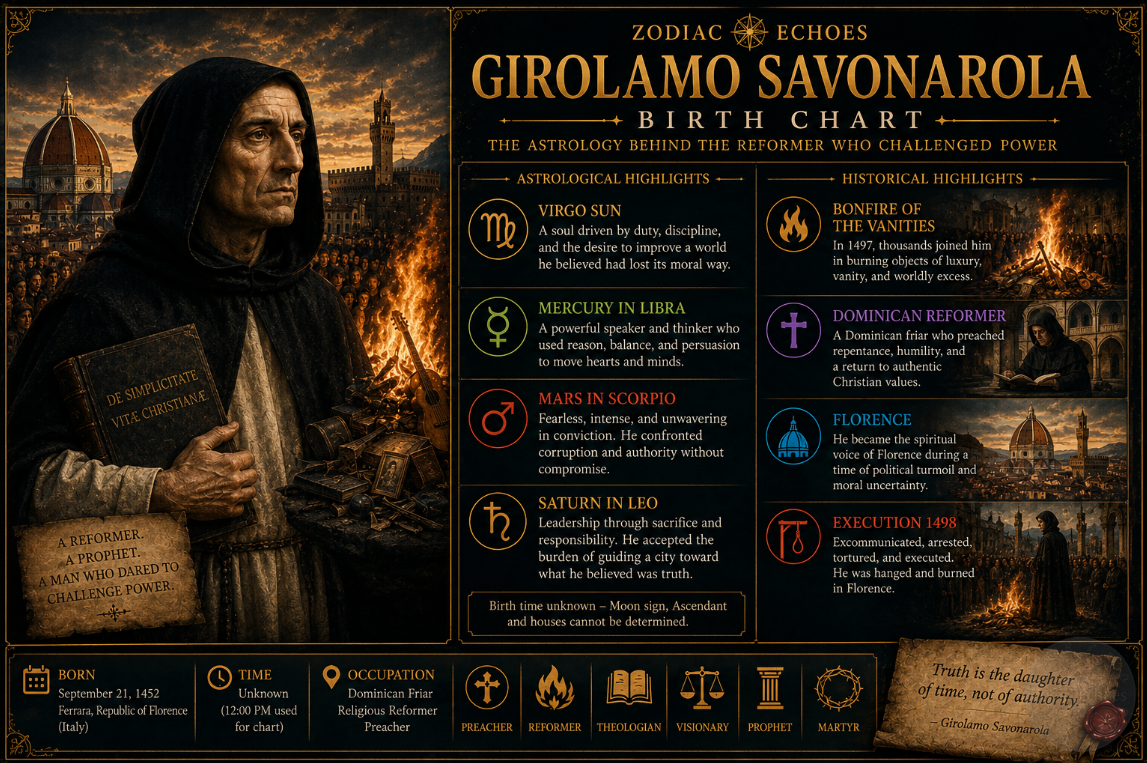
Few religious figures from the Renaissance continue to provoke debate as intensely as Girolamo Savonarola. To some historians, he was a courageous reformer who dared to confront corruption at the height of Florence’s political and cultural power.
To others, he became a religious fanatic whose uncompromising vision transformed one of Europe’s most vibrant cities into a place of fear, censorship, and moral surveillance.
More than five centuries after his death, Savonarola remains one of history’s most fascinating contradictions. He inspired thousands with passionate sermons, predicted political upheaval, openly challenged powerful rulers, and ultimately lost his own life defending the beliefs that made him famous.
The Girolamo Savonarola Birth Chart provides an intriguing symbolic perspective on a man whose influence extended far beyond religion. While astrology cannot explain history or justify personal actions, it can highlight themes that appear repeatedly throughout his extraordinary life.
Why Girolamo Savonarola Still Fascinates the World
Born in Ferrara in 1452, Savonarola entered the Dominican Order as a young man after becoming increasingly disillusioned with the moral decline he believed surrounded him. Unlike many church leaders of his time, he rejected luxury and devoted himself to preaching repentance, discipline, and spiritual renewal.
His influence grew dramatically after moving to Florence. The city was one of Europe’s cultural capitals, celebrated for its artists, philosophers, merchants, and the powerful Medici family. Yet Savonarola argued that beneath this prosperity lay greed, corruption, and spiritual decay.
His sermons attracted enormous crowds. He warned of divine judgment, predicted foreign invasions, and urged citizens to abandon vanity in favor of humility and faith. When King Charles VIII of France invaded Italy in 1494, many Florentines believed Savonarola’s warnings had been fulfilled, dramatically increasing his authority.
Perhaps the most famous event associated with his name is the Bonfire of the Vanities in 1497. Citizens publicly burned objects they believed encouraged pride or moral corruption, including luxury clothing, mirrors, cosmetics, gambling equipment, secular books, musical instruments, and works of art.
Whether viewed as an act of spiritual purification or cultural destruction, the event cemented Savonarola’s place in history. His growing political influence eventually brought him into direct conflict with Pope Alexander VI.
Excommunicated in 1497, arrested the following year, tortured, convicted of heresy and sedition, he was hanged and burned in Florence’s Piazza della Signoria in 1498.
Yet his legacy never disappeared. Historians continue to debate whether he should be remembered as a prophet, a reformer, a political revolutionary, or a dangerous religious extremist.
Birth Data
- Birth Date: September 21, 1452
- Birth Place: Ferrara, Republic of Florence (modern Italy)
- Birth Time: Unknown
Because Savonarola’s birth time has never been historically documented, his Ascendant, Moon sign, and astrological houses cannot be interpreted with confidence. This article focuses only on planetary positions that can be established from the recorded birth date.
Virgo Sun: A Mission Greater Than Himself
With a confirmed Virgo Sun, Girolamo Savonarola’s chart begins with symbolism often associated with discipline, duty, analysis, and the desire to improve an imperfect world.
Unlike the popular image of Virgo as merely practical or detail-oriented, historical figures born under this sign frequently demonstrate an uncompromising commitment to ideals, systems, and moral responsibility. Looking at Savonarola’s life, this symbolism appears repeatedly.
Rather than accepting the wealth and prestige surrounding Renaissance Italy, he became increasingly disturbed by what he saw as spiritual decline within both society and the Church. His decision to join the Dominican Order reflected a conscious rejection of comfort in favor of discipline, study, and religious devotion.
Virgo is often driven by the belief that something is fundamentally broken and must be corrected. In Savonarola’s case, this desire extended far beyond personal improvement. His sermons challenged corruption among political leaders, wealthy merchants, artists, and even senior church officials.
He believed Florence had lost its moral direction and that only repentance could prevent divine punishment. This placement also reflects his extraordinary work ethic. Savonarola spent years studying theology, preparing sermons, writing religious texts, and developing arguments rooted in scripture.
His influence did not emerge overnight but through persistent dedication to ideas he considered more important than personal safety. Virgo symbolism does not necessarily create popularity.
Instead, it often produces individuals willing to criticize systems they believe have become ineffective or corrupt. Whether one views Savonarola as a reformer or a fanatic, his determination to confront established authority strongly reflects this archetype.
Mercury in Libra: Conviction Through Words
If Virgo describes Savonarola’s sense of purpose, Mercury in Libra helps explain how he communicated that purpose to thousands of listeners. Mercury governs thinking, language, persuasion, and the ability to shape ideas into messages others can understand. Libra adds rhetoric, balance, debate, and an awareness of how words influence society.
Savonarola’s sermons became legendary not because they were theatrical alone, but because they combined logic, biblical scholarship, political observation, and emotional intensity. Contemporary accounts describe churches filled beyond capacity as citizens gathered to hear him preach.
Unlike many medieval theologians who focused primarily on abstract doctrine, Savonarola addressed immediate social and political issues. He criticized greed, luxury, injustice, and abuses of power in language ordinary Florentines could understand. His words were not intended merely to educate; they were designed to persuade people to change their lives.
Mercury in Libra often seeks justice through dialogue, yet Savonarola’s speeches reveal another side of this placement. Once convinced that a principle represented truth, compromise became increasingly difficult. His arguments were carefully structured, but his conclusions were uncompromising.
This combination may help explain why his influence extended far beyond the monastery. His greatest weapon was neither political office nor military force. It was language. His sermons shaped public opinion, influenced civic decisions, and helped transform Florence during one of the most turbulent periods of the Renaissance.
Mars in Scorpio: Fearless Confrontation
Among the strongest symbolic themes in Savonarola’s chart is Mars in Scorpio. Mars represents action, courage, conflict, and determination. Scorpio intensifies these qualities, producing persistence, emotional conviction, and a willingness to confront subjects others prefer to avoid.
Savonarola repeatedly challenged some of the most powerful individuals of his era. He criticized members of the Medici family, questioned political corruption, and eventually entered into open conflict with Pope Alexander VI. Few religious leaders of the fifteenth century willingly placed themselves in opposition to both secular and ecclesiastical authority.
This placement also reflects his remarkable endurance under pressure. Even after excommunication, public criticism, and growing political isolation, Savonarola continued preaching with extraordinary confidence. He believed his mission came from God rather than human institutions, making compromise increasingly unlikely.
Mars in Scorpio often symbolizes internal certainty that remains difficult to weaken through external pressure. History shows that Savonarola refused multiple opportunities to moderate his rhetoric. Instead, he continued defending his convictions until his arrest in 1498.
While astrology cannot explain these decisions, the symbolism of Mars in Scorpio aligns with a personality prepared to sacrifice comfort, reputation, and even life itself rather than abandon deeply held beliefs.
Jupiter in Cancer: Faith as Collective Protection
Jupiter is traditionally associated with belief, philosophy, expansion, and moral vision. In Cancer, its symbolism often shifts toward protecting communities, preserving tradition, and creating a sense of spiritual family.
Savonarola rarely presented faith as a private experience. Instead, he believed the entire city shared responsibility for its moral condition. His vision extended beyond individual salvation to the transformation of Florence itself. Citizens were encouraged to see themselves as participants in a collective spiritual renewal rather than isolated believers.
This perspective helps explain one of the defining events of his career: the Bonfire of the Vanities. Modern audiences often remember the destruction of luxury items and artworks, yet supporters viewed the event very differently. Many believed they were voluntarily rejecting excess in order to build a healthier, more virtuous society.
Jupiter in Cancer symbolically reflects this protective instinct. Rather than seeking personal influence alone, Savonarola imagined Florence as a community capable of becoming an example for all Christian Europe.
History ultimately judged this vision in many different ways. Some regard it as sincere religious idealism, while others see it as an example of moral authoritarianism. Whatever conclusion readers reach, the recurring theme remains the same: Savonarola consistently thought in terms of communities rather than individuals, and of collective responsibility rather than private ambition.

Saturn in Leo: Leadership Through Sacrifice
Saturn is often associated with responsibility, endurance, discipline, and the burdens that shape a person’s character. In Leo, this symbolism frequently revolves around leadership, public recognition, authority, and the challenge of balancing personal conviction with the expectations of society.
Savonarola never appeared interested in wealth or personal luxury, yet he accepted an extraordinary level of public responsibility. By the mid-1490s, his influence extended well beyond the pulpit. Political leaders consulted him, ordinary citizens followed his guidance, and many believed Florence itself had a divine mission under his spiritual leadership.
Saturn in Leo often symbolizes individuals who believe leadership should be earned through service rather than privilege. Savonarola’s authority came from his reputation as a preacher committed to moral reform. His willingness to speak against influential families and even the papacy reflected an unusual confidence in his own sense of duty.
Yet Saturn also represents limitations. As Savonarola’s influence grew, so did resistance. The same uncompromising discipline that had inspired thousands eventually isolated him from former supporters. His inability—or unwillingness—to adapt to changing political realities contributed to his downfall.
Astrologically, Saturn reminds us that every form of authority carries consequences. Savonarola’s rise and fall illustrate how leadership based entirely on conviction can become both a source of extraordinary influence and profound vulnerability.
The Bonfire of the Vanities: Reform or Fanaticism?
Few historical events are as closely associated with Girolamo Savonarola as the Bonfire of the Vanities. In February 1497, citizens of Florence gathered to burn objects believed to encourage vanity, moral corruption, and excessive attachment to worldly pleasures.
Contemporary accounts describe piles of mirrors, cosmetics, luxury clothing, gambling equipment, secular literature, musical instruments, and valuable works of art consumed by flames in the city’s central square.
Modern audiences often view the event as an attack on culture and artistic freedom. Many historians, however, point out that the participants largely acted voluntarily, believing they were contributing to the spiritual renewal of Florence rather than participating in simple destruction.
This episode perfectly captures the contradiction at the heart of Savonarola’s legacy. His supporters saw a courageous reformer calling society back to humility and faith. His critics saw a charismatic leader whose certainty left little room for individual freedom or cultural diversity. Astrology cannot determine which interpretation is correct.
What it can illustrate is a recurring pattern throughout his chart: discipline over indulgence, conviction over compromise, and the pursuit of ideals that often demanded extraordinary personal sacrifice from both himself and those who followed him. Even today, the Bonfire of the Vanities remains a symbol whose meaning depends largely on the perspective of the observer.

What Astrology Cannot Explain
Although astrology offers an interesting symbolic framework for exploring historical personalities, it cannot explain why Girolamo Savonarola became one of the Renaissance’s most controversial figures.
Savonarola lived during one of Europe’s most turbulent periods, when political instability, religious tension, and cultural transformation created extraordinary opportunities for influential leaders to emerge. His rise cannot be separated from the Florence of the late fifteenth century any more than his execution can be explained solely through astrology.
Rather than providing definitive answers, astrology invites readers to consider recurring psychological themes that appear throughout a person’s life. The historical record remains the primary source for understanding Savonarola’s achievements, failures, and lasting legacy.
Conclusion
More than five hundred years after his death, Girolamo Savonarola continues to divide historians, theologians, and readers around the world. Some remember him as a courageous reformer who challenged corruption during one of the Renaissance’s most influential periods. Others see a religious zealot whose uncompromising vision contributed to censorship, fear, and intolerance.
His birth chart reflects recurring themes of discipline, conviction, leadership, and an unwavering commitment to principles that he believed transcended personal ambition. While astrology cannot explain every decision or historical event, the symbolism of his chart aligns remarkably well with a life devoted to faith, reform, and moral certainty.
Whether admired or criticized, Savonarola’s influence on Florence and European history remains undeniable. His story serves as a reminder that powerful ideas can inspire profound change, but they can also provoke equally powerful resistance.
The Girolamo Savonarola Birth Chart is therefore more than an astrological interpretation. It is an opportunity to explore the complex relationship between belief, authority, and history through the life of one of the Renaissance’s most unforgettable figures.
Every historical figure has a unique astrological blueprint—and so do you. Create your free Natal Chart and discover the planetary placements that make your story uniquely yours.
Cosmic Highlights

FAQ
Who was Girolamo Savonarola?
Girolamo Savonarola was a Dominican friar, preacher, and religious reformer born in Ferrara in 1452. He became one of the most influential figures in Renaissance Florence through sermons that criticized corruption, luxury, and moral decline. His career ended with excommunication, execution, and public burning in 1498.
Why is Girolamo Savonarola famous?
He is best known for leading Florence during a period of religious reform and for organizing the famous Bonfire of the Vanities, where citizens burned luxury items and possessions considered symbols of moral excess. His dramatic rise and tragic downfall made him one of history’s most controversial religious leaders.
What zodiac sign was Girolamo Savonarola?
Based on his documented birth date of 21 September 1452, Girolamo Savonarola was born under the sign of Virgo. His birth time has not been historically verified, making Ascendant and Moon sign interpretations uncertain.
Did Savonarola really predict the future?
Many of his followers believed his prophecies came true, particularly after the French invasion of Italy in 1494. Historians generally view his predictions within the political and religious context of Renaissance Italy rather than as evidence of supernatural abilities.
Why was Girolamo Savonarola executed?
Savonarola’s growing political influence, criticism of Church corruption, and conflict with Pope Alexander VI eventually led to his excommunication. After losing public support in Florence, he was arrested, tortured, convicted of heresy and sedition, and executed in 1498.
Can astrology explain Savonarola’s life?
No. Astrology offers symbolic interpretations of personality and recurring themes but cannot explain historical events or personal decisions. Savonarola’s life was shaped by the political, religious, and cultural circumstances of Renaissance Italy as well as his own choices and convictions.