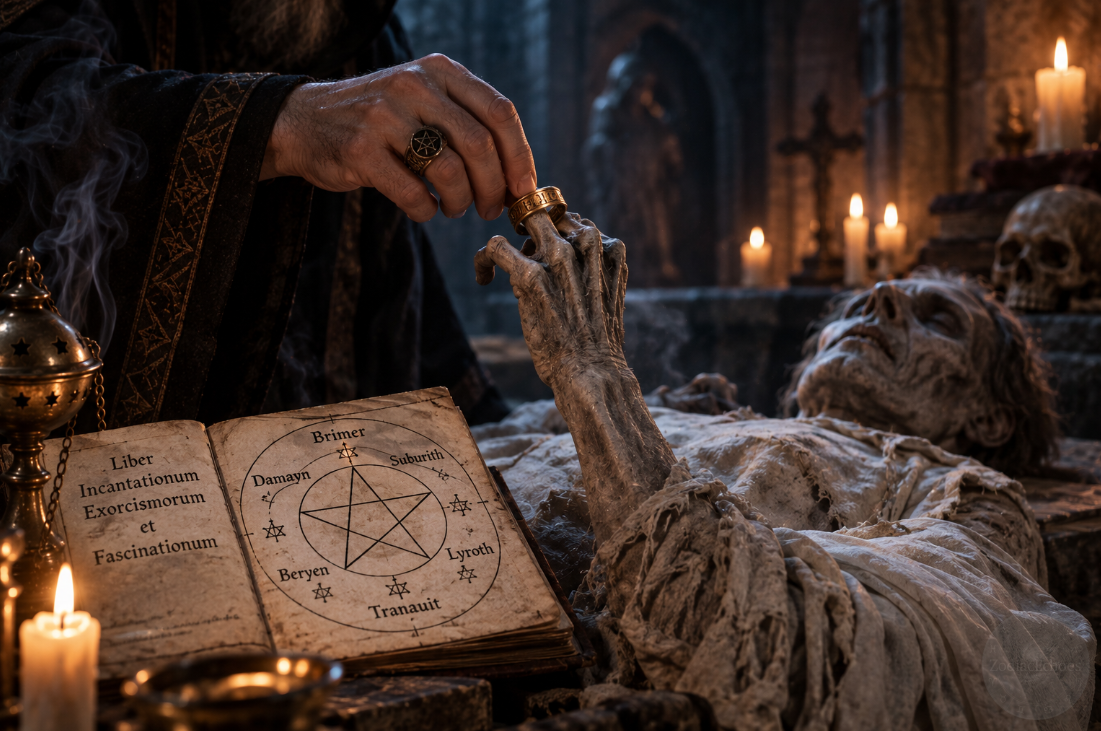
There are medieval rituals for finding treasure, identifying thieves and seeing spirits in mirrors. Then there is this one. Hidden inside the fifteenth-century manuscript known as the Munich Manual of Demonic Magic is an experiment whose stated purpose is difficult to misinterpret:
“For resuscitating a dead person.”
But the text does not promise resurrection in the Christian sense. Its mechanism is considerably stranger. A specially prepared ring supposedly allowed a spirit to enter a corpse, making the dead body look alive again.
The manuscript goes further. The corpse was supposed to get up. It was supposed to speak. And according to the text, the illusion could continue for six days.
Six Names on a Golden Ring
At the center of the operation was a gold ring.
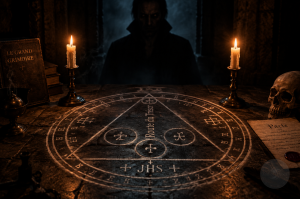
The manuscript gives six names associated with it: Brimer, Suburith and Tranauit on the outside, and Lyroth, Beryen and Damayn on the inside. The spelling varies slightly elsewhere in the manuscript, something Kieckhefer notes is characteristic of Clm 849.
The ring was not treated as an ordinary piece of jewelry. The manuscript describes an extended process of ritual preparation before it could supposedly acquire its strange ability. Eventually the magician entered a specially drawn circle and summoned the six spirits connected with the ring. Fortunately, that circle survives.
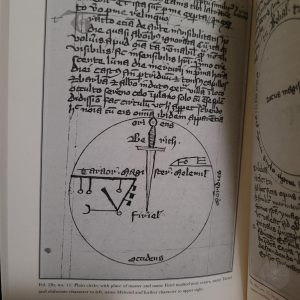
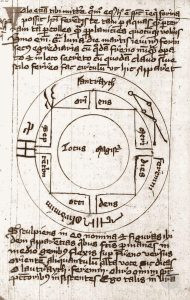
The ritual circle for experiment No. 10 in the Munich Manual of Demonic Magic, Clm 849. The figure contains a pentagram surrounded by the names associated with the magical ring.
The scholarly description confirms that the figure on fol. 26r consists of a double circular band surrounding a pentagram. The spirit names appear within its bands, while the position of the magician is marked in the center.
Six Spirits Come for the Ring
The manuscript then describes something much stranger than simply blessing an object. During the conjuration, six spirits were expected to appear at the circle.
They would ask for the ring.
The magician was instructed to hand it over.
Then the spirits—and the ring—would disappear.
The magician was supposed to leave the circle intact and return six days later.
At the second encounter, the text claims that a figure would approach from the east on horseback, carrying the consecrated ring back to its owner. The messenger supposedly assured the magician that the spirits had given the object the requested power. Only then could it be tested.
Put the Ring on the Living — and They Appear Dead
The first claimed power reverses what we normally expect from a resurrection ritual. Instead of beginning with a corpse, the manuscript says the ring could be placed on the finger of a living person. That person would collapse.
To everyone watching, they would apparently seem to be a corpse, completely devoid of life. Remove the ring, however, and the person was supposed to return to their previous condition.
Kieckhefer therefore places this experiment among the manuscript’s illusionist operations: rituals intended to make something appear different from what it actually was, rather than evidence that medieval necromancers genuinely believed they were reversing biological death. Then comes the reverse experiment.
Put It on a Corpse — and the Corpse Gets Up
According to the manuscript, the ring could be attached to the hand or foot of a dead person. Within an hour, something was supposed to happen. A spirit would enter the corpse. The body would rise in the form it had possessed before death and—most remarkably—speak before those present with what the manuscript calls a living voice.
This was not supposed to last for only a few minutes. The text claims the effect could continue for six days. The explanation is almost bureaucratically neat: there were six spirits associated with the ring, and each would supposedly remain inside the body for one day.
Remove the ring before the six days were finished and the effect ended. The manuscript then concludes that this is how one can “revive” a dead person.
READ THE HISTORICAL TEXT
The Latin edition of experiment No. 10 survives in Richard Kieckhefer’s scholarly edition of Clm 849, where the ritual begins under the heading For Resuscitating a Dead Person.
A Dark Parody of Resurrection
There is another detail that makes the ritual more interesting historically. Kieckhefer points out that several elements appear to echo—or deliberately distort—the Christian Resurrection. The ritual involves a tomb, a white covering and events occurring around Sunday morning before sunrise. In medieval Christian culture, those associations would have been impossible to miss.
The result resembles a dark inversion of resurrection. Christ rises from the dead through divine power. Here, the manuscript imagines a corpse appearing to rise because a demon has entered it.
That distinction also reflects a real medieval theological problem. Christian writers discussed whether demons—or eventually the Antichrist—could actually restore the dead to life. One traditional answer was that they could not: demonic magic might instead animate or manipulate a body so convincingly that observers believed the person had returned.
That is remarkably close to what experiment No. 10 describes.
THE COMPLETE SCHOLARLY EDITION
If someone wants to examine the source rather than a modern retelling, Kieckhefer’s Forbidden Rites contains the complete scholarly edition of the relevant section of Clm 849.
Look for experiment No. 10, fols. 25v–28r. The original Latin transcription begins in the edition under No. 10. For Resuscitating a Dead Person.
The Manuscript Says to Keep It Secret
The final lines add exactly the sort of detail that makes this manuscript so compelling. After explaining that a corpse could supposedly remain animated for six days, the writer warns that the experiment should be kept hidden because of its great power. The same magical figure is then credited with several other alleged abilities unrelated to resurrection.
This is not evidence that any of them worked. But it does show that whoever compiled Clm 849 did not merely preserve a vague legend about raising the dead. He recorded an elaborate system involving named spirits, a ring, a surviving magical diagram and a specific explanation for what supposedly entered the corpse.
And the strangest part may be the six-day limit. The manuscript does not describe a dead person returning permanently. It imagines something else occupying the body. One spirit per day. Then, after the sixth, the borrowed life was over.
FAQ
Is this really a medieval ritual for raising the dead?
Yes. Experiment No. 10 in Clm 849 is explicitly presented as an operation for making a dead person appear alive. It survives on folios 25v–28r.
Did the ritual claim the dead person would speak?
Yes. The text claims the animated body would rise and speak with a living voice.
Why did the effect supposedly last six days?
Six spirits were associated with the ring. The manuscript claims each spirit could remain within the corpse for one day, producing a maximum period of six days.
Could the ring also be used on living people?
According to the manuscript, yes. A living person wearing it would supposedly fall down and appear dead, then recover after the ring was removed.
Is the original magical circle preserved?
Yes. The figure on fol. 26r is described in the scholarly edition as a double circular band containing spirit names and symbols with a pentagram inside it.
Is there evidence that the ritual actually worked?
No. Kieckhefer classifies it among the manuscript’s illusionist experiments, and there is no reliable evidence that a magical ring can animate a corpse or cause a spirit to enter one.
✨ Explore More from Zodiac Echoes ✨Explore More from ZE
Choose your zodiac sign to explore daily, weekly, monthly, and yearly horoscopes.