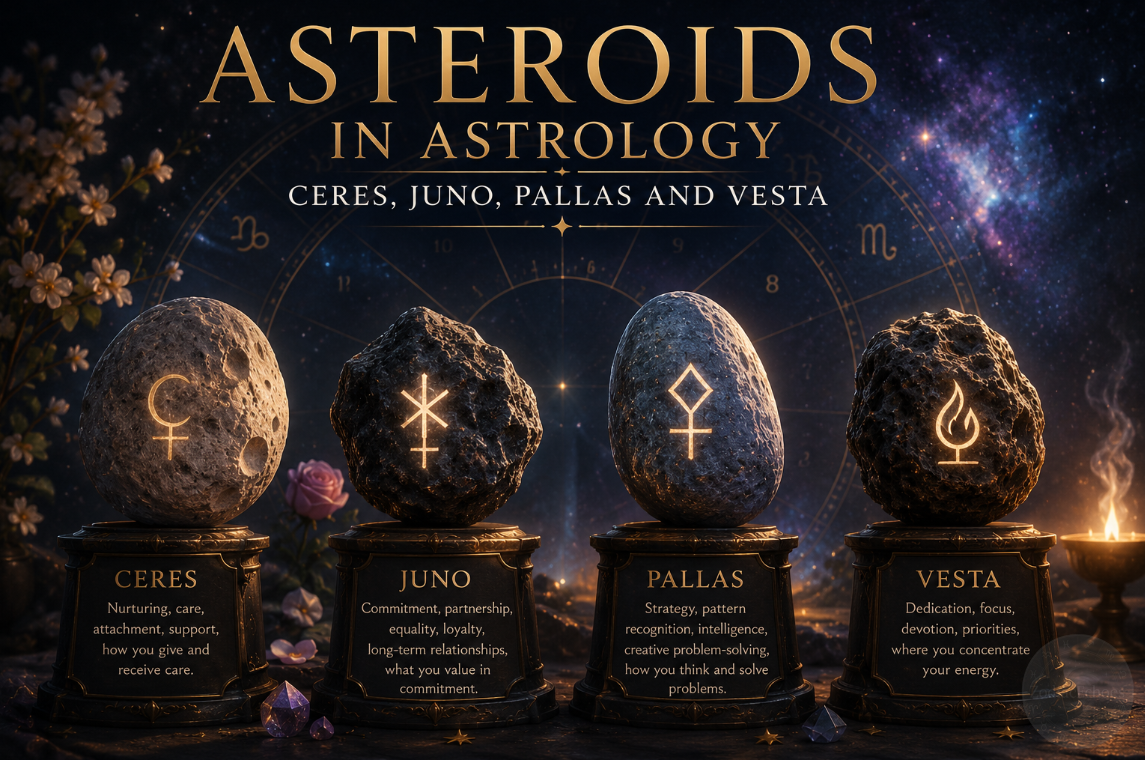
Planets form the foundation of a Birth Chart, but many astrology calculators also display smaller celestial bodies known as asteroids. There are thousands of them, and trying to interpret every asteroid would quickly make a Natal Chart almost impossible to read.
Fortunately, beginners do not need to. When discussing Asteroids in Astrology, four names appear particularly often: Ceres, Juno, Pallas and Vesta. Each adds a narrower theme to the Birth Chart, from nurturing and commitment to strategy and dedication.
They should not replace the Sun, Moon, planets, houses, or major chart angles. Instead, asteroids work best as an additional layer once the main structure of the chart is already understood.
What Are Asteroids in Astrology?
Asteroids are small Solar System bodies orbiting the Sun. Many are concentrated in the main asteroid belt between Mars and Jupiter, although asteroid-like and minor bodies exist elsewhere.
The first asteroid discovered was Ceres in 1801, followed by Pallas in 1802, Juno in 1804, and Vesta in 1807. Ceres is now astronomically classified as a dwarf planet, but astrologers commonly continue to discuss it alongside the major asteroids because of its history and established astrological use.
Astrologers eventually began assigning symbolic meanings to these bodies, often drawing partly from the mythology behind their names. Today, a detailed Birth Chart calculator may allow you to add dozens or even hundreds of asteroids. More information, however, does not automatically produce a better interpretation.
The Four Major Asteroids in Astrology
For someone learning astrology, these four provide a sensible starting point:
| Asteroid | Main Theme | Look Here For |
|---|---|---|
| Ceres | Nurturing and care | How you give and receive support |
| Juno | Commitment and partnership | What matters in long-term relationships |
| Pallas | Strategy and intelligence | How you recognize patterns and solve problems |
| Vesta | Dedication and focus | Where you concentrate energy and commitment |
Each describes a relatively specific dimension of the chart. This is very different from a planet such as Saturn or Venus, whose symbolism covers a much broader range of life experiences.

Ceres: Nurturing and Care
Ceres is associated in modern astrology with nurturing, care, attachment, nourishment, separation, and the ways we support ourselves and other people. Its symbolism comes partly from the Roman goddess Ceres and the myth surrounding her daughter Proserpina, known as Persephone in Greek mythology. In a Birth Chart, Ceres can raise questions such as:
- How do you naturally care for people?
- What makes you feel supported?
- How comfortable are you receiving care rather than always providing it?
For example, Ceres in Cancer might express nurturing through emotional availability and creating security, while Ceres in Capricorn may show care through reliability, responsibility, or practical assistance. The house then tells us where these themes are especially likely to appear.
Juno: Commitment and Partnership
Of the four, Juno receives perhaps the most attention in modern relationship astrology. Juno is associated with commitment, partnership, loyalty, equality, expectations, and long-term relationship dynamics.
This does not make Juno a “soulmate asteroid.” Instead, its placement can provide another perspective on what someone considers important when a relationship becomes serious.
For example, Juno in Libra may place particular importance on equality, cooperation, communication, and balance within partnership. Juno in the 10th House, meanwhile, could connect commitment with public life, career, status, or shared long-term ambitions. As always, the two pieces should be combined.
Pallas: Strategy and Pattern Recognition
Pallas, often called Pallas Athena, is associated with intelligence, strategy, pattern recognition, creative problem-solving, and the ability to approach complicated situations intelligently. It describes a different kind of intelligence from Mercury.
Mercury has much broader associations with thinking, communication, learning, information, and perception. Pallas focuses more narrowly on seeing patterns and finding effective strategies.
Someone with Pallas in Virgo, for example, may approach problems analytically and notice small inconsistencies. Pallas in Aquarius could emphasize unconventional solutions, systems, technology, or an ability to recognize patterns across groups and networks.
Vesta: Focus and Dedication
Vesta is associated with devotion, concentration, commitment, priorities, and the ability to dedicate energy to something important. Its symbolism comes from Vesta, the Roman goddess of the hearth and sacred flame.
In a Birth Chart, Vesta can help describe where sustained focus becomes especially important. For example, Vesta in Capricorn may approach dedication through discipline, responsibility, and long-term goals.
Vesta in the 6th House could direct considerable energy toward work, routines, service, skills, or everyday responsibilities. At its strongest, Vesta can symbolize extraordinary concentration. Its more difficult expression can involve becoming so devoted to one priority that other parts of life receive too little attention.
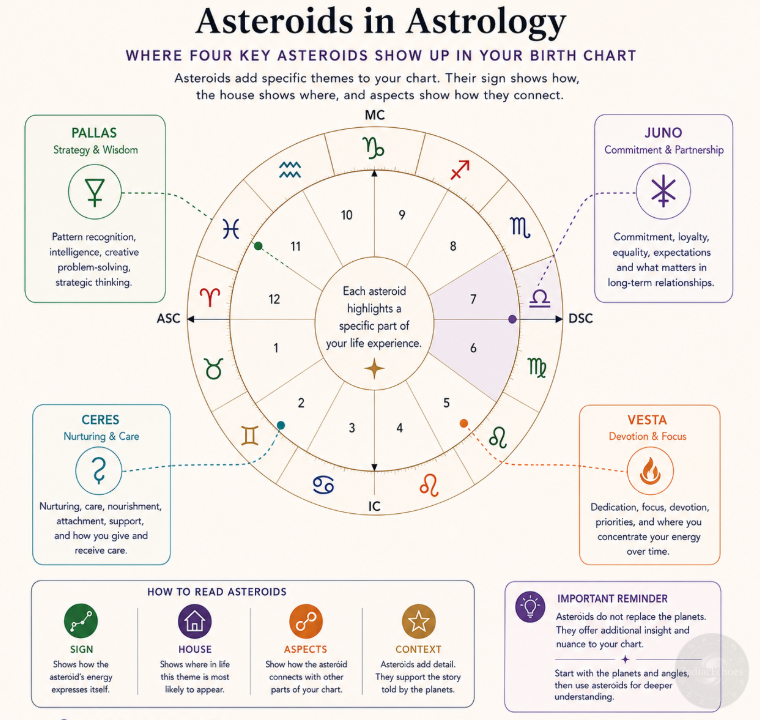
How to Read an Asteroid in Your Birth Chart
You do not need a completely different system for interpreting asteroids. Use the same basic structure we have already used throughout the Guides:
Asteroid → Sign → House → Aspects
- The asteroid provides the subject.
- The sign describes how its qualities are expressed.
- The house shows where in life they are most likely to appear.
- Aspects connect the asteroid with other parts of the Birth Chart.
For example:
Juno in Libra in the 7th House conjunct Venus
- Juno introduces commitment and partnership.
- Libra emphasizes balance, equality, diplomacy, and relationships.
- The 7th House reinforces partnership and one-to-one connections.
- Venus adds attraction, affection, values, pleasure, and relating.
Instead of interpreting four isolated keywords, we now have one concentrated relationship pattern.
Asteroid Sign vs. House
A simple rule remains useful:
- Sign = How
- House = Where
Imagine someone has Vesta in Virgo in the 6th House. Virgo describes an analytical, practical, organized style. The 6th House brings work, routines, service, skills, and everyday responsibilities into focus.
Together, the placement could describe considerable dedication to improving systems, mastering practical skills, or making daily life function efficiently. The rest of the chart determines how important this pattern actually becomes.
Do Aspects to Asteroids Matter?
Yes, particularly close aspects involving major planets or important chart angles. Suppose Juno sits very close to Venus. The symbolism of commitment and partnership becomes directly connected with Venusian themes such as relationships, attraction, values, and affection.
Pallas conjunct Mercury could strengthen themes involving thought, information, strategy, and pattern recognition. Vesta conjunct Mars could connect dedication with drive, action, ambition, or competition.
Astrologers differ considerably in the orbs they use for asteroids, but many prefer tighter aspects than they would use between major planets. This prevents minor objects from overwhelming the chart.
Are Asteroids as Important as Planets?
Generally, no. This is one of the most useful rules for beginners. Finding Juno in your Birth Chart does not suddenly make Venus irrelevant. Pallas should not replace Mercury, and Vesta does not replace Mars or Saturn. A sensible interpretation usually begins with:
Sun, Moon and Ascendant → planets → houses and angles → major aspects → additional points and asteroids
Asteroids then add detail. If an asteroid closely conjuncts the Sun, Moon, Ascendant, Midheaven, or another important placement, it may deserve considerably more attention. Without such connections, its influence may be subtler.
Asteroids vs. Calculated Points
Asteroids are sometimes grouped together with Chiron, the Lunar Nodes, Vertex, and Part of Fortune in extended Birth Chart menus. They are not the same type of object.
- Ceres, Juno, Pallas and Vesta are physical bodies in the Solar System.
- The Lunar Nodes are astronomical intersection points.
- The Vertex is another calculated astronomical point.
- The Part of Fortune is mathematically derived from the Sun, Moon, and Ascendant.
- Chiron is a physical body classified as a centaur and minor planet.
They may all appear as extra symbols on a Birth Chart, but their astronomical origins are very different.
How to Find Asteroids in Your Birth Chart
Many basic Natal Charts do not display asteroids automatically. Look for options such as Additional objects, Asteroids or individual names such as Ceres — Juno — Pallas — Vesta. Once enabled, record the asteroid’s Sign → Degree → House → Major Aspects.
Avoid switching on dozens of asteroids at once. A chart covered with symbols becomes harder to interpret, not more informative. Start with these four and add others only when you have a specific reason to investigate them.
What About Other Asteroids?
There are thousands of named asteroids, and modern astrologers sometimes work with bodies such as Psyche, Eros, Hygiea, Astraea, and many others. Some can be interesting for specialized interpretation. But there is also a major risk of confirmation bias.
If you search through enough asteroids, eventually you can find one with a suggestive name sitting near almost any important chart position. That does not automatically make the connection astrologically significant. For beginners, Ceres, Juno, Pallas, and Vesta are more than enough.
FAQ
What are the main asteroids in Astrology?
Ceres, Juno, Pallas, and Vesta are among the most commonly interpreted. Ceres is technically classified astronomically as a dwarf planet today but remains grouped with the major asteroids in astrological practice.
What does Juno mean in Astrology?
Juno is associated with commitment, partnership, equality, loyalty, and expectations within serious relationships.
What does Ceres represent?
Ceres is associated with nurturing, care, nourishment, attachment, and how support is given and received.
What does Pallas represent?
Pallas relates to strategy, pattern recognition, intelligence, and creative problem-solving.
What does Vesta represent?
Vesta is associated with dedication, focus, devotion, priorities, and sustained concentration.
Are asteroids important in a Birth Chart?
They can add useful detail, especially when closely connected with major planets or chart angles, but they generally should not be given the same weight as the main planets.
Do I need asteroids to understand my Natal Chart?
No. You can build a detailed Birth Chart interpretation without them. Asteroids are best treated as an additional layer once the fundamental chart structure is understood.