Some parts of a Birth Chart naturally pull in different directions. One placement may demand independence while another emphasizes partnership. One planet seeks security while another pushes toward change. Neither side necessarily needs to win. This is the basic principle behind an opposition in Astrology.
With an exact angle of 180°, an opposition places two planets across the Birth Chart from one another. The resulting polarity can create tension, but it can also produce awareness and encourage us to find a way for apparently contradictory needs to coexist.
What Is an Opposition in Astrology?
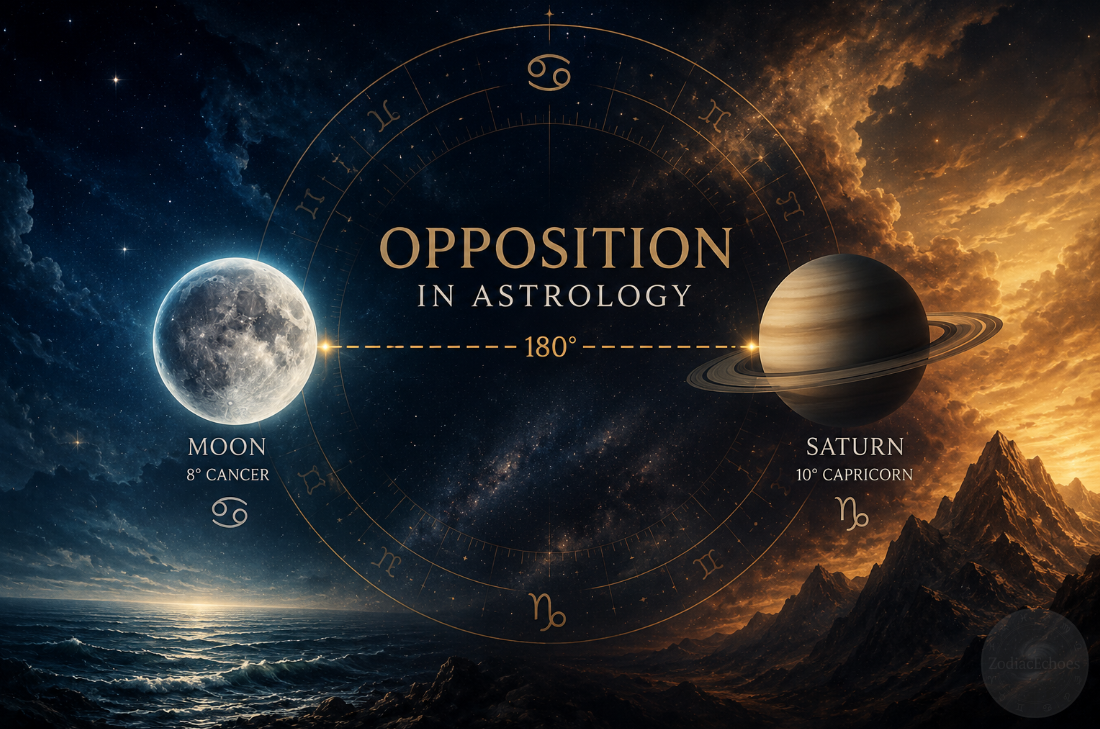
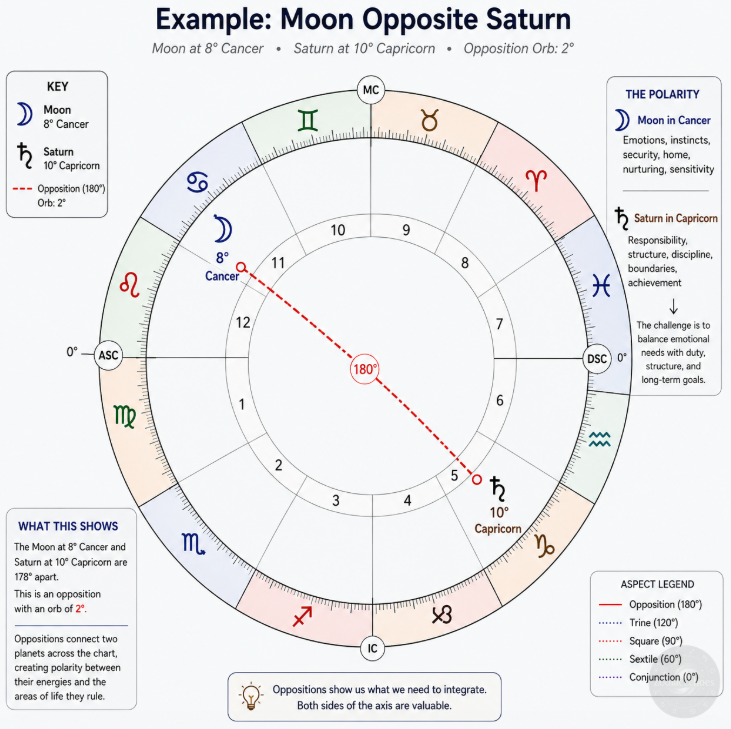
An opposition occurs when two planets are positioned approximately 180° apart. Imagine the Moon at 8° Cancer and Saturn at 10° Capricorn. Cancer and Capricorn are opposite zodiac signs, and the planets are only 2° away from an exact 180° opposition. The aspect therefore has an orb of 2°.
Instead of interpreting the Moon and Saturn independently, we now need to examine the relationship between them. The Moon represents emotions, instincts, security, and emotional needs. Saturn represents structure, responsibility, boundaries, discipline, and limitation. An opposition connects these two functions across the chart.
How Does an Opposition Work?
The easiest way to understand an opposition is to imagine a seesaw. Both ends matter. Put too much weight on one side and the entire system becomes unbalanced. Astrological oppositions work in a similar way. Two planetary functions occupy opposite positions and may initially appear difficult to satisfy simultaneously.
For example:
- Venus opposite Saturn may connect relationships and affection with boundaries, caution, responsibility, or fear of vulnerability.
- Mars opposite Jupiter can create tension between immediate action and expansion, confidence, or taking bigger risks.
- Sun opposite Moon places identity and conscious direction opposite emotional needs and instinctive reactions.
The goal is not necessarily to eliminate one side. It is to recognize what each planet contributes to the polarity.
What Is the Orb of an Opposition?
As with conjunctions, planets do not need to be exactly 180° apart. Astrologers allow an orb around the exact aspect. Different astrologers and chart systems use different limits, particularly depending on the planets involved. A useful beginner guideline is:
| Orb | General Interpretation |
|---|---|
| 0°–2° | Very tight opposition |
| 3°–5° | Strong opposition |
| 6°–8° | Wider opposition |
| Beyond 8° | Depends on planets and method |
The Sun and Moon are often allowed wider orbs than minor planets, asteroids, or calculated points. As a general rule, the tighter the opposition, the more attention it deserves.
Opposite Signs and Oppositions
The zodiac contains six pairs of opposite signs:
| Sign | Opposite Sign |
|---|---|
| Aries | Libra |
| Taurus | Scorpio |
| Gemini | Sagittarius |
| Cancer | Capricorn |
| Leo | Aquarius |
| Virgo | Pisces |
These signs are different, but they also share an underlying axis. Aries and Libra can raise questions about self vs. partnership. Cancer and Capricorn may emphasize private security vs. public responsibility. Virgo and Pisces can highlight the relationship between precision and surrender, practical detail and the larger whole.
This is why opposition does not simply mean that two signs “hate” each other. They represent two ends of the same spectrum.
Can an Opposition Cross Sign Boundaries?
Yes. Consider Moon at 29° Cancer and Saturn at 1° Aquarius. The planets are approximately 152° apart, so despite being in signs that may look visually distant on a simplified chart, they do not form an opposition. This demonstrates why aspects should always be calculated using actual planetary degrees.
Conversely, planets near sign boundaries can sometimes form an out-of-sign opposition even when their signs are not traditional opposites. Geometry comes first. The signs then add another layer to the interpretation.
Common Oppositions
| Opposition | Potential Polarity |
|---|---|
| Sun opposite Moon | Identity ↔ emotional needs |
| Moon opposite Saturn | Emotional security ↔ boundaries |
| Mercury opposite Jupiter | Detail ↔ big-picture thinking |
| Venus opposite Saturn | Affection ↔ restraint |
| Venus opposite Uranus | Connection ↔ independence |
| Mars opposite Jupiter | Action ↔ expansion |
| Jupiter opposite Saturn | Growth ↔ structure |
These are starting points rather than complete interpretations. The signs and houses tell us much more about how and where the polarity operates.
Example: Moon Opposite Saturn
Imagine someone has Moon at 8° Cancer and Saturn at 10° Capricorn. The two planets are approximately 178° apart. That gives us an opposition with an orb of 2°.
- Start with the Moon. The Moon represents emotions, instinctive reactions, comfort, security, habits, and emotional needs. Saturn represents responsibility, structure, boundaries, discipline, maturity, and limitation.
- Now consider the signs. Cancer emphasizes emotional security, belonging, protection, home, and sensitivity. Capricorn emphasizes responsibility, achievement, structure, self-control, and long-term goals.
The opposition creates a clear polarity. This person might sometimes experience tension between allowing themselves to need emotional support and feeling that they must remain responsible or self-controlled.
At other times, the aspect may operate differently. Emotional sensitivity could actually help them understand which responsibilities genuinely matter, while Saturn can provide enough structure to prevent emotional reactions from controlling every decision.
Neither planet needs to defeat the other. The deeper potential of the opposition comes from learning to use both sides of the axis.
Why Houses Matter in an Opposition
Oppositions do not only connect planets. They also connect two areas of life. Suppose the Moon–Saturn opposition falls across the 4th House ↔ 10th House. The polarity may become particularly noticeable between private emotional foundations and public responsibilities.
Move exactly the same planets to 1st House ↔ 7th House and questions involving personal identity and relationships may become much more important. This is one reason an opposition can feel more complex than reading two individual placements. It creates an axis across the Birth Chart.
Is an Opposition a Bad Aspect?
Traditionally, opposition is considered a challenging or “hard” aspect. But describing it simply as bad misses much of its value. Oppositions create contrast. Contrast makes things visible. Someone with a strong opposition may become highly aware of two competing needs precisely because neither can easily be ignored.
That can initially create frustration, projection, or a tendency to swing between extremes. Over time, however, the same aspect can encourage considerable self-awareness. The useful question is therefore not: Which planet wins?
It is:
How can these two planetary needs operate without one continually cancelling out the other?
Opposition vs. Conjunction
These first two aspects in our series are almost geometric opposites themselves.
Conjunction = 0°
Two planetary functions come together.
Opposition = 180°
Two planetary functions face one another from opposite sides of the chart. A conjunction tends to combine and concentrate. An opposition tends to polarize and create awareness between two sides. Both can be extremely powerful. They simply organize planetary relationships differently.
Understanding Oppositions in Your Birth Chart
An opposition in Astrology reveals a relationship between two planetary functions positioned across the Birth Chart from one another. Its central principle is 180° creates polarity. Start with the planets, examine their signs and houses, and then consider the orb and other aspects surrounding them.
The goal is not necessarily to choose one side. Often, the real potential of an opposition emerges when you recognize that both ends of the axis belong to the same chart—and both have something important to contribute.
FAQ
What does opposition mean in Astrology?
An opposition occurs when two planets or chart points are approximately 180° apart, creating a polarity between their symbolism.
What is the symbol for opposition?
The traditional opposition symbol is ☍.
Is opposition a difficult aspect?
It is traditionally classified as a challenging aspect because it can create tension between competing needs. However, it can also encourage balance, awareness, and integration.
Do oppositions always occur in opposite signs?
Usually, but not always. Out-of-sign oppositions are possible near sign boundaries when the planets remain sufficiently close to 180° apart.
Is a tight opposition stronger?
Generally, yes. A 1° or 2° opposition will usually receive more interpretive attention than a very wide opposition.
Can an opposition be positive?
Absolutely. Oppositions can produce awareness, perspective, balance, and the ability to understand two sides of an issue. Their expression depends on the planets and the rest of the Birth Chart.