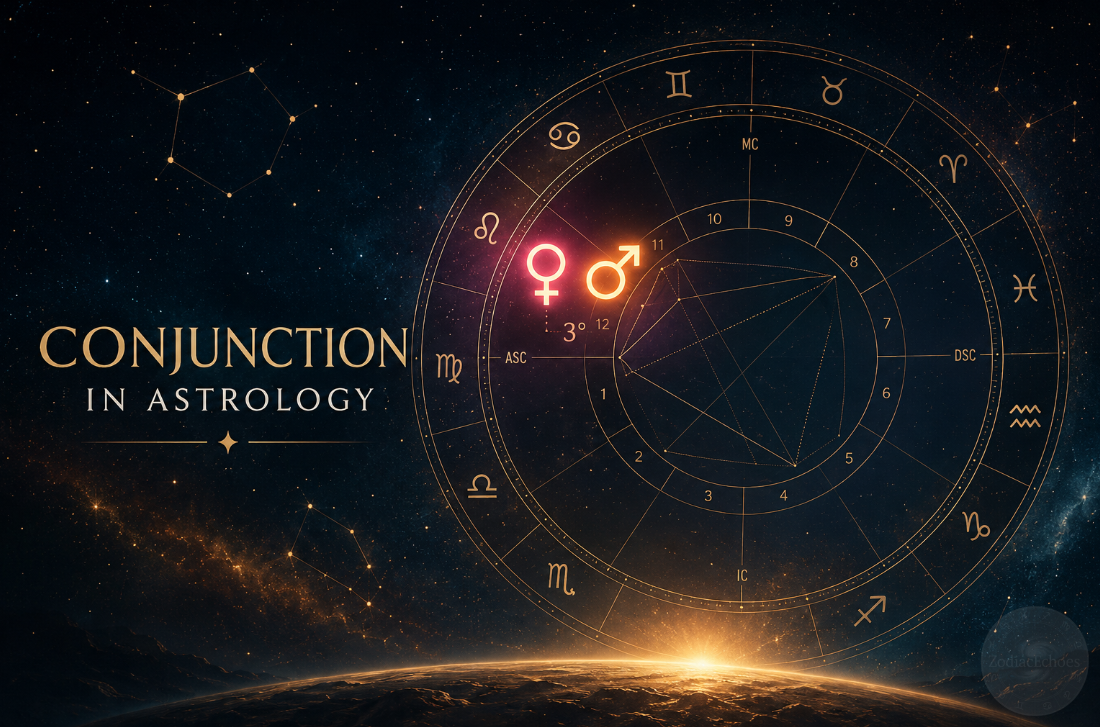
Two planets sitting close together in a Birth Chart are difficult to interpret separately. Their symbolism begins to interact. This is the basic idea behind a conjunction in Astrology, one of the most important aspects you will encounter when learning to read a Natal Chart.
Unlike aspects that create visible angles across the chart, a conjunction brings two placements into approximately the same position, concentrating their influence within one part of the wheel.
What Is a Conjunction in Astrology?
A conjunction is an astrological aspect with an exact angle of 0°.
Imagine Venus positioned at 14° Leo and Mars at 17° Leo. The planets are only three degrees apart. They therefore form a conjunction with an orb of 3°. Instead of reading Venus and Mars as completely independent placements, an astrologer would examine how their symbolism interacts.
Venus relates to attraction, relationships, pleasure, harmony, and values. Mars relates to action, desire, assertion, motivation, and drive. When conjunct, these themes become closely connected.
How Does a Conjunction Work?
The easiest way to understand a conjunction is to think of two people standing in almost exactly the same place. They may cooperate beautifully. They may irritate each other. Or they may produce something neither could create alone. The same principle applies to planets.
A conjunction intensifies the connection between two planetary functions, but the result depends heavily on which planets are involved. For example:
- Mercury conjunct Venus can connect communication with affection, aesthetics, or diplomacy.
- Mars conjunct Saturn combines action with structure, restraint, responsibility, and persistence.
- Moon conjunct Jupiter can connect emotional responses with expansion, optimism, beliefs, or generosity.
The conjunction itself does not tell us whether that combination will be easy or difficult.
What Is the Orb of a Conjunction?
Two planets do not need to occupy exactly the same degree to form a conjunction. Astrologers use an orb, meaning an allowed distance from the exact aspect. There is no single universally accepted orb.
Major planets and luminaries are often given wider orbs, while asteroids and less important chart points are generally interpreted more tightly. A simple beginner guideline might look like this:
| Orb | General Interpretation |
|---|---|
| 0°–2° | Very tight conjunction |
| 3°–5° | Strong conjunction |
| 6°–8° | Wider conjunction |
| Beyond 8° | Depends strongly on planets and method used |
These ranges are guidelines rather than fixed laws. A 1° Sun–Moon conjunction, for example, deserves considerably more attention than a very wide conjunction involving two minor asteroids.
Do Conjunct Planets Have to Be in the Same Sign?
Not necessarily. Consider Venus at 29° Leo and Mars at 1° Virgo. They are only 2° apart, despite occupying different zodiac signs. This is known as an out-of-sign conjunction.
The planets remain geometrically close enough to form the aspect, but interpretation becomes more nuanced because Venus operates through Leo while Mars operates through Virgo. This is one reason aspects should be calculated by degrees, not simply by looking at which signs contain the planets.
Common Conjunctions
| Conjunction | Themes That May Combine |
|---|---|
| Sun conjunct Moon | Identity + emotions |
| Sun conjunct Mercury | Identity + thinking |
| Moon conjunct Venus | Emotions + affection |
| Mercury conjunct Venus | Communication + harmony |
| Venus conjunct Mars | Attraction + desire |
| Mars conjunct Saturn | Action + discipline |
| Jupiter conjunct Saturn | Expansion + structure |
These descriptions are only starting points. The sign and house can dramatically change how the conjunction is expressed.
Example: Venus Conjunct Mars in Leo
Imagine someone has:
- Venus at 14° Leo
- Mars at 17° Leo
The difference is:
- 17° − 14° = 3°
So Venus and Mars form a 3° conjunction.
Start with the planets. Venus represents attraction, affection, values, pleasure, and relationships. Mars represents drive, desire, action, assertion, and motivation. Now add Leo. Leo brings themes of creativity, confidence, self-expression, warmth, visibility, and personal pride.
Instead of interpreting Venus in Leo and Mars in Leo as two unrelated placements, the conjunction tells us their functions are closely connected. Affection and desire may operate together. Creative interests could carry considerable passion and motivation. The person may express attraction directly or invest strong energy into people and activities they genuinely value.
But this does not automatically mean they are passionate, romantic, dramatic, or sexually intense in every situation. The house placement and the rest of the Natal Chart still matter.
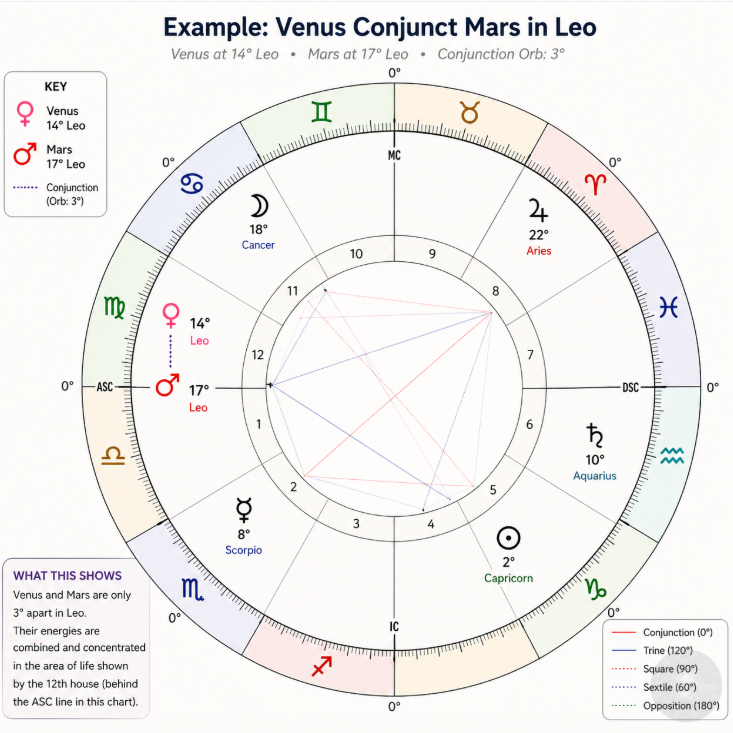
The wheel should show Venus at 14° Leo and Mars at 17° Leo, positioned visibly close together, with the 3° conjunction highlighted.
Is a Conjunction Good or Bad?
Neither. A conjunction is primarily about concentration and combination. Some planets naturally cooperate more easily than others, while certain combinations create more complicated dynamics. Venus conjunct Jupiter may feel very different from Mars conjunct Saturn.
But even apparently difficult combinations can produce strengths. Mars conjunct Saturn, for example, may create frustration when action meets limitation, yet the same combination can symbolize considerable endurance and disciplined effort.
Avoid reducing aspects to good aspect vs. bad aspect. A better question is: What happens when these two planetary functions are forced to operate together?
Why the House Matters
Suppose two people both have Venus conjunct Mars in Leo. One has the conjunction in the 5th House. The other has it in the 10th House.
The first may express the combination particularly strongly through creativity, romance, pleasure, hobbies, or self-expression. The second may experience it more visibly through career, ambition, reputation, or public life.
Same planets. Same conjunction. Same sign. Different area of life. This is why aspects should never be interpreted in isolation.
Understanding Conjunctions in Your Birth Chart
A conjunction in Astrology shows where two planetary functions become closely intertwined. Start with the two planets, calculate the distance between them, then examine their sign, house, orb, and connections with the rest of the chart.
The important idea is simple 0° brings things together.
Once you understand that principle, conjunctions become much easier to recognize—and provide one of the first steps toward reading your Natal Chart as a network of interacting placements rather than a collection of isolated planets.
FAQ
What does conjunction mean in Astrology?
A conjunction occurs when two planets or chart points are positioned close together, creating an aspect centered on 0°.
Is a conjunction a strong aspect?
Yes. Conjunctions can be particularly noticeable because they combine the symbolism of two placements within the same area of the chart.
What is the symbol for conjunction?
The traditional conjunction symbol is ☌.
Can three planets be conjunct?
Yes. Several planets positioned close together can form multiple conjunctions and may also create a stellium, depending on the planets, distances, and definition being used.
Can planets in different signs be conjunct?
Yes. Planets near the boundaries of neighboring signs can form an out-of-sign conjunction if they remain sufficiently close by degree.
Is conjunction the strongest astrological aspect?
It is one of the major aspects and can be extremely influential, particularly when the orb is tight or major planets and chart angles are involved. Its importance still depends on the overall Birth Chart.