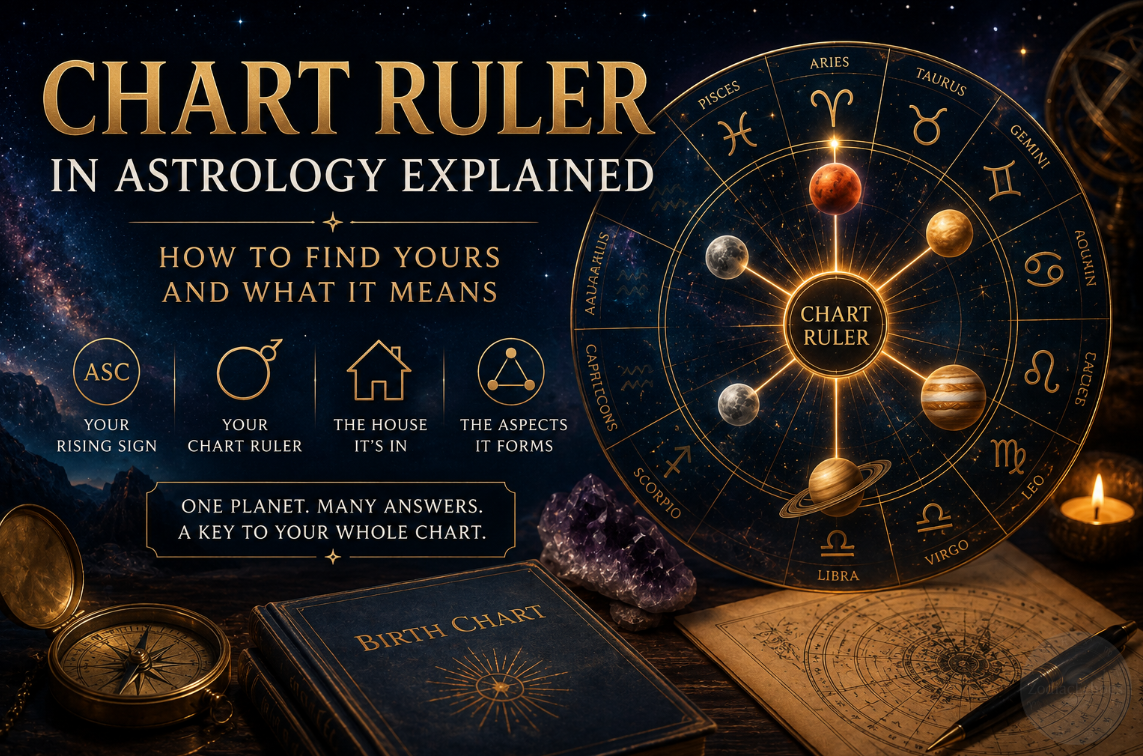
Your Sun sign may be the part of astrology you know best, but there is another planet that can play an especially important role in your Birth Chart: your Chart Ruler.
The Chart Ruler in Astrology is the planet that rules your Rising Sign, or Ascendant. Because the Ascendant represents the beginning of your Birth Chart and influences how you approach life, its ruling planet becomes an important guide to the chart as a whole.
Finding your Chart Ruler is surprisingly simple. Once you know your Rising Sign, you can identify its ruling planet within seconds. The next step is discovering where that planet appears in your Birth Chart—and that is where things become much more personal.
What Is a Chart Ruler in Astrology?
Every zodiac sign is associated with a ruling planet. Aries is ruled by Mars, Taurus by Venus, Gemini by Mercury, and so on. Your Chart Ruler is simply the ruling planet of the zodiac sign occupying your Ascendant.
If you have Aries Rising, Mars is your Chart Ruler. If you have Libra Rising, Venus rules your chart. If you have Sagittarius Rising, your Chart Ruler is Jupiter. The idea becomes more interesting when you locate that ruling planet elsewhere in your Birth Chart.
Suppose you have Libra Rising. Venus is therefore your Chart Ruler—but Venus could be in Gemini, Scorpio, Capricorn, or any other zodiac sign. It could also occupy any of the twelve houses and form aspects with several other planets. All of these factors influence how your Chart Ruler operates.
How to Find Your Chart Ruler
You can find your Chart Ruler in a few simple steps.
Step 1: Find Your Rising Sign
First, calculate your Natal Chart and identify your Rising Sign, also called your Ascendant. Unlike your Sun sign, your Rising Sign changes approximately every two hours. This means an accurate birth time is particularly important. Look for the abbreviation ASC on your Birth Chart. The zodiac sign located there is your Rising Sign.
Step 2: Find the Planet That Rules Your Rising Sign
Once you know your Rising Sign, use the table below to find its ruling planet.
| Rising Sign | Traditional Ruler | Modern Ruler |
|---|---|---|
| Aries | Mars | Mars |
| Taurus | Venus | Venus |
| Gemini | Mercury | Mercury |
| Cancer | Moon | Moon |
| Leo | Sun | Sun |
| Virgo | Mercury | Mercury |
| Libra | Venus | Venus |
| Scorpio | Mars | Pluto |
| Sagittarius | Jupiter | Jupiter |
| Capricorn | Saturn | Saturn |
| Aquarius | Saturn | Uranus |
| Pisces | Jupiter | Neptune |
For most signs, there is only one ruler to remember. Scorpio, Aquarius, and Pisces require a little more explanation, which we’ll cover below.
Step 3: Locate Your Chart Ruler in Your Birth Chart
Now find that planet in your Natal Chart. Look at:
Planet → Zodiac Sign → House → Aspects
These four pieces of information give you a much better understanding of how your Chart Ruler functions. For example:
Libra Rising → Venus → Venus in Gemini → 9th House → Trine Jupiter
That tells you considerably more than simply knowing that Venus rules your chart.
What Does Your Chart Ruler Mean?
Your Rising Sign describes the way you approach the world, respond to new situations, and begin experiences. The Chart Ruler takes that story further. Because it governs your Ascendant, astrologers often examine the Chart Ruler when looking for recurring themes in someone’s personality, priorities, and direction in life.
Think of the Ascendant as the entrance to your Birth Chart and the Chart Ruler as the planet showing where that entrance leads.
- Its zodiac sign describes how the planet expresses itself.
- Its house describes where its energy becomes especially noticeable.
- Its aspects reveal how it interacts with other planets.
This is why two people with exactly the same Rising Sign can still experience it very differently.
Chart Ruler by Zodiac Sign
The zodiac sign containing your Chart Ruler describes the style through which its energy operates. Imagine two people who both have Aries Rising. Both have Mars as their Chart Ruler. But one has Mars in Cancer while the other has Mars in Capricorn.
Mars in Cancer may express drive and assertiveness through emotional, protective, or security-oriented themes. Mars in Capricorn may operate through discipline, ambition, planning, and long-term goals.
Their Ascendants are identical, but their ruling planets tell two different stories. This is one reason Birth Chart interpretation becomes much more precise once you stop examining placements individually and begin connecting them.
Chart Ruler by House
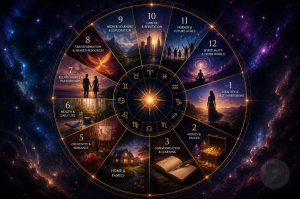
The house containing your Chart Ruler can show an area of life that receives particular emphasis. Here is a simple starting point:
| Chart Ruler House | Main Area of Focus |
|---|---|
| 1st House | Identity, appearance, self-expression |
| 2nd House | Money, possessions, values, security |
| 3rd House | Communication, learning, siblings, local environment |
| 4th House | Home, family, roots, private life |
| 5th House | Creativity, romance, pleasure, children |
| 6th House | Work, routines, service, everyday responsibilities |
| 7th House | Relationships, partnerships, other people |
| 8th House | Intimacy, shared resources, transformation |
| 9th House | Travel, beliefs, education, exploration |
| 10th House | Career, reputation, ambitions, public life |
| 11th House | Friends, communities, networks, future goals |
| 12th House | Inner life, solitude, spirituality, hidden matters |
This does not mean that one house controls your entire life. Rather, the house containing your Chart Ruler can become an important place to investigate when interpreting your overall chart.
Chart Ruler in the 1st House
With your Chart Ruler in the 1st House, themes involving identity, independence, appearance, and self-development can become especially prominent. There may be a strong connection between how you approach life and how you express your individuality.
Chart Ruler in the 2nd House
Money, possessions, security, personal resources, and values may receive greater emphasis. Questions surrounding what you own and what you genuinely value can become important themes.
Chart Ruler in the 3rd House
Communication, information, learning, siblings, and your immediate environment may play a central role. You may be particularly driven to exchange ideas, learn new things, or remain connected with the world around you.
Chart Ruler in the 4th House
Home, family, roots, ancestry, and emotional security may become especially significant. Your private life can have a strong influence on your choices and sense of direction.
Chart Ruler in the 5th House
Creativity, romance, pleasure, hobbies, self-expression, and children may become prominent themes. There can be a strong desire to create, perform, enjoy life, or leave something uniquely yours behind.
Chart Ruler in the 6th House
Daily routines, work, service, responsibilities, and practical organization may receive considerable attention. Much of your development can occur through everyday habits rather than dramatic life events.
Chart Ruler in the 7th House
Relationships and partnerships can become especially important. Other people may play a significant role in your development, and major life experiences may frequently involve cooperation, commitment, or one-to-one relationships.
Chart Ruler in the 8th House
Transformation, intimacy, shared finances, vulnerability, and deeper psychological matters may become recurring themes. Life may periodically push you toward profound changes rather than allowing you to remain on the surface.
Chart Ruler in the 9th House
Travel, higher education, philosophy, spirituality, foreign cultures, and the search for meaning can become particularly significant. You may feel driven to expand your understanding of the world.
Chart Ruler in the 10th House
Career, achievement, reputation, ambition, and public life may become major areas of focus. You may feel a strong need to build something visible or establish a meaningful place in the world.
Chart Ruler in the 11th House
Friendships, communities, social networks, collective projects, and future ambitions may become important. Your direction in life can be strongly influenced by the people and communities around you.
Chart Ruler in the 12th House
Your inner world, solitude, spirituality, imagination, and matters that remain hidden from others may become particularly significant. Much of your personal development may happen privately before becoming visible externally.
Why Aspects to Your Chart Ruler Matter
Finding the Chart Ruler’s house is only part of the interpretation. Next, look at its Astrology Aspects. Aspects describe the angular relationships between planets and reveal how their energies interact.
A Chart Ruler forming a trine with Jupiter tells a different story from the same planet forming a square with Saturn. For example, imagine Venus is your Chart Ruler.
- Venus trine Jupiter may create an easy connection between Venusian themes such as relationships and values and Jupiterian themes such as expansion, optimism, and opportunity.
- Venus square Saturn, however, introduces tension involving Saturn’s themes of boundaries, responsibility, caution, or restriction.
Neither aspect should be interpreted alone as simply good or bad. Instead, they describe different dynamics surrounding one of the most important planets in the chart.
Traditional vs. Modern Chart Rulers
Before Uranus, Neptune, and Pluto were discovered, astrologers used the seven celestial bodies visible to the naked eye: the Sun, Moon, Mercury, Venus, Mars, Jupiter, and Saturn. This created the traditional rulership system.
After the discovery of the outer planets, many modern astrologers assigned them rulership over three signs:
- Scorpio: traditionally Mars, modern ruler Pluto
- Aquarius: traditionally Saturn, modern ruler Uranus
- Pisces: traditionally Jupiter, modern ruler Neptune
You will therefore encounter different approaches.Some astrologers use only traditional rulers. Others primarily use modern rulers, while many consider both planets when interpreting these signs.
If you have Scorpio, Aquarius, or Pisces Rising, examining both rulers can provide additional information. Just be aware that different astrological traditions may prioritize them differently.
Chart Ruler Example: How Everything Comes Together
Imagine someone has:
Aries Rising
The first step is easy. Aries is ruled by Mars, so:
Chart Ruler = Mars
Now suppose Mars is located in Capricorn in the 10th House. The interpretation becomes:
Aries Rising → Mars → Capricorn → 10th House
- Aries Rising already suggests a direct and action-oriented approach to new situations.
- Mars in Capricorn adds a more disciplined, strategic, and goal-oriented style to that drive.
- The 10th House connects the Chart Ruler with career, achievement, reputation, and public ambitions.
Now imagine Mars also forms a trine with Saturn. Suddenly, we have another connection involving discipline, structure, patience, and long-term development.
Instead of interpreting Aries Rising, Mars in Capricorn, the 10th House, and the Mars-Saturn aspect as four unrelated facts, we can see them as parts of one connected pattern. That is the real value of finding your Chart Ruler.

Is Your Chart Ruler the Most Important Planet?
Not necessarily. The Chart Ruler is important, but a Birth Chart should never be reduced to a single planet. Your Sun, Moon, Ascendant, personal planets, houses, aspects, planetary concentrations, and other chart factors all contribute to the overall interpretation.
Some charts may also emphasize another planet very strongly because of its position or numerous aspects. The Chart Ruler is therefore best treated as one of the major threads running through your Birth Chart, rather than a shortcut that explains everything about you.
FAQ
What is my Chart Ruler?
Your Chart Ruler is the planet that rules your Rising Sign. For example, Mars rules Aries Rising, Venus rules Taurus and Libra Rising, and Mercury rules Gemini and Virgo Rising.
Is the Chart Ruler based on my Sun sign?
No. Your Chart Ruler is determined by your Rising Sign, or Ascendant, not your Sun sign.
How do I find my Chart Ruler?
Calculate your Natal Chart, identify the zodiac sign on your Ascendant, and then find the planet that rules that sign. Next, locate that planet’s sign, house, and aspects in your chart.
Can I have two Chart Rulers?
Depending on the astrological system you use, Scorpio, Aquarius, and Pisces Rising can be interpreted using traditional and modern rulers. Many astrologers examine both.
Why is the house of my Chart Ruler important?
The house shows the area of life where the Chart Ruler’s themes are especially likely to appear. For example, a Chart Ruler in the 10th House emphasizes career and public life, while one in the 7th House emphasizes relationships and partnerships.
What if my Chart Ruler is retrograde?
A retrograde Chart Ruler is interpreted using the same basic method, but its planetary themes may be expressed in a more internalized, reflective, or unconventional way. Its sign, house, and aspects remain important.
Find Your Chart Ruler in Your Birth Chart
Understanding the Chart Ruler in Astrology is one of the easiest ways to begin connecting the different pieces of a Natal Chart. Start with your Rising Sign. Find its ruling planet. Then locate that planet’s zodiac sign and house before examining the aspects it forms with the rest of your chart.
Instead of seeing your Birth Chart as dozens of unrelated symbols, you will begin to see how its different parts work together.
Generate your free Natal Chart to discover your Rising Sign, Chart Ruler, planetary placements, houses, aspects, and retrograde planets—and receive your full personalized PDF report completely free.