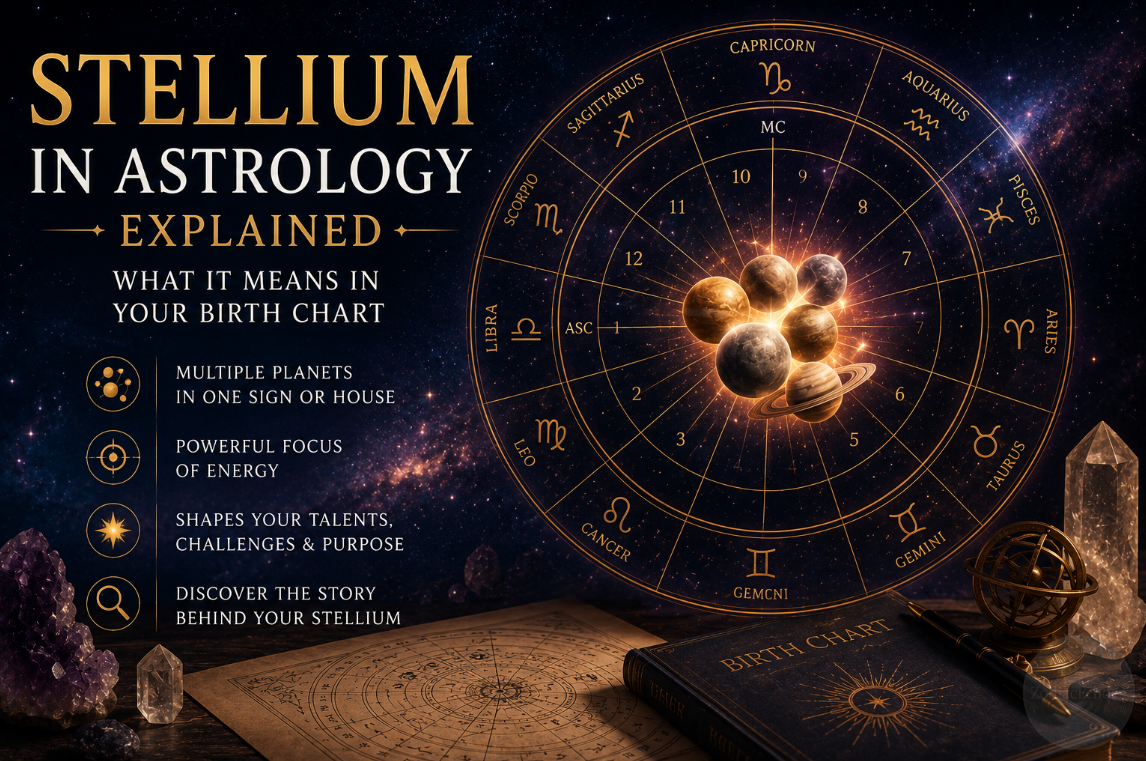
Have you opened your Birth Chart and noticed several planets crowded together in the same zodiac sign or house? You may be looking at a stellium—one of the most noticeable concentrations of planetary energy in astrology.
A Stellium in Astrology occurs when multiple planets gather within a particular area of a Natal Chart. Instead of planetary energy being distributed relatively evenly around the chart, several planets become concentrated around the same sign, house, or region. This can make the themes associated with that part of the chart especially significant.
But identifying a stellium isn’t always as simple as counting planets. Astrologers use different definitions of what qualifies, which planets should be included, and how closely grouped they need to be. Here’s how to recognize a stellium and understand what it may mean in your own Birth Chart.
What Is a Stellium in Astrology?
The word stellium describes a cluster of planets concentrated in a relatively small section of a Birth Chart. Imagine a chart containing planets spread across nearly all twelve zodiac signs. No single part of the wheel immediately dominates.
Now imagine another chart where Mercury, Venus, Mars, and Jupiter are all located in Capricorn. That concentration immediately attracts attention. In astrology, the second chart would likely be described as having a Capricorn stellium.
Because several planets are expressing themselves through Capricorn, themes traditionally associated with the sign—such as ambition, responsibility, structure, persistence, and long-term achievement—may become particularly noticeable.
However, the interpretation does not stop with the zodiac sign. If those planets also occupy the same house, that area of life can receive additional emphasis.
How Many Planets Make a Stellium?
This is where definitions differ. A commonly used modern definition considers three or more planets grouped in the same zodiac sign or astrological house to be a stellium. Other astrologers use stricter rules and require four planets.
Some also consider how closely the planets are positioned by degree rather than simply whether they occupy the same sign.
For example, three planets spread from 1° to 29° of Leo technically occupy the same zodiac sign but are not particularly close together. Another astrologer may reserve the term stellium for planets forming a tighter cluster.
There is therefore no universally accepted numerical rule used by every astrological tradition.
For a beginner, the most useful approach is to treat three or more planets concentrated in the same sign or house as something worth investigating, while remembering that the strength of the grouping depends on the planets and their actual positions.
Stellium in a Zodiac Sign
A sign stellium occurs when several planets occupy the same zodiac sign. The sign acts like a filter through which all those different planetary energies are expressed. For example, imagine:
Mercury + Venus + Mars + Jupiter in Scorpio
- Mercury represents communication and thinking.
- Venus represents relationships, attraction, and values.
- Mars represents action, desire, and motivation.
- Jupiter represents expansion, beliefs, and growth.
Because all four planets occupy Scorpio, many different areas of personality are being expressed through the qualities associated with that sign. The result can make Scorpio themes much more prominent than simply having a Scorpio Sun.
This also explains why someone can strongly resemble a zodiac sign that isn’t their Sun sign. A person with a Gemini Sun but four planets in Taurus may display considerable Taurus energy throughout their personality.
Stellium in an Astrological House
A house stellium concentrates several planets within one of the twelve astrological houses. Instead of emphasizing primarily how the planetary energies operate, the house highlights where in life those energies are expressed.
For example, someone with several planets in the 10th House may experience particularly strong themes involving career, ambition, reputation, achievement, or public life.
A 7th House stellium may place greater emphasis on relationships, partnerships, cooperation, and experiences involving other people. A 4th House stellium can make home, family, roots, privacy, and emotional foundations especially significant. The planets themselves reveal what types of energy are involved.
Stellium in a Sign vs. Stellium in a House
These two types of stellium are related but not identical.
| Stellium Type | What It Mainly Emphasizes |
|---|---|
| Zodiac Sign Stellium | The qualities and expression of one zodiac sign |
| House Stellium | A particular area of life |
| Sign + House Stellium | Both the sign’s qualities and the house’s life themes |
| Personal Planet Stellium | More individualized personality themes |
| Outer Planet Concentration | Potentially broader or generational themes |
A cluster can sometimes qualify as both. For example, Mercury, Venus, Mars, and Jupiter could all occupy Capricorn and all fall within the 6th House. The interpretation would then combine Capricorn qualities with 6th House themes involving daily routines, work, responsibilities, service, and practical organization.
Do the Sun and Moon Count in a Stellium?
Many astrologers count both the Sun and Moon when identifying a stellium, although methods vary. This is another reason you may receive different answers from different astrologers or Birth Chart websites.
The Sun and Moon are not planets astronomically, but astrology traditionally groups them with the planets as major chart bodies and calls them luminaries. Because both are extremely important in Natal Chart interpretation, their presence within a planetary cluster can significantly strengthen its personal relevance.
Do Uranus, Neptune and Pluto Count?
They can, but context matters. Uranus, Neptune, and Pluto move much more slowly through the zodiac than the personal planets. Large groups of people born during the same period therefore share their placements.
For example, an entire generation can have Pluto in the same zodiac sign. A grouping consisting only of slow-moving outer planets may therefore tell us less about an individual’s personality than a stellium involving the Sun, Moon, Mercury, Venus, or Mars.
This doesn’t make outer planets irrelevant. It simply means astrologers usually look carefully at which planets form the concentration before deciding how personally significant it is.
Why Personal Planets Matter in a Stellium
The personal planets are:
- Sun
- Moon
- Mercury
- Venus
- Mars
These bodies move relatively quickly and are closely connected with individual personality and everyday behavior in astrology. When several personal planets form a stellium, the concentration tends to become much more distinctive.
For example, Mercury, Venus, and Mars in Virgo connects thinking, relationships, values, motivation, and action with Virgo themes.
Compare that with Uranus, Neptune, and Pluto grouped together. Because outer-planet combinations can remain similar for many people born over an extended period, their meaning needs more individual context from the rest of the Birth Chart.
What Does a Stellium Mean in Your Birth Chart?
A stellium can create an area of concentrated attention and experience. Think of the Natal Chart as a stage with ten planetary actors. In many charts, those actors are scattered across several different sets. With a stellium, several actors suddenly appear on the same stage. Naturally, more of the story happens there. This can manifest as:
- strong identification with one zodiac sign
- repeated experiences involving one area of life
- unusual talent or interest connected with that area
- challenges that repeatedly demand attention
- an intense focus on particular goals or themes
A stellium should not automatically be interpreted as positive or negative. Much depends on the planets involved and the aspects they form.
How to Interpret a Stellium Step by Step
Once you find a possible stellium, don’t immediately jump to a generic interpretation such as “I have a Leo stellium.” Instead, break it down.
Step 1: Identify the Planets
Which planets form the stellium? A Mercury-Venus-Mars stellium is fundamentally different from Saturn-Uranus-Neptune. Start by understanding what each planet represents.
Step 2: Check the Zodiac Sign
Next, identify the zodiac sign containing the planets. This describes how the planetary energies tend to express themselves. A stellium in fiery Aries operates differently from one in sensitive Cancer or practical Capricorn.
Step 3: Find the House
Now locate the astrological house containing the cluster. The house reveals where in life the concentrated energy is most likely to become noticeable. A Leo stellium in the 2nd House tells a different story from a Leo stellium in the 10th House.
Step 4: Look at the Degrees
Check how closely grouped the planets actually are. Planets within only a few degrees of one another form tighter conjunctions than planets scattered across most of a zodiac sign. This can affect how strongly interconnected their energies are considered.
Step 5: Examine the Aspects
Finally, see what relationships the stellium forms with planets elsewhere in the Birth Chart. A stellium receiving several trines may operate differently from one involved in squares and oppositions. This is where the rest of the chart begins interacting with the concentration.
Example: Capricorn Stellium in the 10th House
Imagine someone has:
Mercury + Venus + Mars + Saturn in Capricorn in the 10th House
- First, look at the planets. Mercury brings communication and thinking. Venus adds relationships and values. Mars represents drive and action. Saturn contributes structure, responsibility, and discipline.
- Next comes Capricorn, traditionally associated with ambition, patience, responsibility, and long-term achievement.
- Finally, all four planets occupy the 10th House, associated with career, reputation, achievement, and public life.
Instead of interpreting four unrelated placements, a clear pattern emerges. Career, long-term goals, responsibility, and achievement could become major recurring themes within this person’s Natal Chart.
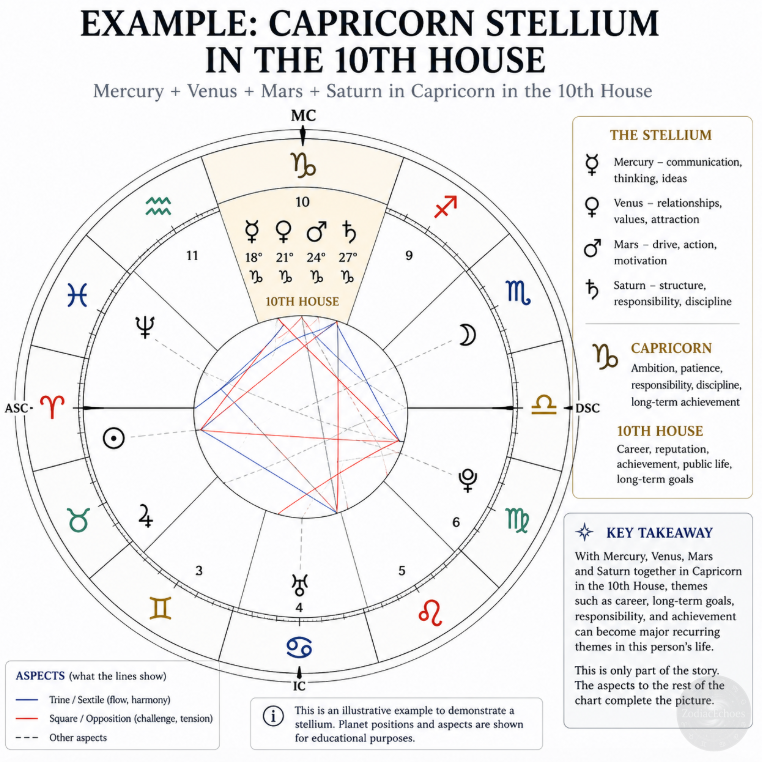
But even this interpretation remains incomplete until we examine the aspects those planets form with the rest of the chart.
Can You Have More Than One Stellium?
Yes. It is possible to have two separate planetary concentrations within the same Birth Chart, although this naturally becomes less common as stricter definitions are used. For example, someone could have three planets concentrated in Gemini and another three grouped in Capricorn.
This can create two particularly emphasized areas of the chart. The relationship between those groups may then become especially interesting, particularly if they form major aspects with one another.
What If You Don’t Have a Stellium?
Nothing is missing from your Birth Chart. Many people do not have a stellium. A chart with planets distributed across many zodiac signs and houses can indicate a wider spread of astrological themes rather than intense concentration in one particular area.
Having a stellium does not make a chart more powerful, unusual, advanced, or important. It is simply one type of planetary pattern. Your Sun, Moon, Rising Sign, Chart Ruler, houses, aspects, and other planetary placements remain meaningful whether or not your chart contains a stellium.
FAQ
What is a Stellium in Astrology?
A stellium is a concentration of multiple planets within one area of a Birth Chart, usually the same zodiac sign or astrological house.
Is three planets a stellium?
Three planets are commonly considered enough to form a stellium in modern astrology, although some astrologers require four or use additional rules involving planetary degrees.
Does the Sun count in a stellium?
Many astrologers count the Sun as part of a stellium. Although the Sun is technically a star rather than a planet, astrology treats it as one of the most important bodies in Natal Chart interpretation.
Does the Moon count in a stellium?
Yes, many astrologers include the Moon. Like the Sun, it is technically a luminary rather than a planet but plays a major role in Birth Chart interpretation.
Can you have a stellium in a house but not a sign?
Yes. Because house boundaries and zodiac sign boundaries do not necessarily align, several planets can occupy the same house while falling into different zodiac signs.
Is having a stellium rare?
Stelliums are less common than charts without strong planetary concentrations, but they are not extraordinarily rare. How common they appear also depends on whether you define a stellium as three planets, four planets, or use stricter degree requirements.
Is a stellium good or bad?
Neither. A stellium creates concentrated energy and emphasis. Whether that feels easy, challenging, or a mixture of both depends on the planets, sign, house, and aspects involved.
Find the Stelliums in Your Birth Chart
A Stellium in Astrology can reveal where several different planetary energies converge around the same themes. It may emphasize a zodiac sign, concentrate attention within one astrological house, or create an especially noticeable pattern connecting several important parts of your personality.
But simply knowing that you have a stellium is only the beginning. Identify the planets involved, examine their zodiac sign and house, check how closely they are grouped, and then look at the aspects connecting them with the rest of your chart.
Generate your free Natal Chart to discover your planetary placements, houses, aspects, Chart Ruler, retrograde planets, and potential stelliums—and receive your full personalized PDF report completely free.