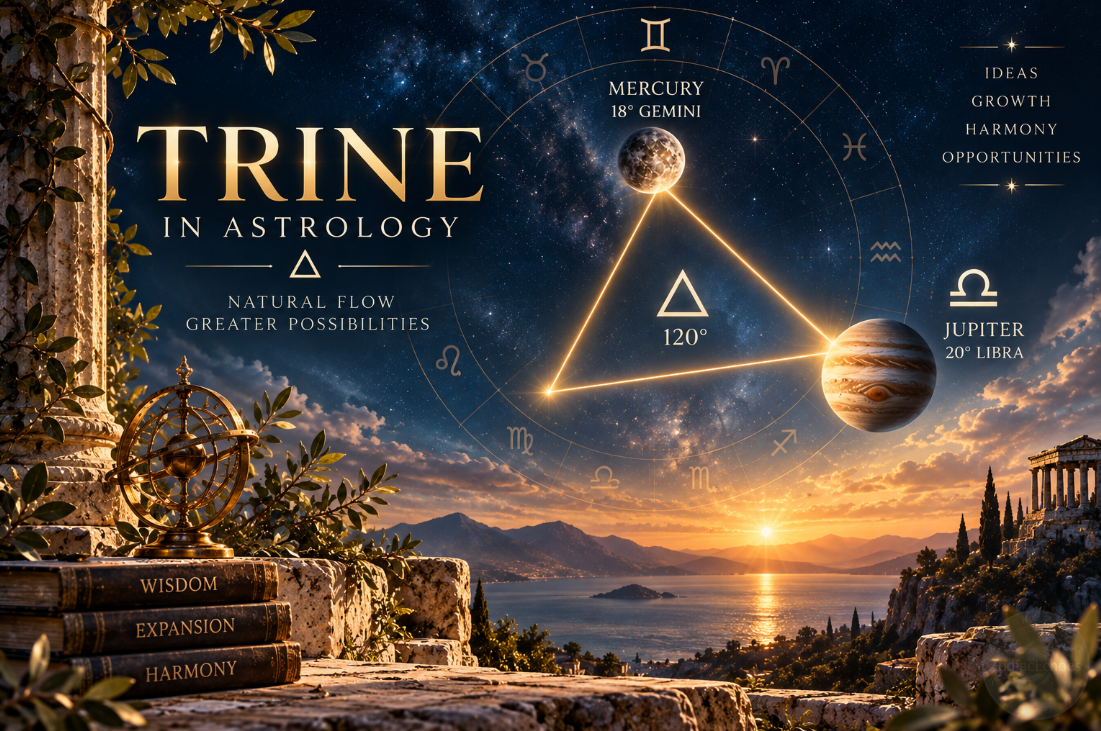
Some parts of a Birth Chart create friction. Others seem to work together almost automatically. A person may possess an ability they barely recognize as unusual because using it feels completely natural. Two seemingly different parts of their personality may support rather than compete with each other.
This is the basic idea behind a trine in Astrology. At approximately 120°, two planetary functions form a harmonious relationship that traditionally represents flow, cooperation, and abilities that may require less conscious effort to access.
What Is a Trine in Astrology?
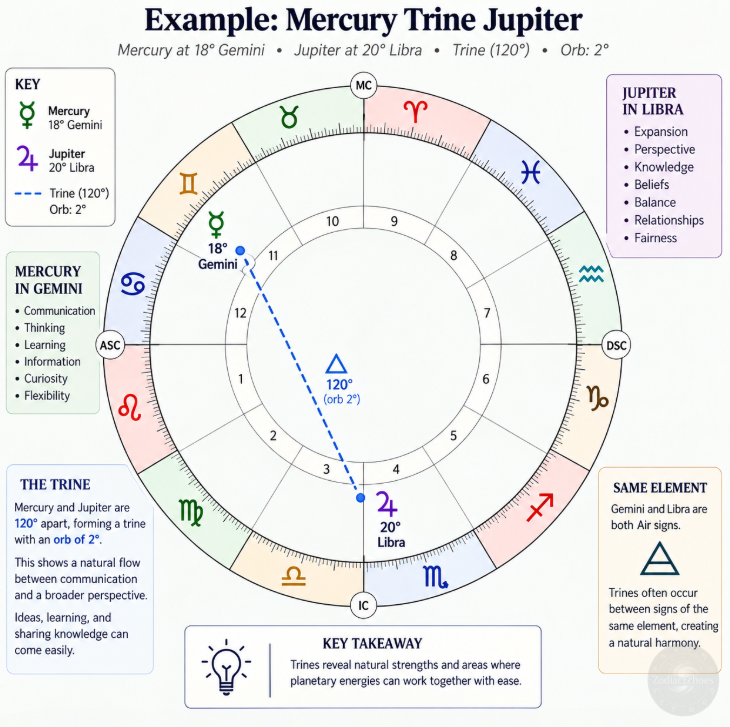
A trine occurs when two planets are approximately 120° apart. Imagine Mercury at 18° Gemini and Jupiter at 20° Libra. The exact trine from 18° Gemini would fall at 18° Libra. Jupiter is at 20° Libra, creating a: Trine with an orb of 2°
Mercury represents thinking, communication, learning, and information. Jupiter represents expansion, perspective, beliefs, knowledge, and growth. The trine suggests these functions may cooperate relatively easily.

How Does a Trine Work?
Where a square creates pressure, a trine tends to create flow. For example:
- Sun trine Jupiter may connect identity and confidence with optimism, expansion, or a broader perspective.
- Moon trine Venus can create an easy relationship between emotional needs, affection, pleasure, and connection.
- Mercury trine Saturn may allow communication and thinking to cooperate naturally with structure, patience, and discipline.
But “easy” does not mean “perfect.” Someone may overlook a trine precisely because the ability it represents feels so natural. A talent that requires little struggle can also receive little deliberate development.
What Is the Orb of a Trine?
An exact trine measures 120°, but astrologers allow some variation. A useful beginner guideline is:
| Orb | General Interpretation |
|---|---|
| 0°–2° | Very tight trine |
| 3°–5° | Strong trine |
| 6°–8° | Wider trine |
| Beyond 8° | Depends on planets and method |
The Sun and Moon are often allowed wider orbs than asteroids and less prominent chart points. As always, tighter major-planet aspects usually deserve more attention.
Which Signs Form Trines?
Trines commonly connect signs belonging to the same element.
| Element | Signs |
|---|---|
| Fire | Aries, Leo, Sagittarius |
| Earth | Taurus, Virgo, Capricorn |
| Air | Gemini, Libra, Aquarius |
| Water | Cancer, Scorpio, Pisces |
This helps explain their natural compatibility. Fire signs share an emphasis on action and inspiration. Earth signs emphasize practicality and stability. Air signs connect through ideas and communication, while Water signs share emotional and intuitive qualities. However, actual aspects depend on degrees. Out-of-sign trines are possible near sign boundaries.
Common Trines
| Trine | Potential Strength |
|---|---|
| Sun trine Jupiter | Confidence + expansion |
| Moon trine Venus | Emotions + affection |
| Mercury trine Saturn | Thinking + structure |
| Venus trine Jupiter | Values + optimism |
| Mars trine Saturn | Action + discipline |
| Mars trine Pluto | Drive + determination |
These combinations are starting points. Houses and signs tell us where and how the potential is expressed.
Example: Mercury Trine Jupiter
Imagine someone has Mercury at 18° Gemini, Jupiter at 20° Libra. The planets are approximately 122° apart, producing a trine with an: Orb of 2°.
Mercury describes communication, thinking, learning, and processing information. Jupiter adds broader perspective, knowledge, expansion, beliefs, and the search for meaning. Gemini emphasizes curiosity, information, flexibility, and communication. Libra adds comparison, balance, relationships, and the ability to consider different viewpoints.
Together, this trine could support an ability to connect individual pieces of information with a broader perspective. The person might find it relatively natural to explain ideas, compare viewpoints, learn through discussion, or communicate complicated subjects in an accessible way.
But the trine does not guarantee exceptional intelligence or academic success. It describes cooperation between two planetary functions, not a predetermined outcome.
Why Houses Still Matter
The same Mercury–Jupiter trine can operate very differently depending on its houses.
Across the:
3rd House △ 7th House
communication, learning, partnerships, and one-to-one interaction may become especially relevant.
Across the:
6th House △ 10th House
the same abilities may become more visible through work, routines, career, or public responsibilities.
The aspect describes how the planets cooperate. The houses help reveal where that cooperation matters.
Is a Trine Always Good?
Trines are traditionally called beneficial aspects, but that description can be too simplistic. Ease is useful. Yet challenge often forces development, while natural abilities can be taken for granted. Someone with a strong trine might think: “Doesn’t everyone find this easy?”
Sometimes they do not recognize the strength until circumstances require them to use it deliberately. The most useful interpretation therefore isn’t simply: Trine = good. It is:
- Trine = planetary functions that can work together with relatively little friction.
What someone does with that potential remains another question.
Trine vs. Square
The geometric difference illustrates the interpretive difference nicely.
- Square = 90° → friction and pressure
- Trine = 120° → flow and cooperation
Squares may push us to develop abilities because something repeatedly demands attention. Trines can describe abilities already available with comparatively little resistance. Neither is inherently better. One creates pressure to develop. The other provides resources that may already be available.
Understanding Trines in Your Birth Chart
A trine in Astrology shows where two planetary functions may cooperate naturally. Its central principle is simple: 120° creates flow.
Look at the planets first, followed by their signs, houses, orb, and surrounding aspects. And don’t dismiss a trine simply because it feels easy. Sometimes the most valuable abilities in a Natal Chart are precisely the ones we use so naturally that we forget they are strengths at all.
FAQ
What does a trine mean in Astrology?
A trine occurs when two planets or chart points are approximately 120° apart and traditionally represents flow and cooperation between them.
What is the symbol for a trine?
The traditional symbol is △.
Is a trine a good aspect?
It is generally considered harmonious, but that does not guarantee positive outcomes. It describes ease between planetary functions.
Do trines always involve the same element?
Often, but not always. Out-of-sign trines can occur because aspects are ultimately determined by degrees.
Can you have several trines?
Yes. Three planets forming interconnected trines can sometimes create a larger aspect pattern known as a Grand Trine.