Key Points
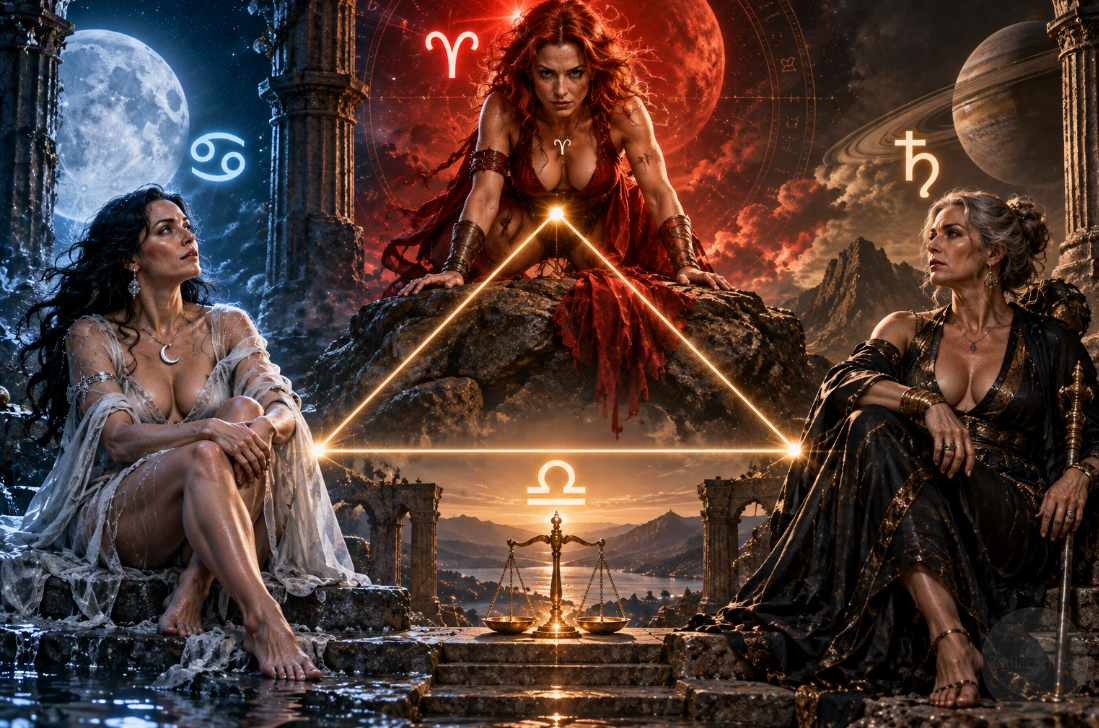
- A T-Square is an aspect pattern involving at least three planets or important chart points.
- It consists of one opposition and two squares.
- The three placements create a distinctive T-shaped pattern in the Natal Chart.
- The planet forming squares to both ends of the opposition is called the apex planet.
- The apex planet often becomes a major focus for the tension and activity within the pattern.
- T-Squares are traditionally considered challenging, but they can also generate motivation, persistence, and considerable drive.
- The apparently empty fourth point opposite the apex is sometimes called the missing leg or release point.
A single square can create pressure. An opposition can pull two planetary functions in different directions. Put them together and you get one of the most recognizable dynamic patterns in a Birth Chart: the T-Square.
Unlike the natural flow associated with a Grand Trine, a T-Square contains tension that is difficult to ignore. Three placements become connected in a system of competing pressures, often creating a strong need to act, adjust, solve problems, or find another way forward.
What Is a T-Square in Astrology?
A T-Square contains three basic components:
1 opposition + 2 squares
Imagine someone has:
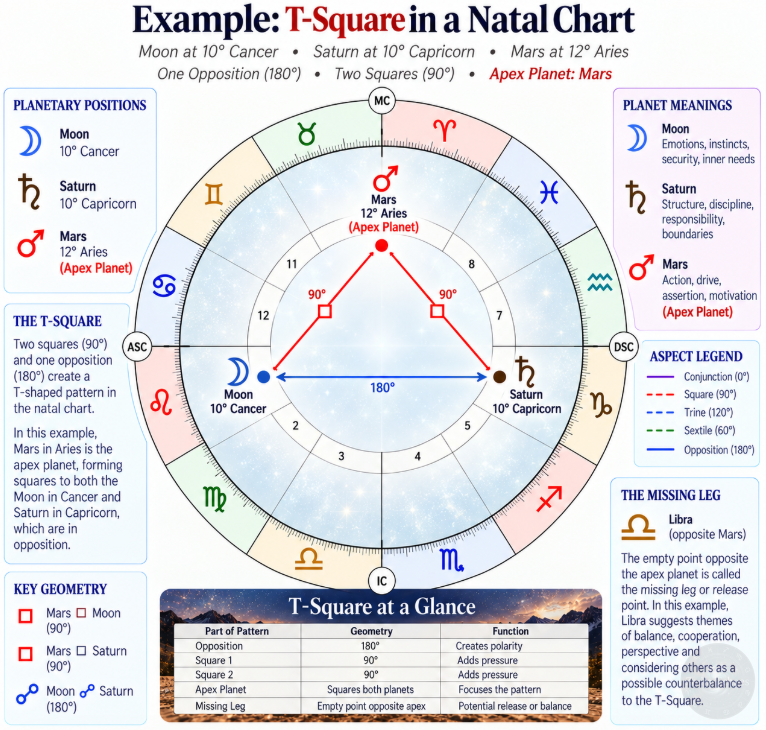
Moon at 10° Cancer
Saturn at 10° Capricorn
Mars at 12° Aries
First, look at the Moon and Saturn. Cancer and Capricorn sit opposite each other, creating:
Moon ☍ Saturn — 180°
Mars in Aries then forms approximately 90° angles to both:
Mars □ Moon — 90°
Mars □ Saturn — 90°
Connect those three aspects inside a Natal Chart and they create the characteristic T shape.
| Part of Pattern | Geometry | Function |
|---|---|---|
| Opposition | 180° | Creates polarity |
| Square 1 | 90° | Adds pressure |
| Square 2 | 90° | Adds pressure |
| Apex Planet | Squares both planets | Focuses the pattern |
What Is the Apex Planet?
The apex planet is one of the most important parts of a T-Square. It is the planet that forms a square with both ends of the opposition. In our example: Mars at 12° Aries = Apex Planet
The Moon–Saturn opposition already creates tension between emotional needs and structure, responsibility, or restraint. Mars becomes the point through which much of that tension may seek expression. Mars represents action, assertion, motivation, competition, anger, and initiative.
This could make taking action particularly important when the person feels caught between emotional security and responsibility. But it could also create a tendency to react before those competing needs have been properly understood. The apex does not automatically “solve” the T-Square. It shows where much of its energy becomes concentrated.
Cardinal, Fixed, and Mutable T-Squares
T-Squares frequently occur within one modality.
| T-Square | Signs Involved | General Emphasis |
|---|---|---|
| Cardinal | Aries, Cancer, Libra, Capricorn | Action, initiation, movement |
| Fixed | Taurus, Leo, Scorpio, Aquarius | Persistence, stability, resistance |
| Mutable | Gemini, Virgo, Sagittarius, Pisces | Adaptation, ideas, changing conditions |
Our Moon–Saturn–Mars example forms a Cardinal T-Square. Cancer, Capricorn, and Aries are all Cardinal signs. This reinforces themes involving initiative, action, direction, and the pressure to do something rather than remain passive.
Example: Moon–Saturn–Mars T-Square
Let’s put the complete example together:
Moon — 10° Cancer
Saturn — 10° Capricorn
Mars — 12° Aries
The Moon represents emotional needs, instinct, security, and internal reactions. Saturn represents structure, boundaries, responsibility, discipline, and limitation. Mars represents action, assertion, drive, and motivation.
The Moon–Saturn opposition could create a recurring polarity between emotional security and responsibility or self-control. Mars in Aries then squares both. Because Mars is also naturally associated with direct action, the person may feel considerable pressure to respond whenever that underlying tension becomes activated.
At its least constructive, this could produce impatience or reactive behavior. Used more deliberately, however, the same configuration may provide significant drive, courage, persistence, and willingness to confront difficult situations. The T-Square does not predict which expression will occur. It shows the structure of the tension.
What Is the Missing Leg of a T-Square?
A T-Square occupies three points of what could geometrically become a Grand Cross. That leaves one position empty. In our example, the apex is Mars in Aries. Directly opposite Aries lies Libra. This is sometimes called the missing leg, empty leg, or release point of the T-Square.
Some astrologers interpret this area as a useful symbolic counterbalance to the concentrated pressure of the apex. For our example, Libra introduces themes such as cooperation, perspective, negotiation, balance, and considering other people.
That provides an interesting contrast to the direct action of Mars in Aries. However, the missing leg should not be treated as a magical solution to the entire pattern. It is better understood as another area to consider when interpreting its geometry.
Why Houses Matter
Signs describe how the T-Square operates. Houses reveal where its tensions may become particularly noticeable.
A T-Square connecting the 1st → 4th → 10th Houses may strongly involve identity, private foundations, family, career, and public direction. Move the same planets into different houses and the practical expression changes. This is why identifying a T-Square is only the beginning.
Is a T-Square Bad?
T-Squares are traditionally considered challenging because they contain three hard aspects. But difficult does not mean useless. The pattern provides very little opportunity to simply ignore the planets involved. Something repeatedly demands adjustment. That can create frustration, but it can also produce determination and problem-solving ability.
Compare it with the Grand Trine:
- Grand Trine → natural flow
- T-Square → concentrated pressure
The Grand Trine may provide abilities that come relatively easily. The T-Square may create abilities because something repeatedly has to be worked through. Neither pattern determines whether someone succeeds or fails. They describe different internal dynamics.
Understanding a T-Square in Your Birth Chart
A T-Square in Astrology combines three challenging aspects into one interconnected structure: one opposition + two squares. The opposition creates polarity. The squares create pressure.
And the apex planet becomes a major point through which that energy seeks expression. Rather than treating a T-Square simply as a difficult feature of the Natal Chart, look at what its geometry actually demands. Sometimes the placements that create the most friction are also the ones that give us the strongest reason to move, adapt, and develop.
FAQ
What does a T-Square mean in Astrology?
A T-Square is an aspect pattern consisting of one opposition and two squares, connecting at least three planets or important chart points.
What is the apex planet in a T-Square?
The apex is the planet that forms a square with both planets in the opposition. It often becomes a major focal point of the pattern.
Is a T-Square rare?
T-Squares are less common than individual squares or oppositions because several planets must occupy compatible positions simultaneously, but they are not exceptionally rare in Natal Charts.
What is the missing leg?
The missing leg is the empty fourth point opposite the apex planet. Some astrologers use its sign and house as an additional interpretive counterbalance.
Can a T-Square become a Grand Cross?
Yes. If another planet occupies the missing fourth position and forms the necessary aspects, the configuration can create a Grand Cross.
✨ Explore More from Zodiac Echoes ✨Explore More from ZE
Choose your zodiac sign to explore daily, weekly, monthly, and yearly horoscopes.