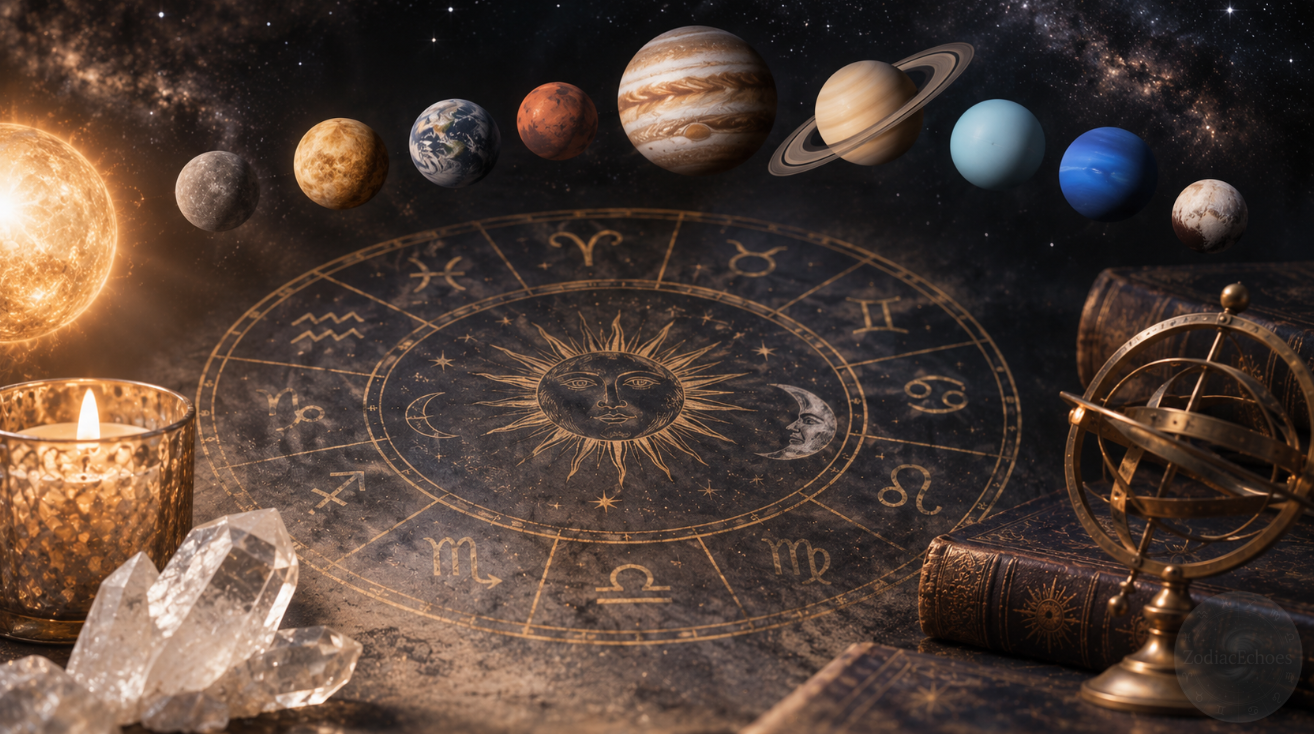
- Each of the ten major astrological bodies represents a different principle, from personality and emotions to love, ambition, luck, and transformation.
- The Sun, Moon, Mercury, Venus, and Mars describe fundamental aspects of identity, relationships, communication, and personal motivation.
- Jupiter and Saturn symbolize expansion and opportunity on one side, discipline and responsibility on the other.
- Uranus, Neptune, and Pluto represent broader themes of change, imagination, spiritual awareness, and profound transformation.
Why do some people seem naturally confident while others are guided by their emotions? What determines the way you fall in love, pursue success, handle money, or respond to difficult situations? According to astrology, the answers involve much more than your zodiac sign.
Every birth chart contains a complex arrangement of planets, each representing a particular dimension of human experience. Some describe your personality and emotional needs, while others symbolize ambition, relationships, personal growth, or the challenges you encounter throughout life.
Astrologers traditionally work with ten major celestial bodies: the Sun, Moon, Mercury, Venus, Mars, Jupiter, Saturn, Uranus, Neptune, and Pluto. Although the Sun and Moon are not planets in astronomy, and Pluto is classified as a dwarf planet, all ten are commonly grouped together as planets in astrological interpretation.
Understanding their symbolic meanings can help explain why two people born under the same zodiac sign may have remarkably different personalities. Your Sun sign reveals only one part of your astrological identity. The positions of the other planets add further layers to the story.
1. Sun: Personality, Identity, and Self-Confidence
The Sun represents the center of your personality. It symbolizes your conscious identity, vitality, willpower, self-expression, and the qualities that make you feel most authentically yourself. In a birth chart, its zodiac position determines the Sun sign most people associate with their horoscope.
Traditional astrology connects the Sun with the masculine principle, authority, leadership, and the archetype of the father. It also represents the desire to create, achieve, and establish a recognizable place in the world. While the Moon reflects your emotional responses, the Sun describes the person you consciously strive to become.
A prominent Sun may be interpreted as a sign of confidence, ambition, determination, and a strong sense of purpose. Its more challenging expression can involve arrogance, excessive pride, or the need to dominate situations and receive constant recognition.
The Sun’s placement by sign and house offers additional symbolic insight into how you express your individuality. Someone with the Sun in Leo may seek creative recognition, while a person with the Sun in Virgo may build their identity around usefulness, competence, and careful attention to detail.
The central question of the Sun is simple: Who am I, and how do I express my true nature?
2. Moon: Emotions, Intuition, and Family Life
Where the Sun symbolizes conscious identity, the Moon represents your inner emotional world. It is associated with feelings, instinctive reactions, memories, personal security, and the need to belong somewhere.
In traditional astrology, the Moon embodies the feminine principle and the archetype of motherhood. It is closely connected with nurturing, fertility, tenderness, family relationships, and the emotional atmosphere of the home. The Moon symbolizes the place where you can withdraw from external pressures and feel protected.
Its position in your birth chart is believed to describe how you respond emotionally when life becomes difficult. Some Moon signs seek reassurance through conversation, others need privacy, and some regain their balance through activity, familiar routines, or close physical affection.
The Moon also relates to intuition and subconscious habits. Unlike the Sun, which encourages deliberate action, lunar symbolism concerns responses that arise almost automatically, sometimes before you have consciously understood what you are feeling.
For this reason, two people with the same Sun sign may behave very differently in intimate relationships. Their Moon signs can symbolize contrasting emotional needs, approaches to family life, and ways of seeking comfort.
- Discover your emotional nature: Try our ZodiacEchoes Moon Sign Calculator to explore the Moon’s position in your birth chart.
3. Mercury: Communication, Intelligence, and Learning
Mercury is the messenger of the astrological world. It represents communication, curiosity, reasoning, language, memory, and the ability to process information quickly. Its symbolism includes everything from ordinary conversations to complex negotiations and intellectual discoveries.
Someone with a strongly emphasized Mercury may be described as articulate, observant, adaptable, and interested in learning. This planetary principle encourages exchanging ideas, asking questions, connecting information, and finding practical solutions through thought and discussion.
Mercury is also associated with commerce, trade, writing, education, and the movement of information. It governs the symbolic exchange of goods, knowledge, promises, and messages, making it particularly relevant to occupations involving communication or negotiation.
However, intelligence and wisdom are not necessarily the same thing. Mercury represents the speed and flexibility of the mind rather than the deeper philosophical understanding traditionally associated with Jupiter.
Its challenging expression can include nervousness, excessive analysis, gossip, scattered attention, and the tendency to speak before thinking. A person may possess a brilliant mind but struggle to direct it toward a consistent purpose.
Mercury’s zodiac placement is therefore interpreted as an indication of how you think, learn, communicate, and make sense of the world.
4. Venus: Love, Beauty, and Personal Values
When astrologers discuss romance, attraction, and relationships, Venus is one of the first planets they examine. Named after the Roman goddess of love and beauty, Venus represents affection, pleasure, sensuality, aesthetics, and the desire to experience harmony.
Its influence extends beyond romantic relationships. Venus also symbolizes artistic taste, music, fashion, decoration, and the things that bring enjoyment into everyday life. It describes what you find beautiful and what makes you feel appreciated.
In relationships, Venus is associated with the way you express affection and the qualities you find attractive in others. Some Venus placements emphasize tenderness and emotional closeness, while others suggest a preference for independence, excitement, intellectual connection, or physical affection.
Venus also concerns personal values. What do you consider worth protecting? What are you willing to invest your time, attention, or money in? Your answers may reveal priorities traditionally connected with this planet.
Its more difficult expressions can include vanity, possessiveness, superficiality, excessive indulgence, or becoming overly dependent on another person’s approval. Venus ultimately asks what you love, what you value, and what brings genuine pleasure into your life.
- Explore your romantic personality: Try our ZodiacEchoes Venus Sign Calculator to discover what your Venus placement reveals about love and attraction.
5. Mars: Courage, Ambition, and Sexual Desire
Mars represents action, physical energy, courage, and the instinct to pursue what you want. In traditional astrology, it embodies the warrior archetype and is associated with competition, determination, confrontation, and the willingness to overcome obstacles.
While Venus seeks attraction and harmony, Mars symbolizes desire in motion. It describes the energy behind pursuing romantic interests, defending personal boundaries, competing for recognition, and taking decisive action.
Mars also governs themes traditionally associated with sexual passion, physical attraction, athletic ability, and personal assertiveness. Its placement may be interpreted as a clue to how directly someone expresses desire or responds to challenges.
A person with a prominent Mars may demonstrate remarkable determination, resilience, and enthusiasm for competition. This can be useful in professional life, sports, entrepreneurship, or any situation requiring initiative and courage.
However, Mars has a more confrontational side. Anger, impatience, aggression, and unnecessary conflict are among its traditional negative associations. When the desire to win becomes more important than the consequences, its symbolism turns destructive.
The challenge of Mars is learning to use strength constructively. Courage becomes most valuable when combined with judgment, self-control, and a clear understanding of what is worth fighting for.
6. Jupiter: Luck, Prosperity, and Wisdom
Jupiter is traditionally known as the great benefic, the planet of good fortune, expansion, and opportunity. Its symbolism includes prosperity, generosity, optimism, personal growth, and the belief that life offers possibilities beyond present limitations.
In mythology, Jupiter was the king of the Roman gods. Astrologically, this powerful image is reflected in themes of authority, abundance, reputation, and the desire to achieve something meaningful.
Jupiter is also associated with education, philosophy, travel, religion, and the search for wisdom. Unlike Mercury, which focuses on collecting and exchanging information, Jupiter encourages people to understand the broader significance of what they learn.
Its placement in a birth chart is traditionally interpreted as an indication of where someone may find opportunities for growth, develop confidence, or experience a sense of abundance.
In financial matters, Jupiter symbolizes expansion, investment, resources, and the management of material prosperity. It can represent generosity and successful growth, but its more excessive expression may involve extravagance, unrealistic expectations, or taking unnecessary risks.
Jupiter reminds us that growth involves more than accumulating money. Knowledge, meaningful experiences, personal development, and the ability to share opportunities with others can also represent forms of wealth.
- Discover your potential for growth: Try our ZodiacEchoes Jupiter Sign Calculator to explore the astrological meaning of Jupiter in your birth chart.
7. Saturn: Responsibility, Discipline, and Life Lessons
If Jupiter represents expansion and opportunity, Saturn symbolizes structure, restrictions, time, and responsibility. It is traditionally regarded as one of astrology’s most demanding planetary influences because its lessons often involve patience, persistence, and accepting the consequences of personal decisions.
Saturn is associated with rules, obligations, authority figures, boundaries, and the gradual process of building something lasting. Its influence is rarely described as effortless. Instead, it emphasizes achievements that require commitment and sustained work.
In a birth chart, Saturn’s placement may be interpreted as an indication of where a person encounters recurring challenges, fears, or responsibilities. These experiences are traditionally understood as opportunities to develop maturity and resilience.
Someone influenced strongly by Saturn may be exceptionally disciplined, reliable, ambitious, and capable of handling demanding responsibilities. However, this same symbolism can also involve pessimism, emotional reserve, excessive caution, or the feeling that life is constantly testing personal endurance.
Saturn also represents time. Some ambitions cannot be fulfilled immediately, and some abilities become valuable only after years of experience. In this sense, Saturn encourages long-term thinking rather than instant gratification.
Its central lesson is that meaningful success often depends on accepting limits, developing patience, and learning from repeated difficulties.
8. Uranus: Freedom, Revolution, and Unexpected Change
Uranus is astrology’s revolutionary. It symbolizes independence, originality, innovation, rebellion, and the sudden changes that challenge established ways of thinking.
Where Saturn seeks stability and carefully maintained structures, Uranus questions whether those structures are still necessary. Its influence is traditionally associated with breaking conventions, exploring unfamiliar possibilities, and refusing to accept restrictions simply because they have always existed.
Uranus also represents technological progress, scientific discovery, unconventional ideas, and the desire for personal freedom. Its symbolism is frequently connected with inventors, reformers, independent thinkers, and people who challenge social expectations.
In an individual birth chart, Uranus may describe the areas of life where someone seeks autonomy or feels compelled to express their uniqueness. A strong Uranian influence can suggest creativity, intellectual independence, and the ability to recognize possibilities that others overlook.
However, constant rebellion can become as restrictive as excessive obedience. Uranus is also associated with impatience, unpredictability, instability, and making dramatic changes without considering their consequences.
Its deeper message concerns finding the balance between independence and responsibility. Genuine progress does not always require destroying everything that came before it.
- Explore your independent side: Try our ZodiacEchoes Uranus Sign Calculator to discover the symbolism of Uranus in your natal chart.
9. Neptune: Dreams, Imagination, and Spirituality
Neptune governs the mysterious territory between imagination and reality. In astrology, it symbolizes dreams, intuition, spirituality, artistic inspiration, compassion, and the subconscious mind.
Its influence is traditionally associated with music, poetry, visual art, mysticism, and the ability to perceive meaning beyond ordinary practical concerns. Neptune encourages people to explore possibilities that cannot always be explained through logic alone.
Someone with a strongly emphasized Neptune may possess a rich imagination, emotional sensitivity, creative talent, or a deep interest in spiritual questions. The planet’s symbolism also involves empathy and the desire to connect with something greater than individual ambition.
However, Neptune has a complicated relationship with truth. The same imagination that inspires remarkable creativity can also encourage unrealistic expectations, idealization, and self-deception.
Its challenging expressions include confusion, escapism, indecision, blurred boundaries, and the tendency to overlook uncomfortable realities. In relationships, Neptune may symbolize romantic idealism that makes it difficult to distinguish genuine affection from imagined potential.
The lesson of Neptune is to preserve imagination without losing the ability to recognize reality. Dreams can inspire meaningful achievements, but they become more useful when supported by practical understanding.
10. Pluto: Transformation, Power, and Hidden Desires
Pluto represents some of astrology’s most intense themes: power, transformation, secrecy, obsession, and profound psychological change. Its symbolism concerns experiences that challenge established identities and force people to confront aspects of themselves they would rather ignore.
Unlike Uranus, which is associated with sudden disruption and innovation, Pluto represents transformation at a deeper level. Its influence is traditionally connected with endings, renewal, and the process of rebuilding life after a significant turning point.
Pluto also symbolizes hidden motivations, control, manipulation, and the desire to understand what lies beneath the surface. It is associated with psychological insight, secrets, taboo subjects, and situations involving complicated power dynamics.
In a birth chart, Pluto’s placement may be interpreted as an indication of where someone experiences intense personal development or encounters questions involving trust, vulnerability, and control.
Its more difficult expressions include jealousy, possessiveness, destructive ambition, and the inability to release situations that have already reached their natural conclusion.
Yet Pluto also represents remarkable resilience. Its symbolism suggests that even painful endings can become the beginning of a completely different chapter. Transformation may require confronting uncomfortable truths, but it can also reveal strengths that were previously hidden.
- Discover your transformative potential: Try our ZodiacEchoes Pluto Sign Calculator to explore Pluto’s meaning in your birth chart.
How the Ten Astrological Planets Work Together
Although each planet represents a different principle, astrologers do not interpret them as completely separate influences. A birth chart is understood as a network of relationships between planetary placements, zodiac signs, houses, and aspects.
For example, the Sun may describe someone’s conscious identity, while the Moon represents emotional needs that do not always agree with that identity. Venus may symbolize a desire for harmony in relationships, while Mars introduces a stronger need for independence or passionate expression.
Jupiter may encourage ambitious expansion, while Saturn asks whether those ambitions are realistic and sustainable. Uranus can challenge established patterns, Neptune introduces imagination and idealism, and Pluto symbolizes the deeper transformations that follow major life experiences.
The zodiac sign occupied by each planet changes how its symbolism is interpreted. Mars in Aries, for example, is traditionally associated with direct action and initiative, while Mars in Libra may express its assertiveness through negotiation, relationships, and questions of fairness.
Astrologers also consider the houses in which planets appear. These twelve divisions of the birth chart correspond to different areas of life, including identity, finances, communication, home, relationships, career, and personal development.
Finally, planetary aspects describe the angular relationships between celestial bodies. A conjunction, square, trine, or opposition may suggest that two planetary principles reinforce one another, create tension, or require greater integration. For this reason, knowing your Sun sign alone provides only a limited view of your complete astrological profile.
Conclusion
The ten major planets in astrology represent ten different principles through which astrologers interpret personality, relationships, ambitions, opportunities, and personal transformation.
The Sun represents identity, the Moon emotions, Mercury communication, Venus love, and Mars action. Jupiter symbolizes expansion and good fortune, Saturn responsibility and discipline, Uranus change and independence, Neptune imagination and spirituality, and Pluto transformation and hidden power.
Understanding these meanings provides a foundation for exploring a natal chart. Each placement contributes another layer to the symbolic picture, helping explain why individuals with the same zodiac sign may express their personalities in very different ways.
Astrology is a symbolic interpretive tradition rather than a scientifically established method of predicting personality or destiny. Nevertheless, its planetary archetypes continue to offer an interesting framework for reflection on human behavior, motivations, and personal growth.
Cosmic Highlights

FAQ
What are the ten planets used in astrology?
The ten major astrological bodies are the Sun, Moon, Mercury, Venus, Mars, Jupiter, Saturn, Uranus, Neptune, and Pluto. Although the Sun and Moon are not astronomical planets and Pluto is classified as a dwarf planet, all ten are traditionally included in astrological chart interpretation.
Which planet rules love in astrology?
Venus is traditionally associated with love, attraction, beauty, romance, pleasure, and personal values. Mars also contributes to relationship interpretations through its associations with passion, desire, and physical attraction.
Which planet represents luck and prosperity?
Jupiter is traditionally considered the planet of good fortune, abundance, opportunity, wisdom, and expansion. Its natal placement is interpreted as a symbolic indication of potential areas for personal growth.
Which planet represents career success and ambition?
Several planets contribute to career interpretations. The Sun represents personal ambition and identity, Mars symbolizes initiative, Jupiter expansion, and Saturn discipline and long-term achievement. Astrologers also examine the Midheaven and tenth house.
What is the difference between the Sun sign and Moon sign?
The Sun sign represents conscious identity, vitality, and self-expression, while the Moon sign symbolizes emotional needs, instinctive reactions, and the desire for security. Both are determined by the positions of these celestial bodies at birth.
Which planets are associated with major life changes?
Uranus and Pluto are especially associated with change. Uranus symbolizes unexpected developments, freedom, and innovation, while Pluto represents profound transformation, endings, renewal, and shifts in personal power.
How can I find out where the planets were when I was born?
You can use a natal chart calculator with your birth date, birth time, and birthplace. The resulting chart displays the zodiac positions of the planets and other astrological factors, allowing you to explore their traditional interpretations.