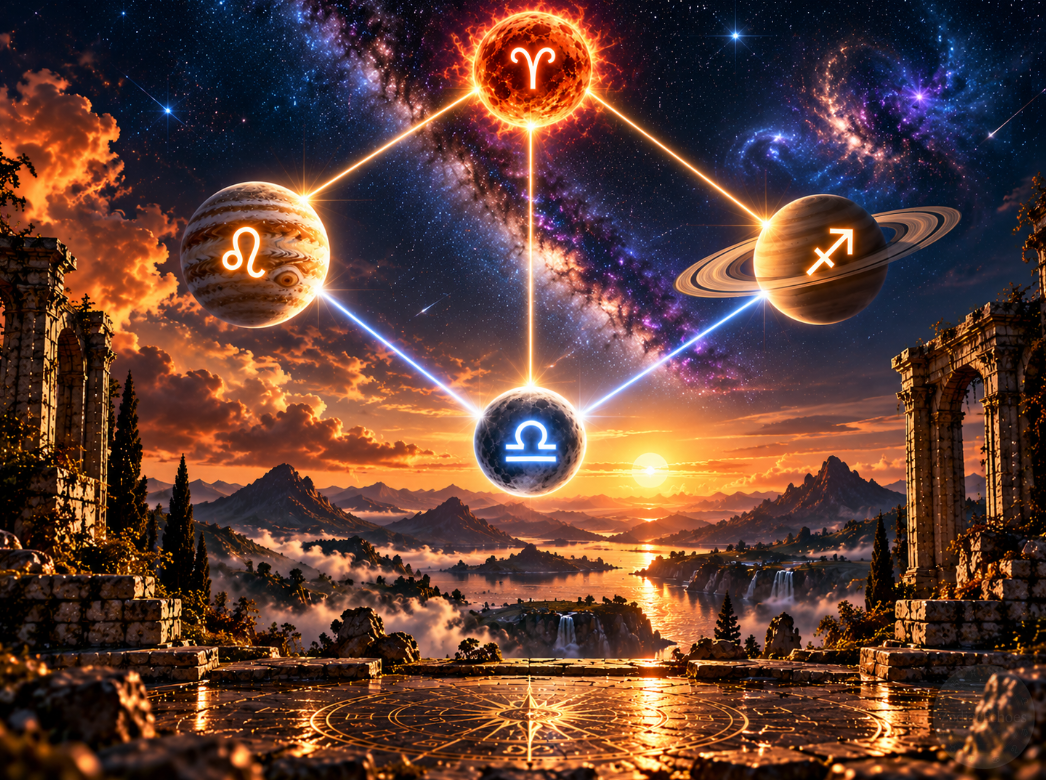
- A Kite Pattern is an astrological configuration involving four planets or important chart points.
- It develops from a Grand Trine, with a fourth planet adding an opposition and two sextiles.
- The complete pattern contains three trines (120°), two sextiles (60°), and one opposition (180°).
- Its distinctive geometry resembles a kite, with a triangular structure extending toward a fourth point.
- The Grand Trine represents natural abilities, cooperation, and relatively effortless connections.
- The opposition introduces tension that may encourage motivation, direction, and purposeful action.
- The planets, signs, houses, and aspect orbs determine how the Kite Pattern is interpreted.
Some planetary configurations emphasize harmony, while others concentrate tension. The Kite Pattern in Astrology brings these two influences together in one interconnected structure.
It begins with a Grand Trine, a configuration traditionally associated with natural strengths and supportive planetary relationships. A fourth planet then introduces an opposition, creating a more dynamic pattern that resembles a kite stretched across the Natal Chart.
The result is an interesting combination: the ease of a Grand Trine supported by the motivating pressure of an opposition.
What Is a Kite Pattern in Astrology?
A Kite Pattern forms when three planets create a Grand Trine and a fourth planet opposes one of those planets while forming sextiles with the remaining two. This produces six interconnected aspects.
| Aspect | Number | Angle | Main Theme |
|---|---|---|---|
| Trine | 3 | 120° | Natural flow and cooperation |
| Sextile | 2 | 60° | Opportunities and connections |
| Opposition | 1 | 180° | Polarity and motivation |
The three trines establish the original triangular structure. The additional planet creates two sextiles and an opposition, transforming the Grand Trine into a more complex configuration. Unlike a Grand Cross, which contains several challenging aspects, the Kite Pattern remains predominantly harmonious. However, its single opposition introduces a point of contrast that can encourage the constructive use of existing strengths.
How Does a Kite Pattern Work?
The relationship between the Grand Trine and the opposition is central to understanding the Kite. A Grand Trine connects three planets through harmonious 120° aspects. These relationships are traditionally associated with abilities or tendencies that operate relatively naturally.
But ease does not always create motivation. The fourth planet changes that dynamic. By opposing one planet within the Grand Trine, it introduces a contrasting influence that may require attention, adjustment, or deliberate action.
Meanwhile, its sextiles to the other two planets provide additional pathways for cooperation. The result is a configuration in which natural abilities may find greater direction through the need to reconcile opposing influences.
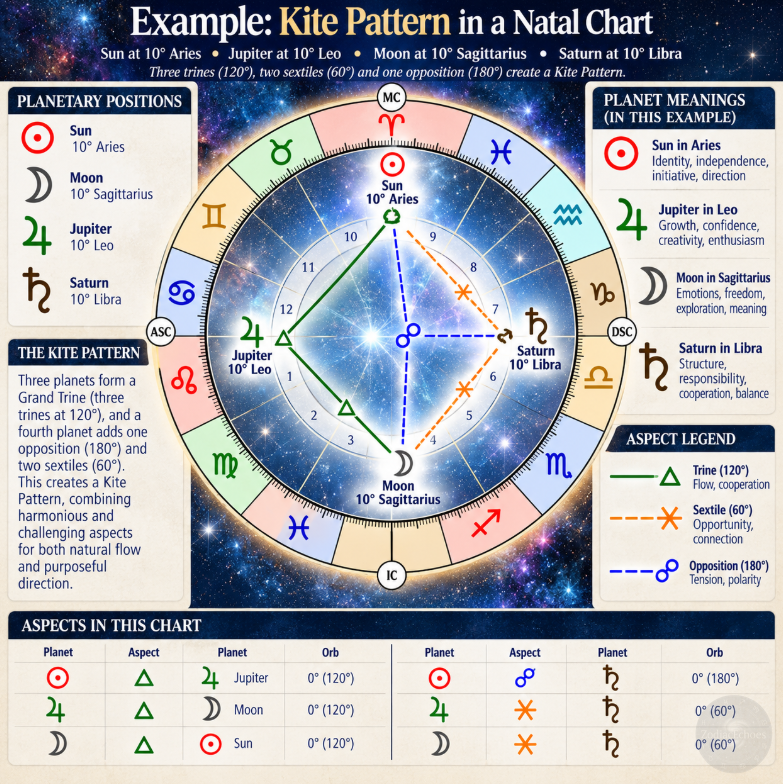
Example: Sun–Jupiter–Moon–Saturn Kite Pattern
Consider this hypothetical Natal Chart:
- Sun — 10° Aries
- Jupiter — 10° Leo
- Moon — 10° Sagittarius
- Saturn — 10° Libra
The first three planets create an exact Fire Grand Trine.
Their connections are:
- Sun △ Jupiter — 120°
- Jupiter △ Moon — 120°
- Moon △ Sun — 120°
Saturn in Libra then completes the Kite Pattern through three additional aspects:
- Saturn ☍ Sun — 180°
- Saturn ⚹ Jupiter — 60°
- Saturn ⚹ Moon — 60°
All six aspects are exact. The Sun in Aries represents independence, initiative, identity, and personal direction. Jupiter in Leo emphasizes confidence, creative expansion, and enthusiasm, while the Moon in Sagittarius introduces emotional freedom, exploration, and the search for meaning.
Together, these placements create a Fire Grand Trine associated with initiative, inspiration, confidence, and an instinctive desire to explore possibilities. Saturn in Libra introduces a different influence. Saturn represents responsibility, structure, discipline, and boundaries. In Libra, these themes become connected with cooperation, fairness, and relationships.
Its opposition to the Sun creates a potential contrast between individual independence and responsibility toward others. Yet Saturn also forms sextiles with Jupiter and the Moon, suggesting opportunities to connect enthusiasm and emotional freedom with patience, structure, and considered decisions.
The Kite therefore combines the spontaneous energy of the Fire Grand Trine with Saturn’s emphasis on responsibility. Rather than suppressing the original harmony, Saturn may help provide focus, consistency, and a clearer direction for its expression.
What Is the Focal Planet in a Kite?
Astrologers sometimes describe the planet within the Grand Trine that receives the opposition as the focal planet of the Kite.
In our example, that planet is the Sun in Aries. It receives Saturn’s opposition while maintaining trines to Jupiter and the Moon. This position can become particularly important because it connects the configuration’s central polarity with the harmonious Grand Trine.
However, the opposing planet also deserves attention. Saturn introduces the contrast that distinguishes the Kite from an ordinary Grand Trine. Both ends of the opposition are therefore important when interpreting the pattern.
Kite Pattern vs. Grand Trine
The Kite and Grand Trine are closely related, but their geometry creates different interpretive possibilities.
| Feature | Grand Trine | Kite Pattern |
|---|---|---|
| Planets | 3 | 4 |
| Trines | 3 | 3 |
| Sextiles | 0 | 2 |
| Oppositions | 0 | 1 |
| Main Theme | Natural flow | Flow with direction and contrast |
The Grand Trine emphasizes cooperation between three planetary functions. The Kite adds an opposition, introducing a dynamic that may encourage those strengths to become more actively expressed. Neither configuration guarantees success or achievement. Their meanings depend on the complete Birth Chart.
Why Houses Matter
The houses reveal where the Kite Pattern’s influences may become most noticeable. For example, a Kite connecting the 1st, 5th, 7th, and 9th Houses could involve personal identity, creativity, relationships, education, and broader life perspectives.
A different house arrangement would shift the emphasis toward other areas of experience. This is why interpreting the Kite requires examining more than its geometric outline. The planets describe the energies involved, the signs influence their expression, and the houses identify the life areas they connect.
Does Orb Matter in a Kite Pattern?
Yes. The six aspects do not need to be mathematically exact, but their orbs determine how closely the configuration matches the ideal geometry. A Kite with tight trines, sextiles, and opposition forms a particularly clear pattern.
Wider orbs may still be accepted by some astrologers, although excessively generous allowances can produce configurations that are less geometrically convincing. The most useful approach is to examine the actual planetary degrees and assess how closely all six connections fit together.
Understanding a Kite Pattern in Your Birth Chart
A Kite Pattern in Astrology transforms a Grand Trine into a more dynamic configuration by introducing one opposition and two sextiles. Its harmonious aspects suggest natural cooperation, while the opposition introduces a contrasting influence that may encourage adjustment and purposeful development.
The pattern’s significance comes from the interaction between all four planets, rather than from any single aspect. Where the Grand Trine represents natural flow, the Kite introduces the possibility of giving that flow a clearer direction.
Cosmic Highlights
FAQ
What does a Kite Pattern mean in Astrology?
A Kite Pattern is a configuration involving four planets connected by three trines, two sextiles, and one opposition. It combines harmonious planetary relationships with a contrasting influence that may encourage purposeful action.
Is a Kite Pattern rare?
It requires four placements to form six compatible aspects, making it more specialized than individual trines or oppositions. Its frequency depends partly on the orbs used.
Is a Kite Pattern considered lucky?
Kites are often interpreted positively because they contain several harmonious aspects. However, the opposition introduces tension, and the overall interpretation depends on the planets and houses involved.
What is the difference between a Kite and a Grand Trine?
A Grand Trine contains three planets connected by three trines. A Kite adds a fourth planet that opposes one of them and forms sextiles with the other two.
Does a Kite Pattern have an apex planet?
The planet within the Grand Trine receiving the opposition is sometimes called the focal planet. However, terminology varies, and both planets forming the opposition are important.