- A Boomerang Yod is an extended version of the traditional Yod, also known as the Finger of God.
- It involves four planets or important chart points, rather than the three found in a standard Yod.
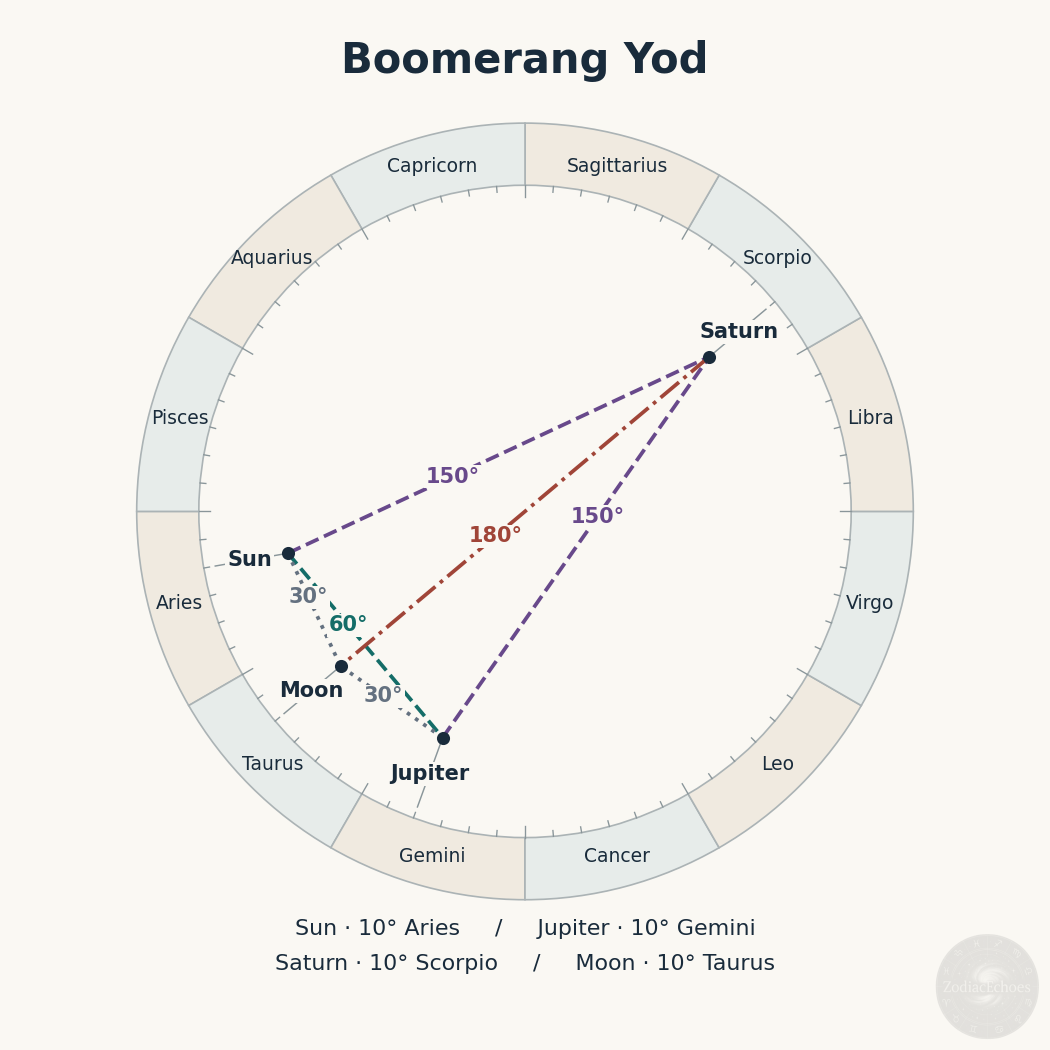
- The configuration contains two quincunxes (150°), one sextile (60°), one opposition (180°), and two semisextiles (30°).
- The fourth planet sits directly opposite the Yod’s apex planet, creating an additional axis of tension.
- The planet opposing the apex is often called the reaction point or release point.
- The pattern is associated with adjustment, redirection, competing priorities, and the search for constructive ways to manage pressure.
- Its interpretation depends on the planets involved, their signs, houses, and the precision of the aspects.
Some astrological configurations become more complex when an additional planet enters their geometry. The Boomerang Yod in Astrology is a particularly interesting example. A traditional Yod connects three planets through two quincunxes and one sextile, creating a narrow triangle pointing toward an apex planet. The Boomerang Yod adds a fourth planet directly opposite that apex.
This creates a new polarity within an already demanding configuration, introducing an additional focal point through which the Yod’s themes may be expressed, challenged, or redirected.
What Is a Boomerang Yod in Astrology?
A Boomerang Yod forms when a fourth planet opposes the apex of an existing Yod. The original three-planet configuration remains intact, but the additional opposition changes its overall structure.
| Aspect | Number | Angle |
|---|---|---|
| Quincunx | 2 | 150° |
| Sextile | 1 | 60° |
| Opposition | 1 | 180° |
| Semisextile | 2 | 30° |
The two base planets form a sextile, while both create quincunxes to the apex planet. The fourth planet occupies the opposite side of the zodiac from the apex, forming an opposition with it and semisextiles with the two base planets.
Together, these six connections create the complete Boomerang Yod. The defining difference from a traditional Yod is the additional opposition connecting the apex to a fourth planetary influence.
How Does a Boomerang Yod Work?
The traditional Yod is often associated with adjustment because its two quincunxes connect planetary functions that do not easily share the same approach. The apex planet receives both quincunxes and becomes the primary focus of the configuration.
A Boomerang Yod adds another dimension. The planet opposite the apex introduces a contrasting influence, creating a relationship that may demand greater awareness or a more deliberate response.
Some astrologers interpret this fourth planet as a release point, suggesting that its themes can provide an alternative way to express the tensions concentrated at the apex. However, the opposition does not automatically resolve the Yod. Instead, it creates another relationship that must be integrated into the wider planetary pattern.
Example: Sun–Jupiter–Saturn–Moon Boomerang Yod
Consider this hypothetical Natal Chart:
- Sun — 10° Aries
- Jupiter — 10° Gemini
- Saturn — 10° Scorpio
- Moon — 10° Taurus
The Sun and Jupiter form the base of the original Yod. Their aspects are:
- Sun ⚹ Jupiter — 60°
- Sun ⚻ Saturn — 150°
- Jupiter ⚻ Saturn — 150°
Saturn in Scorpio becomes the apex planet. The Moon in Taurus then completes the Boomerang Yod through three additional aspects:
- Moon ☍ Saturn — 180°
- Moon ⚺ Sun — 30°
- Moon ⚺ Jupiter — 30°
All six aspects are exact. The Sun in Aries represents independence, initiative, personal identity, and the desire to act. Jupiter in Gemini emphasizes curiosity, communication, learning, and intellectual exploration. Their sextile suggests opportunities for independent thinking, experimentation, and the exchange of ideas.
Saturn in Scorpio introduces responsibility, emotional depth, control, boundaries, and the need to confront complicated realities. As the apex planet, Saturn receives quincunxes from both the Sun and Jupiter.
This can symbolize a recurring need to reconcile personal freedom and intellectual exploration with responsibility, restraint, and deeper commitments. The Moon in Taurus adds another influence. The Moon represents emotional needs, instincts, and security, while Taurus emphasizes stability, comfort, consistency, and tangible reassurance.
Its opposition to Saturn creates a polarity between emotional security and the demands of responsibility or control. The Moon may therefore become an important point through which the configuration’s pressures are recognized and expressed.
For example, someone with this pattern might repeatedly encounter situations in which personal ambitions, intellectual interests, and long-term obligations compete with the need for emotional stability. Constructively, the configuration could encourage greater emotional awareness, more realistic commitments, and a better balance between independence and security.
What Is the Reaction Point?
The reaction point is the planet positioned opposite the Yod’s apex. In our example, this is the Moon in Taurus. While Saturn concentrates the original Yod’s two quincunxes, the Moon introduces an opposing influence that may reveal how those pressures are experienced or expressed.
A reaction point involving Mercury could emphasize communication and decision-making, while Venus might introduce themes involving relationships, values, and personal priorities. The reaction point is not necessarily an escape from the Yod’s challenges. Instead, it offers another perspective through which the configuration’s competing planetary functions can be understood.
Boomerang Yod vs. Traditional Yod
The distinction between these two patterns is straightforward.
| Feature | Traditional Yod | Boomerang Yod |
|---|---|---|
| Planets | 3 | 4 |
| Quincunxes | 2 | 2 |
| Sextiles | 1 | 1 |
| Oppositions | 0 | 1 |
| Semisextiles | 0 | 2 |
| Main Theme | Adjustment and redirection | Adjustment with added polarity |
A traditional Yod focuses attention on the apex planet. A Boomerang Yod preserves that focal point while introducing an opposing planet that adds another dimension to the configuration.
Why Houses and Orbs Matter
The houses reveal which areas of life may be connected through the Boomerang Yod. For example, a configuration involving the 1st, 3rd, 7th, and 9th Houses could emphasize identity, communication, partnerships, education, and personal beliefs. A different house arrangement would shift the interpretation toward other experiences.
Orbs are particularly important because the pattern relies on relatively precise minor aspects. Many astrologers prefer tight orbs of approximately 2°–3° for quincunxes, with similarly careful allowances for semisextiles.
The opposition and sextile must also fit the overall geometry. A clearly defined Boomerang Yod should therefore be identified through the actual planetary degrees rather than relying exclusively on automated chart labels.
Is a Boomerang Yod Rare?
A Boomerang Yod requires four placements to occupy six compatible angular relationships. This makes it more specialized than a traditional three-planet Yod. However, its apparent rarity depends on the number of celestial bodies and chart points included, as well as the orb allowances used. Including numerous asteroids or calculated points can substantially increase the number of configurations identified by astrology software.
Understanding a Boomerang Yod in Your Birth Chart
A Boomerang Yod in Astrology builds upon the traditional Finger of God by adding a fourth planet opposite the apex. The original Yod creates a pattern of adjustment through two quincunxes, while the additional opposition introduces another polarity that may influence how those pressures are experienced.
The reaction point becomes an important part of the interpretation, but it does not replace the apex or eliminate the original configuration’s challenges. Where the traditional Yod emphasizes adjustment and redirection, the Boomerang Yod introduces another perspective through which those competing influences may be recognized, balanced, and expressed.
Cosmic Highlights

FAQ
What does a Boomerang Yod mean in Astrology?
A Boomerang Yod is an extended Yod configuration involving four planets. It adds an opposition to the traditional Yod, introducing another focal point for adjustment and integration.
What is the difference between a Yod and a Boomerang Yod?
A traditional Yod contains three planets connected by two quincunxes and one sextile. A Boomerang Yod adds a fourth planet opposite the apex, creating an additional opposition and two semisextiles.
What is the reaction point in a Boomerang Yod?
The reaction point is the planet directly opposite the Yod’s apex. Some astrologers interpret it as a potential outlet or alternative expression of the configuration’s tension.
Is a Boomerang Yod considered challenging?
It is generally associated with adjustment and competing influences because it combines two quincunxes with an opposition. However, its meaning depends on the planets, signs, houses, and wider Birth Chart.
Does a Boomerang Yod indicate destiny?
No specific event or predetermined life path can be established from the configuration alone. Its traditional symbolism emphasizes adjustment, redirection, and the interaction between contrasting planetary functions.