Key Points
- The ritual appears in Le Véritable Dragon Rouge, a grimoire circulating in several European languages during the nineteenth century.
- It is explicitly designed to call a specific dead person and question the resulting apparition.
- The operation begins during a night Mass and continues in a church graveyard.
- The ritual involves grave earth and bones belonging to the dead.
- The magician is instructed to travel 5,900 steps westward before calling the deceased by name.
- He then lies on the ground beneath the night sky and waits for the dead person to appear.
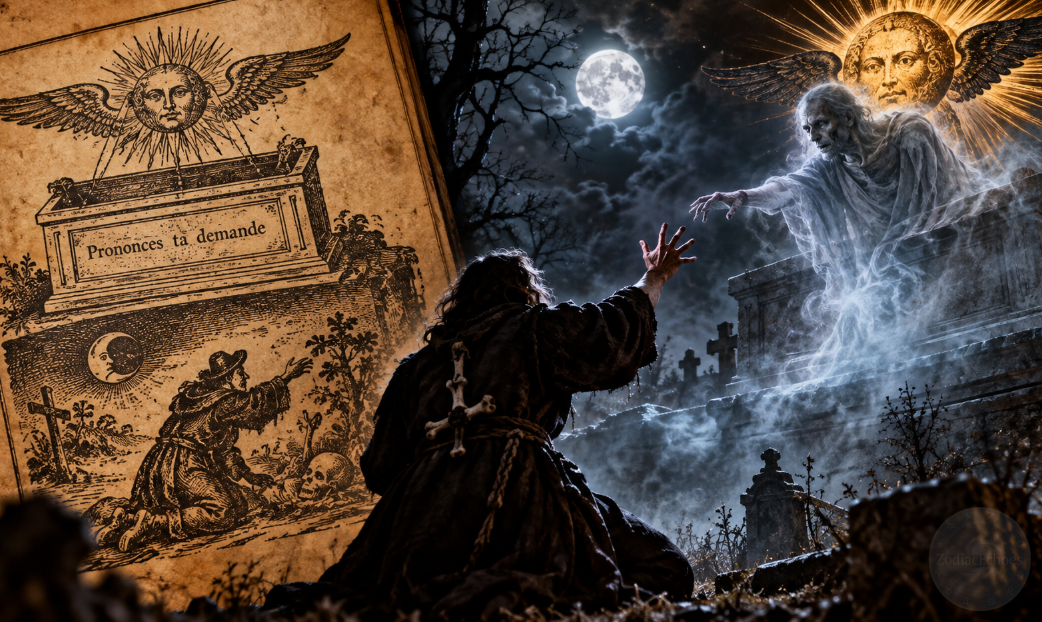
- The surviving illustration on page 79 depicts a magician at a grave beneath the Moon and a mysterious winged Sun rising from a sarcophagus.
- There is no evidence that the ceremony can actually communicate with the dead.
There are plenty of old magical texts promising conversations with spirits. Le Véritable Dragon Rouge proposes something considerably more specific. Choose a dead person. Go to the cemetery. Take something connected with the remains. Walk thousands of steps into the darkness. Lie beneath the Moon. Then call that person by name.
The grimoire claims that what happens next is not merely a dream, omen or encounter with some anonymous spirit. The person who has been summoned is supposed to appear and answer questions.
It Begins During Mass
The ceremony does not begin inside an occult chamber surrounded by pentagrams. It begins in a church during a Mass celebrated at night. At the moment when the priest raises the consecrated Host, the practitioner crosses his arms and secretly recites a Latin command calling for the dead to rise and come to him.
That collision between Catholic ritual and necromancy is one of the most disturbing features of the operation. One of the most sacred moments of the Mass is effectively appropriated and redirected toward an attempt to establish contact with the dead. Once the service has ended, the practitioner leaves the church and heads toward the cemetery.
The First Grave in the Cemetery
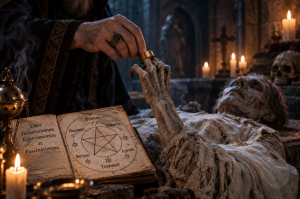
The instructions direct the magician toward the church graveyard and its first grave. There, further formulas accompany the handling and scattering of grave earth. The practitioner kneels facing east before progressing to the part of the ceremony that makes this considerably darker than ordinary nineteenth-century spirit divination.
Human remains enter the ritual. The text describes bones belonging to the deceased being used during the operation, including carrying bones arranged in the form of a cross around the neck. Bones are also thrown toward the church.
The symbolism is difficult to miss. A sacred Christian symbol has effectively been reconstructed from pieces of the dead. Yet according to the grimoire, even this is not enough to make the spirit appear. The magician must now leave the cemetery and begin counting.
5,900 Steps Into the Darkness
This is the detail that makes the ritual especially memorable. The practitioner is instructed to travel 5,900 steps toward the west.
The grimoire does not simply tell him to walk for a while, reach a crossroads or continue until the cemetery disappears. It specifies thousands of individual steps. West naturally carries associations with sunset and the disappearance of the Sun, although the text does not provide a detailed explanation for the choice of direction.
Imagine the experience in practical terms. After performing the first part of the ceremony at a grave, the practitioner walks alone through the night while keeping count. With every hundred steps the church becomes more distant, the landscape darker and the familiar world farther behind. By the time the count approaches 5,900, the participant has spent a considerable period concentrating on nothing except the ritual.
Then he stops. And lies down on the earth.
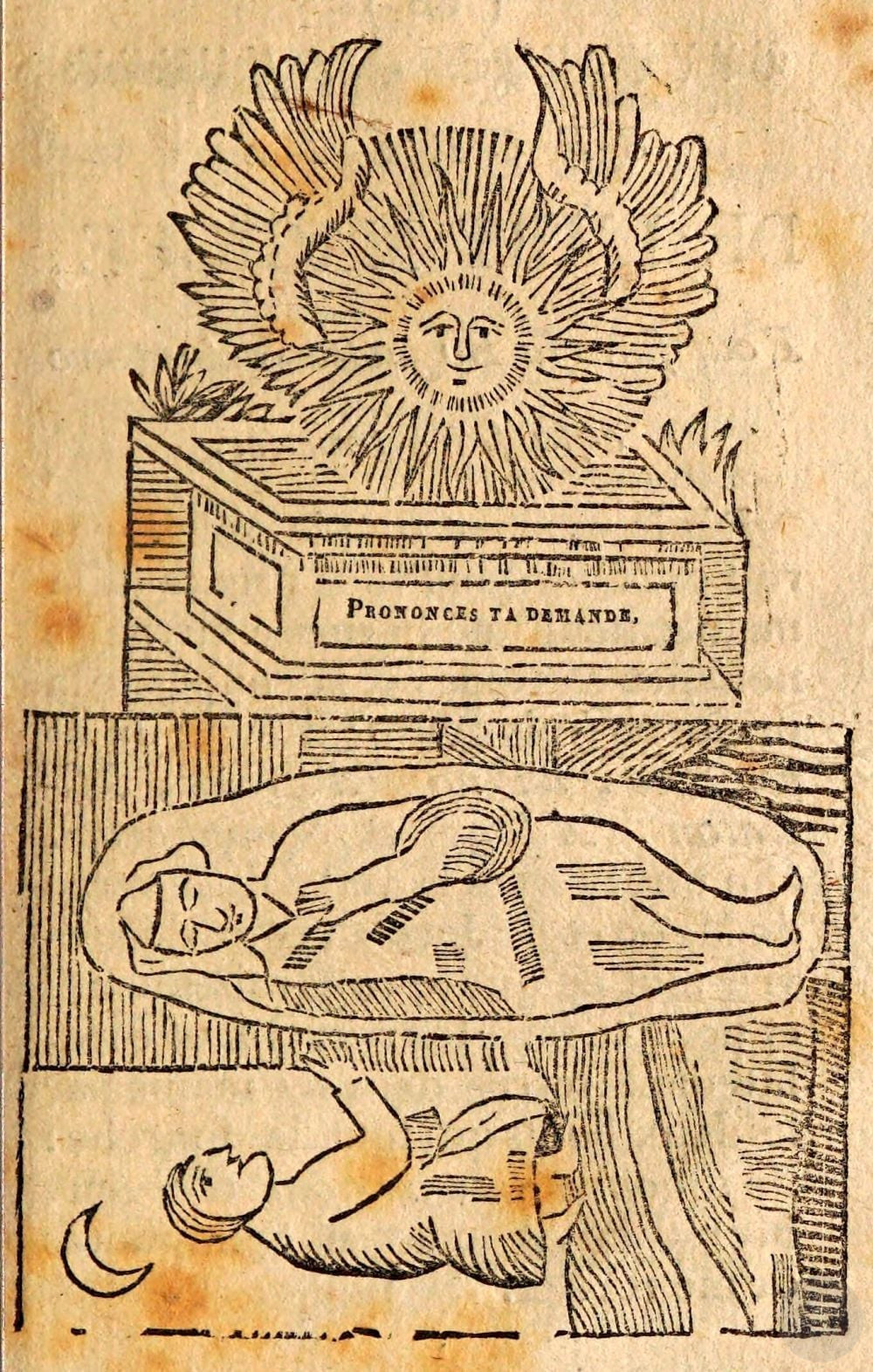
This is not simply decorative gothic artwork added by a modern publisher. Historian Sergei Zotov identifies it as one of the relatively unusual illustrations in the grimoire that does not depict a demon. The lower portion corresponds closely with the necromantic operation: a solitary figure kneels beside a grave beneath the Moon.
Above that scene is something considerably stranger. A stone sarcophagus appears, and from it rises a Sun equipped with wings. The image seems perfectly suited to a book about calling the dead, but its history turns out to be far more complicated.
Call the Dead Person by Name
After completing the westward journey, the practitioner lies on the ground and turns his attention toward the night sky and Moon. Only now does he actually call the dead person. The target is not an anonymous wandering ghost or whichever supernatural being happens to answer. The deceased is addressed by name.
One of the surviving formulas essentially declares that the practitioner is the person calling the deceased and wishes to see them. According to the grimoire, an apparition of the summoned individual should then appear.
The purpose of everything that came before now becomes clear. The night Mass, cemetery, grave earth, human bones, long westward journey and invocation are all preparation for an audience. The magician has questions, and the dead person is expected to answer.
“Speak Your Request”
Look closely at IMAGE 1 and the sarcophagus carries an unusually direct instruction: “Prononces ta demande” — “Speak your request.” The picture therefore does more than depict a mysterious supernatural scene. It tells the reader what to do when the apparition arrives.
Research published by the Warburg Institute reveals something fascinating about this illustration. The winged Sun apparently did not originate as an image of necromancy. Its ancestry lies in European alchemical imagery, particularly the visual tradition surrounding the Rosarium philosophorum.
In that older tradition, tombs and dead bodies represented stages of alchemical transformation. Matter symbolically died, decomposed and was subsequently purified or reborn. As the imagery migrated into later occult manuscripts and grimoires, however, its meaning changed dramatically. By the time it appeared in Le Véritable Dragon Rouge, an image once associated with alchemical transformation had become an illustration of something far more literal: the dead returning to answer a question.
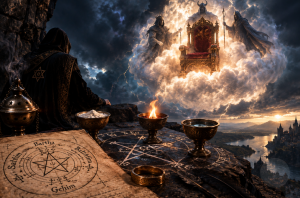
An Alchemical Tomb Became a Necromantic Tomb
The transformation is remarkable. In the older alchemical tradition, the tomb represents a stage in the transformation of matter. Death is symbolic and ultimately leads toward renewal. In Le Véritable Dragon Rouge, the symbolism becomes almost literal. There is now a magician at a grave, a Moon overhead, a sarcophagus and something apparently rising from it.
Zotov’s research traces the adapted image through the grimoire tradition and identifies an 1846 French manuscript preserved in Porrentruy, Switzerland, as the earliest currently known grimoire example containing this particular adaptation. Later printed editions continued the motif.
That makes IMAGE 1 valuable for more than atmosphere. It preserves evidence of the way occult imagery itself mutated as manuscripts were copied, translated and republished. An illustration could survive while its meaning gradually changed around it.
READ THE HISTORICAL GRIMOIRE
The relevant French witness discussed by the Warburg Institute is the Wellcome Collection copy of Le Véritable Dragon Rouge, reference EPB/A/20876. The necromantic illustration appears on page 79.
Warburg Institute — The Alchemical Tomb as a Necromantic Ritual
The same research also identifies related German witnesses in Berlin, Vienna and Zürich, demonstrating that this strange combination of necromantic ritual and recycled alchemical imagery was not restricted to a single surviving book.
Why Exactly 5,900 Steps?
Unfortunately, this is one mystery the grimoire does not neatly solve. Numbers in ritual magic frequently impose structure on an operation through particular hours, repetitions, directions and distances, but the text does not provide a clear explanation for why 5,900 was chosen. Any elaborate numerological explanation would therefore be speculation.
The instruction nevertheless has an obvious psychological effect. Imagine actually counting 5,900 footsteps at night after leaving a cemetery. The church gradually disappears behind you, the landscape becomes unfamiliar and the practitioner becomes increasingly isolated. After concentrating on a single ritual action for thousands of steps, he finally lies on the ground, looks into the night and expects a dead person to appear.
Whether intentional or not, those conditions could create a powerful combination of expectation, fear, exhaustion and altered perception. No supernatural explanation is required to understand how someone deeply convinced of the ritual’s power might interpret an ambiguous sight, sound or sensation as evidence that the dead had arrived.
The Dead Were Supposed to Answer
The objective is not resurrection in the ordinary sense. The corpse is not permanently restored to biological life. The operation is better understood as classical necromancy: summoning the dead specifically to obtain information.
That distinction makes the ritual considerably more interesting. The magician does not ask for immortality or attempt to keep the deceased alive. He wants temporary access to someone who can no longer normally be questioned. The imaginable motives are obvious: a person might have died knowing a secret, the location of something valuable, the circumstances surrounding a mysterious event or information they never revealed while alive.
The grimoire provides no evidence that such conversations actually occurred. What survives is evidence that readers were presented with a detailed ceremony claiming they could occur—and even an illustration showing what the encounter was supposed to look like.
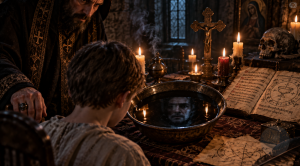
The Image May Be Stranger Than the Ritual
That makes IMAGE above one of the most interesting historical occult images in this series. At first glance, it looks like a straightforward illustration of necromancy: darkness, a grave, the Moon, a kneeling magician and something supernatural emerging from a tomb.
Look closer and several centuries of occult history are compressed into the picture. An alchemical tomb became a grave. Symbolic transformation became apparent resurrection. The winged Sun became a visual sign of something responding from beyond death. Beneath it all, a solitary figure waits under the Moon for the impossible. The sarcophagus gives him only one instruction: Speak your request.
Cosmic Highlights
FAQ
Is this ritual really found in Le Véritable Dragon Rouge?
Yes. The Warburg Institute discusses the necromantic procedure preserved in Le Véritable Dragon Rouge, including the night Mass, cemetery, use of human remains, westward journey and invocation of a specific deceased person.
How old is Le Véritable Dragon Rouge?
Some versions claim much earlier dates, but those claims should not be taken literally. The relevant grimoire tradition belongs primarily to the nineteenth century. The Warburg research identifies an illustrated French manuscript from 1846, with related printed editions appearing later.
Why does the magician walk 5,900 steps?
The ritual specifies 5,900 steps westward but does not clearly explain why that precise number was selected. A specific numerological interpretation would therefore go beyond what the surviving source tells us.
What is the winged Sun above the sarcophagus?
Research traces the motif to older alchemical imagery, particularly the tradition surrounding the Rosarium philosophorum. In the later grimoire context, that imagery was repurposed to accompany a ritual concerned with summoning and questioning the dead.
Was the dead person supposed to physically return to life?
No permanent bodily resurrection is described. The operation is better understood as necromantic spirit consultation: the summoned deceased person is expected to appear and answer questions before the encounter ends.
Does the ritual actually allow communication with the dead?
There is no reliable evidence that it does. The historical grimoire, its unusual ritual and its illustration are genuine objects of study; the supernatural result claimed by the text has not been established.
✨ Explore More from Zodiac Echoes ✨Explore More from ZE
Choose your zodiac sign to explore daily, weekly, monthly, and yearly horoscopes.