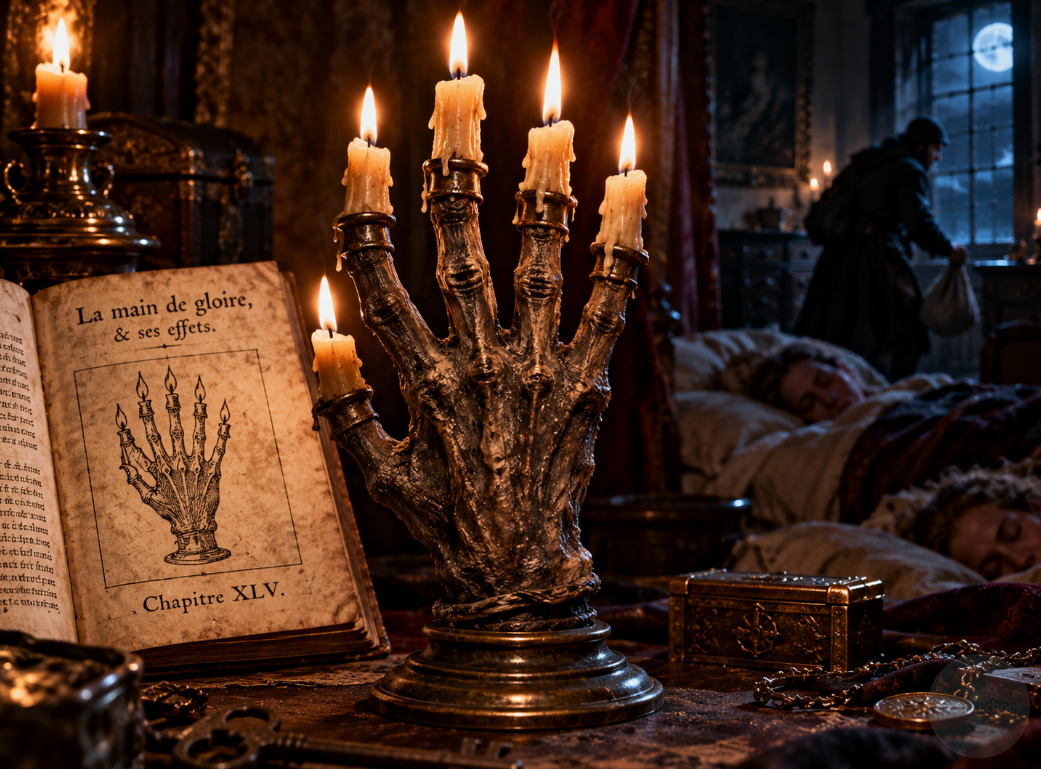
- Origin: European occult folklore and the eighteenth-century grimoire Le Petit Albert.
- Purpose: To render everyone inside a house motionless while thieves searched for valuables.
- Ritual Object: The severed, preserved hand of an executed criminal.
- Supernatural Claim: A candle placed in the hand supposedly prevented sleepers from waking.
- Historical Evidence: A real mummified hand identified as a Hand of Glory survives in Whitby Museum, England.
Imagine entering a house where every person has fallen into an unnatural sleep. No matter how loudly you move, how many doors you open, or how much noise you make, nobody wakes. The only source of light is a candle held by a severed human hand, taken from the body of a criminal who died on the gallows.
This was the terrifying promise of the Hand of Glory, one of the most disturbing objects in European occult history. Its alleged powers were described in old grimoires, repeated in criminal folklore, and feared by generations who believed that certain parts of the dead could retain supernatural abilities.
Unlike many legendary magical objects, however, the Hand of Glory has a remarkable physical counterpart. A genuine mummified human hand survives in Whitby Museum, where it has been preserved since 1935.
The Forbidden Ritual in Le Petit Albert
One of the most important historical descriptions appears in Le Petit Albert, a French grimoire containing magical secrets, charms, unusual remedies, and occult experiments. The 1782 edition includes a chapter titled “La main de gloire, & ses effets” — The Hand of Glory and Its Effects — beginning on page 115.
The passage describes a magical object associated with criminals and nighttime theft. According to the text, the hand was obtained from an executed offender and subjected to an elaborate preservation process. It was then used to support a specially prepared candle.
The intended result was extraordinary: everyone within the illuminated house would supposedly become incapable of movement, allowing the intruder to operate without resistance.
The grimoire presents the preparation as a secret associated with criminals rather than an ordinary protective charm. Its author also admits that he had not personally tested the operation, attributing the account to alleged confessions extracted from offenders under torture.
That admission makes the passage especially revealing. The Hand of Glory was already surrounded by fear, criminal suspicion, and extraordinary stories when the text was recorded.
ORIGINAL HISTORICAL GRIMOIRE
Le Petit Albert (1782), Chapter 45, “La main de gloire, & ses effets,” page 115.
Why the Hand Had to Come From an Executed Criminal
The Hand of Glory belonged to a much wider tradition in which the bodies of executed criminals were believed to possess unusual powers.
Across parts of Europe, objects associated with executions appeared in folk medicine, protective charms, and magical practices. The gallows represented more than punishment. In popular belief, they marked a boundary between life and death, guilt and supernatural danger.
A criminal’s hand was particularly significant because it symbolized action, wrongdoing, and the physical power of the condemned person.
The Hand of Glory transformed that symbolism into an instrument of control. The same hand that had supposedly committed crimes in life became, after death, a tool that allowed others to commit crimes undetected.
It was an especially sinister reversal of justice: the body of a punished criminal was imagined as helping new criminals escape punishment.
The Candle That No One Could Extinguish
The Hand of Glory appeared in more than one form. In some accounts, the preserved hand served as a candlestick, supporting a single magical flame. In others, its outstretched fingers were themselves said to burn like candles.
Both versions supposedly produced the same effect. Anyone asleep inside the house would remain unconscious, while those affected by the charm could not interfere with the intruder. Some stories added an even stranger detail: if one finger refused to burn, someone inside the building was still awake.
The magical flames were also said to resist ordinary attempts to extinguish them. Water, which should have destroyed the fire, was sometimes described as useless. Folklore instead assigned special power to milk or blood.
These details transformed the object from a gruesome candleholder into something resembling a supernatural security system for thieves. The Hand of Glory did not merely provide light. According to the legends, it identified potential witnesses, suppressed resistance, and protected the criminal from discovery.
The Real Severed Hand Found in Yorkshire
The most remarkable part of this story is that an object identified as a Hand of Glory actually survives. According to Whitby Museum, a severed, mummified human hand was discovered during the early twentieth century, hidden in the wall of a thatched cottage in Castleton, North Yorkshire.
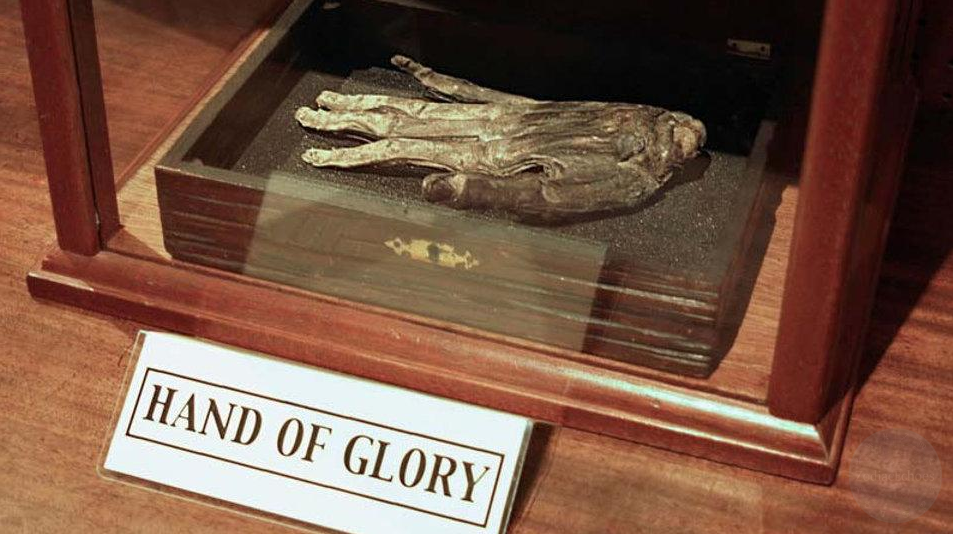
The object eventually came into the possession of Joseph Ford, a stonemason and local historian, who recognized its resemblance to the legendary Hand of Glory. In 1935, Ford donated the hand to Whitby Museum, where it became one of the institution’s most extraordinary exhibits. The museum describes it as the only alleged Hand of Glory of its type known to survive.
Its exact history remains uncertain. The discovery proves that a preserved human hand was concealed in a building, but it does not establish that the object was used in a magical ceremony. Nevertheless, its existence gives the old legends a disturbing physical dimension. The severed hand is not an artistic reconstruction or a fictional prop. It is a genuine human remain.
The Inn Where a Thief Used a Burning Human Hand
One of the best-known Hand of Glory legends describes a mysterious traveller who obtained shelter at an inn. After the household retired for the night, the visitor supposedly produced a withered human hand and caused its fingers to burn. The occupants fell into an unnatural sleep, leaving the stranger free to search for valuables.
But a servant remained awake. In the story, she noticed that one of the fingers would not ignite. When she tried to wake the household, nobody responded. She then attempted to extinguish the supernatural flames, only to discover that ordinary liquids could not stop them. Finally, she used milk, which supposedly extinguished the fire and broke the enchantment.
The household awakened, and the intruder was captured. Versions of this tale circulated in northern England, including stories associated with Spital Inn. Whitby Museum preserves accounts of these traditions alongside its remarkable exhibit. The tale illustrates the central fear surrounding the Hand of Glory: a criminal might enter a home and make its occupants completely helpless without using physical violence.
A Human Hand Turned Into an Occult Symbol
The Hand of Glory became especially memorable because its appearance was inseparable from its alleged power.
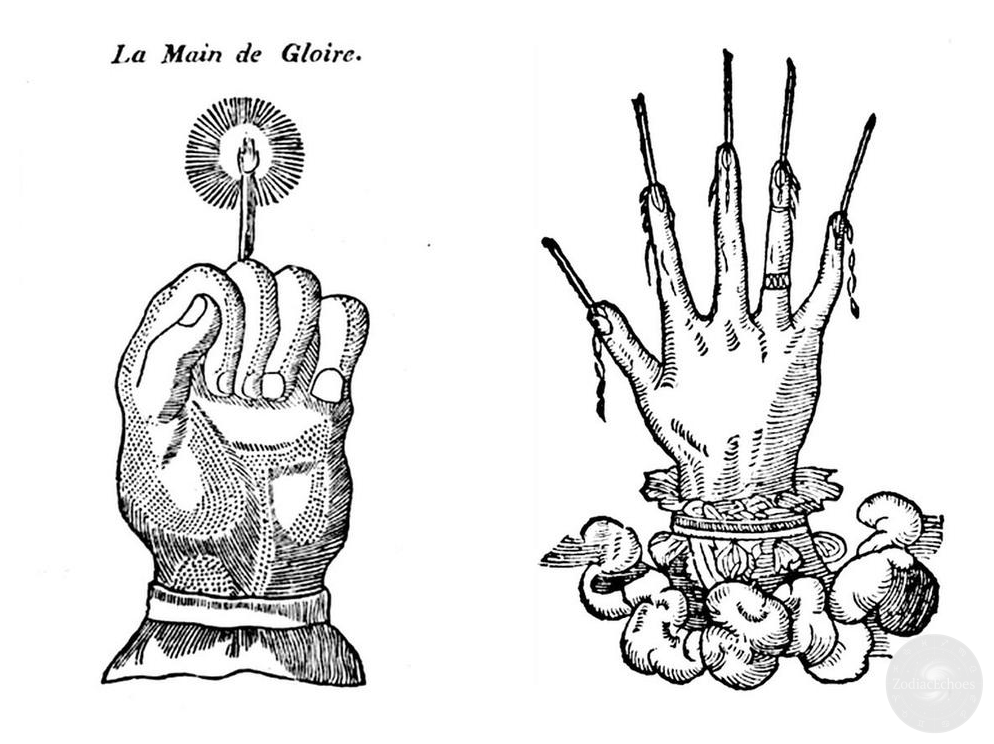
Unlike a magical ring, talisman, or written seal, the object was unmistakably human. Its fingers, skin, and recognizable shape served as constant reminders that it had once belonged to a living person.
The legend combined several powerful fears: the desecration of the dead, the vulnerability of sleeping households, and the possibility that criminals possessed secret knowledge unavailable to ordinary people.
Even the idea of a flame that could not be extinguished contributed to the horror. The hand represented a reversal of the natural order, in which a dead body appeared to exercise control over the living. That combination helped the Hand of Glory survive in folklore long after belief in its supernatural abilities began to decline.
Why the Hand of Glory Still Disturbs Us
The Hand of Glory occupies an unusual position between documented occult literature, criminal folklore, and physical history. Its supposed powers remain unverified, but the historical sources are real. The ritual appears in Le Petit Albert, its legends circulated through European communities, and a genuine preserved hand remains in a British museum.
Few occult objects offer such an unsettling connection between the written traditions of magic and the physical remains of the dead. The most disturbing question is not whether a severed hand could magically paralyze an entire household. It is why someone concealed a real human hand inside the wall of a Yorkshire cottage — and what they believed it could do.
Cosmic Highlights

FAQ
What is the Hand of Glory?
The Hand of Glory is a legendary magical object made from the preserved hand of an executed criminal. European folklore claimed it could render household occupants unconscious or motionless, allowing thieves to enter without being detected.
Is the Hand of Glory mentioned in a real grimoire?
Yes. The eighteenth-century French grimoire Le Petit Albert contains a chapter titled “La main de gloire, & ses effets,” describing the object and its supposed supernatural properties.
Is there a real Hand of Glory in a museum?
Yes. Whitby Museum in North Yorkshire, England, preserves a genuine mummified human hand donated in 1935. The museum identifies it as an alleged Hand of Glory, although its original purpose has not been established.
Why were the fingers supposed to burn?
In some versions of the legend, the fingers acted as supernatural candles. A finger that failed to ignite supposedly indicated that someone inside the house remained awake.
Could the Hand of Glory really paralyze people?
There is no reliable evidence that the Hand of Glory possessed supernatural powers. Its historical importance lies in the surviving grimoire descriptions, European criminal folklore, and the unusual preserved human hand held by Whitby Museum.