Key Points
- The Black Pullet is a French-derived grimoire centered on magical talismans, rings, spirits and the legendary Black Hen that supposedly discovers hidden treasure.
- Figure No. 21 is one of the book’s darkest talismans.
- The grimoire explicitly claims that the talisman and its corresponding ring can direct “all the infernal powers” against enemies.
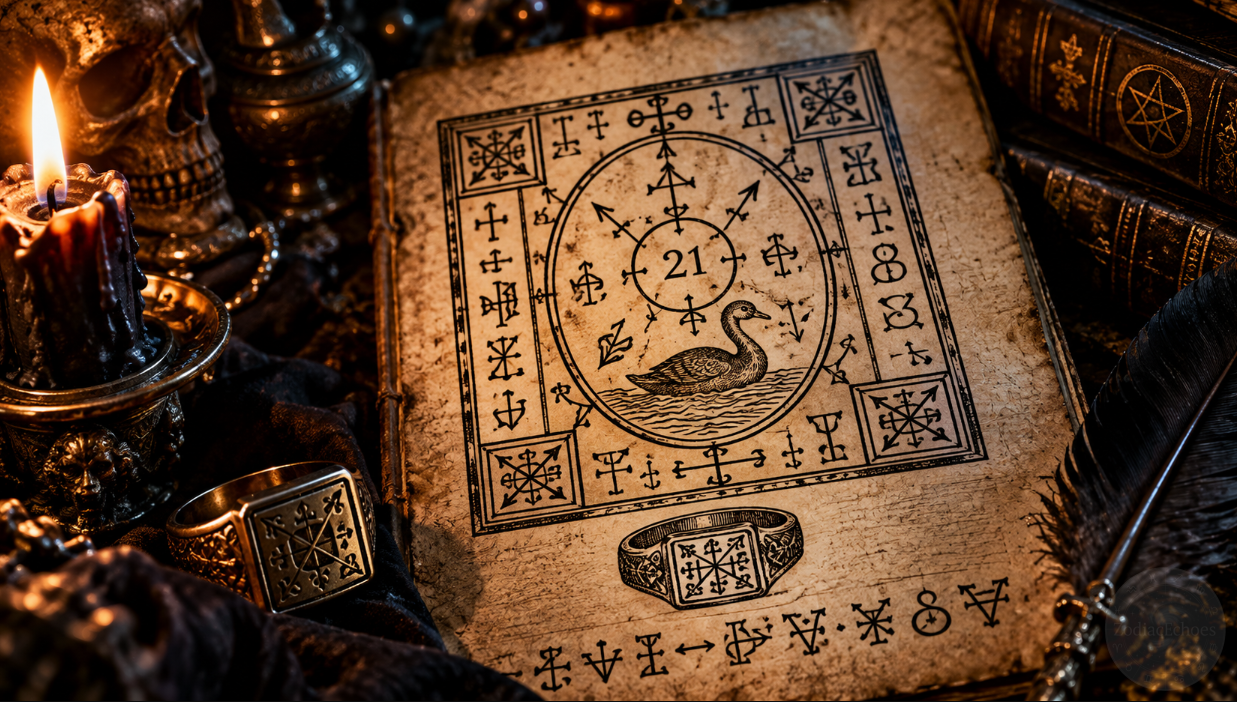
- The original illustration shows a square talisman filled with occult characters, a central oval and an unusual bird resembling a swan or duck.
- A separate ring and additional magical characters appear immediately beneath the main design.
- The book specifies grey-white shaded satin for Talisman No. 21.
- The supernatural powers attributed to the talisman are claims made by the historical occult text, not demonstrated abilities.
Most magical amulets promise protection, luck, knowledge or wealth. Figure No. 21 from The Black Pullet promises something considerably more aggressive. According to the grimoire, its owner could use the talisman and accompanying ring to direct the powers of Hell against an enemy—or against somebody threatening a friend.
The book does not bury this purpose beneath layers of symbolism. Its description is remarkably direct. The talisman is presented as a means of commanding infernal forces and turning them outward against another person. Yet the illustration accompanying that claim is surprisingly strange.
Instead of a recognizable demon, skull or monstrous spirit, its central image appears to contain a peaceful-looking water bird. That contrast makes No. 21 one of the most intriguing images in the entire grimoire.
A Grimoire Built Around Magical Objects
The Black Pullet, also known as La Poule Noire or The Hen with the Golden Eggs, belongs to the European grimoire tradition but differs from many famous ceremonial-magic books in one important respect. Rather than concentrating primarily on elaborate circles and lengthy conjurations, much of the text revolves around physical magical objects.
Its anonymous narrator tells a fantastic story in which he survives Napoleon’s Egyptian campaign and encounters a mysterious old man living within the pyramids. The old man possesses secret magical knowledge supposedly preserved from antiquity and gradually teaches the narrator about talismans, rings, spirits and hidden treasure. Modern editions describe the work as a manual for constructing and using magical talismanic rings.
The book’s talismans promise an extraordinary range of abilities. Different figures supposedly reveal secrets, locate treasure, influence other people or command supernatural beings. At the center of the narrative is the Black Pullet itself—a magical hen said to possess an extraordinary instinct for discovering gold.
But Figure No. 21 moves away from treasure hunting. Its target is the magician’s enemies.
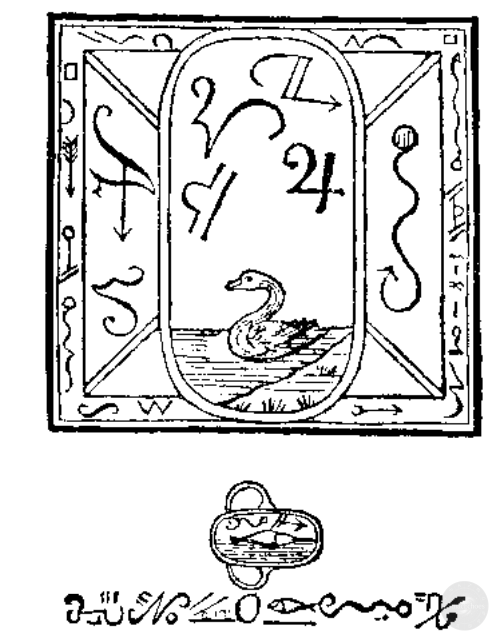
The surviving illustration is worth examining closely because it is far stranger than the description surrounding it. A heavy square border encloses an oval center filled with the number 21 and surrounded by arrows, marks and glyph-like characters. At the bottom of the oval sits what resembles a swan or duck floating on water. Beneath the principal talisman is a smaller object representing the accompanying ring or amulet, followed by another line of unusual magical characters.
Nothing about the bird obviously communicates vengeance or infernal power. There is no horned demon, flaming sword or obvious image of destruction. The text does not provide a convenient explanation of why this particular bird belongs inside a talisman supposedly capable of commanding infernal forces. That unexplained element is part of what makes the original diagram so compelling.
The Promise of Talisman No. 21
The description accompanying Figure No. 21 is extremely short compared with its extraordinary claim. The Black Pullet states that the talisman and ring will enable their possessor to direct “all the infernal powers” against enemies or people attempting to harm the possessor’s friends.
The text then associates the object with three mysterious magical words. Like many voces magicae found throughout Western occult literature, they do not function as an ordinary sentence with an obvious everyday translation. Their role is magical rather than conversational.
Interestingly, the instructions do not surround No. 21 with an elaborate midnight ceremony. There is no graveyard journey, sacrificial altar or complicated planetary timing in the short passage accompanying the figure. Instead, the power is concentrated in the object itself, its corresponding ring and the words attached to them. For a grimoire claiming control over infernal beings, the simplicity is striking.
A Grey-White Talisman for the Powers of Hell
Later in the text, The Black Pullet explains how its collection of talismans should supposedly be constructed. Each figure receives a particular combination of fabric and embroidery. Some are white satin embroidered with gold, others red with silver, black with gold or dark blue with silver. No. 21 is different again. The specification is simply “Grey-White satin, shaded.”
The rings accompanying the talismans are described collectively as being made from bronzed steel with characters engraved upon them, while the talismans themselves are supposed to reproduce the dimensions of the illustrated figures in silk cloth.
That gives Figure No. 21 an additional significance. It was not merely intended as decoration for the reader. Within the logic of the book, the printed diagram functioned as a pattern for constructing the magical object.
The Ring Was Part of the System
The smaller figure beneath the main talisman is easy to overlook, but The Black Pullet repeatedly treats talismans and rings as paired objects. The ring was therefore not simply an ornamental addition to the page.
The book describes bronzed-steel rings engraved with magical characters, while separate figures show additional characters associated with their construction. The pairing occurs repeatedly throughout the collection, creating a magical system in which symbols printed on the page are transferred onto objects intended to be worn or carried.
In Figure No. 21, that system reaches one of its darkest claimed purposes. The wearer is not merely protecting themselves from infernal powers. The text claims those same forces can be redirected toward somebody else.
READ THE ORIGINAL GRIMOIRE
The complete English text includes the original illustrations, including Figure No. 21 and its accompanying description.
The relevant sequence contains the Figure No. 21 illustration followed by the short passage describing its alleged ability to turn infernal powers against enemies. The later Composition of the Talismans and the Rings section gives the grey-white satin specification for No. 21.
Who Were the “Infernal Powers”?
This is where The Black Pullet becomes frustratingly mysterious. The passage does not provide a convenient list of demons assigned specifically to Talisman No. 21. Instead, the book operates with a much broader supernatural world populated by celestial, aerial, terrestrial, infernal, oceanic and fiery powers.
Near the end of the instructions concerning construction, the old magician even warns that these powers would supposedly rebel against an immoral practitioner. According to the narrative, possession of the objects and knowledge of the magical language were not sufficient by themselves; the magician was also expected to be morally worthy of the mysteries.
That creates an odd contradiction at the heart of No. 21. The same book that insists upon purity, virtue and honor also provides an object whose stated function is directing infernal powers against enemies.
The grimoire attempts to resolve this by extending the talisman’s purpose beyond personal revenge. It can supposedly be directed against those who would injure the magician’s friends as well. Within the book’s own moral framework, the object can therefore be imagined as supernatural retaliation or defense rather than indiscriminate aggression.
Why Is There a Bird Inside the Talisman?
The surviving English text does not provide a reliable explanation, and imposing a modern symbolic interpretation would risk inventing something the source never says. The bird might carry symbolism inherited from an earlier magical source, represent a corrupted or altered design copied between editions, or possess a meaning known to the compiler that was never explained to readers.
It is also possible that the apparent bird is simply one element of an intentionally mysterious symbolic vocabulary. Grimoires frequently combine recognizable images with characters whose meanings are obscure, corrupted through copying or deliberately concealed.
Whatever its origin, the visual contradiction is remarkable. A talisman promising command over all the infernal powers contains not a demon but what looks remarkably like a bird calmly floating on water.
The Black Pullet’s Strange Moral Rule
One of the strangest passages comes after the construction instructions. The mysterious old man insists that the magical objects will not properly serve someone whose heart is corrupt. A person guilty of harming others—or even intending such harm—is told that the supernatural powers would rebel against him.
Read alongside Figure No. 21, the statement creates a fascinating tension. The book promises a supernatural weapon while simultaneously claiming that an immoral person cannot successfully wield its magic. This is not unusual in magical literature.
Grimoires often surround dangerous supernatural power with rules about purification, religious devotion or moral authority. Such requirements help establish the magician not as a helpless petitioner but as someone supposedly entitled to command spirits. In The Black Pullet, that authority becomes especially strange because the powers being commanded are explicitly described as infernal.
A Tiny Diagram With an Enormous Claim
Figure No. 21 occupies little space on the page. Its instructions are shorter than many ordinary magical recipes. Yet the claim attached to it is enormous: a piece of grey-white satin, a ring and mysterious characters supposedly give their owner access to supernatural forces capable of being turned against an enemy.
There is no evidence that the talisman possesses any such power. What makes it valuable today is something different. IMAGE 1 preserves the actual visual technology of a historical magical text—the symbols readers were expected to reproduce, carry and invest with supernatural meaning.
And unlike countless modern recreations of occult seals, we do not have to guess what this one was supposedly for. The grimoire tells us directly. It was the talisman for turning the powers of Hell against your enemies.
Cosmic Highlights
FAQ
What Is Talisman No. 21 in The Black Pullet?
It is one of the illustrated magical talismans contained in The Black Pullet. The text claims that Figure No. 21 and its corresponding ring could direct infernal powers against enemies or people attempting to harm the owner’s friends.
What Does the Original Talisman Look Like?
The main figure is a square design surrounding an oval center marked with the number 21. Various occult characters and arrows appear around it, while a bird resembling a swan or duck appears near the bottom. A smaller ring or amulet and additional magical characters are printed beneath it.
What Was Talisman No. 21 Supposed to Be Made From?
The grimoire specifies grey-white shaded satin for No. 21. Its general construction instructions describe the associated rings as bronzed steel engraved with magical characters.
Is The Black Pullet a Real Historical Grimoire?
Yes. The Black Pullet or La Poule Noire is a genuine work from the European grimoire tradition, although its narrative claims about ancient Egyptian wisdom and supernatural powers should not be confused with verified history. Modern library records identify the English edition as a translation of La Poule noire.
Does Talisman No. 21 Actually Command Demons?
There is no reliable evidence that the talisman can command supernatural beings or harm enemies. Its importance is historical: the surviving grimoire genuinely attributes that extraordinary power to Figure No. 21 and preserves the diagram associated with the claim.
✨ Explore More from Zodiac Echoes ✨Explore More from ZE
Choose your zodiac sign to explore daily, weekly, monthly, and yearly horoscopes.