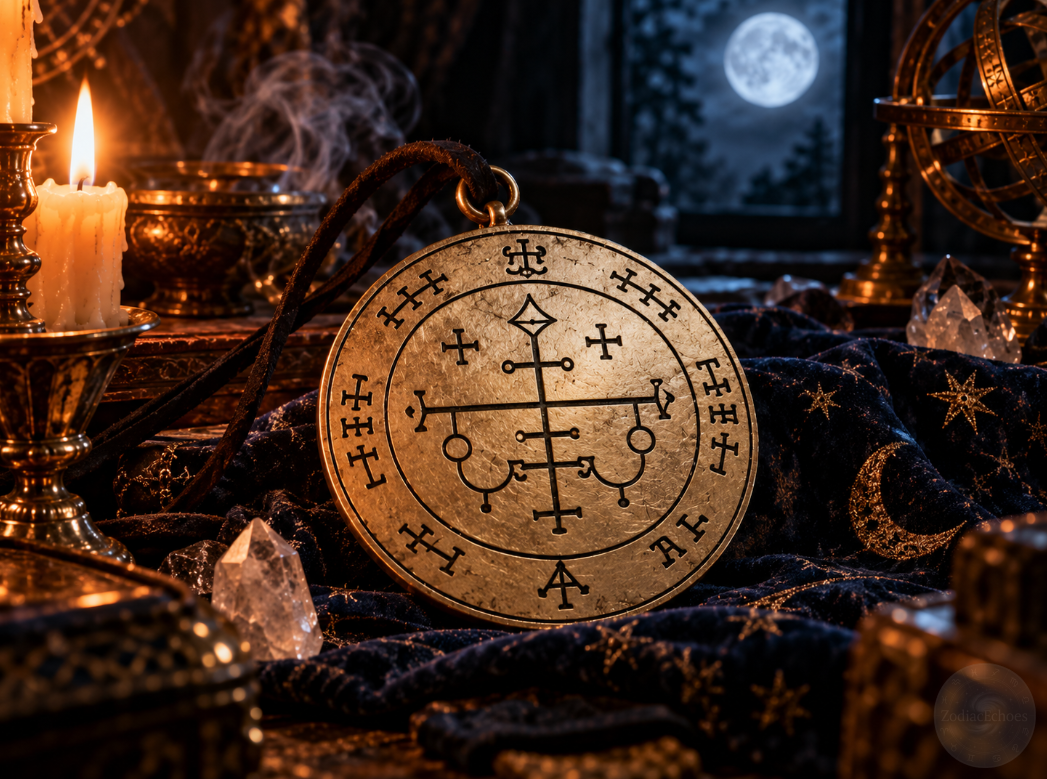
- Original Source: The Sixth and Seventh Books of Moses, a nineteenth-century grimoire attributed to the biblical Moses.
- The Ritual: The Sixth Mystery describes a magical seal intended to reveal hidden knowledge during sleep.
- The Symbol: Figure 7, known as the Seal of the Power-Angels, is associated with spirits governing the elements.
- The Promise: According to the grimoire, wearing the seal in bed could reveal desired information through dreams and visions.
- The Spirit Alymon: The accompanying conjuration calls upon Alymon to appear in human form.
- Historical Material: The original seal and instructions survive in nineteenth-century printed editions.
Imagine falling asleep with a mysterious magical symbol beside you, believing that the answer to a question you cannot solve will appear in your dreams. No elaborate temple, midnight graveyard, or sacrificial offering is required. According to one nineteenth-century grimoire, a single occult seal could open the sleeping mind to knowledge hidden from ordinary consciousness.
The instructions appear in The Sixth and Seventh Books of Moses, a collection of ceremonial magic that claims to preserve supernatural secrets associated with the biblical prophet. Among its numerous invocations, angelic names, and strange symbols is a particularly intriguing operation called The Sixth Mystery.
Its purpose was extraordinary: to obtain answers through dreams and visions by wearing a sacred seal while sleeping. The grimoire presents the operation as a means of accessing the knowledge of powerful angelic beings, turning an ordinary night’s sleep into a potential encounter with the invisible world.
The Forbidden Books That Claimed to Reveal Moses’ Secret Magic
The Sixth and Seventh Books of Moses belongs to a tradition of magical literature that attributed secret supernatural knowledge to famous biblical figures. Although the title invokes Moses, the surviving work is a much later compilation, shaped by European ceremonial magic, Jewish mystical terminology, and Christian religious symbolism.
The collection became especially influential during the nineteenth century, circulating through printed editions containing elaborate seals, conjurations, magical alphabets, and instructions for commanding spiritual forces. Its appeal rested on the suggestion that familiar biblical history concealed an entirely different body of knowledge.
The book presents Moses not simply as a prophet but as a master of supernatural operations. Sacred names, mysterious characters, and angelic hierarchies supposedly gave the practitioner access to powers unavailable through ordinary prayer.
Many of the rituals involve complicated invocations. Others promise protection, healing, or influence over unseen beings. Yet the Sixth Mystery stands apart because its final instruction is remarkably simple. The practitioner was supposed to sleep while wearing a particular seal.
The Sixth Mystery appears in The Sixth Book of Moses, on printed pages 11–12. The description of Figure 7 and its dream-related purpose appears on page 12.
The Sixth Mystery: A Seal of the Power-Angels
The operation appears under the heading The Sixth Mystery, followed by a description identifying the seal with the Power-Angels, or Potestates. In traditional Christian angelology, the Powers belong to the celestial hierarchy. They are frequently associated with maintaining cosmic order and resisting hostile spiritual influences. The grimoire adapts this terminology into its own system of magical authority.
The Sixth Mystery places these beings in relation to the angels and spirits of the elements. The seal therefore represents more than a decorative emblem. Within the text’s supernatural framework, it functions as a symbolic connection between the human practitioner and an invisible hierarchy governing the natural world.
The accompanying description names several angelic or spiritual entities, including Schunmyel, Alymon, Mupiel, Symnay, Semanglaf, and Taftyah. Their unusual names are part of the grimoire’s characteristic language, combining recognizable religious terminology with obscure magical expressions.
The names were not incidental additions. In ceremonial magic, knowing and pronouncing the correct name was often considered essential to establishing authority over a supernatural being.
The Original Dream Seal
The seal belongs to a series of magical figures appearing throughout the Sixth Book. Each is associated with a different spiritual power or intended result. Unlike ordinary written prayers, these figures were designed to communicate through their visual arrangement. Their unfamiliar letters and characters served as the visible representation of an otherwise invisible supernatural authority.
The Sixth Mystery’s description includes a particularly striking promise. A person wearing the seal in bed was supposed to learn whatever they wished to know through dreams and visions. This makes Figure 7 an example of oneiromancy, the practice of seeking information or guidance through dreams.
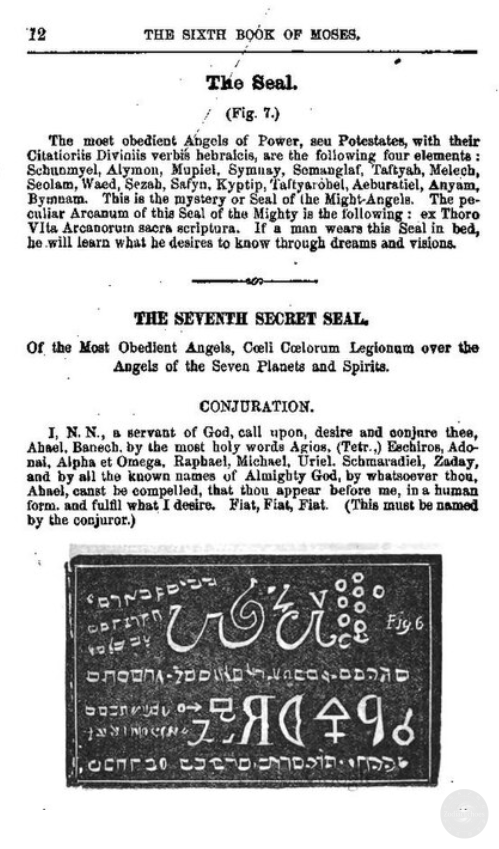
The Sixth Mystery, Figure 7, described as the Seal of the Power-Angels in The Sixth and Seventh Books of Moses. The original design is preserved in the Historical PDF.
Dream divination has a much longer history than this particular grimoire. Ancient cultures recorded dreams as possible messages from gods, ancestors, and other supernatural beings. Medieval and early modern magical traditions continued to develop methods for obtaining answers during sleep. The Sixth Book places that old ambition into the form of a portable magical symbol.
The Spirit Alymon and the Conjuration of the Sixth Mystery
The dream seal does not appear in isolation. Immediately before Figure 7, the grimoire includes a conjuration addressed to the spirit Alymon. The operator identifies themselves as a servant of God and calls upon Alymon through a sequence of sacred and mysterious names. These include Jehovah, Elohim, Ophiel, Zophiel, Sophiel, and Habriel, alongside other names found in the magical formula.
The invocation demands that Alymon appear in a gentle, beautiful human form and fulfill the practitioner’s command. It ends with the repeated declaration Fiat, Fiat, Fiat, a Latin expression meaning that something should be accomplished or brought into being. This wording reveals the ceremony’s underlying logic.
The magician does not simply request assistance but attempts to compel the spirit through names considered sacred and authoritative. The relationship between this conjuration and the dream seal is especially interesting. The Sixth Mystery combines a commanding invocation with a passive method of receiving knowledge during sleep.
The practitioner is first presented with a formula for summoning a spirit, followed by a seal whose promised effect occurs through dreams. The text does not explicitly require the entire conjuration to be recited every night before wearing the seal. That distinction matters when reconstructing the historical instructions.
How the Historical Dream-Seal Ritual Was Supposed to Work
Compared with many elaborate ceremonial operations, the practical instruction attached to Figure 7 is unusually brief. The essential action is to wear the Seal of the Power-Angels while sleeping. According to the book, the desired knowledge would then be communicated through dreams and visions.
A faithful reconstruction of the described practice involves examining the original figure, reproducing its design accurately, and keeping the reproduction on the person during sleep.The grimoire does not specify a required metal, particular ink, lunar phase, or complicated preparation for this dream-related use. It also does not prescribe a fixed number of nights.
Those details are sometimes associated with other forms of talismanic magic, but they should not be confused with the actual wording of the Sixth Mystery. A modern historical reconstruction could therefore use a paper copy of the original seal and a written question prepared before sleep. The question provides a way to organize the experience, although writing it down is a modern addition rather than an instruction from the grimoire.
The next morning, any remembered dreams could be recorded and compared with the original question. The historically distinctive element remains the seal itself: a specific magical figure that the text claims can transform sleep into a source of hidden knowledge.
Why Dreams Were Considered a Gateway to Invisible Knowledge
For practitioners of ceremonial magic, dreams offered an unusual opportunity. During sleep, ordinary perception faded, the body became inactive, and the mind produced vivid experiences seemingly independent of the external world. These conditions made dreaming especially attractive to traditions concerned with spirits, prophecy, and supernatural communication.
A dream could present unfamiliar places, mysterious figures, warnings, or conversations that felt more significant than ordinary thoughts. Within an occult framework, such experiences might be interpreted as encounters with entities operating beyond waking consciousness. The Sixth Mystery exploits precisely this uncertainty between inner experience and supernatural revelation.
Rather than demanding a visible apparition in a ritual chamber, it promises information through the private imagery of sleep. The seal becomes a symbolic bridge between two states: waking intention and dreaming experience. Its alleged power rests on the belief that spiritual beings could influence what the sleeper saw, remembered, or understood.
The Mystery of the Angelic Names
One of the most distinctive features of the Sixth Mystery is its long sequence of unfamiliar names. The text identifies beings such as Schunmyel, Alymon, Mupiel, Symnay, Semanglaf, Taftyah, Melech, Seolam, and others as belonging to the seal’s spiritual system.
Some names resemble words or constructions found in Hebrew-influenced magical literature, while others are difficult to identify outside the grimoire itself. Different printed editions also preserve variations in spelling. Such differences are common in magical texts that passed through copying, translation, and typesetting over generations.
For historical reconstruction, the precise edition matters. A reader attempting to reproduce Figure 7 should work from the actual printed illustration rather than a modern redesign that may alter its characters.
The names and the seal together form the symbolic identity of the Sixth Mystery. Separating them from their original context risks turning a documented magical operation into a generic modern dream ritual.
The Dream Seal’s Place in Occult History
The Sixth Mystery illustrates a recurring ambition in ceremonial magic: obtaining knowledge without relying on ordinary observation. Other grimoires describe mirrors, crystals, spirits, and visionary encounters. This operation instead places the decisive moment inside sleep itself. Its simplicity is part of its fascination. An elaborate hierarchy of angels and sacred names ultimately leads to one small object carried into bed.
The surviving text offers no documented demonstration that the seal can reveal supernatural knowledge. What it preserves is the historical belief that dreams could be deliberately influenced through sacred symbols and ritual authority.
More than a century after its nineteenth-century publication, the Sixth Mystery remains an unusual example of how European occult traditions combined angelic invocation, magical seals, and dream divination. The promise was as unsettling as it was seductive: go to sleep with the right symbol, and the hidden world might answer a question that waking life could not resolve.
Cosmic Highlights

FAQ
What is the Sixth Mystery in the Sixth Book of Moses?
The Sixth Mystery is an operation involving the Seal of the Power-Angels, identified as Figure 7. The grimoire associates the seal with spiritual beings and claims that wearing it during sleep reveals information through dreams and visions.
What is the purpose of the dream seal?
Its stated purpose is to help the practitioner obtain desired knowledge through dreams. The book presents this as a supernatural effect associated with the seal.
Who is Alymon?
Alymon is the spirit addressed in the conjuration accompanying the Sixth Mystery. The text calls upon Alymon to appear in human form and obey the practitioner’s command.
Does the ritual require a magical circle?
The specific instruction for wearing the Sixth Mystery’s dream seal does not require drawing a protective circle. The grimoire contains other ceremonial procedures, but they should not automatically be added to this operation.
Must the seal be made from metal or parchment?
The dream-related passage does not prescribe a particular material. Its essential instruction is that the person wear the seal while sleeping.
Where can I find the original seal?
Figure 7 appears in historical editions of The Sixth and Seventh Books of Moses. The original PDF linked above includes the relevant section and its printed magical figures.
Is the Sixth Book of Moses really written by Moses?
No. The surviving collection is a much later work of occult literature attributed to the biblical figure. Its title reflects a tradition of claiming ancient religious authority for magical writings.