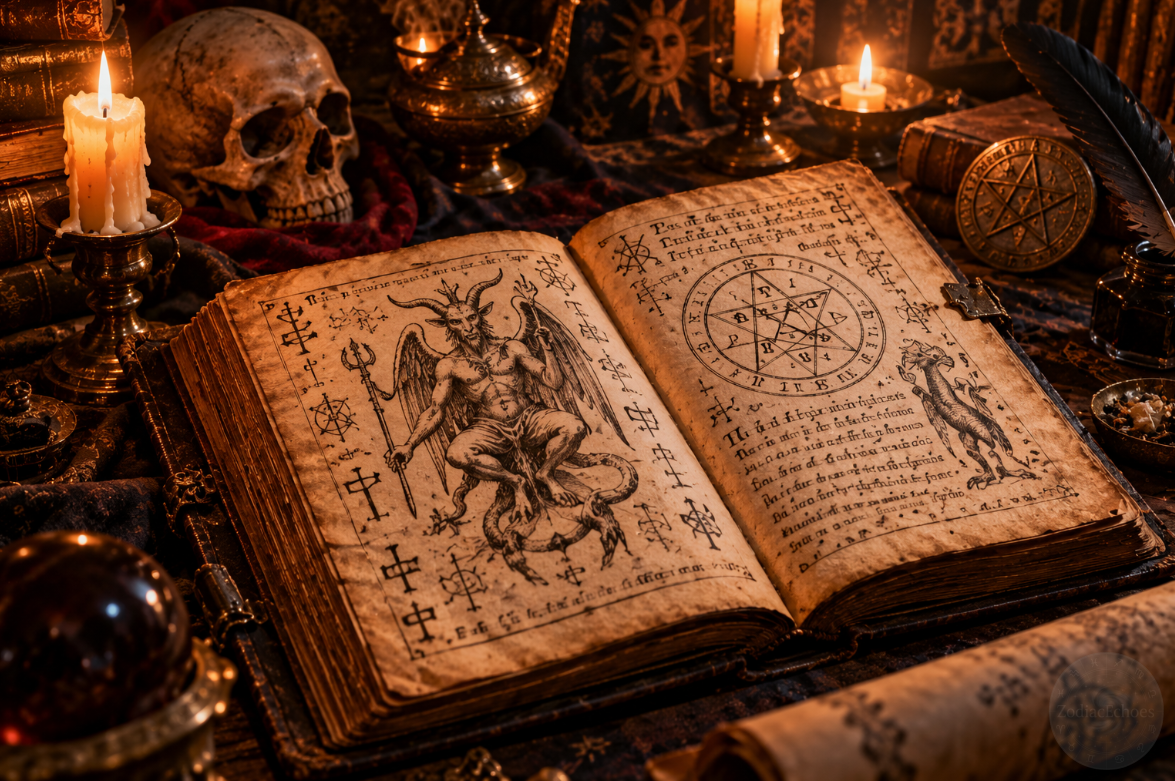
- Original Grimoire: The Magus, or Celestial Intelligencer, published by Francis Barrett in London in 1801.
- Forbidden Operation: The creation and consecration of a Book of Evil Spirits, intended to bind supernatural entities to obedience.
- Magical Seals: Each spirit was assigned a name, image, character, and written oath.
- The Crossroads: One version of the ceremony required a magical circle prepared at a crossroads during a clear night.
- Three-Night Ritual: The book was buried inside the circle and recovered on the third night.
- Historical Evidence: The complete 1801 edition survives, including original engravings of occult symbols and spirit characters.
In 1801, an English occultist published instructions for a ceremony that promised something more disturbing than simply summoning a demon. The magician was supposed to create a book that could bind spirits to permanent obedience. Each entity would be recorded by name, image, and magical character, then compelled to acknowledge the book’s authority.
The ritual did not end with a single invocation. One version required the magician to visit a crossroads at night, construct a protective circle, call upon the spirits, and bury the book beneath the ground. Three nights later, the operator was instructed to return and retrieve it.
This extraordinary operation appears in The Magus, or Celestial Intelligencer, published by Francis Barrett in London in 1801. Its chapter Of the Invocation of Evil Spirits, and the Binding of, and Constraining of Them to Appear preserves a detailed account of how such a book was supposedly created.
The Magus: The Occult Encyclopedia of 1801
Francis Barrett’s The Magus was one of the most ambitious English-language occult publications of its period. It assembled material on astrology, alchemy, talismans, ceremonial magic, divine names, and the conjuration of spirits.
Much of its content was adapted from older European magical literature, particularly traditions associated with Heinrich Cornelius Agrippa and his successors. Barrett’s achievement was not the invention of an entirely new system but the presentation of centuries of occult material in an elaborate illustrated publication.
The book’s title promised a complete system of occult philosophy. Its pages contained magical squares, planetary seals, angelic characters, strange alphabets, and representations of supernatural beings.
Among these subjects was the creation of a special volume intended to establish authority over spirits. Barrett called it a Book of Evil Spirits, and the instructions surrounding its preparation are among the most unsettling passages in the work.
Original edition published in London by Lackington, Allen and Co. The digitized volume preserves the historical text and engravings.
The Book That Was Supposed to Control Spirits
The central object of the ceremony was not a wand, a mirror, or a talisman. It was a specially prepared book containing the identities and obligations of the spirits the magician intended to command. Barrett instructed that it be made from clean, unused paper, traditionally described as virgin paper. Each spirit would receive its own entry.
On the left-hand page, the magician was supposed to draw an image of the spirit. On the right, the corresponding magical character would appear, accompanied by a written oath identifying the entity’s name, rank, location, office, and powers.
These details were not merely descriptive. Within the grimoire’s supernatural framework, recording the spirit’s identity and binding oath established the terms of its obedience.
Barrett acknowledged that some magicians omitted the images and characters. He nevertheless recommended including them, believing that a more complete record strengthened the operation. The book was then to be carefully bound, secured, and protected against accidental opening.
This final warning reveals the atmosphere surrounding the ceremony. The object was treated not as an ordinary notebook but as a potentially dangerous magical instrument whose contents demanded strict control.
The Original Characters of Good and Evil Spirits
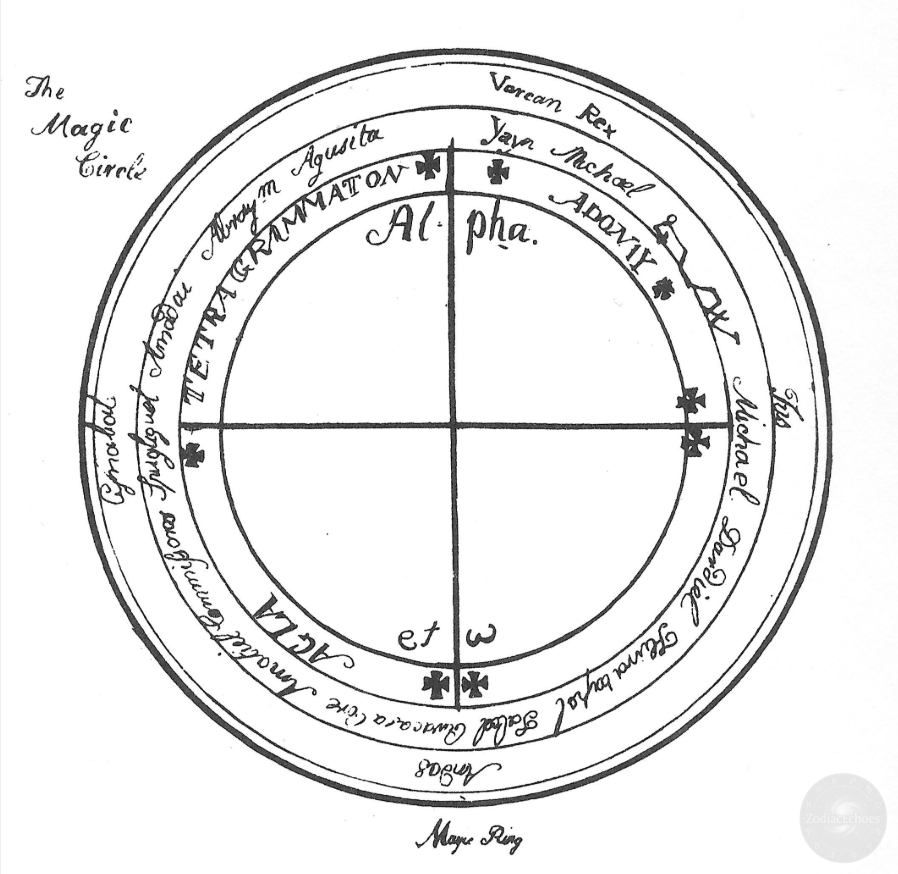
The surviving engravings help explain why Barrett considered visual symbols essential to ceremonial magic. A spirit’s character was treated as a magical signature. It represented an entity in a form that could be inscribed on paper, metal, or other ritual materials. The grimoire also contains elaborate pentacles and sacred names intended to establish divine authority over the invisible world.
In the Book of Evil Spirits, these different elements were brought together. The spirit’s image identified its appearance, its character represented its identity, and its oath defined its obligation. The resulting pages were meant to transform a collection of drawings and names into a permanent instrument of supernatural command.
The First Method: Making Spirits Swear Obedience
Barrett described two principal methods for consecrating the book. In the first, the magician was instructed to summon the spirits individually into a ceremonial setting. The book would be placed inside a triangle outside the protective circle.
The distinction between these two shapes mattered. The magician remained within the circle, while the book occupied a separate ritual space associated with the summoned beings. Once the spirits had appeared, their written oaths were to be read aloud.
The most extraordinary instruction followed: the spirits were supposedly required to place their hands upon the pages containing their images and characters, thereby confirming their obedience. Only after this supernatural acknowledgment could the book be closed and preserved.
The magician would then formally dismiss the spirits. This ceremony reflects a recurring principle in European grimoire traditions: a spirit’s spoken promise was imagined as something that could be fixed permanently through a written oath and magical seal.
The Second Method: A Book Buried at a Crossroads
Barrett also recorded an alternative ceremony that avoided requiring every spirit to appear visibly during the book’s initial consecration. This version is particularly remarkable because of its setting and unusual sequence.
The magician was instructed to prepare the book with the necessary invocations and binding formulas. It would then be enclosed between two sacred pentacles, described as symbols of divine majesty. On a clear night, the operator was to bring the book to a magical circle established at a crossroads.
The crossroads was a powerful setting in European magical traditions. As a place where paths meet and separate, it was frequently associated with supernatural encounters, boundaries, and transitions. Within the circle, the magician would open the book and invoke the spirits recorded inside it.
Each entity was to be called in its proper order, with the binding formulas repeated three times. But the spirits were not necessarily expected to appear immediately. The ceremony demanded that they acknowledge the book’s authority within three days.
Why the Book Had to Be Buried
After the conjurations, the magician was instructed to wrap the book in clean linen and bury it in the center of the circle. The burial place was to be concealed so that no visible disturbance remained. The operator would then dismiss the spirits, remove the circle, and depart before sunrise.
This strange instruction gave the book a symbolic journey beneath the earth. The text does not provide a detailed explanation of why burial was necessary, but its position within the ceremony is unmistakable. The book was hidden after the spirits had been commanded and before their promised obedience was confirmed.
The burial also separated the ceremony into two distinct encounters. The first established the demand. The second completed the consecration. Barrett’s instructions treated the buried book as an object undergoing a transformation, although the text does not describe any physically observable change that could verify such a process.
The Third Night: Returning for the Book
The final stage was to take place on the third day, around the middle of the night. The magician was instructed to return to the same location and construct the protective circle again. Before recovering the book, the operator would kneel and offer prayers of thanksgiving. Perfume or incense formed part of the ceremonial preparations.
Only then would the buried volume be retrieved. Barrett instructed that the book be preserved carefully and not opened unnecessarily. The spirits were again to be dismissed according to the appropriate ceremonial formulas. The recovered book was now supposed to possess the authority established during the three-night operation.
Its pages could subsequently be consulted when the magician wished to invoke a particular spirit. Rather than repeat the entire consecration, the operator would open the relevant entry and address the entity through the oath, character, and binding formulas already recorded. This was the central promise of the ritual: one elaborate ceremony could supposedly create a reusable means of commanding spirits.
The Sacred Pentacles That Bound the Book
The two pentacles described in the ritual were especially important. Barrett associated them with divine majesty and the sacred symbolism of the Apocalypse. One was placed at the beginning of the volume and the other at its end. In this arrangement, the spirit entries were symbolically enclosed between representations of superior spiritual authority.
The book therefore combined two different systems of control. The individual seals identified the spirits. The sacred pentacles supposedly constrained them.
The magician’s authority was not presented as a personal power strong enough to dominate demons independently. Instead, the ritual claimed to operate through divine names and symbols regarded as superior to the spirits themselves. This distinction explains why Christian sacred imagery appears so frequently in grimoires devoted to summoning infernal entities.
What Happened After the Book Was Consecrated?
According to Barrett, the completed book could be used during later operations. The magician would choose suitable weather and ceremonial conditions, face the direction associated with the intended spirit, and open the book to its corresponding entry.
The entity would then be invoked through the oath and magical character recorded on its pages. If necessary, additional binding formulas could be employed. Once the requested result had supposedly been achieved, the spirit was to be dismissed.
The book thus functioned as a supernatural register of names, seals, and obligations, intended to make repeated conjurations possible without performing the entire original consecration again. The surviving text documents these instructions, but it does not establish that any spirit ever appeared or became bound through the ceremony.
The Grimoire That Tried to Turn Demons Into Servants
The Book of Evil Spirits ceremony is one of the most striking operations preserved in The Magus. Its disturbing quality lies not in a single dramatic invocation but in its long-term ambition. The magician was supposed to create an object capable of compelling supernatural beings repeatedly, using their own identities and sworn obligations.
The crossroads, the buried book, the third-night return, and the sacred pentacles all formed part of that imagined process. Barrett’s ritual transformed the idea of a grimoire into something more sinister: a book that was not merely meant to describe spirits, but to hold authority over them.
More than two centuries later, the original 1801 edition remains a remarkable record of European ceremonial magic and its elaborate attempts to organize the invisible world through written names, sacred symbols, and binding oaths.
Cosmic Highlights
FAQ
What is the Book of Evil Spirits in The Magus?
It is a specially prepared volume described by Francis Barrett in 1801. Each entry supposedly contained a spirit’s image, magical character, identity, powers, and oath of obedience.
Did the ritual really require burying a book?
Yes. One of Barrett’s described methods instructs the magician to bury the consecrated book inside a magical circle at a crossroads and return on the third night to retrieve it.
Why were the spirits’ images and seals important?
Within the grimoire’s magical system, images and characters identified individual spirits and helped establish their supposed obligation to obey the operator.
What was the purpose of the two sacred pentacles?
They were placed at the beginning and end of the book, symbolically enclosing its contents within divine authority.
Did the spirits have to appear physically?
Barrett described a method requiring spirits to appear and confirm their oaths, as well as an alternative method in which visible appearance was not always expected.
Can the historical ritual be reconstructed today?
Its written sequence, book design, inscriptions, and ceremonial structure can be studied and reconstructed from the surviving text. There is no reliable evidence that the supernatural results claimed by the grimoire occur.
Where can I read the original 1801 edition?
The complete historical edition of Francis Barrett’s The Magus is available in the PDF linked above, including its ceremonial magic chapters and original engraved illustrations.