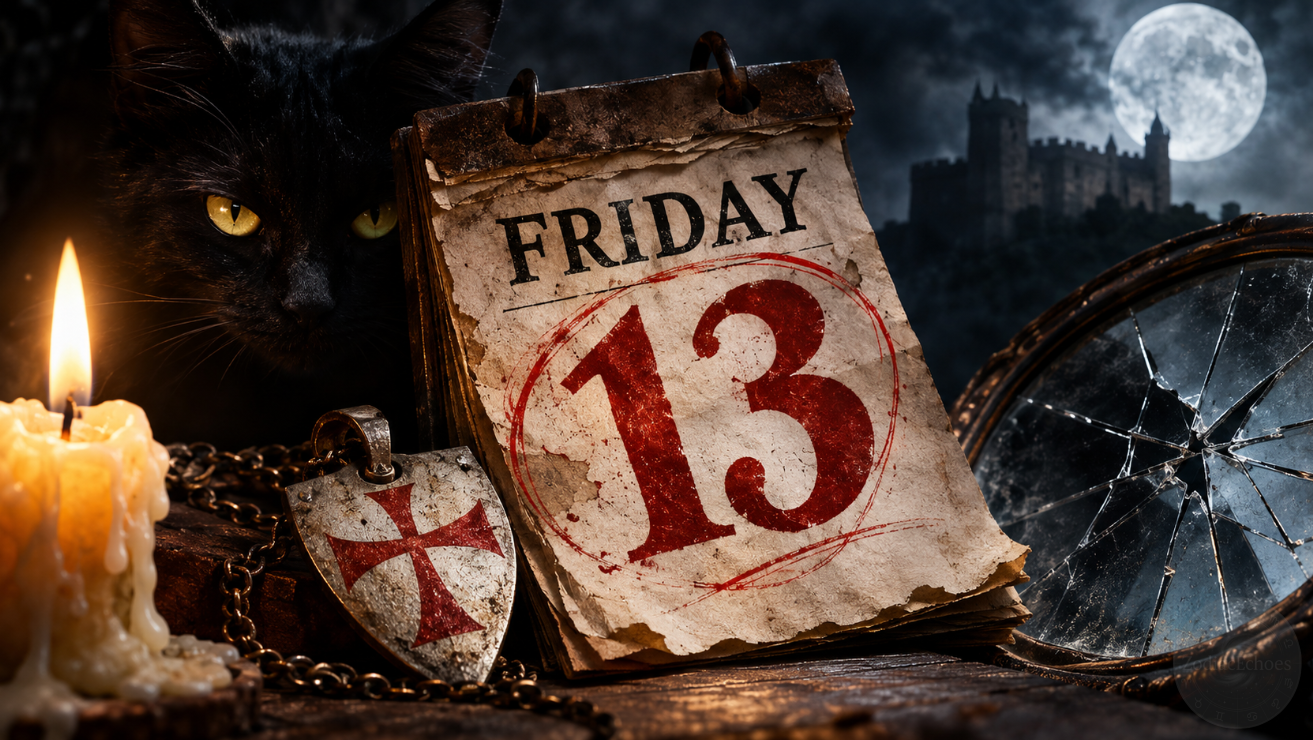
- Friday the 13th combines two older superstitions: the belief that Friday can bring misfortune and the fear of the number 13.
- The Last Supper, the crucifixion of Jesus, and Norse mythology are frequently cited as explanations, although some connections are later interpretations.
- The arrest of the Knights Templar on October 13, 1307 really happened, but there is no reliable evidence that it created the superstition.
- The modern fear of Friday the 13th developed through folklore, literature, and popular culture, rather than any demonstrated supernatural danger.
For millions of people, Friday the 13th is more than an ordinary date on the calendar. It is a day associated with accidents, broken mirrors, black cats, mysterious warnings, and the uncomfortable feeling that something terrible might happen without explanation.
Some people refuse to travel on Friday the 13th. Others avoid signing contracts, making important decisions, or beginning new projects. Even those who claim not to believe in superstition may hesitate when they notice the date.
But why is Friday the 13th considered unlucky? What transformed an otherwise ordinary combination of a weekday and a number into one of the most recognizable symbols of misfortune in Western culture?
The answer is more complicated than a single ancient curse. It involves religious traditions, medieval history, numerology, folklore, psychological expectations, and centuries of storytelling.
Perhaps the most surprising discovery is that the individual fears surrounding Friday and the number 13 are much older than the widespread superstition about Friday the 13th itself.
Why Was the Number 13 Considered Unlucky?
Long before Friday the 13th became a recognizable expression, the number 13 had already acquired an uncomfortable reputation in parts of Western culture.
One explanation involves the symbolic importance of the number 12. Throughout history, 12 has frequently represented completeness, order, and an established system.
There are 12 months in the year, 12 zodiac signs, 12 traditional Olympian gods in Greek mythology, and 12 tribes of Israel. Christianity also recognizes 12 apostles of Jesus.
Against this background, 13 can appear to disrupt an otherwise complete structure. In symbolic interpretations, it represents something that arrives after the expected cycle has ended.
The number 13 therefore became associated with uncertainty, imbalance, and the disturbance of established order. This is a cultural interpretation rather than a mathematical property of the number, but symbolism can have a powerful influence on human beliefs.
Over time, the fear of 13 became sufficiently widespread to influence architecture and everyday behavior. Some hotels and office buildings omit a floor labeled 13, while certain establishments avoid using the number for rooms or seating arrangements.
The psychological fear of the number 13 is known as triskaidekaphobia. Although many people simply regard the number as unlucky, others experience genuine anxiety when they encounter it.
Yet 13 has not always been interpreted negatively. In some spiritual and esoteric traditions, it symbolizes transformation, renewal, or the beginning of a new cycle. Its sinister reputation is therefore far from universal.
The Last Supper: Did Christianity Make 13 an Unlucky Number?
One of the most frequently repeated explanations for the unlucky reputation of 13 comes from the Last Supper of Jesus Christ. According to Christian tradition, Jesus shared his final meal with his 12 apostles before his arrest and crucifixion. This created a gathering of 13 people.
Judas Iscariot, the disciple who betrayed Jesus, was among those present. Later folklore connected the number of diners with betrayal, suffering, and death. From this association emerged the belief that having 13 people seated together at a table could bring misfortune. Some versions of the superstition warned that one of the guests might die within the following year.
However, the biblical account does not establish a general rule that the number 13 is cursed. The interpretation developed through later religious symbolism and popular tradition. The Last Supper nevertheless became an influential part of the mythology surrounding unlucky numbers, especially when combined with the Christian associations of Friday.
Why Was Friday Itself Considered an Unlucky Day?
Before the modern superstition became popular, Friday already carried negative associations in some European Christian traditions. The most important connection is Good Friday, the day traditionally commemorating the crucifixion of Jesus Christ.
Because Friday was associated with suffering and death in this religious context, certain communities came to regard it as an unfavorable day for beginning important activities. Historical folk beliefs sometimes discouraged starting a long journey, beginning a major undertaking, or arranging particular ceremonies on a Friday.
Some later traditions also associated other biblical misfortunes with Friday, including the temptation of Adam and Eve or Cain’s murder of Abel. However, the Bible does not identify Friday as the day on which those events occurred. These associations belong to folklore rather than established biblical chronology.
Friday’s negative reputation was never universal. Different cultures attached different meanings to the day, and many people regarded it as entirely ordinary or even favorable. Nevertheless, when an allegedly unlucky weekday eventually became associated with an allegedly unlucky number, the combination offered an especially powerful foundation for superstition.
Norse Mythology and the Legend of the Thirteenth Guest
Another popular explanation takes the story far beyond Christianity and into the world of Norse mythology. According to a frequently repeated modern version of the legend, 12 gods were attending a feast when Loki, the trickster god, arrived as an unwelcome thirteenth guest.
The story continues with Loki’s involvement in the death of Baldr, a beloved god associated with beauty and light. The tragedy supposedly established the idea that 13 guests at a gathering could bring disaster. It is an atmospheric explanation, but there is an important historical problem.
Surviving medieval Norse accounts do not clearly establish the famous arrangement of 12 guests plus Loki as the origin of the unlucky number 13. Folklore researchers have identified the story as an example of how later explanations can be attached to much older mythology.
Baldr’s death is a genuine part of Norse mythological tradition. The precise connection between that story and the superstition about 13, however, remains unproven. This distinction matters because many supposed ancient origins of Friday the 13th are actually modern attempts to explain a belief whose development is much more recent.
Friday, October 13, 1307: The Arrest of the Knights Templar
Perhaps the darkest historical event associated with Friday the 13th occurred in medieval France. On Friday, October 13, 1307, King Philip IV of France initiated a coordinated campaign of arrests against the Knights Templar, a powerful medieval religious and military order.
The Templars had accumulated considerable wealth, property, and political influence. Their relationship with the French monarchy had become increasingly complicated, particularly because of financial and political pressures.
Under the king’s orders, members of the order were arrested and accused of serious religious offenses, including heresy. Many were subjected to imprisonment, interrogation, and torture. The campaign ultimately contributed to the destruction of the Templar order. In 1312, Pope Clement V formally suppressed it, and in 1314, its last grand master, Jacques de Molay, was executed.
The events surrounding the Templars are undeniably tragic, and the date of the initial arrests is historically documented. But did this catastrophe create the belief that Friday the 13th is cursed?
There is no reliable historical evidence that medieval Europeans began fearing Friday the 13th because of the Templar arrests. The connection appears in much later explanations and was popularized in modern fiction, including Dan Brown’s The Da Vinci Code.
For historians, this is an important distinction. The persecution happened, but the claim that it originated the superstition is not supported by contemporary evidence. The Templar story remains one of the most dramatic associations with the date, yet it is better understood as a later addition to the legend than as its proven birthplace.
When Did Friday the 13th Actually Become Unlucky?
One of the most interesting discoveries about Friday the 13th is that the combined superstition appears to be considerably younger than many people assume. Research published by the Library of Congress has identified references in French literature dating back to 1834 that associate Friday and the thirteenth day of the month with misfortune.
Further French literary examples from the middle of the nineteenth century indicate that the combination had become recognizable as an unlucky date. This challenges the widespread assumption that the superstition must have originated in the Middle Ages or even in antiquity.
By the late nineteenth century, the belief was also visible in American culture. In New York, a group known as the Thirteen Club deliberately challenged superstitions by organizing dinners with 13 guests and engaging in activities traditionally associated with bad luck.
The club’s first dinner took place on Friday, January 13, 1882, demonstrating that the combination already had cultural significance before the twentieth century. Another important milestone arrived in 1907, when American author Thomas W. Lawson published his novel Friday, the Thirteenth.
The story involved financial manipulation and the exploitation of superstition on Wall Street. Rather than inventing the fear, the novel reflected an existing belief and helped bring it to a wider audience.
The modern Friday the 13th superstition therefore appears to have developed gradually, drawing together older ideas about unlucky Fridays and the number 13.

How Horror Movies Turned Friday the 13th Into a Symbol of Terror
During the twentieth century, popular culture transformed Friday the 13th from a traditional superstition into a recognizable symbol of horror. The most influential example was the release of the American slasher film Friday the 13th in 1980.
The film and its sequels associated the date with isolated locations, mysterious deaths, violent danger, and the enduring figure of Jason Voorhees, who became the franchise’s most recognizable character. For younger generations, Friday the 13th increasingly became associated with horror entertainment rather than medieval history or religious folklore.
Movies, television programs, novels, and Halloween-themed marketing reinforced the connection between the date and frightening events.
Every new reference made the superstition more familiar. Even people who had never heard of the Last Supper explanation or the Templar arrests understood that Friday the 13th was supposed to be ominous. This illustrates how popular culture can preserve and amplify a superstition long after its historical origins have become uncertain.
Why Do People Still Fear Friday the 13th?
Despite modern scientific knowledge, superstition remains a powerful psychological phenomenon. The fear of Friday the 13th is sometimes called paraskevidekatriaphobia or friggatriskaidekaphobia, terms describing an unusually strong fear of this particular date.
For many people, the anxiety is mild. They may make jokes about bad luck, avoid unnecessary risks, or feel slightly uncomfortable when making an important decision. For others, the fear can become more disruptive, influencing travel plans, work commitments, and ordinary daily activities. Psychology offers several explanations for why such beliefs persist.
One involves confirmation bias, the tendency to notice and remember information that supports an existing belief while overlooking contradictory evidence. If someone believes Friday the 13th is unlucky and then experiences a minor accident, an argument, or an unexpected expense, the event may seem to confirm the superstition.
Yet similar incidents happen on countless other dates without attracting the same attention. Another explanation is anticipatory anxiety. Someone who expects something bad to happen may become unusually tense, distracted, or sensitive to ordinary inconveniences.
This heightened awareness can make the day feel more stressful, even when nothing objectively unusual occurs. Social influence also matters. When family members, friends, movies, and news stories repeatedly describe a particular date as dangerous, the association can become familiar from childhood. The expectation of misfortune may therefore become more psychologically significant than the date itself.
Is Friday the 13th Really More Dangerous Than Other Days?
Despite its sinister reputation, there is no convincing scientific evidence that Friday the 13th possesses supernatural powers or inevitably causes more accidents and disasters.
Researchers have examined whether accidents and other unfortunate events occur more frequently on this date, but findings have not established a consistent, universal increase in danger. Some studies have produced conflicting observations, partly because human behavior changes when people believe a particular day is risky.
For example, someone who avoids driving on Friday the 13th may reduce their exposure to road accidents, while another person who becomes unusually anxious could behave differently from normal. These behavioral changes complicate attempts to interpret statistics.
What remains clear is that a calendar date does not provide a scientifically demonstrated mechanism for attracting misfortune. Accidents, illness, financial problems, and unexpected events can happen on any day of the year. The reputation of Friday the 13th reflects the extraordinary influence of cultural beliefs, collective memory, and human expectations rather than a proven supernatural threat.
Is Friday the 13th Unlucky Everywhere in the World?
One of the strongest arguments against the idea of a universally cursed date is that different cultures fear different numbers and weekdays. In parts of Spain and Greece, Tuesday the 13th has traditionally carried an unlucky reputation. Tuesday is associated with Mars in classical planetary naming traditions, and the date has acquired negative associations in certain regional customs.
In Italy, Friday the 17th is a better-known unlucky date in some traditions. One explanation involves the Roman numeral XVII, whose letters can be rearranged to form VIXI, a Latin expression meaning that someone has lived, sometimes interpreted as implying death. In parts of East Asia, the number 4 can be considered unlucky because its pronunciation resembles words associated with death in certain languages.
These differences reveal that the meaning of an unlucky number depends heavily on language, religion, history, and cultural tradition. If Friday the 13th were inherently dangerous, its reputation would not vary so dramatically between societies.
Friday the 13th in Numerology: Misfortune or Transformation?
While popular superstition treats 13 as a warning, numerology offers a more complicated symbolic interpretation. In some numerological systems, 13 is reduced by adding its digits together:
1 + 3 = 4
The number 4 is often associated with structure, discipline, responsibility, and building stable foundations. From this perspective, 13 need not represent disaster. Instead, it can symbolize the need to transform uncertainty into something practical and enduring. Some esoteric interpretations also connect 13 with endings, renewal, and significant transitions.
In the traditional tarot sequence, the thirteenth Major Arcana card is Death. Despite its unsettling name and imagery, the card is frequently interpreted symbolically as transformation, closure, and the beginning of a new chapter, rather than a literal prediction of physical death.
These interpretations belong to symbolic and spiritual traditions, not scientific evidence that the number influences external events. Nevertheless, they demonstrate that the same number can represent fear in one tradition and personal transformation in another.
How Often Does Friday the 13th Occur?
Friday the 13th is not a rare astronomical phenomenon or an unusual disturbance in the calendar. Under the Gregorian calendar, every year contains at least one Friday the 13th and can contain as many as three. The date occurs whenever the first day of a month falls on a Sunday, making the thirteenth day a Friday.
This predictable mathematical pattern is another reminder that the day itself is entirely ordinary. Its mysterious reputation comes from the meanings people have attached to it, not from anything unusual happening to time or the planets.

Conclusion
Friday the 13th is considered unlucky because centuries of religious symbolism, folklore, historical associations, and popular storytelling gradually transformed an ordinary date into a symbol of misfortune.
The number 13 acquired negative associations partly through its contrast with the symbolically complete number 12 and through traditions surrounding the Last Supper. Friday developed its own reputation through Christian beliefs connected with the crucifixion.
The persecution of the Knights Templar on October 13, 1307, added a dramatic historical association, although there is no convincing evidence that the event originated the superstition. Later literary references, public fascination, and horror entertainment helped establish Friday the 13th as one of the world’s most recognizable unlucky dates.
Yet perhaps the greatest mystery is not whether the day is cursed, but why human beings remain so fascinated by the possibility that a particular number and weekday could influence their fate.
There is no established reason to believe Friday the 13th is more dangerous than any other day. But as long as people continue telling stories about curses, strange coincidences, and unexplained misfortune, its reputation is unlikely to disappear.
Cosmic Highlights

FAQ
Why is Friday the 13th considered unlucky?
Friday the 13th combines older Western superstitions surrounding Friday and the number 13. Christian symbolism, folklore, historical associations, and popular culture helped transform the combination into a widely feared date.
Did the Knights Templar cause the Friday the 13th superstition?
No reliable historical evidence establishes that connection. Many Knights Templar were arrested on Friday, October 13, 1307, but the idea that this event originated the superstition appears to be a much later interpretation.
What does the Bible say about Friday the 13th?
The Bible does not identify Friday the 13th as a cursed or unlucky date. Later Christian traditions connected the number 13 with the Last Supper and Friday with the crucifixion of Jesus, but the combined superstition is not a biblical teaching.
What is the fear of Friday the 13th called?
The fear is commonly called paraskevidekatriaphobia or friggatriskaidekaphobia. The broader fear of the number 13 is known as triskaidekaphobia.
Is Friday the 13th actually more dangerous?
There is no convincing scientific evidence that Friday the 13th is inherently more dangerous or that the date attracts supernatural misfortune. Anxiety, expectations, and confirmation bias can influence how people experience and remember events.
When did people start believing Friday the 13th was unlucky?
Researchers have identified references in French literature from the nineteenth century, including examples dating to 1834. The superstition later became more widely recognized through literature, newspapers, and popular culture.
Is Friday the 13th unlucky in every country?
No. Different cultures have different unlucky dates. Tuesday the 13th is feared in some Spanish-speaking and Greek traditions, while Friday the 17th has an unlucky reputation in parts of Italy.
Does the number 13 have a positive spiritual meaning?
Yes. In some numerological and esoteric traditions, 13 symbolizes transformation, renewal, and the ending of an old cycle. These are symbolic interpretations rather than scientifically established effects.
Sources
1. Library of Congress – Friday the 13th: A History of the Superstition https://blogs.loc.gov/folklife/2017/10/friday-the-13th/
2. HISTORY – Why Is Friday the 13th Considered Unlucky? https://www.history.com/news/why-is-friday-the-13th-unlucky
3. Encyclopaedia Britannica – Friday the 13th https://www.britannica.com/topic/Friday-the-13th
4. Encyclopaedia Britannica – Knights Templar https://www.britannica.com/topic/Templars
5. Encyclopaedia Britannica – Triskaidekaphobia