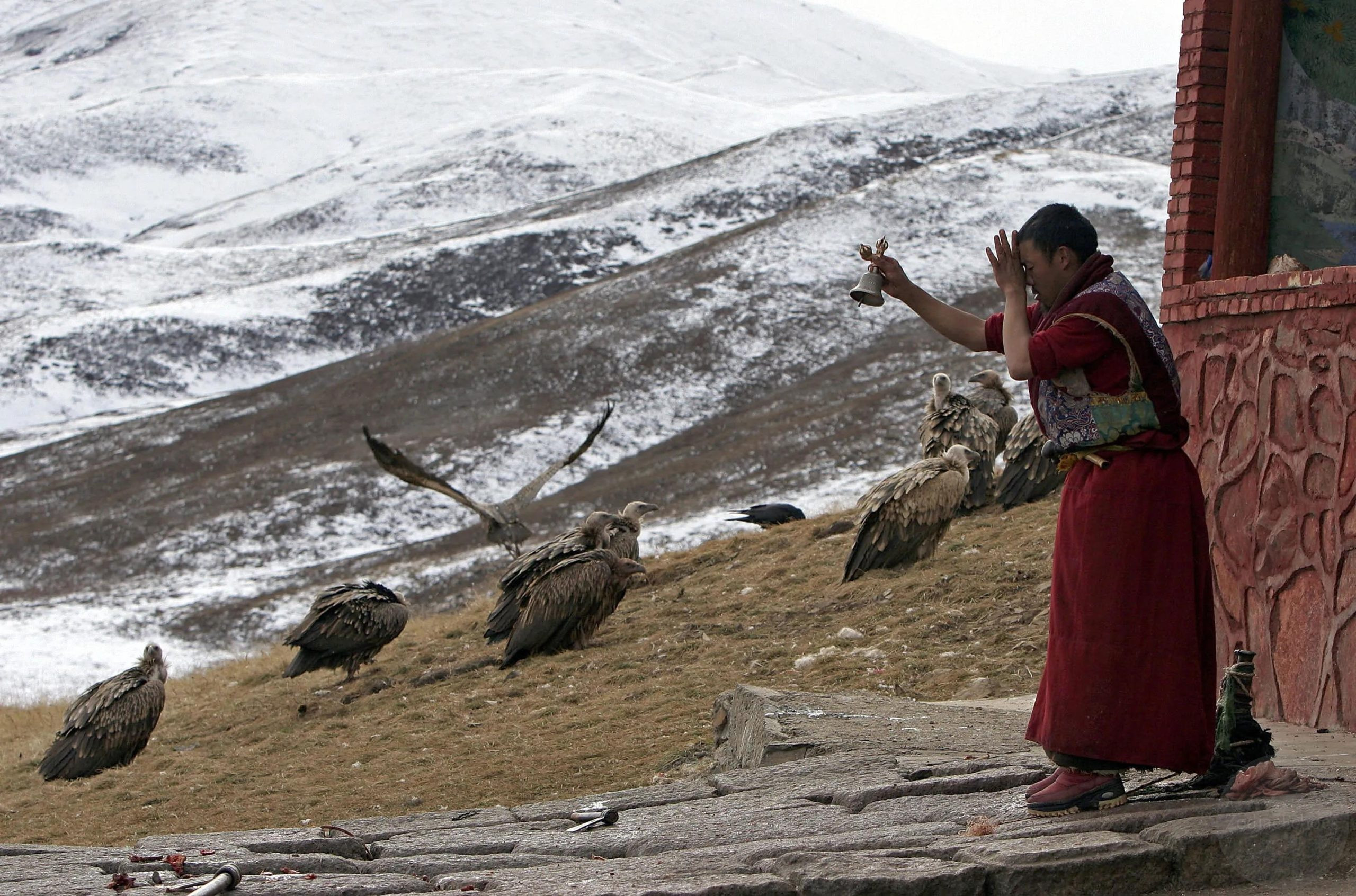
- Jhator, or Tibetan sky burial, is a traditional funerary practice in which human remains are offered to vultures.
- The ceremony reflects Buddhist teachings about impermanence, compassion, and generosity toward other living beings.
- The rocky terrain, frozen ground, and scarcity of firewood across parts of Tibet also influenced traditional burial practices.
- Some local beliefs regarded vultures refusing the remains as an unfavorable omen, although interpretations varied between communities.
- Sky burials continue in some Tibetan Buddhist communities today and remain culturally and religiously significant.
High in the Himalayan mountains, where the air is thin and the landscape stretches across vast, rocky plateaus, an extraordinary funeral tradition has survived for centuries. Instead of burying their dead beneath the earth or reducing their bodies to ashes, some Tibetan communities follow a ritual in which human remains are offered to vultures.
Known as jhator, often translated as “giving alms to the birds,” the ceremony is one of the most unusual funerary practices in the world. Its physical reality can be confronting, but behind it lies a profound religious understanding of death, generosity, and the impermanence of the human body.
What Happens During a Tibetan Sky Burial?
Following a death, Buddhist religious specialists may perform prayers and recitations intended to guide the deceased through the transition between death and rebirth. In Tibetan Buddhist belief, consciousness does not simply disappear when the physical body stops functioning.
At the appropriate time, the deceased is transported to a designated open-air burial ground, often situated on elevated terrain. Specially trained practitioners prepare the body so that vultures can consume the remains. In some traditions, even the bones are broken down and offered to the birds.
The ceremony varies between communities and religious traditions. It is not an ordinary public spectacle, but a meaningful funerary observance connected to the deceased and their family.
Why Give a Human Body to Vultures?
The explanation lies partly in the Buddhist teaching of impermanence, known as anitya or anicca. Everything that exists changes, including the human body. Death marks the end of its physical life, but Tibetan Buddhist teachings describe consciousness as continuing through a process associated with rebirth.
From this perspective, the body no longer needs to be preserved once consciousness has departed. Offering it to scavenging birds becomes a final act of generosity toward other living beings. Vultures are especially significant because they consume animals that have already died. By feeding them, the deceased symbolically gives something back to the natural world.
The practice also has a practical dimension. Much of the Tibetan Plateau has rocky ground, severe winters, and limited supplies of firewood. These environmental conditions can make conventional burial or cremation difficult, although scholars debate how much they explain the historical development of jhator.
The Disturbing Omen of Vultures Refusing the Body
One of the most unsettling aspects of Tibetan sky burial folklore concerns the behavior of the birds themselves.
In some local traditions, vultures refusing to consume the remains were regarded as an unfavorable omen. Their willingness to approach the offering could carry spiritual significance for those participating in the ceremony.
Accounts from Tibetan communities describe beliefs that the complete consumption of the remains was desirable. The absence of birds, or the presence of uneaten remains, could therefore cause anxiety.
These interpretations belong to religious and local folklore rather than evidence that the birds can predict the fate of the deceased. Nevertheless, they reveal how closely the natural world and spiritual expectations were connected within the ritual.
The Tibetan Book of the Dead and the Journey Beyond Death
Tibetan funerary traditions are also associated with teachings about bardo, the transitional states connected with death and rebirth. Religious texts, including those commonly known in English as the Tibetan Book of the Dead, describe spiritual experiences and guidance associated with this transition.
Monks or other qualified practitioners may recite prayers and sacred texts for the deceased. The purpose is not to preserve the physical body indefinitely, but to support the spiritual journey described within Buddhist tradition.
Sky burial is only one of several Tibetan funerary practices. Cremation, water burial, and other forms of disposal have also existed, depending on local customs and circumstances.
A Tradition That Continues Today
Jhator is not merely an extinct practice described in historical books. Sky burials continue in some Tibetan Buddhist communities, including parts of the wider Himalayan cultural region.
Modern pressures, changing environments, and restrictions surrounding burial sites have affected the practice. Yet its central religious significance remains recognizable: death does not make the body useless, because it can still sustain other living creatures.
Conclusion
To outsiders, the image of vultures consuming human remains may seem disturbing. Within the religious traditions that practice jhator, however, the ceremony represents generosity, compassion, and acceptance of mortality.
Sky burial confronts a question that many societies prefer to avoid: what should happen to the body after the person has died? In the mountains of Tibet, one answer has endured for generations. The body returns to nature, while the living are reminded that nothing physical lasts forever.
Cosmic Highlights

FAQ
What is a Tibetan sky burial?
A Tibetan sky burial, traditionally called jhator, is a funerary ceremony in which the deceased’s remains are prepared and offered to vultures. The practice reflects religious beliefs about impermanence and generosity after death.
Why are bodies offered to vultures in Tibet?
Within Tibetan Buddhist tradition, the body is no longer needed after death, and offering it to birds can represent a final act of compassion. Environmental conditions, including rocky terrain and limited firewood, have also influenced funerary customs.
What happens if vultures refuse to eat the body?
In some local traditions, vultures refusing the remains were interpreted as an unfavorable omen. These interpretations belong to religious folklore and vary between communities; they do not establish anything about the deceased’s spiritual fate.
Are Tibetan sky burials still performed today?
Yes. Sky burials continue in certain Tibetan Buddhist communities, although practices differ by region. The ceremonies are religiously significant and are not intended as public tourist attractions.