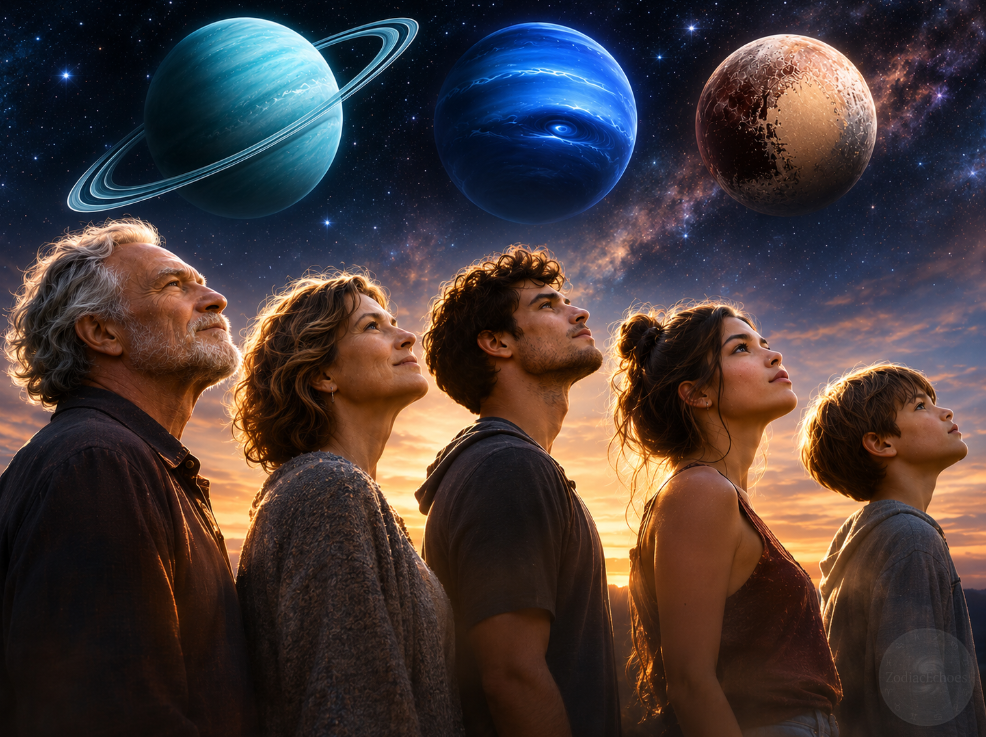
- Uranus, Neptune, and Pluto are known as generational planets because they spend many years traveling through individual zodiac signs.
- Pluto represents transformation and power, Uranus symbolizes revolution and freedom, and Neptune governs collective dreams and ideals.
- Major aspects between generational planets are traditionally associated with periods of profound social and cultural change.
- Baby Boomers, Generation X, Millennials, Generation Z, and Generation Alpha each have distinctive combinations of outer planetary placements.
People born during the same historical period often share more than important events, cultural experiences, and technological developments. They may also develop similar attitudes toward authority, relationships, work, and the future.
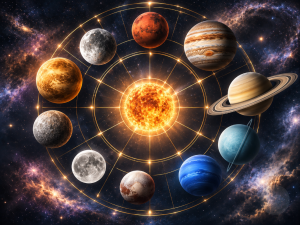
In astrology, Uranus, Neptune, and Pluto are known as generational planets because they move through the zodiac much more slowly than the Sun, Moon, Mercury, Venus, and Mars.
While personal planets help describe individual characteristics in a birth chart, the outer planets represent broader themes that influence entire generations. Their placements create a symbolic background against which individual lives unfold.
Understanding these planetary cycles can offer an astrological perspective on why different generations sometimes struggle to understand one another.
Generational Planets in Astrology: How Do They Influence Us?
Uranus spends approximately seven years in each zodiac sign, Neptune around fourteen years, and Pluto between twelve and thirty years. Pluto’s highly elliptical orbit causes considerable variation in the time it spends in individual signs.
Because these celestial bodies move so slowly, millions of people are born with similar generational planetary placements.
Their symbolism therefore concerns collective experiences, social developments, shared values, and historical transformations rather than the everyday personality traits of a single individual. Each generational planet represents a different dimension of change.
Pluto: The Slowest and Most Powerful Agent of Transformation
Pluto symbolizes profound transformation, the collapse of outdated structures, and the emergence of something new. In astrology, its influence is often associated with difficult processes that force individuals and societies to confront realities they would prefer to avoid.
On a collective level, Pluto is connected with power, control, political and financial systems, psychological depth, and subjects that society considers taboo. These themes include sexuality, death, manipulation, and the hidden motivations behind human behavior.
Pluto’s symbolism suggests that genuine transformation is rarely comfortable. Old structures may need to lose their influence before new systems can emerge. Its central lesson is that change is unavoidable, and meaningful growth sometimes follows the breakdown of what no longer works.
Uranus: Revolution, Freedom, and Technology
Uranus represents sudden change, innovation, independence, and revolution. Its astrological influence is considered unpredictable, but it also symbolizes liberation from restrictions and outdated expectations.
Where Uranus becomes prominent, established ways of thinking may be questioned and pressure for greater freedom can develop. On a social level, Uranus is associated with technological progress, social revolutions, changing values, new lifestyles, and the rejection of obsolete traditions.
Its placement in Aquarius between approximately 1996 and 2003 is often connected symbolically with the rapid expansion of the internet, digital communication, and globalization. Uranus teaches adaptability and suggests that change can represent an opportunity rather than merely a threat.
Neptune: Dreams, Ideals, and Collective Sensitivity
Neptune represents collective dreams, ideals, spirituality, faith, and illusion. It is associated with empathy, imagination, and the emotional atmosphere of a particular historical period.
However, Neptune also symbolizes confusion, uncertainty, and the disappearance of clear boundaries between reality and fantasy. On a collective level, Neptune is linked with spiritual and religious movements, artistic expression, cinema, music, culture, media, and shared hopes and fears.
Its influence can inspire compassion and creativity, but it may also encourage unrealistic expectations or excessive faith in attractive ideas. Neptune’s central lesson is to develop empathy without losing the ability to distinguish reality from illusion.
When Generational Planets Meet: Historical Turning Points
Some of the most significant collective changes are traditionally associated with major aspects between the generational planets.
When Uranus, Neptune, and Pluto form conjunctions, sextiles, squares, oppositions, or other important configurations, astrologers interpret these periods as moments when different forces of social transformation interact.
Political systems may change, established values may be challenged, and familiar ways of living can begin to disappear. These are the periods that can create a widespread feeling that the world will never be quite the same again.
Different generations experience these transformations at different stages of life, which helps explain their contrasting attitudes toward authority, security, and social progress.
Baby Boomers (1946–1964): The Builders
Baby Boomers grew up during the postwar period of reconstruction, economic expansion, and powerful social institutions. Astrologically, this generation is particularly associated with Pluto in Leo and Neptune in Libra.
Pluto in Leo emphasized personal achievement, authority, leadership, and the desire to leave a lasting legacy. Neptune in Libra represented ideals of harmony, partnership, and a belief in a fair and stable social order.
Between approximately 1953 and 1956, Pluto and Neptune formed a harmonious sextile. In astrological interpretations, this period is associated with the rise and eventual questioning of powerful personalities and established authorities.
Many Baby Boomers developed a strong belief that hard work, loyalty, and commitment to existing institutions could provide stability and security. Their present generational challenge is confronting the transformation or disappearance of some of the structures they helped maintain and develop.
Generation X (1965–1980): Skeptics Between Two Worlds
Generation X grew up during the Cold War, major social changes, and the gradual weakening of established assumptions. Astrologically, this generation is associated with Pluto in Virgo and Libra, together with Uranus in Scorpio.
People born in 1965, 1966, and 1967 were particularly influenced by the conjunction of Uranus and Pluto in Virgo. Pluto in Virgo symbolized a critical examination of institutions, work, and public health, while Uranus contributed a desire for truth, freedom, and reform.
Virgo’s association with work and responsibility also gives this planetary configuration a strong connection with diligence and practical effort.
During the 1970s, Uranus entered Scorpio, symbolically bringing greater attention to subjects involving power, sexuality, psychological experiences, and previously restricted conversations. Generation X consequently occupies an unusual position between older institutional values and the increasingly rapid changes experienced by younger generations.
Millennials — Generation Y (1981–1996): The Seekers
Millennials are often associated with the search for meaning, the questioning of established expectations, and the desire for a healthier balance between work and personal life. Rather than automatically accepting traditional definitions of success, this generation increasingly asks whether established ways of living provide genuine satisfaction.
Astrologically, Millennials are associated with Pluto in Scorpio and Sagittarius, together with Uranus and Neptune in Capricorn. Pluto in Scorpio symbolized deep self-examination, emotional transformation, and an interest in psychological experiences.
Neptune in Capricorn challenged idealized assumptions about careers, financial security, and established authorities. Uranus in Capricorn represented pressure to transform institutions and traditional working arrangements.
The year 1989 was especially significant in this astrological interpretation. Saturn and Neptune met in Capricorn, while Pluto in Scorpio formed a supportive aspect. Uranus was also moving through Capricorn during this period.
These configurations are associated symbolically with the revolutionary collapse of established political structures and the beginning of a new historical era. Millennials inherited a world in which old certainties were increasingly questioned, encouraging them to search for different definitions of success and personal fulfillment.
Generation Z (1997–2012): Authenticity, Speed, and Sensitivity
Generation Z grew up with the internet, social media, and an almost continuous flow of information. This generation is often described as adaptable, technologically confident, and sensitive to social pressure and uncertainty.
Astrologically, Generation Z is associated with Pluto in Sagittarius and Capricorn, Neptune in Aquarius, and Uranus in Pisces. Uranus in Pisces symbolizes a desire for emotional freedom and a transformation in how people understand sensitivity and personal experiences.
Pluto in Capricorn represents the questioning and potential breakdown of traditional authorities, institutions, and established paths toward success. Neptune in Aquarius is connected with ambitious technological ideals and the rapid development of digital society.
However, Neptune’s symbolism also introduces the possibility of illusion, particularly when new technologies are accepted without sufficient critical examination. Generation Z’s challenge is therefore connected with finding authenticity, emotional stability, and independent judgment within an increasingly complicated digital world.
Generation Alpha (From Approximately 2013): A World Without Boundaries?
Generation Alpha is still growing up, but its experiences are already developing within a world very different from that of previous generations. Digital technology, artificial intelligence, global communication, and rapidly changing social structures are becoming ordinary parts of everyday life.
Astrologically, this generation is associated particularly with Pluto in Aquarius, which began its sustained transit through the sign in late 2024. Pluto in Aquarius symbolizes profound transformations involving technology, social organization, collective awareness, equality, and new forms of cooperation.
Artificial intelligence and increasingly powerful technological systems are central themes of this planetary period. One of the major challenges associated with this symbolism is learning to use advanced technologies consciously and ethically.
Neptune in Pisces also contributes themes of imagination, emotional sensitivity, compassion, and creativity to part of this generation. Generation Alpha may therefore face the task of balancing technological possibilities with empathy, responsibility, and genuine human connection.
Conclusion
Generational planets in astrology provide a symbolic explanation for the different values, challenges, and historical experiences shared by people born during similar periods.
Pluto represents transformation and the redistribution of power. Uranus symbolizes revolution, freedom, and innovation. Neptune reflects collective dreams, ideals, and the tension between inspiration and illusion. Baby Boomers, Generation X, Millennials, Generation Z, and Generation Alpha each reflect different combinations of these planetary influences.
Although every individual has a unique birth chart, the slow movements of Uranus, Neptune, and Pluto create broader astrological themes shared across entire generations. Understanding these cycles can offer an additional perspective on why societies change, why generations sometimes disagree, and how collective priorities evolve over time.
Cosmic Highlights

FAQ
What are the generational planets in astrology?
Uranus, Neptune, and Pluto are known as generational planets because they move slowly through the zodiac and remain in individual signs for many years.
How long does Uranus stay in one zodiac sign?
Uranus spends approximately seven years in each zodiac sign, meaning people born within a similar period often share the same Uranus placement.
How long does Neptune stay in one zodiac sign?
Neptune spends approximately fourteen years in each zodiac sign. Its astrological symbolism is associated with collective ideals, imagination, spirituality, and cultural developments.
How long does Pluto stay in one zodiac sign?
Pluto spends approximately twelve to thirty years in a zodiac sign, depending on its position in its elliptical orbit around the Sun.
Which generational planets influenced Baby Boomers?
Baby Boomers are particularly associated with Pluto in Leo and Neptune in Libra, reflecting astrological themes of leadership, social structures, harmony, and institutional stability.
Which planets influenced Millennials?
Millennials are associated with Pluto in Scorpio and Sagittarius, Uranus in Capricorn, and Neptune in Capricorn. These placements symbolize emotional transformation, changing institutions, and the search for meaning.
What does Pluto in Aquarius mean for Generation Alpha?
Pluto in Aquarius symbolizes major transformations involving technology, collective organization, equality, and social cooperation. Its themes include artificial intelligence and the ethical use of powerful new technologies.
Do generational planets determine individual personality?
In astrology, generational planets represent broader collective themes. Individual interpretations also depend on the Sun, Moon, personal planets, houses, and aspects within a complete birth chart.