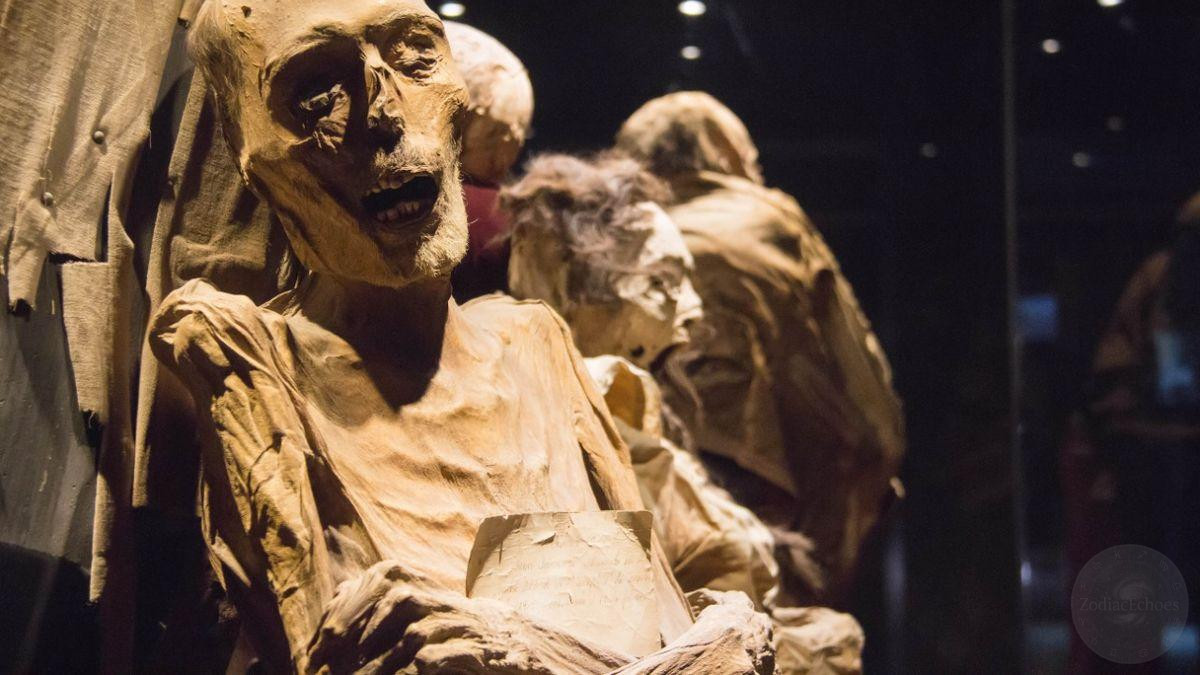
Naturally preserved human remains displayed at the Mummies of Guanajuato Museum in Mexico. Their haunting appearance has inspired stories of premature burial, although their unusual facial features can result from natural postmortem processes. Photo credit: ReyungCho
- The Mummies of Guanajuato are naturally preserved human remains discovered in a Mexican cemetery during the nineteenth century.
- Several bodies have open mouths and distorted facial features that resemble expressions of terror.
- Legends of premature burial became associated with the collection, although an open mouth is not evidence that someone was buried alive.
- The mummies are preserved at the Museo de las Momias de Guanajuato, one of Mexico’s most unusual museums.
Behind the glass displays of a museum in central Mexico stand dozens of human bodies that appear to have been frozen in their final moments of terror. Their skin is dark and leathery, their limbs unnaturally thin, and some have mouths stretched wide open as though they were screaming.
These are the Mummies of Guanajuato, one of the world’s most unsettling collections of naturally preserved human remains. But the most disturbing question surrounding them has persisted for generations: were some of these people buried before they were actually dead?
The Cemetery That Revealed Its Dead
The story began in the nineteenth century at the Santa Paula Cemetery in Guanajuato, Mexico. Local authorities required payments connected with maintaining burial spaces. When certain payments were not made, remains could be exhumed to make room for other burials.
In 1865, cemetery workers reportedly uncovered the preserved body of a French doctor named Remigio Leroy, traditionally identified as the first mummy discovered there. Instead of the skeletal remains they expected, they encountered a body whose skin and other tissues had survived.
Further exhumations revealed additional naturally mummified bodies. The discovery transformed an ordinary cemetery into the setting for one of Mexico’s strangest historical mysteries.
Why Do Some Mummies Look as Though They Are Screaming?
Several Guanajuato mummies have wide-open mouths, exposed teeth, and facial features that appear twisted into expressions of fear. To visitors unfamiliar with the changes that occur after death, these faces can look terrifyingly human.
However, the apparent expressions do not necessarily reflect what the individuals experienced while dying. As a body decomposes or dries, soft tissues shrink and lose their original shape. The jaw may fall open, while the lips and surrounding tissues retract.
These processes can produce an appearance resembling a scream. A mummy’s facial expression cannot reliably reveal the person’s final emotions or prove that death occurred during burial.
The Terrifying Legend of Premature Burial
Stories of people accidentally buried alive circulated widely during the nineteenth century, when fears of premature burial influenced literature, medicine, and funeral customs. The Guanajuato mummies provided unusually disturbing images around which such stories could develop.
One frequently repeated account concerns a woman whose body was supposedly discovered in a position suggesting that she had struggled inside her coffin. Popular retellings have interpreted unusual body positions, damaged clothing, or facial expressions as evidence of desperate attempts to escape.
Yet these interpretations are difficult to establish without reliable medical and archaeological documentation. There is no convincing evidence that the collection’s open-mouthed mummies were buried alive. The legends remain part of the museum’s wider cultural fascination rather than verified explanations of the deaths.
How Did the Bodies Become Naturally Mummified?
Unlike ancient Egyptian mummies, the Guanajuato bodies were not deliberately preserved through elaborate embalming rituals. Their unusual condition developed through natural processes associated with their burial environment.
When conditions favor drying over ordinary decomposition, human tissues can lose moisture rapidly enough to resist complete destruction. Factors such as temperature, humidity, ventilation, and the particular conditions of burial may influence whether natural mummification occurs.
Not every person buried in the cemetery became a mummy, which makes the surviving examples especially remarkable. The preservation of skin, hair, clothing, and facial features allows modern visitors to encounter individuals who died more than a century ago.
From Forgotten Graves to a Museum of the Dead
As discoveries accumulated, the preserved bodies attracted public curiosity. Visitors began coming to see them, and the collection eventually developed into the Museo de las Momias de Guanajuato, formally established as a museum in the twentieth century.
Today, the displays include adults and children whose remains have survived in strikingly different states of preservation.
The museum has also prompted discussions about the ethics of exhibiting human bodies, particularly when the deceased never consented to becoming public attractions. Behind the sensational stories are real individuals whose lives, families, and personal histories deserve recognition.
Conclusion
The screaming mummies of Guanajuato remain disturbing because their faces appear to preserve emotions that death should have erased. Science offers explanations for their unusual appearance, but the legends surrounding them continue to capture the imagination.
Perhaps the true mystery is not whether the dead screamed inside their coffins, but why their silent faces still make the living imagine that they did.
Cosmic Highlights

FAQ
Where are the screaming mummies of Guanajuato?
They are displayed at the Museo de las Momias de Guanajuato in Guanajuato, Mexico.
Were the Guanajuato mummies buried alive?
Stories of premature burial exist, but there is no convincing evidence that the mummies’ open mouths prove they were buried alive.
Why are their mouths open?
Natural postmortem changes, including tissue shrinkage and changes in jaw position, can create the appearance of a scream.
Are the Guanajuato mummies real?
Yes. They are genuine human remains preserved through natural mummification rather than artificial Egyptian-style embalming.
When were the mummies discovered?
The earliest documented discoveries are traditionally dated to 1865, during exhumations at Santa Paula Cemetery.