- A Nightmare on Elm Street grew from Wes Craven’s interest in reports of deaths during sleep.
- The Changeling drew on Russell Hunter’s account of a Denver haunting, but archival research challenges important details.
- The Sacrament uses Jonestown as its historical framework, according to director Ti West.
- The stories raise different questions about unexplained deaths, an alleged hidden identity and the final hours of an isolated community.
Some horror stories begin with a newspaper report. Others arrive through someone’s account of a house, or through a catastrophe whose surviving recordings and witnesses reveal only parts of a much larger history.
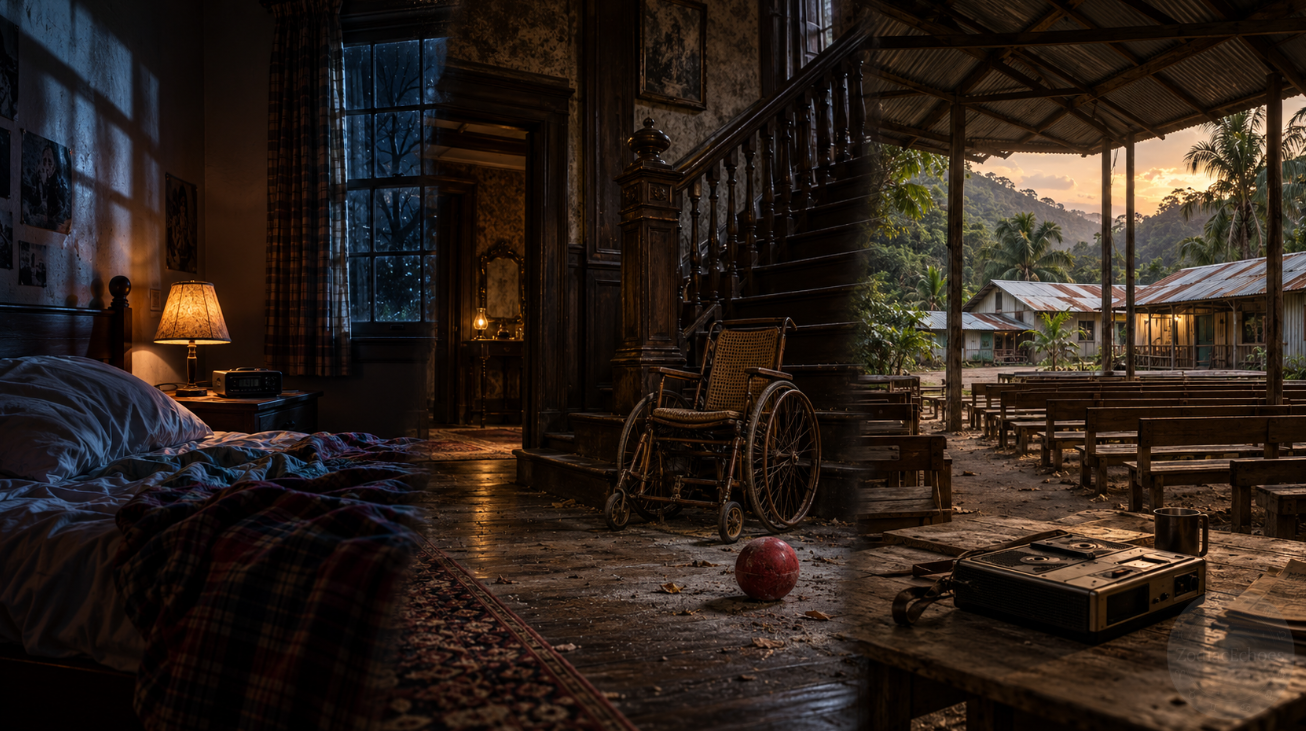
The third instalment of this series explores A Nightmare on Elm Street, The Changeling and The Sacrament. Their connections to real events range from a spark of inspiration to a deliberately borrowed historical framework. Following those connections reveals stories considerably different from the films they helped create.
A Nightmare on Elm Street: The Deaths That Made Sleep Frightening
Freddy Krueger belongs to fiction, but Craven linked his film’s origins to a report of a young person dying during sleep.
The broader historical context was a genuine public-health puzzle. In December 1981, the CDC reported 38 sudden deaths among Southeast Asian refugees, all apparently occurring during sleep. Thirty-seven of those who died were men. Most were refugees from Laos, including 25 people from the Hmong community.
These were deaths occurring across different households and American states. Investigators gathered information from families, coroners and medical examiners, looking for something that could explain the pattern. The circumstances were especially unsettling because people who had survived displacement and reached a new country were dying in an apparently ordinary setting: their beds.
By the CDC’s 1988 update, surveillance had recorded 117 cases of sudden unexplained death syndrome among Southeast Asian refugees. Reports were declining, but the agency still described the cause as unknown at that time. Researchers had considered possible cardiac abnormalities and stress among the potential factors.
Craven’s film gives the fear a visible attacker. The historical reports contain no equivalent figure and do not establish that nightmares themselves killed anyone. Their disturbing connection to the film is more fundamental: sleep, normally a retreat from danger, had become the setting for deaths investigators struggled to explain.
The Changeling: Who Was the Child in the House?
The story behind The Changeling leads to Denver and composer Russell Hunter. According to his account, he rented a house near Cheesman Park in the late 1960s and began experiencing violent noises, moving objects and other disturbances.
Hunter’s narrative became increasingly elaborate. He described discovering a concealed staircase and a trunk containing a child’s schoolbooks and journal. A séance supposedly revealed that a sickly child had died and been secretly replaced by another boy so that an inheritance would remain within the family. Hunter also claimed that information obtained during the séance led to buried remains. These details survive as his account of events.
The film develops that material into a mystery involving a concealed death and an identity that should never have belonged to its bearer. The historical question is whether the Denver household supports the story Hunter told.
Denver Public Library investigated using city directories, building information and genealogical records. Its researchers could not confirm Hunter’s tenancy through the directories and telephone books they consulted. That absence does not settle whether he stayed there, but it leaves a basic element of the account uncorroborated.
The family history produced a more substantial complication. The house’s owners, Henry Treat Rogers and his wife Kate, were childless. A niece and nephew did spend time living with them, but the records described by the library do not establish Hunter’s story of an isolated boy and a secret replacement.
The unresolved question therefore concerns the origins of Hunter’s narrative as much as the alleged haunting. A real house and identifiable residents sit behind the film, while the most extraordinary events remain dependent on the storyteller who supplied them.
The Sacrament: The Final Hours Behind Eden Parish
In The Sacrament, visiting journalists enter an isolated community whose reassuring welcome gradually gives way to coercion and danger. Ti West has explicitly identified the final 48 hours at Jonestown as the framework for the film. Its community, Eden Parish, and its central characters are fictional.
The historical sequence began before the deaths. Congressman Leo Ryan travelled to Guyana in November 1978 to investigate allegations about Jim Jones’s Peoples Temple settlement. Those allegations included mistreatment and restrictions on residents’ freedom. During the visit, some members asked to leave with Ryan’s group.
On November 18, gunmen attacked the departing party at the Port Kaituma airstrip, killing Ryan and others. Back at Jonestown, Jones directed the gathering toward mass death. More than 900 people died, including hundreds of children. The FBI subsequently investigated Ryan’s murder and assisted with the wider investigation and identification work.
The scale of the catastrophe can obscure the individual circumstances within it. West has stressed that his interest extended beyond the final act to the manipulation that preceded it. In an interview, he described Jonestown as more accurately understood through mass murder than through the familiar shorthand of collective suicide.
His film concentrates those themes into the experience of a few visitors. The historical questions reach further back: how people’s hopes became instruments of control, how warnings were handled and what opportunities different residents had to escape. Jonestown left witnesses and an extensive investigative record, but no single camera followed every person through the final hours.
Cosmic Highlights

FAQ
Was Freddy Krueger based on a real killer?
Freddy is fictional. Craven associated the film’s origins with a reported death during sleep; the wider historical background includes documented unexplained nocturnal deaths.
Was the haunting behind The Changeling verified?
Hunter’s account inspired the film, but Denver Public Library’s archival research found significant gaps and discrepancies in its historical background.
Is The Sacrament a film about Jonestown?
It is a fictional story using Jonestown as a framework. West identified the settlement’s final 48 hours as a central influence.
Sources
- Vulture — Freddy Lives: An Oral History of A Nightmare on Elm Street
- CDC — Sudden, Unexpected, Nocturnal Deaths Among Southeast Asian Refugees, 1981
- CDC — Update on Sudden Unexplained Death Syndrome, 1988
- Denver Public Library — A Denver House That Inspired a Horror Film
- Cinemacy — Ti West and Cast on The Sacrament
- Mandatory — Ti West on the Horrors of Jonestown
- FBI — Jonestown