-
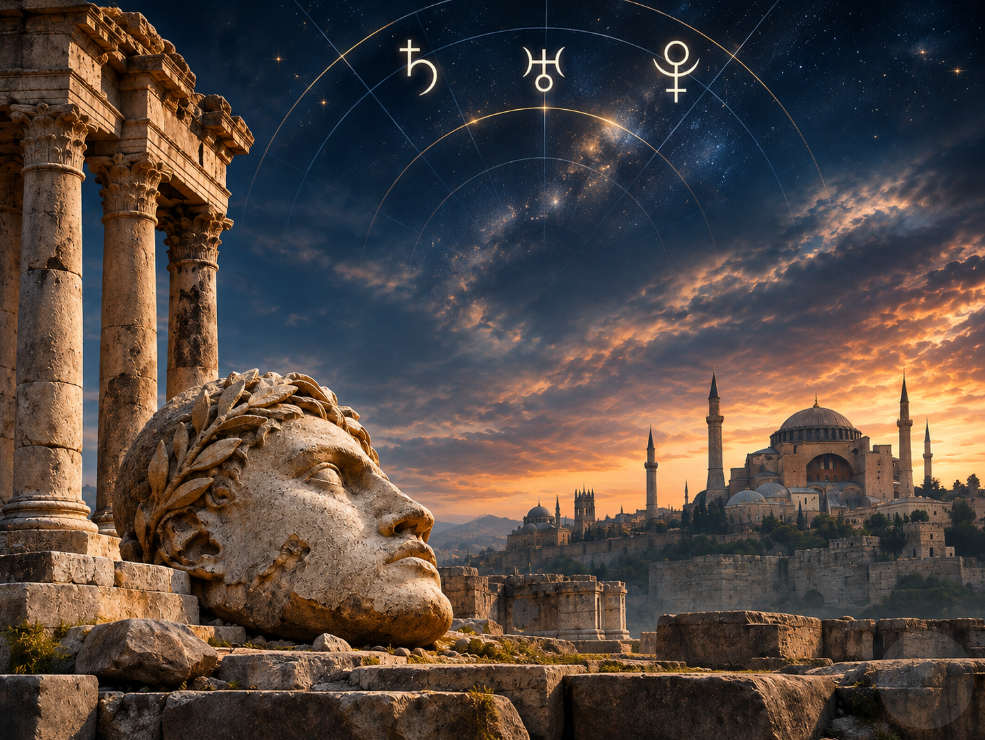
Saturn, Uranus and Pluto provide an important symbolic framework for examining the collapse of political systems in Western mundane astrology.
-
The fall of Rome, Constantinople and the Holy Roman Empire offers historical perspectives on the transformation of imperial authority.
-
The dissolution of Austria-Hungary and the Ottoman Empire illustrates the relationship between dynastic power and emerging national identities.
-
The collapse of the Soviet Union occurred during the approaching Uranus–Neptune conjunction in Capricorn.
-
Three Saturn–Pluto squares between June 2028 and March 2029 introduce another significant phase of institutional transformation.
Empires rarely imagine their own disappearance. Their rulers build monuments intended to survive centuries, establish political systems designed to preserve authority and create institutions that appear inseparable from the world around them.
Yet even the most powerful civilizations eventually encounter periods when their established structures can no longer withstand internal and external pressures. From the fall of Rome to the dissolution of the Soviet Union, the end of an empire often marks the beginning of an entirely different geopolitical order.
Western mundane astrology offers a fascinating perspective on these historical transformations through the planetary cycles associated with institutional authority, revolution and the redistribution of power.
The Planetary Architecture of Imperial Power
Western mundane astrology examines planetary cycles in relation to governments, nations, political institutions and collective historical developments. Three planets are particularly relevant to the study of imperial dissolution: Saturn, Uranus and Pluto. Each represents a different dimension of political power and its transformation.
Saturn: The Structures That Hold Civilization Together
Saturn represents authority, administration, hierarchy, laws and institutional continuity. Its symbolism encompasses the structures through which political systems maintain stability across generations. In an imperial context, Saturn represents the machinery of government, established borders, bureaucratic institutions and the legitimacy of authority.
Uranus: Revolution and Political Independence
Uranus is associated with rebellion, liberation, independence and sudden departures from established systems. Its relationship with Saturn creates a symbolic confrontation between preservation and change, particularly when conjunctions, squares or oppositions bring their contrasting principles together.
The institutions that once guaranteed stability may become the very structures that revolutionary movements seek to dismantle.
Pluto: The Transformation of Power
Pluto represents concentrated power, hidden forces, destruction, regeneration and irreversible transformation. While Uranus symbolizes the forces challenging established authority, Pluto introduces questions about whether the fundamental structure of that authority can survive.
In mundane astrology, the Saturn–Pluto cycle is particularly relevant to the concentration, exercise and restructuring of institutional power.
Six Empires and Their Historical Transformations
The following six historical milestones illustrate different ways in which imperial authority can disappear, fragment or evolve into entirely new political systems. Their historical circumstances provide a foundation for exploring the symbolism of planetary cycles in Western astrology.
1. The Fall of the Western Roman Empire — September 4, 476
The deposition of Romulus Augustulus by Odoacer is conventionally regarded as the end of the Western Roman Empire. Centuries of military pressure, economic problems, political instability and administrative fragmentation culminated in the disappearance of imperial authority in the West.
From a mundane astrological perspective, the event embodies the symbolism of Saturn and Pluto: the transformation of sovereign leadership and the institutions supporting it.
Roman civilization continued to influence Europe long after the disappearance of its western imperial throne. Its political structure, however, had entered an entirely different historical chapter. The Roman example demonstrates how the cultural legacy of an empire can survive even after its political authority has disappeared.
2. The Fall of Constantinople — May 29, 1453
Almost a thousand years after the conventional fall of the Western Roman Empire, Constantinople fell to the Ottoman forces of Sultan Mehmed II. The event ended the Byzantine Empire and fundamentally altered the political relationship between Europe and the eastern Mediterranean.
Its historical symbolism reflects the tension associated with Saturn and Uranus: an established political order confronting the forces capable of replacing it.
The capture of Constantinople also illustrates how the disappearance of one empire can establish the foundations of another. The Byzantine imperial tradition gave way to an expanding Ottoman political system that would survive for centuries.
3. The Dissolution of the Holy Roman Empire — August 6, 1806
On August 6, 1806, Francis II relinquished the imperial crown, formally dissolving the Holy Roman Empire. Napoleon’s military and political expansion had fundamentally changed the balance of power across Central Europe. The creation of the Confederation of the Rhine accelerated the collapse of an imperial framework that had existed for centuries.
The event illustrates a central theme of Saturn–Uranus symbolism: the dissolution of an established constitutional order and the reorganization of political relationships.
The territories of the former empire continued to exist, but the institutional framework connecting them had disappeared. Europe was entering an era in which political legitimacy, territorial organization and national identity would undergo substantial changes.
4. The Disintegration of Austria-Hungary — November 11, 1918
The final months of the First World War witnessed the disintegration of the Austro-Hungarian Empire. National independence movements accelerated throughout October and November 1918. November 11 marked the general armistice and Emperor Charles I’s withdrawal from participation in Austrian state affairs.
The historical circumstances reflect the symbolic confrontation between Saturn’s established hierarchy and Uranus’s revolutionary principles. Dynastic authority was giving way to independent national identities, fundamentally changing the political geography of Central Europe.
The disappearance of the Habsburg imperial structure also demonstrated how quickly political arrangements that had survived for centuries could become incompatible with emerging social and national movements.
5. The End of the Ottoman Sultanate — November 1, 1922
More than four centuries after the conquest of Constantinople, the Ottoman sultanate was abolished by the Grand National Assembly of Turkey. The decision brought an end to centuries of dynastic sovereignty and prepared the way for the establishment of the Republic of Turkey in 1923.
The historical emphasis shifts from rebellion against imperial authority toward the transformation of its underlying political structure, a central theme of Saturn–Pluto symbolism. The Ottoman experience demonstrates how the disappearance of an imperial institution can create the conditions for an entirely different conception of political legitimacy.
6. The Dissolution of the Soviet Union — December 26, 1991
The formal dissolution of the Soviet Union brought an end to one of the most influential political entities of the twentieth century. Its astrological context is particularly interesting because the Soviet collapse occurred during the approaching conjunction of Uranus and Neptune in Capricorn, which subsequently became exact in 1993.
Uranus represents political liberation and radical change, while Neptune is associated with collective ideals, ideological beliefs and dissolution. Capricorn provides the institutional setting for these themes.
The combination offers an astrological interpretation centered on the dissolution of a political system whose collective ideological foundations were undergoing profound transformation. The Soviet example also demonstrates that the collapse of an empire can involve the erosion of the beliefs that once justified its existence.
The Recurring Astrological Themes Behind Imperial Dissolution
The six historical cases illustrate three distinct dimensions of imperial transformation.
| Planetary relationship | Mundane astrological symbolism |
|---|---|
| Saturn–Uranus | Revolution, independence and challenges to established authority |
| Saturn–Pluto | Transformation of institutional power and political hierarchies |
| Uranus–Neptune | Ideological dissolution and changing collective beliefs |
- Saturn–Uranus configurations emphasize the relationship between established institutions and forces seeking independence or revolutionary change.
- Saturn–Pluto configurations emphasize the deeper reorganization of political authority and concentrated power.
- Uranus–Neptune configurations introduce the transformation of collective beliefs, political ideals and the ideological foundations of civilization.
Together, these relationships reflect three questions central to the survival of empires: Can their institutions adapt, can their structures of power remain legitimate, and can their founding beliefs survive changing historical circumstances?
The Saturn–Pluto Conjunction of 2020: The Beginning of a New Cycle
On January 12, 2020, Saturn and Pluto formed an exact conjunction in Capricorn, beginning a new phase of their approximately 33-to-38-year planetary cycle.
The conjunction brought together two planets associated with institutional authority, concentrated power and structural transformation within a sign traditionally connected with government and administration.
The following years witnessed extraordinary changes in the relationship between governments, economies and populations. The COVID-19 pandemic, emergency legislation, economic intervention and growing geopolitical tensions placed established institutions under considerable pressure.
From a mundane astrological perspective, the conjunction marked the symbolic beginning of a prolonged period of institutional restructuring. The approaching squares of 2028–2029 represent the next major challenging phase of that same planetary cycle.
The Saturn–Pluto Squares of 2028–2029
The next major challenging phase of the Saturn–Pluto cycle will produce three exact squares between June 2028 and March 2029.
| Date | Planetary configuration |
|---|---|
| June 24, 2028 | Saturn square Pluto |
| November 15, 2028 | Saturn square Pluto |
| March 29, 2029 | Saturn square Pluto |
During these configurations, Saturn will occupy Taurus while Pluto travels through Aquarius. The cycle follows the Saturn–Pluto conjunction of January 12, 2020, representing its first square phase.
Taurus is traditionally associated with material security, territory, economic resources and ownership. Aquarius introduces themes of collective organization, political systems and technological transformation.
Within mundane astrology, this combination raises questions about the relationship between material resources and the institutions responsible for controlling and distributing them. The repeated nature of the square extends its symbolic significance across several months, creating three distinct stages within the same planetary configuration.
What Could the Next Historical Cycle Represent?
Modern geopolitical power extends beyond traditional territorial empires. International alliances, economic networks, multinational institutions and competing political blocs now shape the distribution of global influence. The Saturn–Pluto squares of 2028–2029 offer an astrological framework for examining the durability of these arrangements.
The Economic Cost of Maintaining Global Power
Throughout history, empires have depended on their ability to finance military operations, administrative systems and territorial commitments. Saturn in Taurus introduces questions surrounding national debt, material resources, economic sustainability and the financial cost of geopolitical influence.
Countries with extensive international commitments may face increasingly difficult decisions about how their resources are distributed.
The Transformation of International Alliances
Pluto in Aquarius brings the symbolism of profound transformation into the sphere of collective organization. International alliances, political unions and multinational institutions may encounter growing pressure to reconsider their internal relationships, responsibilities and distribution of authority.
The historical comparison raises an important question: What happens when the interests of individual members begin to diverge from the interests of the larger political structure?
The Changing Meaning of Sovereignty
Traditional empires maintained their authority primarily through territorial control. Modern power increasingly depends on economic influence, access to resources, financial infrastructure and international agreements.
The Saturn–Pluto square may symbolically highlight tensions between national sovereignty and participation in larger political and economic systems. These tensions could become particularly significant when governments face competing demands from domestic populations and international partners.
Could an Empire Fall Without Losing Its Territory?
One of the most intriguing questions raised by modern mundane astrology concerns the definition of imperial collapse itself. A powerful nation can retain its territory, population and political institutions while experiencing a substantial decline in its international influence.
The loss of economic dominance, the weakening of alliances or the emergence of competing centers of power can fundamentally transform its geopolitical position.
The fall of a modern empire may therefore resemble a gradual redistribution of global influence rather than a single dramatic historical event. The approaching Saturn–Pluto squares offer a symbolic framework for examining precisely this kind of transformation.
Conclusion
From ancient Rome to the Soviet Union, the disappearance of imperial authority has repeatedly transformed the political geography of the world. The approaching Saturn–Pluto squares of 2028–2029 introduce another opportunity to explore the symbolic relationship between institutional authority, economic resources and historical transformation.
In an increasingly multipolar world, the defining question of the next planetary cycle may be which established powers can adapt to changing circumstances and which will find themselves gradually surrendering the influence they once considered permanent.
Cosmic Highlights
FAQ
What is the astrology of falling empires?
The astrology of falling empires is a branch of mundane astrology that examines planetary cycles in relation to the decline of civilizations, political systems and imperial authority. Particular attention is given to Saturn, Uranus and Pluto, which symbolize institutional structures, revolutionary change and the transformation of power.
Which planetary aspects are associated with the collapse of empires?
Mundane astrologers traditionally associate challenging aspects between Saturn and Uranus or Saturn and Pluto with periods of political and institutional transformation. Conjunctions, squares and oppositions are considered particularly significant, although no single planetary configuration reliably predicts imperial collapse.
What does the Saturn–Pluto square of 2028–2029 mean?
The Saturn–Pluto square represents a challenging phase of the planetary cycle that began in January 2020. With Saturn in Taurus and Pluto in Aquarius, its astrological symbolism emphasizes economic resources, institutional authority, collective interests and the redistribution of political power.
How often do Saturn and Pluto begin a new planetary cycle?
Saturn and Pluto form a conjunction approximately every 33 to 38 years. Mundane astrologers interpret the subsequent squares and oppositions as important stages in the development of themes associated with the original conjunction.
Can astrology predict the collapse of a modern superpower?
Mundane astrology provides a symbolic framework for examining periods of geopolitical instability and institutional transformation. However, planetary configurations alone cannot reliably determine which country, political alliance or economic system will experience a decline.
Can an empire collapse without losing its territory?
Yes. Modern geopolitical decline can involve the loss of economic dominance, diplomatic influence, military superiority or international alliances without significant territorial changes. The gradual erosion of global influence may represent a contemporary equivalent of historical imperial decline.
Could 2028–2029 mark a turning point in the global balance of power?
From a Western mundane astrology perspective, the approaching Saturn–Pluto squares offer an interesting framework for exploring changes in international alliances, economic hierarchies and political authority. Their historical significance will ultimately depend on how existing institutions respond to emerging challenges.
Sources and Methodology
The article follows Western tropical mundane astrology. Historical milestones are examined through planetary symbolism, while interpretations of future geopolitical developments represent astrological hypotheses.