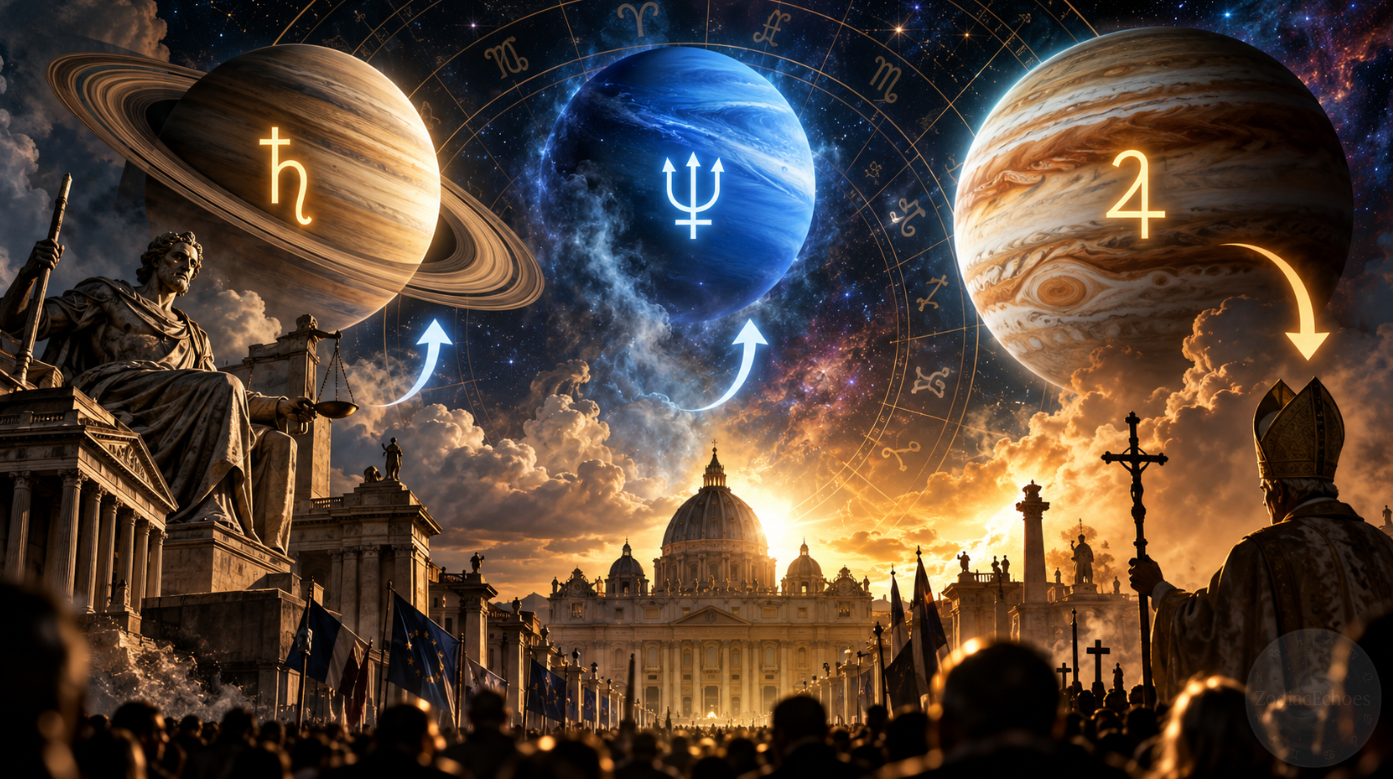
- Rare Timing: Saturn, Neptune and Jupiter reach their stationary points within approximately 49.5 hours.
- Critical Dates: December 10–13, 2026, marks the central astrological window.
- Political Authority: Saturn’s direct station highlights governments, laws and established institutions.
- Religious Influence: Neptune and Jupiter bring questions of faith, spiritual leadership and ideological change.
- Vedic Perspective: Saturn and Neptune occupy sidereal Pisces, while Jupiter stands in Leo, linking spiritual authority with leadership.
Three Planets Change Direction as 2026 Approaches Its End
Could December 2026 mark a turning point for the world’s political and religious institutions? An unusual concentration of planetary stations will bring three major astrological forces into focus within just over two days, raising intriguing questions about authority, faith, leadership and the future of established power structures.
Between December 10 and 13, Saturn and Neptune will end their retrograde periods while Jupiter begins its own. In mundane astrology, which interprets planetary movements in relation to collective events, all three planets carry associations with institutions, belief systems and the exercise of authority.
What makes this sequence particularly interesting is the contrasting symbolism. Saturn represents established order, Neptune governs spiritual ideals and collective beliefs, while Jupiter symbolizes religion, law and influential leaders. Their nearly simultaneous stations create a striking picture of institutions moving forward while traditional sources of wisdom and authority enter a period of reassessment.
The configuration also follows the historic Saturn–Neptune conjunction of February 2026, adding another chapter to a planetary cycle traditionally associated with the relationship between political structures and collective ideals.
December 10–13: The Three Critical Planetary Stations
The planetary sequence unfolds across three closely spaced events in the tropical zodiac:
| Date (UTC) | Planetary event | Position |
|---|---|---|
| December 10 | Saturn stations direct | 7°56′ Aries |
| December 12 | Neptune stations direct | 1°37′ Aries |
| December 13 | Jupiter stations retrograde | 27°01′ Leo |
Although the planets do not form a triple conjunction, their changes of apparent direction occur within approximately 49.5 hours, creating an unusual concentration of stationary planetary activity.
In astrology, stationary planets receive particular attention because their apparent movement against the zodiac temporarily slows to almost nothing before reversing direction. Traditionally, this is interpreted as a period when the planet’s symbolic themes become especially prominent.
Saturn Direct: Governments and Institutions Face a Test
The Return of Political Authority
Saturn turns direct in Aries on December 10 after moving retrograde since July 26. In mundane astrology, Saturn represents governments, legal frameworks, institutional discipline, responsibility and the structures that hold societies together.
Aries introduces a very different influence. Traditionally ruled by Mars, this fire sign symbolizes initiative, confrontation, independence and decisive leadership. Saturn is considered to be in its fall in Aries, creating an astrological tension between established authority and the impulse to act without restraint.
For political astrology, this combination raises questions about government reforms, institutional power struggles and the enforcement of controversial decisions. Leaders may find themselves symbolically caught between the need to preserve stability and demands for immediate change.
Saturn’s direct station could also be interpreted as a shift from prolonged institutional uncertainty toward more decisive action. The central theme is responsibility: who exercises authority, who challenges it and which structures are strong enough to withstand pressure?
Neptune Direct: A Turning Point for Religion and Ideology?
When Spiritual Ideals Meet Political Reality
Neptune turns direct on December 12 at the beginning of Aries, adding a second major shift to the same period. In modern Western astrology, Neptune symbolizes religion, spiritual movements, collective dreams, ideological beliefs and the boundary between idealism and illusion.
Its placement in Aries creates an unusual contrast. Neptune is associated with transcendence and surrender, while Aries represents individual will, action and the desire to lead.
In mundane interpretations, this combination can symbolize the emergence of new ideological movements, changes in religious leadership or growing tensions between spiritual ideals and political ambitions.
One particularly interesting possibility concerns the relationship between religious institutions and governments. Could spiritual leaders become more influential during periods of political uncertainty? Could established religious organizations face internal debates about their future direction?
Neptune’s station invites astrologers to examine how collective beliefs evolve when traditional sources of authority are questioned.
Jupiter Retrograde: The Authority of Religious Leaders Under Review
Wisdom, Leadership and the Question of Legitimacy
Just hours after Neptune turns direct, Jupiter begins its retrograde period on December 13 at 27°01′ Leo.
In traditional astrology, Jupiter governs religion, philosophy, law, higher education, moral authority and influential spiritual teachers. Leo, ruled by the Sun, adds symbolism associated with kingship, public prestige and prominent leaders.
This combination places particular emphasis on individuals and institutions that claim authority through wisdom, tradition or moral principles.
Jupiter’s retrograde station introduces a different theme from the direct movements of Saturn and Neptune. Rather than symbolizing immediate expansion, retrograde Jupiter is traditionally associated with reconsidering established beliefs, questioning authority and revisiting decisions rooted in ideology or faith.
In mundane astrology, this may inspire interpretations involving religious reforms, debates over institutional legitimacy or influential figures reconsidering their public responsibilities.
The symbolism also raises a broader question: What happens when established political power and spiritual authority begin moving in different directions?

The Vedic Perspective: Pisces, Leo and the Question of Spiritual Power
The same planetary events acquire a different symbolic emphasis in Vedic astrology because of the sidereal zodiac.
Using the Lahiri ayanamsa, Saturn and Neptune occupy Pisces during their December stations, while Jupiter remains in Leo. This places the traditional ruler of Pisces, Jupiter, in a sign strongly associated with leadership and royal authority.
In Vedic astrology, Pisces represents spiritual liberation, religious devotion, withdrawal and the search for higher meaning. Saturn’s presence introduces discipline, duty and institutional responsibility into these themes.
Neptune is not one of the classical grahas used in traditional Jyotisha, but modern astrologers sometimes incorporate it into their interpretations of spiritual and collective developments.
Jupiter’s position in sidereal Leo adds another dimension. Leo is associated with the Sun, sovereignty and the visible exercise of authority. Its combination with retrograde Jupiter brings questions of religious leadership, inherited traditions and the responsibilities of influential figures into focus.
The contrast between Pisces and Leo creates a compelling theme: spiritual duty versus worldly power. One emphasizes transcendence and service, while the other highlights leadership, prestige and public responsibility.
The Saturn–Neptune Cycle: Why December 2026 Matters
The December stations become even more interesting when placed within the broader Saturn–Neptune cycle.
On February 20, 2026, Saturn and Neptune formed an exact conjunction near 0° Aries in the tropical zodiac. This marked the beginning of a new cycle lasting approximately 36 years.
Historically, astrologers have associated Saturn–Neptune cycles with changes in political ideology, collective ideals and the relationship between governments and belief systems.
The previous conjunction occurred in 1989, a year remembered for the fall of the Berlin Wall and dramatic political transformations across Eastern Europe. Earlier conjunctions occurred in 1952–1953 and 1917, periods that also witnessed major ideological and geopolitical developments.
These historical episodes provide a fascinating background for examining the symbolism of the cycle.
In December 2026, Saturn and Neptune are no longer in exact conjunction, but both reach their direct stations within two days. Their simultaneous return to forward apparent motion can be interpreted as another significant stage in the development of themes introduced earlier in the year.
With Jupiter turning retrograde almost immediately afterward, the emphasis shifts toward the relationship between institutional authority, collective beliefs and the individuals who claim the right to lead.
Three Developments Mundane Astrologers May Watch
1. Religious Institutions Enter a Period of Change
The combination of Neptune’s spiritual symbolism and Jupiter’s association with religious authority may draw attention to debates surrounding religious leadership, institutional traditions and reform movements. Changes in the public influence of spiritual figures would be particularly relevant to this interpretation.
2. Governments Confront Questions of Legitimacy
Saturn’s direct station in Aries highlights the tension between established political structures and decisive leadership. Astrologers may examine disputes involving institutional authority, constitutional responsibilities or the relationship between governments and influential ideological movements.
3. A New Phase in the Relationship Between Faith and Power
The broader Saturn–Neptune cycle introduces questions about how political institutions respond to changing collective beliefs. Jupiter’s retrograde movement in Leo adds the possibility of renewed debate over the responsibilities of prominent leaders and the role of traditional authority.

Conclusion
The three planetary stations of December 10–13, 2026, bring together powerful astrological themes of political authority, religious influence and ideological transformation. With Saturn and Neptune moving direct while Jupiter turns retrograde, mundane astrologers may view this period as a significant moment in the evolving relationship between governments, spiritual institutions and influential leaders.
Coming just months after the Saturn–Neptune conjunction, the configuration adds another intriguing chapter to a cycle traditionally associated with profound changes in collective beliefs and established power.
Cosmic Highlights
FAQ
Which three planets change direction in December 2026?
Saturn turns direct on December 10, Neptune turns direct on December 12 and Jupiter begins retrograde motion on December 13. The three stations occur within approximately 49.5 hours.
Is this a triple planetary conjunction?
No. The event involves three closely timed planetary stations rather than three planets occupying the same zodiacal longitude.
Why is Jupiter important for religious predictions?
In traditional astrology, Jupiter represents religion, philosophy, moral authority, spiritual teachers and established systems of wisdom.
What does Saturn direct in Aries symbolize?
Saturn direct in Aries is traditionally interpreted through themes of institutional responsibility, leadership, discipline and tensions between established structures and decisive action.
How does Vedic astrology interpret this configuration?
In the Lahiri sidereal zodiac, Saturn and Neptune occupy Pisces while Jupiter is in Leo. Modern Vedic interpretations may connect these positions with spiritual responsibility, religious institutions and questions of leadership.