- 79 UFC Champions: The research covers 12 men’s and women’s weight divisions over a 15-year period.
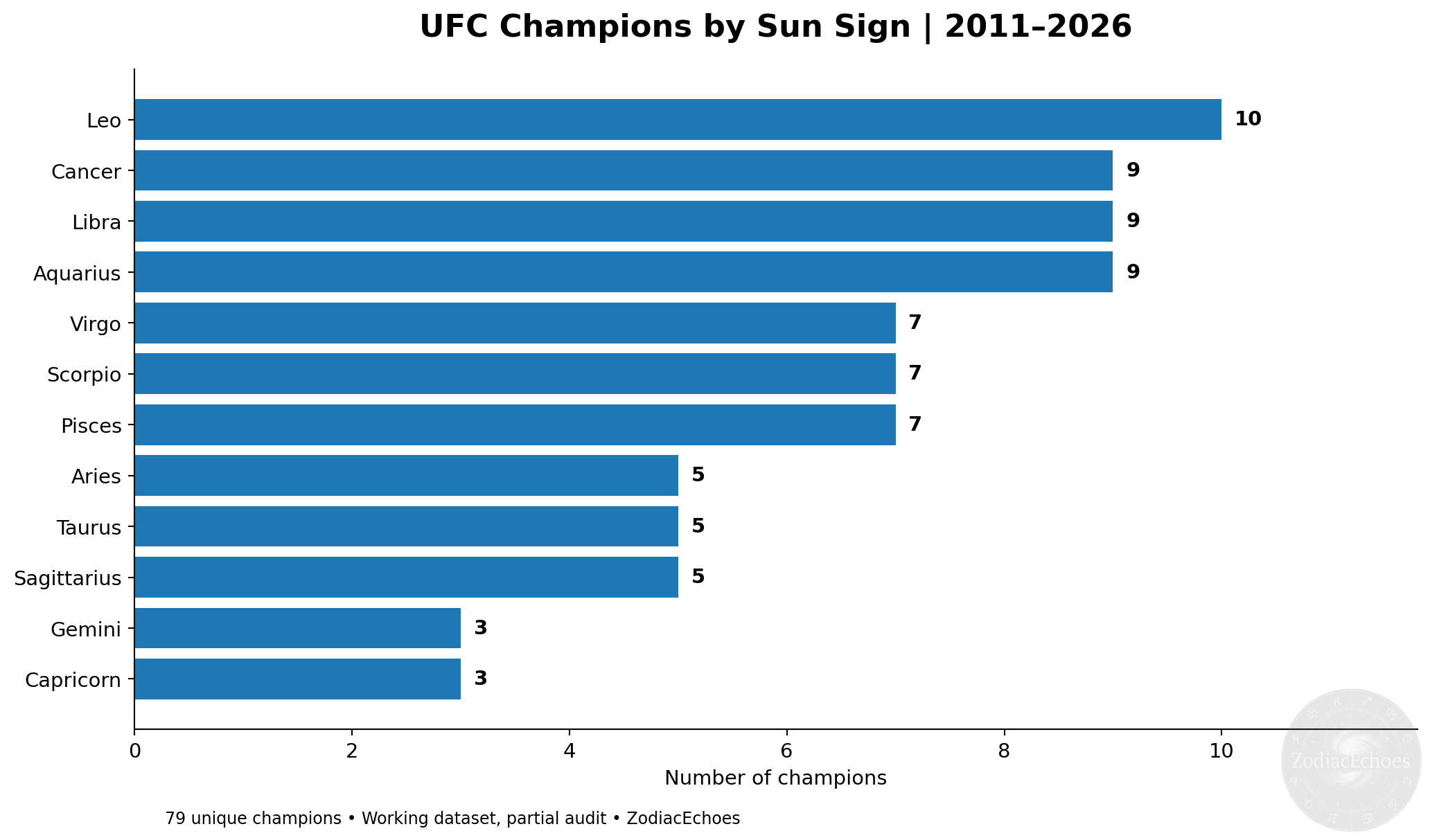
- Leo Leads: Leo appears 10 times (12.7%), followed by Cancer, Libra and Aquarius with nine champions each.
- The Rarest Signs: Gemini and Capricorn appear only three times each (3.8%).
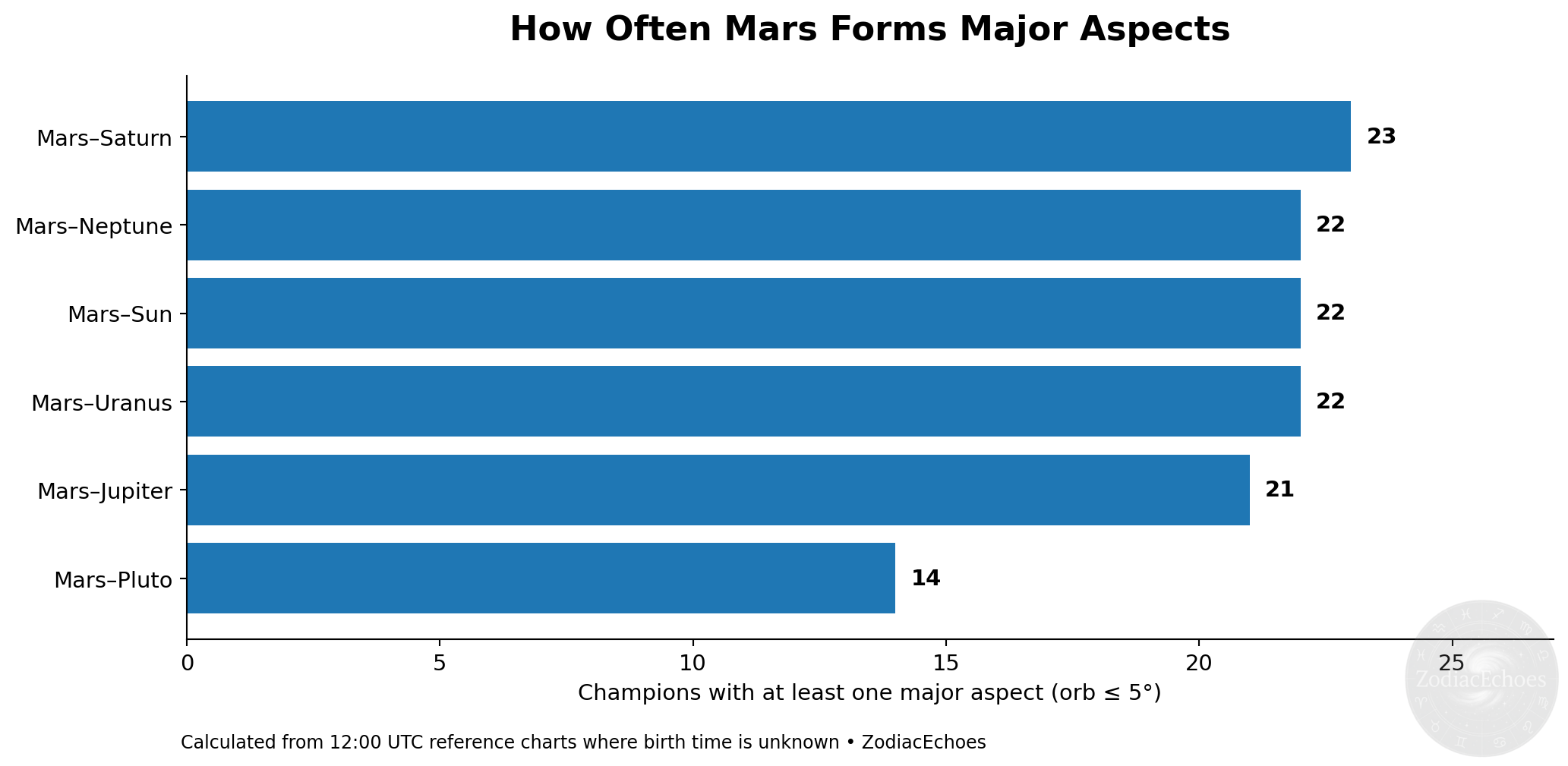
- Mars–Saturn: Major aspects between these planets appear in 23 champions’ charts, the highest count among the six planetary pairings examined.
- Six Timed Birth Charts: Recorded birth-time data allow additional analysis of the Ascendant for a smaller group of champions.
What separates an ordinary professional fighter from someone capable of becoming a UFC world champion? Technical ability, discipline, physical conditioning and mental resilience all play important roles. But astrology raises another question: do the birth charts of elite fighters share recognizable planetary patterns?
To investigate, ZodiacEchoes assembled a research dataset of 79 UFC champions whose title reigns fall within the period from October 2011 to October 2026, covering 12 men’s and women’s weight divisions. The selection includes legendary champions such as Jon Jones, Georges St-Pierre, Anderson Silva, Demetrious Johnson, Amanda Nunes and Khabib Nurmagomedov, alongside more recent titleholders.
Rather than simply assigning fighters personality traits based on their Sun signs, we calculated planetary positions using the Swiss Ephemeris and examined the angular relationships between Mars and six other celestial bodies. The analysis also incorporates six recorded birth times from Astro-Databank, allowing a closer look at the Ascendants of selected champions.
The results reveal an uneven distribution of zodiac signs, several recurring Mars aspects and striking differences between individual champions. They also demonstrate why a fighter’s Sun sign alone tells only a small part of the astrological story.
Which Zodiac Signs Produce the Most UFC Champions?
The first comparison examines the Sun signs of all 79 fighters. Each champion is counted once, regardless of how many titles or weight divisions they have competed in.
| Zodiac Sign | Champions | Share |
|---|---|---|
| Leo | 10 | 12.7% |
| Cancer | 9 | 11.4% |
| Libra | 9 | 11.4% |
| Aquarius | 9 | 11.4% |
| Virgo | 7 | 8.9% |
| Scorpio | 7 | 8.9% |
| Pisces | 7 | 8.9% |
| Aries | 5 | 6.3% |
| Taurus | 5 | 6.3% |
| Sagittarius | 5 | 6.3% |
| Gemini | 3 | 3.8% |
| Capricorn | 3 | 3.8% |
Leo: The Most Common Sun Sign Among Champions
Leo leads the dataset with 10 champions, representing approximately one in eight fighters. In traditional astrology, Leo is associated with confidence, leadership, competitive pride and the desire to distinguish oneself.
Among the prominent Leo champions in the dataset are Demetrious Johnson, Stipe Miocic and Joanna Jędrzejczyk. Their careers demonstrate different expressions of elite-level success: technical versatility, heavyweight endurance and exceptional striking ability.
The astrological symbolism is intriguing. Leo is a fixed fire sign, combining the intensity of the fire element with the persistence traditionally associated with fixed signs. An equal distribution across 12 signs would produce approximately 6.6 champions per sign. Leo’s total of 10 is above that benchmark, although the difference alone does not establish statistical significance.
Cancer, Libra and Aquarius: Three Very Different Paths to the Top
Cancer, Libra and Aquarius each account for nine champions, producing a three-way tie behind Leo.
Cancer’s representatives include Jon Jones, Conor McGregor and Alex Pereira, fighters whose careers are associated with very different technical approaches and public personalities. Cancer’s traditional symbolism emphasizes instinct, emotional intensity and protection, but these fighters show why one Sun sign cannot describe an entire competitive style.
Libra, meanwhile, includes Alexander Volkanovski, Charles Oliveira and Jiří Procházka. Its astrological association with balance and timing provides an interesting lens for considering striking distance, positional control and tactical adjustments.
Aquarius includes Ronda Rousey, Henry Cejudo and T.J. Dillashaw, alongside more recent champions in the dataset. The sign is traditionally linked with independence, unconventional thinking and the willingness to challenge established methods.
Why Are Gemini and Capricorn at the Bottom?
Gemini and Capricorn appear only three times each. That is one of the largest differences visible in the chart, with Leo represented more than three times as often as either sign.
The difference is a finding about this particular collection of champions. Birth-year distributions, the number of active fighters, geographic demographics and the selection of titleholders all matter when interpreting these counts.
Mars: The Planet at the Center of Our UFC Analysis
In traditional astrology, Mars symbolizes physical drive, competition, confrontation, aggression and the willingness to act under pressure. For a study of professional combat sports, it is therefore a natural starting point.
We examined Mars in relation to the Sun, Jupiter, Saturn, Uranus, Neptune and Pluto. The analysis uses five major aspects — conjunction, sextile, square, trine and opposition — with a maximum orb of 5 degrees.
Mars–Saturn: Discipline Meets Physical Force
Mars–Saturn aspects appear in 23 of the 79 charts (29.1%), the highest count among the planetary pairings examined. The most frequent individual aspect is the trine, appearing 10 times, followed by the sextile in five charts, square in four, opposition in three and conjunction in one.
Astrologically, Mars represents action while Saturn represents structure, restriction, patience and endurance. Their relationship is particularly interesting in a sport where raw aggression must be controlled through years of repetitive training.
Consider Max Holloway, whose chart contains a Mars–Saturn sextile with an orb of just 0.782°. His career is strongly associated with sustained output and remarkable consistency. The aspect offers a compelling symbolic parallel to those characteristics.
Ronda Rousey has a Mars–Saturn trine with an orb of 1.787°, while Julianna Peña has a Mars–Saturn trine at 2.360°. These are three different fighters with distinct competitive histories, but all share a close relationship between the planets traditionally associated with action and discipline.
Mars–Jupiter: Expansion, Confidence and Risk
Mars–Jupiter aspects appear in 21 champions’ charts (26.6%). The most frequent configuration is the sextile, present in 13 charts.
Conor McGregor has a Mars–Jupiter sextile with an orb of 1.639°. His chart also contains a Mars–Saturn square at 2.748° and a Mars–Uranus square at 2.204°. This combination brings together three different astrological themes: expansion, restriction and disruption.
Islam Makhachev also has a Mars–Jupiter sextile, with an orb of 1.451°. Yet his broader chart is substantially different from McGregor’s, demonstrating how a single shared aspect can appear within very different planetary configurations.
Mars–Uranus: Unpredictability and Sudden Action
Mars–Uranus aspects appear in 22 charts (27.8%), including eight trines and seven squares.
Uranus is traditionally associated with sudden changes, independence and unconventional behavior. Combined with Mars, its symbolism suggests rapid reactions and unexpected changes of direction.
Makhachev has a Mars–Uranus sextile at 3.169°, while McGregor has a Mars–Uranus square at 2.204°. Both have achieved championship success, but their aspects differ in geometry and astrological interpretation.
The type of aspect, its orb and its position within the complete chart matter.
Mars–Pluto: Intensity and the Struggle for Control
Mars–Pluto is less common in the dataset than the other planetary pairings, appearing in 14 charts (17.7%).
One particularly close example belongs to Jon Jones, whose natal Mars forms a square to Pluto with an orb of 1.014°. In astrology, this pairing is traditionally associated with intense willpower, confrontation and struggles over power or control.
Jones’ championship career makes him an obvious subject for deeper individual analysis. His close Mars–Pluto square provides a distinctive feature of his natal chart.
The Most Common Individual Mars Aspects
| Aspect | Champions | Share |
|---|---|---|
| Mars sextile Jupiter | 13 | 16.5% |
| Mars trine Saturn | 10 | 12.7% |
| Mars square Neptune | 10 | 12.7% |
| Mars sextile Sun | 9 | 11.4% |
| Mars trine Uranus | 8 | 10.1% |
| Mars square Uranus | 7 | 8.9% |
| Mars sextile Pluto | 7 | 8.9% |
Mars sextile Jupiter is the most frequently recorded individual aspect in the dataset. Its traditional interpretation combines competitive initiative with confidence and the willingness to pursue opportunity.
The distribution provides a starting point for identifying which configurations deserve closer attention in individual championship careers.
Three UFC Champions, Three Distinct Mars Configurations
The individual charts provide some of the most interesting material because they reveal differences hidden by simple Sun-sign rankings.
| Fighter | Sun | Mars | Notable Mars Aspect |
|---|---|---|---|
| Jon Jones | Cancer | Leo | Square Pluto, 1.014° |
| Conor McGregor | Cancer | Aries | Sextile Jupiter, 1.639° |
| Islam Makhachev | Scorpio | Scorpio | Sextile Jupiter, 1.451° |
Jon Jones: Cancer Sun, Leo Mars
Jones combines a Cancer Sun with Mars in Leo, a fire sign traditionally associated with pride, confidence and self-expression. His close Mars–Pluto square adds another layer of intensity to the chart.
This is especially interesting because Jones and McGregor share the same Sun sign but have different Mars placements and planetary relationships. Their comparison illustrates the limitations of assigning fighters a single personality profile based solely on the month of their birth.
Conor McGregor: Cancer Sun, Aries Mars
McGregor’s Mars is in Aries, the sign traditionally ruled by Mars itself. In classical astrology, this is considered a strong placement for direct action, initiative and competitive drive.
His chart also contains the close Mars–Jupiter, Mars–Saturn and Mars–Uranus aspects identified above. Together, these create a more complex astrological profile than the Cancer Sun alone suggests.
Islam Makhachev: Scorpio Sun, Scorpio Mars
Makhachev has both his Sun and Mars in Scorpio. His calculated chart contains a Sun–Mars conjunction with an orb of 3.711°, alongside a Mars–Jupiter sextile and Mars–Uranus sextile.
The concentration of Sun and Mars in the same sign makes his chart a particularly interesting comparison with McGregor’s. Both have Mars–Jupiter sextiles, yet their Sun–Mars relationships and sign placements differ significantly.
What the Recorded Birth Times Reveal
Most fighters in the dataset do not have publicly documented birth times. However, six champions have recorded times in Astro-Databank, allowing their Ascendants to be examined.
| Champion | Recorded Birth Time | Ascendant |
|---|---|---|
| Demetrious Johnson | 12:31 | Scorpio |
| Ronda Rousey | 12:39 | Gemini |
| Renan Barão | 19:00 | Leo |
| Conor McGregor | 01:30 | Taurus |
| Julianna Peña | 11:11 | Libra |
| Luke Rockhold | 02:42 | Leo |
Leo appears twice among these six Ascendants, while Scorpio, Gemini, Taurus and Libra appear once each.
This small group also highlights an interesting contrast: Demetrious Johnson has a Leo Sun but Scorpio Ascendant, while Conor McGregor combines a Cancer Sun, Aries Mars and Taurus Ascendant.
These combinations show why a complete natal chart can tell a substantially different astrological story from the Sun sign alone.
Does Weight Class Change the Astrological Picture?
The dataset covers heavyweight, light heavyweight, middleweight, welterweight, lightweight, featherweight, bantamweight and flyweight, together with the UFC women’s divisions.
A fighter who succeeds in heavyweight competition faces different physical demands from a champion competing at flyweight. This makes weight-class comparisons an important dimension of the research.
For example, the dataset includes heavyweight champions Stipe Miocic, Francis Ngannou and Jon Jones, alongside lighter-weight champions such as Demetrious Johnson, Alexander Volkanovski and Islam Makhachev.
Several fighters appear in more than one division, and those overlaps must be handled carefully to avoid counting the same individual twice.
Download the Full Research Dataset (PDF)
Conclusion
Our analysis of 79 UFC champions reveals Leo as the most frequently represented Sun sign, with Cancer, Libra and Aquarius close behind. The strongest recurring Mars pairing by frequency is Mars–Saturn, while Mars sextile Jupiter is the most common individual aspect under the study’s five-degree orb rule.
The individual charts provide equally interesting contrasts. Jon Jones, Conor McGregor and Islam Makhachev achieved championship success with markedly different Mars configurations, even where some of their planetary relationships overlap. The most valuable finding is not that one zodiac sign creates champions, but that elite fighters display a varied collection of astrological patterns worth examining in greater detail.
FAQ
Which zodiac sign has the most UFC champions?
Leo, with 10 of the 79 champions in the current research dataset, followed by Cancer, Libra and Aquarius with nine each.
Which zodiac signs have the fewest UFC champions?
Gemini and Capricorn are tied at three champions each in the analyzed sample.
What is the most common Mars aspect among UFC champions?
Mars sextile Jupiter, appearing in 13 charts with a maximum orb of five degrees.
Do UFC champions frequently have Mars–Saturn aspects?
The dataset identifies 23 champions with a major Mars–Saturn aspect, making it the most common planetary pairing examined in this study.
Which UFC champions have documented birth times?
The dataset includes recorded times for Demetrious Johnson, Ronda Rousey, Renan Barão, Conor McGregor, Julianna Peña and Luke Rockhold.
Can a birth chart predict who will become a UFC champion?
The research identifies astrological patterns among people who have already become champions. It does not establish predictive accuracy. A comparison with non-champions would be necessary to determine whether these patterns distinguish champions from other fighters.
Research Dataset and Sources
The analysis uses the ZodiacEchoes UFC Champions Astrology Dataset, covering 79 fighters across 12 divisions. Planetary positions were calculated using Swiss Ephemeris with tropical geocentric longitudes. Where an exact birth time was unavailable, calculations used 12:00 UTC as a reference, not as an assumed birth time. Major aspects were measured with a maximum orb of five degrees.
The dataset is a partially audited research release. The known omission of Natália Silva was corrected, but the full roster, individual birth dates and title-defense records have not all undergone independent final verification.
Research sources:
- ZodiacEchoes UFC Champions Astrology Research Dataset (PDF)
- Astro-Databank — recorded birth times and Rodden ratings
- UFC Official Website — championship records and event information
- FightIQ — birth dates and historical champion information
- Swiss Ephemeris — astronomical calculations