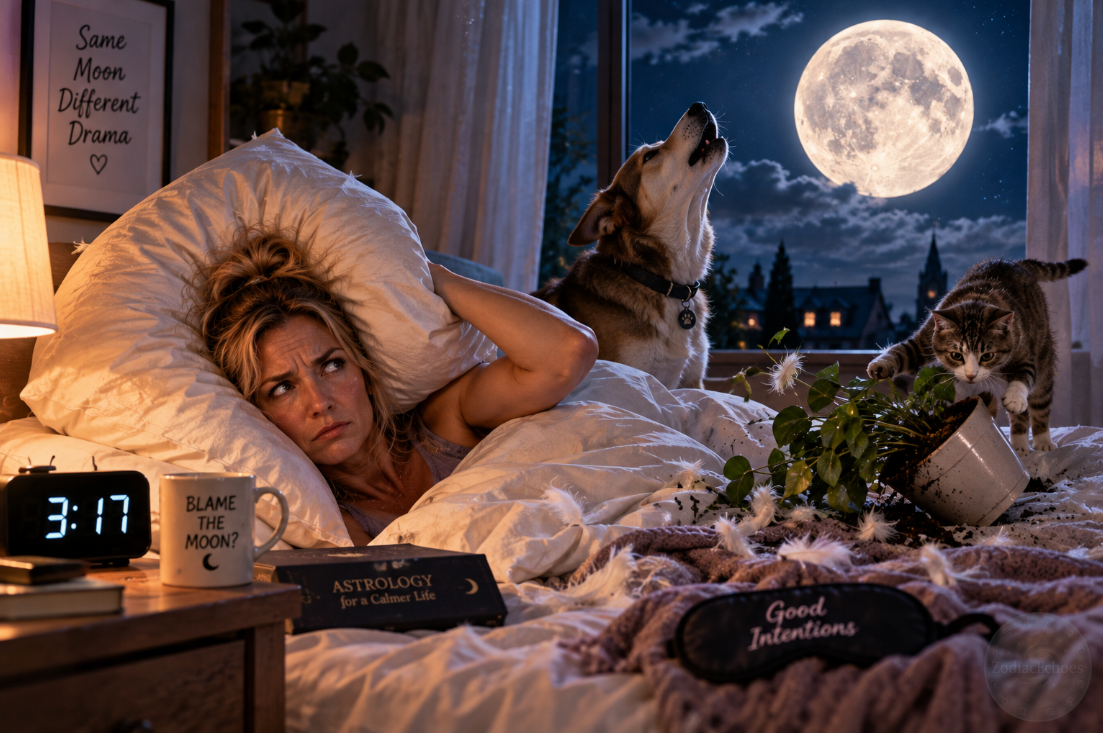
The Full Moon has fascinated people for thousands of years. It has been blamed for sleepless nights, arguments, strange dreams, accidents, unusual behavior and even crowded maternity wards. When something feels slightly off and a huge glowing Moon happens to be hanging outside the window, it’s remarkably easy to connect the two.
After a restless night, you may look outside, notice the Full Moon and immediately think, Of course. That’s why I couldn’t sleep. The same happens with irritability, vivid dreams or the feeling that everyone around you is behaving a little strangely.
But how much of the Full Moon’s reputation is supported by evidence, and how much belongs to folklore and expectation? Some of the answers are surprisingly complicated.
Myth #1: Everyone Sleeps Worse During a Full Moon
This is probably the most familiar Full Moon claim, and it is also one of the few where the answer isn’t simply yes or no. Some studies have reported associations between lunar phases and changes in sleep, while others haven’t found such clear effects.
Light exposure, sleeping environment and individual sensitivity can all complicate the picture. So if you regularly feel that you sleep badly around a Full Moon, that experience doesn’t necessarily have to be imaginary. But it also doesn’t mean the Full Moon automatically ruins everyone’s sleep.
Expectation may play a role too. If you’re already convinced that the Full Moon keeps you awake, you’re more likely to notice every awakening during the night and remember it the following morning. In other words, the Moon may not be the only thing keeping you awake. Sometimes simply expecting a bad night’s sleep doesn’t exactly help.
Myth #2: More Babies Are Born During a Full Moon
This belief has survived remarkably well. One explanation for its popularity is the Moon’s relationship with water. Because lunar gravity influences Earth’s tides, people have long drawn comparisons between tides, amniotic fluid and childbirth. It sounds convincing enough to become a great story.
The problem is that large analyses of births haven’t demonstrated a convincing Full Moon baby boom. Babies apparently aren’t particularly interested in checking the lunar calendar before deciding it’s time to arrive. Yet the belief remains so deeply rooted that you’ll still hear stories about maternity wards becoming unusually busy whenever the Moon is full.
Myth #3: People Become More Aggressive During a Full Moon
There’s a reason the English word lunatic sounds suspiciously lunar: its history is connected to luna, the Latin word for Moon. Humans have been associating the Moon with madness and unusual behavior for centuries. Full Moons have consequently been blamed for arguments, aggression, crime and all kinds of strange nighttime behavior.
But there is no convincing evidence that an otherwise calm person suddenly becomes aggressive simply because the Moon is full. Stress, exhaustion, alcohol and circumstances provide much more ordinary explanations.
There is also a memory problem. If you have a spectacular argument with your partner on an ordinary Tuesday night, you probably won’t remember what the Moon looked like. Have exactly the same argument beneath an enormous Full Moon, however, and suddenly the Moon becomes part of the story. So if your partner infuriates you during the next Full Moon, checking the relationship might be more useful than checking the sky.
Myth #4: More Accidents Happen During a Full Moon
The logic seems plausible. If Full Moons interfere with sleep and make people restless, perhaps tired drivers become less attentive and accidents increase. Yet there is no simple rule saying a Full Moon automatically creates a more dangerous night. Once again, our memory may strengthen the belief.
An unusual accident beneath a dramatic Full Moon makes a memorable story. The same accident beneath an unremarkable sky doesn’t come with such an obvious celestial culprit. The Moon is extremely good at getting blamed for things.
Myth #5: Hair Grows Faster If You Cut It During a Full Moon
Lunar hair calendars remain popular, and according to some traditions, cutting your hair around the Full Moon can encourage stronger or faster growth. It’s a lovely ritual. It’s just not something science has demonstrated.
Hair growth is influenced much more directly by factors such as genetics, hormones, age, nutrition and health. There is no established evidence that changing lunar phases can suddenly persuade your hair follicles to work faster.
That doesn’t mean you need to abandon the tradition. If booking your haircut according to the Moon makes the experience more enjoyable, why not? Just don’t expect several bonus centimeters courtesy of lunar magic.
Myth #6: The Full Moon Controls Menstruation
Few connections sound more naturally mystical than the Moon and the menstrual cycle. A lunar month and the average menstrual cycle are similar enough in length that many cultures developed strong symbolic associations between the Moon, femininity, fertility and menstruation.
But that similarity doesn’t mean every woman’s body naturally synchronizes with a particular lunar phase. Menstrual cycles differ between individuals and can also change throughout a person’s life. If your own cycle repeatedly happens to align with the Full Moon, you may find that personal rhythm fascinating. It simply isn’t a universal rule that every female body follows.
Myth #7: Dreams Have More Meaning During a Full Moon
This is where science and spiritual interpretation begin heading in different directions.Full Moons are often associated with intuition, the subconscious and things coming to the surface. It’s therefore easy to understand why an unusually vivid dream during a Full Moon can feel important.
Scientifically, however, there is no evidence that dreams automatically contain more significant messages simply because the Moon is full. There is another possible explanation. If your sleep is more fragmented and you wake more frequently, you may simply remember more of your dreams. Dreams often disappear from memory remarkably quickly after waking.
And if you already consider the Full Moon meaningful, a bizarre dream that night may receive far more attention than an equally bizarre dream one week later. Whether that makes the dream meaningless is another question entirely. Sometimes what matters to us personally doesn’t need to be measurable in a laboratory.
Myth #8: The Full Moon Affects Everyone the Same Way
Perhaps this is the biggest Full Moon myth of all. The Moon becomes full and suddenly everyone is supposedly emotional, restless, irritable and staring at the ceiling at 3 a.m. Real people aren’t that predictable. Some barely notice lunar phases. Others insist they repeatedly sleep worse in the days surrounding a Full Moon. Someone else may notice mood changes or unusually vivid dreams.
Even within astrology, a Full Moon isn’t interpreted as producing one identical experience for every person. Its zodiac sign and its relationship to an individual’s natal chart are part of the interpretation. So even from an astrological perspective, “It’s a Full Moon, therefore everyone will feel X” is far too simplistic.
Myth #9: A Full Moon Is the Best Time for New Beginnings
This one isn’t really a scientific claim. It belongs to astrology and spiritual traditions — but even there, the Full Moon and New Moon are often mixed up. Within lunar symbolism, the New Moon is generally associated with beginnings, intentions and planting the seeds of something you want to develop.
The Full Moon represents culmination, illumination, completion and release. So if you enjoy Full Moon rituals, you don’t necessarily need to sit down and write ten ambitious new goals. A question much more aligned with traditional Full Moon symbolism would be: What am I ready to let go of?
A habit, resentment, expectation, unfinished chapter or something you’ve simply outgrown can make far more sense than starting another enormous to-do list. Looking for more personalized insights? Explore our free Astro Tools and discover astrology, numerology, tarot, witch type, and many more mystical experiences.

Conclusion
The Full Moon’s reputation is considerably more dramatic than the evidence behind many of its most famous myths.
There is no convincing universal Full Moon surge in births, aggression, accidents or hair growth. The relationship with sleep is more complicated, while vivid dreams may sometimes be easier to remember simply because sleep has been interrupted. And many apparent Full Moon effects can be strengthened by expectation and our tendency to remember unusual events when they happen beneath an unusually memorable Moon.
That doesn’t make the Full Moon boring. For thousands of years, people have used the Moon as a symbol of cycles, culmination and release. You can enjoy that symbolism without blaming every sleepless night, argument or questionable decision on the enormous glowing object outside your window. Sometimes it’s the Full Moon. And sometimes you simply shouldn’t have had that coffee at 10 p.m.
Cosmic Highlights
FAQ
Does a Full Moon really cause insomnia?
Research has produced mixed results. Some studies have reported changes in sleep around particular lunar phases, while others haven’t found a clear universal effect. Environment, light, individual sensitivity and expectation may also play roles.
Are more babies born during a Full Moon?
Large analyses haven’t demonstrated a convincing increase in births during Full Moons, despite this being one of the most persistent lunar myths.
Does a Full Moon make people aggressive?
There is no convincing evidence that the Full Moon itself makes normally calm people aggressive. Stress, tiredness, alcohol and circumstances are more plausible influences.
Can a Full Moon make your hair grow faster?
There is no established scientific evidence that lunar phases accelerate hair growth. Genetics, hormones, age, nutrition and health are much more important factors.
Are Full Moon dreams more meaningful?
Science hasn’t shown that dreams occurring during a Full Moon contain inherently more important messages. However, waking more frequently can make dreams easier to remember, while spiritual traditions may interpret Full Moon dreams differently.
Is a Full Moon good for manifesting new beginnings?
In traditional lunar symbolism, new beginnings are more closely associated with the New Moon. The Full Moon is generally connected with culmination, awareness, completion and releasing what is no longer needed.