An original ZodiacEchoes investigation into the planetary patterns of Olympic 100-meter medalists from Seoul 1988 to Paris 2024.
- 20 individual athletes account for 30 Olympic 100-meter medal finishes across ten Games.
- Mars in Sagittarius leads the dataset, appearing in four reference-time birth charts (20%).
- Jupiter in Aquarius appears five times (25%), the strongest concentration for Jupiter.
- Usain Bolt’s Mars in Capricorn is distinctive, but no single Mars sign dominates Olympic gold medalists.
The men’s Olympic 100 meters is one of sport’s most unforgiving competitions. Years of preparation are compressed into approximately ten seconds, and a fraction of a second can separate a gold medal from fourth place. But do the athletes who thrive under that pressure share any meaningful astrological characteristics?
For this ZodiacEchoes Original Analysis, we examined the birth charts of 20 Olympic medalists from 1988 through 2024, covering 30 podium finishes. Rather than simply counting Sun signs, we compared Mars, Jupiter, Saturn, Mercury, Venus, and the other planetary placements recorded in our dataset.
The results challenge one particularly obvious astrological expectation: Mars in Aries does not dominate the birth charts of Olympic sprint champions. In fact, not one of the 20 reference-time charts places Mars in Aries.
That finding is intriguing, but it needs to be interpreted carefully. Astrology has not been scientifically demonstrated to predict athletic ability, and this is an exploratory analysis of a small, highly selected group rather than evidence of a causal relationship.
Mars: The Most Surprising Result of the Study
Mars is traditionally associated with physical energy, aggression, competition, determination, and the instinct to win. In an astrological investigation of elite sprinters, it is therefore a natural starting point. Yet the results do not reveal a straightforward pattern.
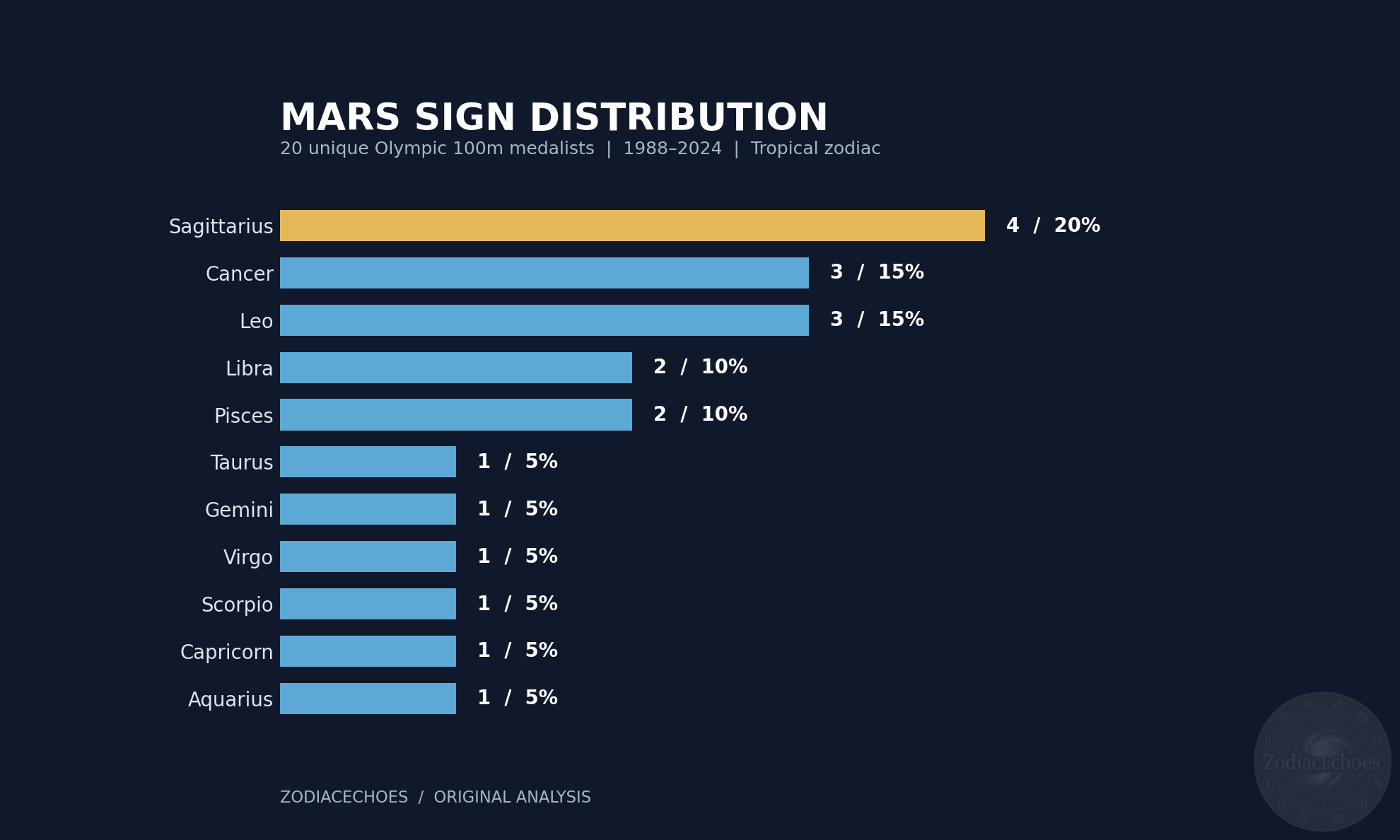
Mars in Sagittarius appears most frequently, occurring in four of the 20 athletes, or 20% of the sample. Mars in Leo and Mars in Cancer follow with three athletes each, representing 15% apiece.
The Sagittarius group includes Frankie Fredericks, Francis Obikwelu, Yohan Blake, and Kishane Thompson. All four reached the Olympic 100-meter podium, although none won gold in the races covered by this study.
From a traditional astrological perspective, Mars in Sagittarius is associated with freedom, enthusiasm, ambitious goals, and a willingness to test physical limits. It is easy to construct a symbolic connection between these qualities and competitive sprinting.
However, the data tell a more interesting story than that interpretation alone. The most common Mars placement among all medalists does not appear among the eight individual Olympic champions in our sample.
This distinction is crucial. A placement can be common among successful competitors without being especially common among those who finish first. There is also a birth-time limitation. Linford Christie’s Mars is sensitive to the unknown time of birth, meaning the precise distribution could change slightly if reliable birth-time information becomes available.
Olympic Gold Medalists: Eight Champions, Eight Different Stories
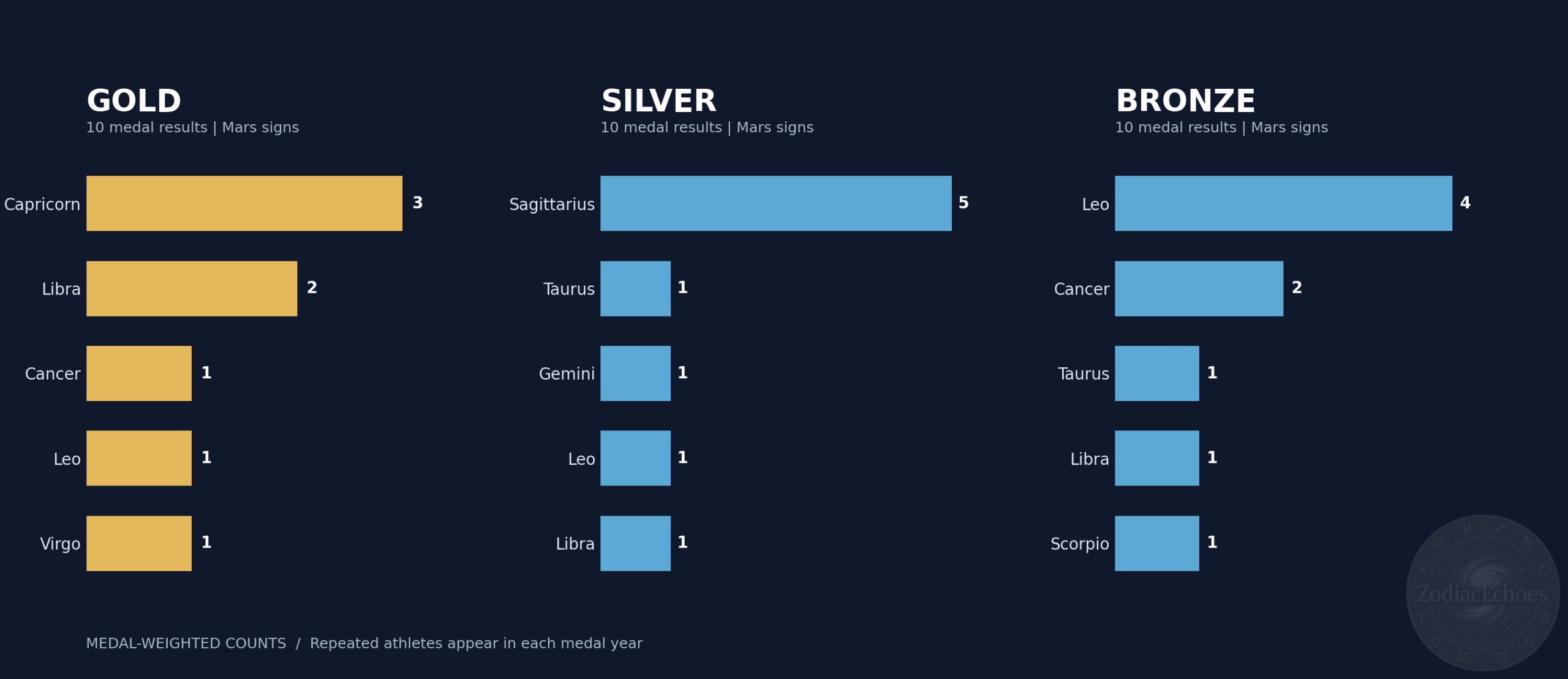
The distinction between medalists and champions becomes particularly revealing when examining the Olympic gold medal winners. Across the ten Olympic finals, eight different athletes won gold. Their Mars placements are remarkably diverse.
| Olympic Champion | Gold Medal Year(s) | Mars Sign |
|---|---|---|
| Carl Lewis | 1988 | Virgo |
| Linford Christie | 1992 | Pisces* |
| Donovan Bailey | 1996 | Aquarius |
| Maurice Greene | 2000 | Leo |
| Justin Gatlin | 2004 | Libra |
| Usain Bolt | 2008, 2012, 2016 | Capricorn |
| Lamont Marcell Jacobs | 2020 | Cancer |
| Noah Lyles | 2024 | Libra |
*Christie’s reference-time Mars position is uncertain without an exact birth time. Tokyo 2020 was held in 2021.
Only Mars in Libra occurs twice among the eight individual champions. Every other reference-time Mars placement appears once. That is not a strong concentration. Rather, it suggests that Olympic sprinting success is compatible with a wide range of Mars placements.
Interestingly, Libra is traditionally ruled by Venus and associated with balance, timing, and coordination rather than raw aggression. Both Justin Gatlin and Noah Lyles have Mars in Libra in the dataset, demonstrating how simplistic interpretations of a supposedly ideal athletic Mars sign can be misleading.
The wider lesson is that an Olympic champion’s astrological profile cannot be reduced to a single planetary placement.
Usain Bolt: The Champion With Mars in Capricorn
No analysis of modern Olympic sprinting would be complete without examining Usain Bolt.
Bolt is the only athlete in this dataset to win the men’s Olympic 100 meters three consecutive times: Beijing 2008, London 2012, and Rio 2016. His unprecedented dominance makes his birth chart an obvious point of interest.
According to the calculated planetary positions for August 21, 1986, Bolt has:
| Planet | Zodiac Sign |
|---|---|
| Sun | Leo |
| Mercury | Leo |
| Venus | Libra |
| Mars | Capricorn |
| Jupiter | Pisces |
| Saturn | Sagittarius |
Mars in Capricorn is traditionally considered an exalted placement in classical astrology. It is symbolically associated with discipline, endurance, strategic effort, and the ability to direct energy toward long-term goals.
This is an especially compelling astrological description of Bolt’s career. His achievements required more than exceptional natural speed. They also depended on repeated preparation, sustained international competition, and the ability to deliver under extraordinary pressure.
His Sun and Mercury in Leo introduce a different symbolic dimension: visibility, confidence, performance, and an unmistakable public identity. Bolt’s celebrations and theatrical presence became almost as recognizable as his performances.
Jupiter in Pisces, meanwhile, is traditionally associated with imagination, intuition, and expansive possibilities.
Nevertheless, there is an important statistical limitation. Bolt is the only athlete with Mars in Capricorn among the 20 individuals studied. His success does not establish that Mars in Capricorn is especially common among Olympic champions. He is an exceptional athlete with an individual chart, not proof that a particular planetary placement produces exceptional speed.
Jupiter in Aquarius: The Strongest Jupiter Concentration
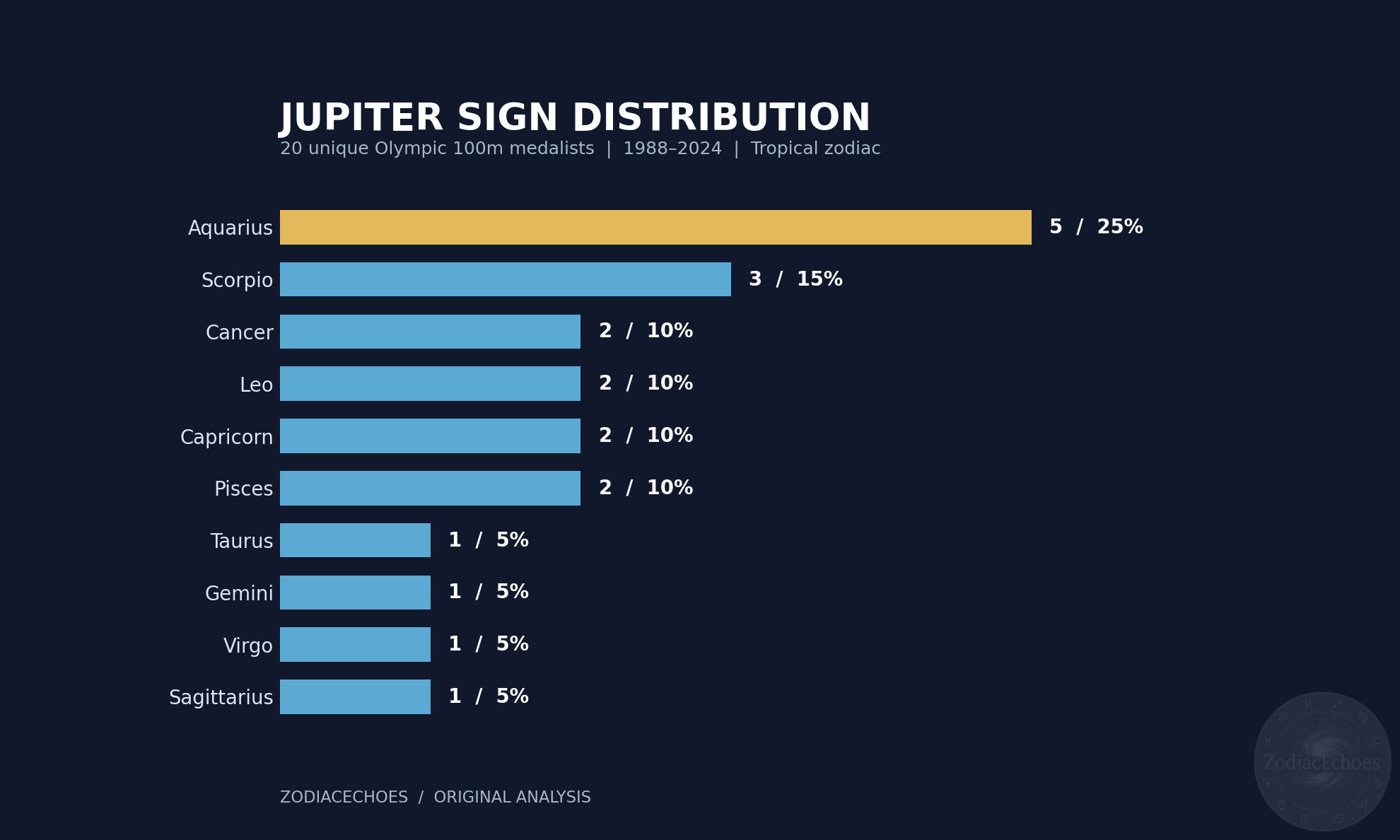
Jupiter is traditionally linked with opportunity, growth, confidence, expansion, and favorable circumstances. In this dataset, Jupiter in Aquarius appears in five athletes, representing 25% of the entire sample. Those athletes are Carl Lewis, Ato Boldon, Richard Thompson, Walter Dix, and Noah Lyles.
This is a notable concentration, particularly because it includes two Olympic champions from different generations: Lewis and Lyles. In astrological symbolism, Aquarius is associated with originality, independence, unconventional approaches, and innovation. Jupiter in Aquarius could therefore be interpreted as a placement connected with experimentation and breaking established boundaries.
Yet Jupiter moves much more slowly than Mars. Athletes born within certain periods are consequently more likely to share its sign. For example, Lewis and several other athletes in this dataset belong to a similar birth generation, while Lyles represents a much later period.
The key analytical question is not simply whether five sprinters share Jupiter in Aquarius. It is whether 25% is unusually high compared with the distribution among athletes of similar ages who did not win Olympic medals. Our current dataset cannot establish that. A matched comparison group would be necessary.
Saturn: Discipline Across Different Zodiac Signs
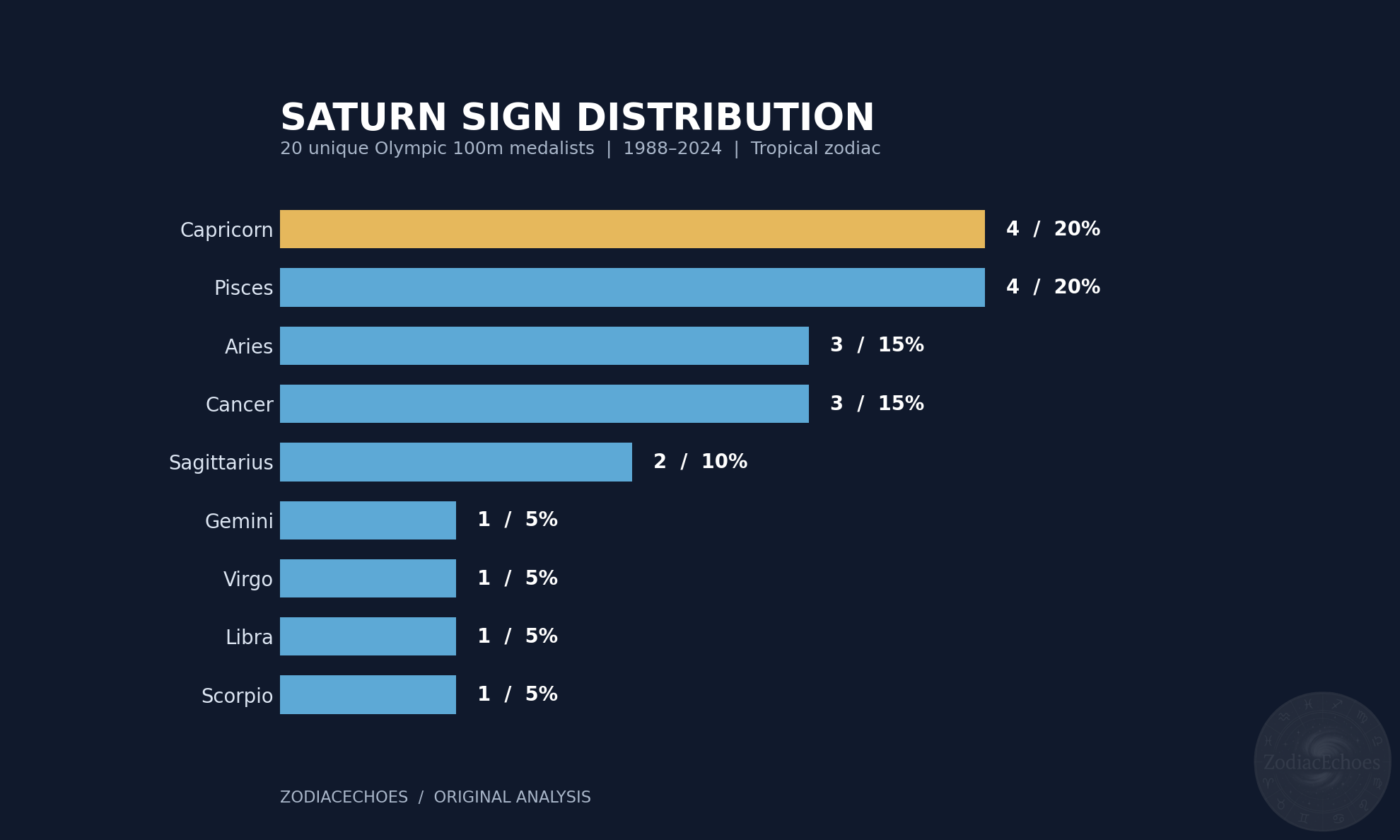
If Mars symbolizes competitive energy, Saturn traditionally represents the structure required to develop that energy over time. Its astrological associations include discipline, persistence, responsibility, limitations, patience, and long-term achievement.
The Saturn distribution reveals two leading placements: Saturn in Capricorn and Saturn in Pisces, each appearing in four athletes, or 20% of the sample. Saturn in Aries and Cancer follow with three athletes each.
Saturn in Capricorn is particularly interesting from a traditional perspective because Capricorn is one of Saturn’s ruling signs. The placement is commonly associated with methodical ambition, self-control, and respect for demanding processes.
However, Saturn’s slow movement creates a major interpretive challenge. Several athletes share Saturn placements because they were born within relatively narrow periods, not necessarily because of any distinctive athletic characteristic.
A study that ignores these generational effects risks presenting ordinary birth-year clustering as an extraordinary astrological discovery. The Saturn findings are therefore descriptive, not predictive.
What About Sun Signs? Cancer and Capricorn Lead
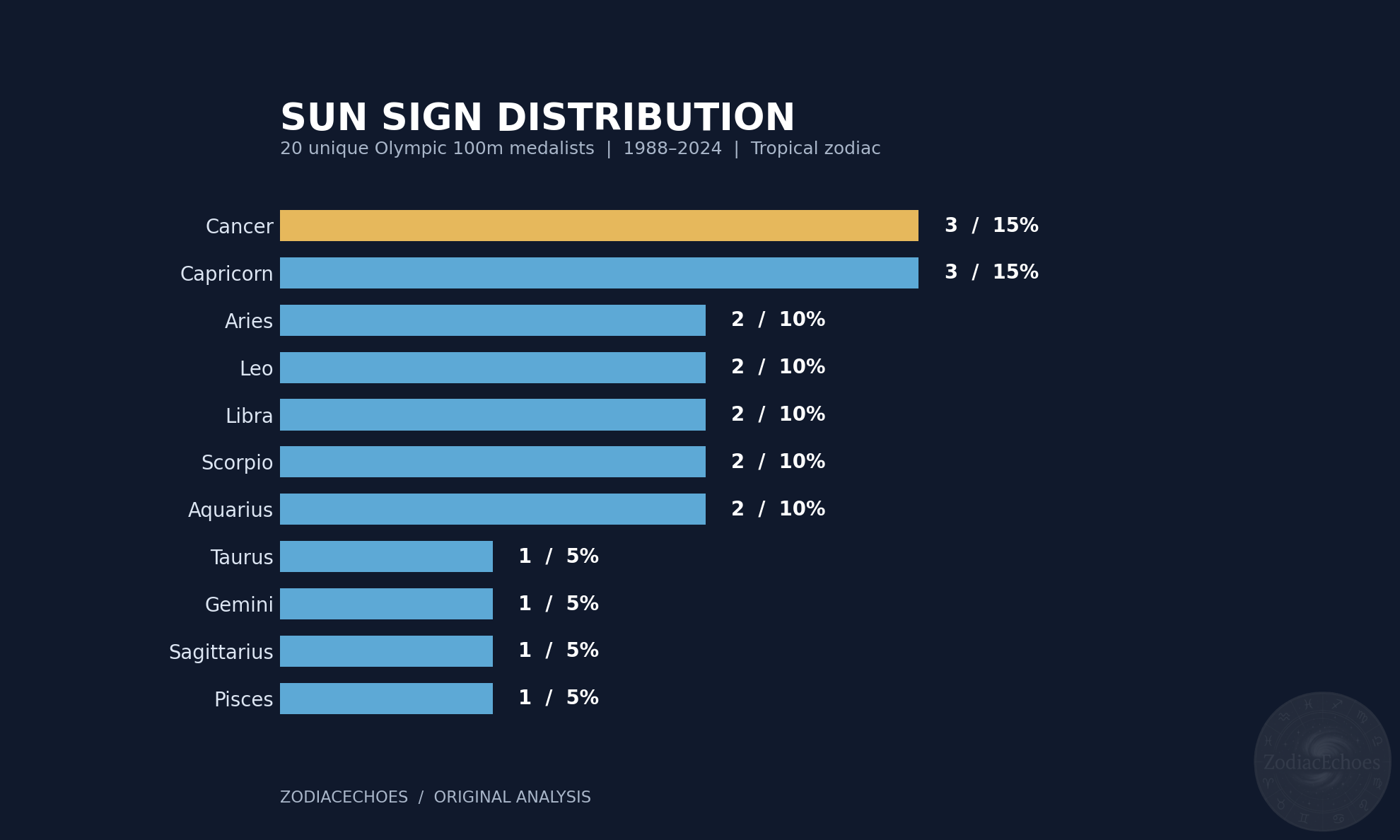
Sun signs remain the most familiar part of popular astrology. Aries is often portrayed as the archetypal competitor, Leo as the natural performer, and Capricorn as the disciplined achiever. The actual distribution among these Olympic medalists is more varied.
Cancer and Capricorn share first place, each appearing in three athletes, or 15% of the sample. Aries, Libra, Leo, Scorpio, and Aquarius each appear twice. Sagittarius, Pisces, Gemini, and Taurus appear once each. Virgo does not appear among the reference-time Sun signs in this particular sample.
The Cancer group includes Carl Lewis, Noah Lyles, and Kishane Thompson. Capricorn includes Calvin Smith, Ato Boldon, and Yohan Blake. These patterns offer interesting material for astrological interpretation, but the differences are small. Three athletes sharing a Sun sign in a sample of 20 is not enough to establish a meaningful relationship with elite sprinting.
Moreover, the athletes were not born uniformly across the calendar. Without a relevant comparison population, raw zodiac frequencies alone cannot determine whether a particular sign is genuinely overrepresented.
Venus and Mercury: Two Additional Patterns Worth Examining
Although Mars, Jupiter, and Saturn provide the main analytical focus, the dataset also reveals two secondary patterns.
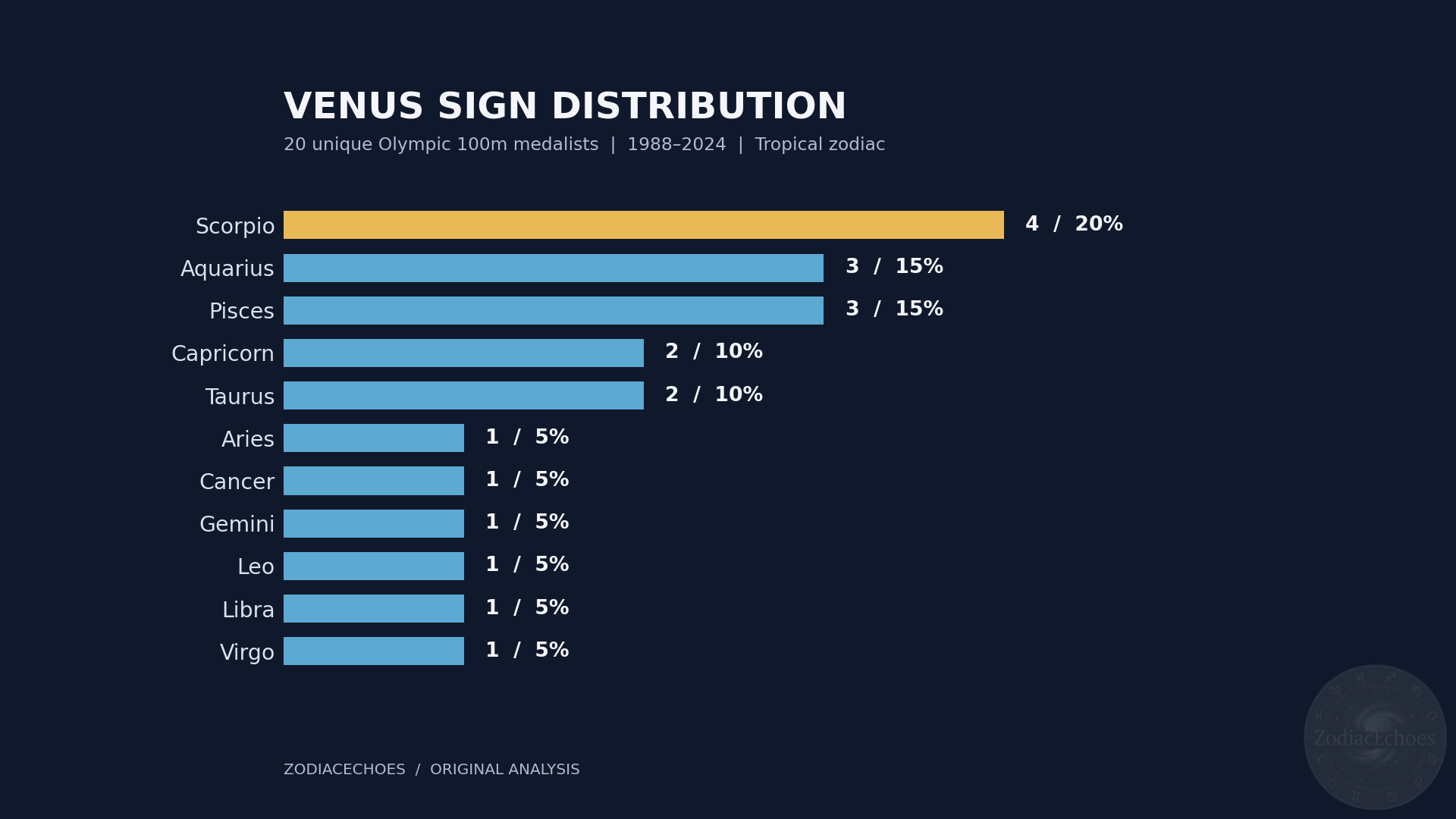
Venus in Scorpio emerges as the leading Venus placement, appearing in four of the 20 Olympic medalists (20%). Venus in Pisces and Aquarius follow with three athletes each (15%), while Taurus and Capricorn each account for two competitors (10%).
In traditional astrology, Venus in Scorpio is associated with intensity, emotional determination, and an all-or-nothing approach to personal commitments. Although Venus is not usually considered the primary planet of athletic competition, this concentration offers an interesting secondary pattern alongside the Mars findings.
For sprinters, coordination is clearly important, but it would be inappropriate to infer that Venus in Scorpio improves coordination or physical performance.
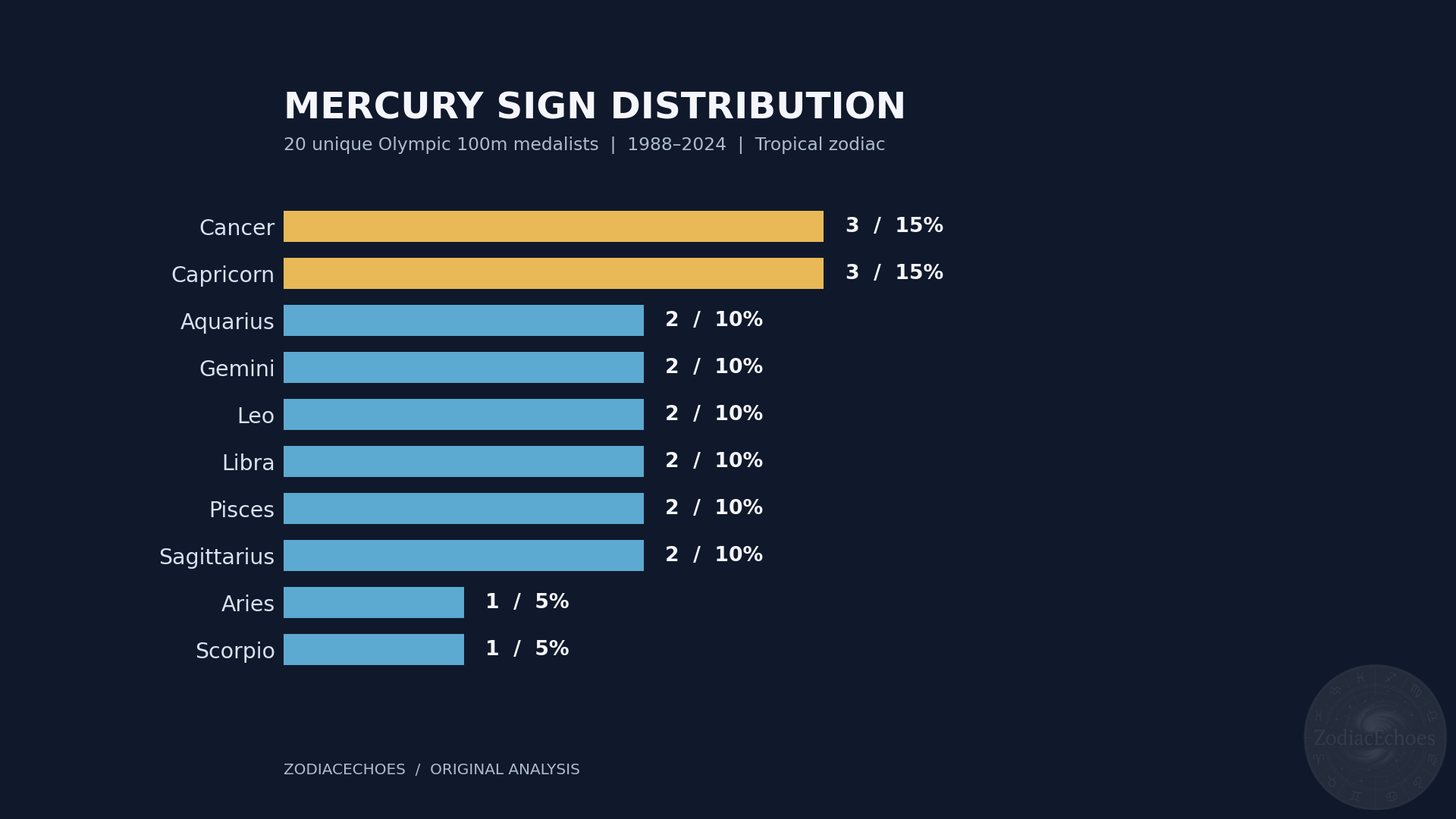
Mercury produces a different result. Mercury in Cancer and Mercury in Capricorn share first place, each appearing in three athletes (15%). Mercury in Pisces, Sagittarius, Aquarius, Leo, Gemini, and Libra follows with two appearances per sign (10%).
Mercury traditionally governs mental processing, perception, reaction, and decision-making. In a sport where athletes must respond almost instantaneously to the starting signal, its symbolic association with mental responsiveness is particularly interesting.
The contrast between Cancer and Capricorn is especially notable: one is traditionally associated with instinctive perception, while the other emphasizes calculated decisions, concentration, and discipline. Both appear equally frequently among these Olympic medalists.
These findings are useful as starting points for further investigation, not as established explanations.
Why the Same Athlete Must Not Be Counted Three Times
One of the most important methodological decisions concerns repeat Olympic medalists. Bolt won three gold medals in the event. Justin Gatlin won one gold, one silver, and one bronze. Andre De Grasse and several other athletes also appear more than once in the Olympic results.
If every medal were treated as a separate birth chart, repeat champions would disproportionately influence the overall planetary distributions. For that reason, the primary zodiac analysis counts 20 unique individuals, while medal-category comparisons can separately examine the 30 podium finishes. This distinction prevents a single athlete’s chart from artificially dominating the findings.
The dataset also uses planetary positions calculated for a reference time where exact birth times are unavailable. Certain placements, particularly the Moon and planets close to sign boundaries, may be uncertain. Those limitations are documented rather than silently ignored.
Finally, the study does not claim that the observed patterns are statistically significant. A stronger investigation would require a larger comparison group, birth-time verification where possible, and statistical controls for the athletes’ birth years.
Conclusion: Is Mars Really the Planet of Sprint Champions?
The results are more complicated than the popular image of Mars as the ultimate planet of athletic competition.
Mars in Sagittarius is the most frequent Mars placement among the 20 medalists, but it does not appear among the eight individual gold medal winners. Mars in Libra occurs twice among champions, while the other reference-time gold-medalist placements are distributed across different signs.
Jupiter in Aquarius provides another interesting concentration, appearing in 25% of the sample. Saturn in Capricorn and Pisces each occur in 20%, while Cancer and Capricorn share the lead among Sun signs.
And then there is Usain Bolt, whose Mars in Capricorn offers one of the study’s most compelling symbolic interpretations of sustained competitive dominance. Yet no single placement emerges as a convincing astrological signature of Olympic sprinting greatness.
That is arguably the most valuable finding. Rather than confirming a predetermined stereotype about Aries or Mars, the dataset reveals considerable diversity among the birth charts of some of the fastest athletes in Olympic history.
The results offer material for astrological discussion, but they do not demonstrate that planetary positions determine sporting success. For readers interested in examining the evidence themselves, the complete dataset includes the athletes’ birth dates, Olympic medals, planetary positions, and documented birth-time uncertainties.
- Research dataset: Olympic 100m Astrology — 1988–2024 (PDF)
Frequently Asked Questions
Which Mars sign is most common among Olympic 100-meter medalists?
Mars in Sagittarius is the most frequent placement in the 20-athlete dataset, appearing four times (20%). Mars in Leo and Cancer follow with three appearances each.
What is Usain Bolt’s Mars sign?
Usain Bolt has Mars in Capricorn, a placement traditionally associated with discipline, ambition, and controlled effort. His Sun and Mercury are in Leo.
Which zodiac sign has the most Olympic sprint medalists?
Cancer and Capricorn share the lead among the 20 individual athletes, with three representatives each.
Do Olympic champions share the same planetary placements?
Some placements recur, including Jupiter in Aquarius, but the eight individual gold medalists display considerable diversity in their Mars signs. The dataset does not establish a reliable planetary signature for winning Olympic gold.
Can astrology predict who will win the Olympic 100 meters?
There is no established scientific evidence that birth-chart placements predict sprinting ability or Olympic results. This analysis examines patterns within a historical sample rather than making validated predictions.