Marie Curie did something extraordinarily rare even among history’s greatest scientists. She did not simply succeed within an established field — her research helped transform humanity’s understanding of matter itself.
Born in Warsaw in 1867, she overcame restrictions on women’s education, moved to Paris with very little money, became a pioneering physicist and chemist, discovered polonium and radium with Pierre Curie, and became the first woman to win a Nobel Prize. She later became the first person to win two Nobel Prizes and remains the only individual to have received Nobel Prizes in two different scientific categories.
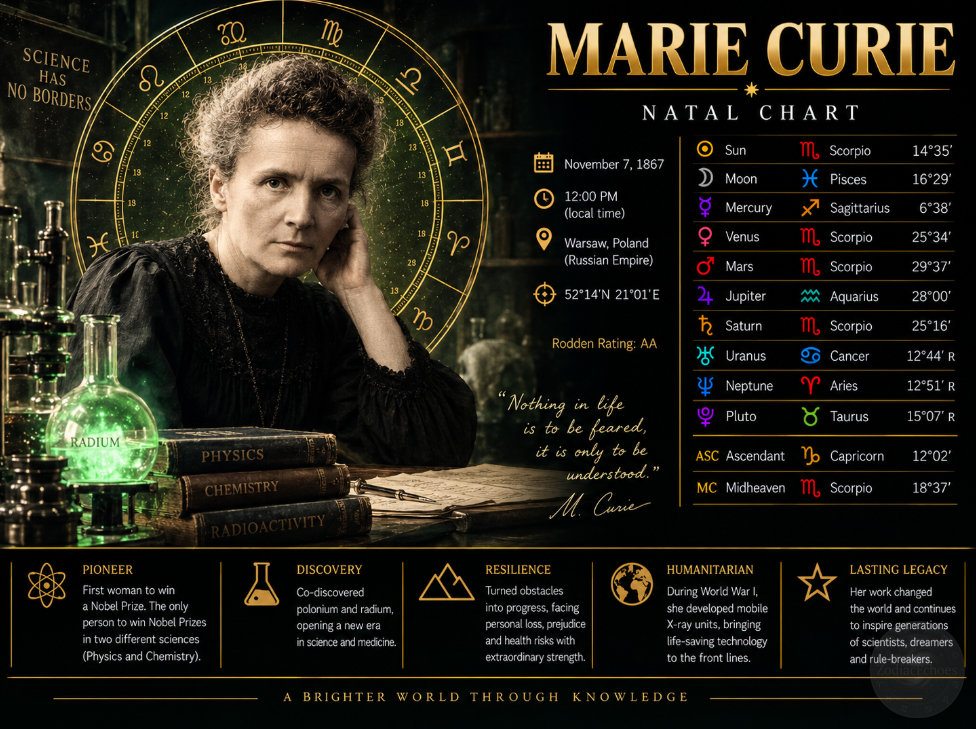
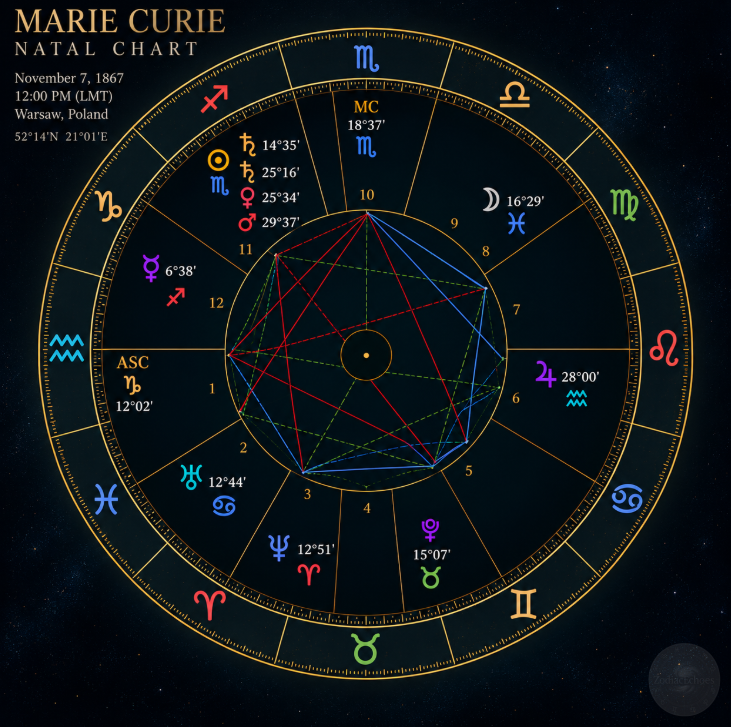
Her birth chart is remarkable in its own way. Curie was a Scorpio Sun with a Pisces Moon and Capricorn Rising, but Scorpio dominates far beyond her Sun. Venus, Mars and Saturn are also in Scorpio, while her Midheaven falls in the same sign. For a woman whose life’s work centered on discovering powerful invisible forces hidden inside matter, the symbolism is difficult to miss.
Marie Curie’s Life: From Warsaw to Paris
Maria Salomea Skłodowska was born on November 7, 1867, in Warsaw, then part of the Russian Empire. Both of her parents were teachers, and education was central to family life. Her childhood also brought considerable hardship: her eldest sister died of typhus and her mother died from tuberculosis while Marie was still young.
Opportunities for women to pursue advanced education in Russian-controlled Poland were extremely limited. Marie and her older sister Bronya therefore devised a practical arrangement: Marie worked as a governess and helped finance Bronya’s medical studies in Paris, with the understanding that Bronya would later help Marie pursue her own education.
In 1891, at age 24, Marie finally moved to Paris and studied physics and mathematics at the Sorbonne. She lived modestly and devoted herself intensely to her studies. In 1894 she met physicist Pierre Curie; they married the following year. Their relationship soon became both a marriage and one of science’s most famous research partnerships.
After Henri Becquerel discovered radiation from uranium, Curie began investigating the phenomenon for her doctoral research. She noticed that pitchblende was more radioactive than its uranium content could explain. Something unknown had to be producing additional radiation.
That observation eventually led Marie and Pierre Curie to identify polonium in 1898, named after her native Poland, followed by radium. Curie’s work helped establish that radiation was connected to processes occurring within atoms themselves — a profound development in the emerging understanding of atomic physics.
Nobel Prizes, Pierre’s Death and a Second Life in Science
In 1903, Marie Curie shared the Nobel Prize in Physics with Pierre Curie and Henri Becquerel for their work on radiation phenomena. She became the first woman ever awarded a Nobel Prize. Then tragedy changed her life.
On April 19, 1906, Pierre Curie was killed in Paris after being struck and run over by a horse-drawn vehicle. Marie was suddenly a widow with two daughters and had lost the scientific partner with whom she had built much of her research career. She continued.
Curie succeeded Pierre in his university position and became the first woman to hold a professorship at the University of Paris. In 1911 she received the Nobel Prize in Chemistry for her work involving radium and polonium, including the isolation and study of radium.
Her scientific work also moved beyond the laboratory. During World War I, Curie helped develop and organize mobile radiography vehicles — later known as “petites Curies” — that brought X-ray technology closer to wounded soldiers. She trained people in radiography and worked alongside her daughter Irène. More than 20 mobile vehicles and around 200 fixed radiological installations were equipped during the war effort.
Science, for Curie, was never merely theoretical. It was something that could save lives.
Marie Curie Birth Data
- Date of Birth: November 7, 1867
- Time of Birth: 12:00 PM
- Place of Birth: Warsaw, Poland
- Time System: Local Mean Time
- Rodden Rating: AA
- Sun Sign: Scorpio
- Moon Sign: Pisces
- Rising Sign: Capricorn
Astro-Databank records Curie’s noon birth time from a quoted birth certificate/birth record and assigns the data its highest Rodden AA reliability rating. Her principal tropical placements include a 14°35′ Scorpio Sun, 16°29′ Pisces Moon and 12°02′ Capricorn Ascendant.
Scorpio Sun: Searching Beneath the Surface
Few astrological archetypes fit Curie’s work as strikingly as Scorpio. Scorpio is traditionally associated with investigation, hidden processes, transformation and the determination to penetrate beneath appearances. Curie’s research did exactly that in a literal scientific sense.
She investigated a phenomenon that could not be seen directly and followed the evidence toward processes taking place inside matter. Her work demanded years of physically exhausting experimentation under poor laboratory conditions. Scorpio is also associated with persistence under pressure.
Curie’s career contained obstacles involving poverty, gender discrimination, personal tragedy and physically dangerous research. Yet her response repeatedly followed the same pattern: continue working. Her Scorpio Sun was therefore not operating alone. It was part of an unusually concentrated Scorpio signature.
Pisces Moon: Sensitivity Behind the Scientist
Curie’s Moon at 16°29′ Pisces introduces a completely different element. Pisces is sensitive, intuitive and compassionate. That may seem distant from the disciplined scientist remembered in formal black-and-white photographs, but Curie’s life was never emotionally detached from her work.
She experienced devastating losses early in life and later the sudden death of Pierre. Her relationship with him combined intellectual partnership with profound personal attachment. Pisces also carries humanitarian symbolism.
Curie’s determination to apply scientific knowledge to medicine became particularly visible during World War I. Instead of remaining safely within academic research, she helped bring X-ray equipment directly to wounded soldiers. The Scorpio-Pisces combination gives her chart both depth and sensitivity: the investigator and the humanitarian existing together.
Mercury in Sagittarius: Knowledge Without Borders
Mercury in Sagittarius fits Curie’s intellectual journey in a different way. Sagittarius expands. It crosses borders, searches for larger principles and resists intellectual confinement. Curie physically crossed borders to obtain the education unavailable to her in Warsaw. She also crossed disciplinary boundaries throughout her career, working between physics and chemistry.
That is especially significant considering what eventually happened. She did not simply receive two Nobel Prizes. She received them in two separate scientific disciplines. Mercury in Sagittarius symbolically reflects an intellect unwilling to remain confined to one narrow territory. Curie’s questions became progressively larger as her discoveries opened new areas of investigation.
Venus in Scorpio: Love and Scientific Partnership
Curie’s Venus at 25°34′ Scorpio suggests emotional depth rather than casual attachment. Her relationship with Pierre Curie became one of the defining partnerships of her life. They were lovers, spouses, parents and scientific collaborators. Their research became so intertwined that separating their personal and intellectual lives is difficult.
Pierre’s sudden death in 1906 was therefore devastating on several levels. Venus in Scorpio often symbolizes relationships that transform the individual profoundly. It can love with enormous intensity, but that depth also means loss can leave equally deep marks.
Curie nevertheless continued the work they had begun together. Her chart turns especially powerful here because Venus is extremely close to Saturn in Scorpio, connecting affection symbolically with commitment, endurance, responsibility and loss.
Mars in Scorpio: Extraordinary Willpower
Curie’s Mars at 29°37′ Scorpio is one of the chart’s most striking placements. In traditional astrology, Mars has a particularly strong relationship with Scorpio. Here, drive is concentrated rather than scattered. Curie’s research required precisely this type of endurance.
Extracting tiny quantities of radioactive material from enormous amounts of pitchblende residue involved difficult, repetitive physical and chemical processing. Laboratory conditions were primitive, yet she persisted. Nobel’s biography describes the work as physically demanding and ultimately dangerous.
Mars in Scorpio does not necessarily need immediate rewards. It needs a reason to keep digging. Curie’s life provides an extraordinary real-world image of that symbolism: when evidence suggested something unknown was hidden inside the material, she kept searching until she found it.
Jupiter in Aquarius: Science for Humanity
Jupiter in Aquarius brings another important dimension to the chart. Aquarius is associated astrologically with innovation, collective progress and ideas that move society forward. Curie did not treat scientific discovery simply as a path toward personal wealth. Her work contributed to entirely new areas of physics, chemistry and medicine.
The wartime X-ray program illustrates this particularly clearly. Scientific knowledge was transformed into practical technology that could help doctors locate bullets and shrapnel inside wounded soldiers. Her later international work also reflected a belief that scientific knowledge should transcend national boundaries.
Jupiter in Aquarius therefore complements her Scorpio concentration beautifully: Scorpio discovers the hidden force; Aquarius asks what humanity can do with it.
Saturn in Scorpio: Endurance Through Loss
Curie’s Saturn at 25°16′ Scorpio sits extraordinarily close to her Venus. Saturn symbolizes responsibility, limitation, endurance and the consequences of time. Curie’s life repeatedly demanded these qualities.
She worked through financial difficulty, institutional barriers and the death of her husband. After Pierre died, she assumed his university position and continued their scientific work rather than allowing the partnership’s end to become the end of her career.
The Venus-Saturn conjunction becomes especially poignant when viewed symbolically against her biography: love and loss, partnership and responsibility, attachment and endurance. It is one of the chart’s strongest personal signatures.
Capricorn Rising: The Face of Discipline
Curie’s Capricorn Ascendant at approximately 12°02′ adds another layer of seriousness and persistence. Capricorn Rising often presents itself to the world through competence, restraint and responsibility. Curie’s public image fits this archetype almost perfectly.
The photographs that survive rarely project celebrity glamour. Instead, they show a focused researcher whose identity seems inseparable from her work. Capricorn also understands that meaningful achievements can take years.
Curie’s scientific career was not built around one sudden moment of inspiration. It depended on education, measurement, repeated experimentation and enormous patience. Combined with her Scorpio concentration, Capricorn Rising creates an exceptionally persistent astrological signature.
Scorpio Midheaven: A Legacy Built Around the Invisible
Curie’s Midheaven at approximately 18°37′ Scorpio may be the most remarkable symbolic coincidence in the entire chart. The Midheaven is traditionally connected with career, reputation and public legacy. Curie’s legacy became inseparable from radioactivity — invisible energy emerging from processes hidden within matter.
That language almost reads like classical Scorpio symbolism. Even more strikingly, her Scorpio Sun lies relatively close to the Midheaven, strengthening the connection between identity and vocation. Curie did not simply have a scientific career. Her name became permanently associated with a transformation in humanity’s understanding of the hidden structure of the physical world.
How Her Planetary Combination Shaped Her Life
Marie Curie’s chart is dominated by an extraordinary combination of Scorpio, Capricorn and Pisces. Scorpio supplies investigative intensity and the determination to uncover what is hidden. Capricorn provides discipline, patience and the ability to continue working through difficult circumstances. Pisces adds sensitivity and the desire for knowledge to alleviate human suffering.
Mercury in Sagittarius expands the intellectual horizon, while Jupiter in Aquarius connects discovery with collective progress. Most striking is the Scorpio concentration. Sun, Venus, Mars and Saturn are all in Scorpio, with the Midheaven there as well.
This does not scientifically explain Curie’s discoveries. But as astrological symbolism, it creates an unusually coherent portrait of a person whose life revolved around persistence, transformation and invisible forces.
Strengths and Challenges
Curie’s chart suggests formidable strengths: concentration, emotional endurance, intellectual independence, discipline and the ability to remain committed to an objective for extraordinarily long periods. Scorpio rarely approaches important questions casually. Capricorn does not expect achievement without effort. Together, they create tremendous persistence.
But the same combination can carry challenges. Scorpio intensity can make it difficult to disengage. Capricorn may continue carrying responsibility long after rest is necessary. Pisces Moon can absorb emotional suffering deeply. Curie’s life contained all three themes. And tragically, the work she refused to abandon eventually contributed to the destruction of her own health.
Marie Curie’s Final Years and Death
By the later years of her life, Curie had become an international scientific icon. She continued supporting research and helped establish radioactivity research in both France and Poland. Her daughter Irène Joliot-Curie followed her into science and worked alongside her; Marie lived long enough to see Irène and Frédéric Joliot’s important research into artificial radioactivity, although she died before they received the 1935 Nobel Prize in Chemistry.
But decades of exposure to radiation had taken a terrible toll. The dangers of radioactive materials were poorly understood during much of Curie’s career. She and Pierre handled radioactive substances without the protective procedures that later became standard, and their early laboratory work involved prolonged exposure under primitive conditions.
Marie Curie died on July 4, 1934, at the age of 66, in France. The cause was aplastic anemia, a serious blood disorder considered likely to have resulted from her long-term exposure to ionizing radiation. There is a haunting irony to her death.
Curie spent her life uncovering the extraordinary power hidden inside matter before humanity fully understood the danger accompanying that power. The phenomenon that transformed her into one of history’s greatest scientists was also likely responsible for ending her life. Yet her work continued beyond her.
The Curie name became attached to institutes, scientific research, medical treatments and even a unit once used to measure radioactivity. Some of her surviving laboratory notebooks remain radioactive today and require protective storage.

A Life Guided by Discovery
Marie Curie’s legacy reaches far beyond her Nobel Prizes. She challenged barriers facing women in science, transformed the study of radioactivity, helped open new paths in nuclear physics and medicine, and demonstrated during World War I that scientific knowledge could move directly from the laboratory to the battlefield to save lives. Her story also carries an unusual contradiction.
Curie devoted herself to understanding something invisible. That invisible force brought extraordinary scientific progress, medical possibilities, international recognition — and ultimately profound personal danger. In astrological terms, that makes her Scorpio-dominated chart particularly compelling. She spent a lifetime bringing what was hidden into the light.
Conclusion
Marie Curie’s birth chart combines Scorpio’s intensity, Pisces’ sensitivity, Sagittarius’ intellectual exploration, Aquarius’ vision and Capricorn’s extraordinary discipline. Together, these placements form a striking symbolic portrait of a woman who endured poverty, discrimination, personal tragedy and dangerous working conditions while fundamentally changing modern science.
Astrology cannot explain Marie Curie’s genius or discoveries. But her chart reflects many themes that defined her remarkable life: relentless investigation, emotional endurance, intellectual courage and a determination to understand forces the world could not yet see.
Cosmic Highlights
FAQ
What was Marie Curie’s zodiac sign?
Marie Curie was a Scorpio, born on November 7, 1867. Her tropical Sun is approximately 14°35′ Scorpio.
What was Marie Curie’s Moon sign?
Her Moon was approximately 16°29′ Pisces, a placement astrologically associated with sensitivity, intuition, imagination and compassion.
What was Marie Curie’s Rising sign?
Marie Curie had Capricorn Rising at approximately 12°02′. Her recorded noon birth time carries a Rodden AA rating, based on a quoted birth certificate/birth record.
Why is Scorpio so important in Marie Curie’s birth chart?
Curie had her Sun, Venus, Mars and Saturn in Scorpio, along with a Scorpio Midheaven. This creates an unusually strong concentration of Scorpio symbolism involving investigation, persistence, transformation and hidden processes.
How many Nobel Prizes did Marie Curie win?
She won two: the Nobel Prize in Physics in 1903 and the Nobel Prize in Chemistry in 1911. She remains the only individual to have won Nobel Prizes in two different scientific categories.
How did Marie Curie die?
Marie Curie died on July 4, 1934, aged 66, from aplastic anemia. Her long-term exposure to ionizing radiation during decades of research is considered the likely cause.
Did Marie Curie’s work with radiation cause her death?
It is considered highly likely. Curie worked with radioactive substances before their long-term dangers were properly understood, often without the shielding and safety procedures used today. Nobel Prize sources connect her fatal aplastic anemia with radiation exposure.
Does Marie Curie’s birth chart explain her scientific achievements?
No. Astrology cannot scientifically explain Curie’s intelligence, discoveries or achievements. Her birth chart can instead be used as a symbolic framework for examining themes that also appear in her documented life.