- Historical Source: Arbatel de magia veterum, first published in Basel in 1575.
- The Spirit: Och, one of seven Olympic spirits, governs the powers associated with the Sun.
- The Ritual: Aphorism 21 describes an invocation performed at sunrise on the appropriate planetary day.
- The Seal: Och possesses a distinctive magical character reproduced in historical editions.
- The Promise: The grimoire attributes extraordinary wisdom, healing knowledge, gold, and supernatural servants to Och.
- The Final Rule: The spirit must be formally dismissed and should not be detained for more than one hour without a special relationship with the practitioner.
In 1575, an anonymous grimoire published in Basel described a supernatural being capable of granting wisdom, transforming matter into gold, and revealing the secrets of medicine. His name was Och, and he was said to command the powers of the Sun.
Unlike the terrifying demons found in many medieval grimoires, Och belonged to a hierarchy of seven mysterious entities known as the Olympic spirits. Each governed a planetary domain and commanded an immense invisible army. Their powers supposedly extended across the natural world, influencing everything from metals and precious stones to human knowledge and longevity.
Yet the instructions for approaching these extraordinary beings were surprisingly direct. The magician was told to observe the rising Sun, recite a particular invocation, and dismiss the spirit once the encounter was complete. The procedure survives in Arbatel de magia veterum, one of the most unusual magical books of the Renaissance.
The Arbatel: A Mysterious Grimoire Published in 1575
The Arbatel first appeared in Latin in Basel, Switzerland, in 1575. Its author remains unknown, although the work clearly belongs to the religious and intellectual atmosphere of the sixteenth century.
The surviving text consists of 49 aphorisms arranged into seven groups of seven, known as septenaries. It presents itself as an introduction to a much larger system of magic, although the additional books it describes are not known to survive as part of the original publication.
Rather than promising power through demonic bargains, the Arbatel repeatedly insists that all legitimate magical authority comes from God. The practitioner is expected to seek wisdom, behave honestly, and avoid using supernatural knowledge for destructive or selfish purposes.
This religious framework distinguishes the book from many darker ceremonial grimoires. Nevertheless, its instructions include something remarkable: direct communication with planetary spirits believed to possess extraordinary powers over the physical world. The best-known section appears in the Third Septenary, where the author introduces the seven Olympic spirits and explains how they may be approached.
The relevant passages appear in Aphorisms 16, 17, and 21. This 36-page PDF reproduces Turner’s historical English translation rather than the original 1575 Latin typography.
The Seven Olympic Spirits and Their Planetary Kingdoms
According to Aphorism 16, seven spiritual governors administer the celestial order. Their names are Aratron, Bethor, Phaleg, Och, Hagith, Ophiel, and Phul. Each corresponds to a traditional planet: Saturn, Jupiter, Mars, the Sun, Venus, Mercury, and the Moon.
The Arbatel describes these beings as rulers of 186 celestial provinces, supported by vast hierarchies of subordinate spirits. They are not presented as independent gods but as powerful administrators acting within a divinely established universe.
Their authority also follows a system of planetary days and hours. Aratron, the spirit of Saturn, is specifically associated with the first hour of Saturday, while the remaining spirits follow the corresponding planetary order. Och occupies the solar position, making Sunday and its first planetary hour the traditional time associated with his invocation.
The grimoire even assigns the seven governors successive periods of 490 years. In its historical chronology, Och’s period of rule extends from approximately AD 920 to 1410, followed by the government of Hagith. This elaborate system turns the visible heavens into a supernatural administration, with each planetary spirit responsible for a different sphere of existence.
Who Was Och, the Spirit of the Sun?
Of all seven Olympic spirits, Och receives some of the most astonishing powers. Aphorism 17 describes him as the governor of solar things. The text claims that he can grant 600 years of life in perfect health, bestow exceptional wisdom, provide powerful attendant spirits, and teach the secrets of medicine.
His authority supposedly extends into alchemy. Och is credited with transforming substances into pure gold and precious stones, and even providing a purse that continually produces gold. The grimoire also claims that someone favored with his magical character could receive extraordinary honor from earthly rulers. These promises reflect the traditional symbolism of the Sun: vitality, authority, illumination, wealth, and the perfection of natural substances.
But the text’s ambitions go far beyond ordinary astrology. Och is presented as a being who can accelerate processes that nature would otherwise require enormous periods of time to accomplish. The Arbatel gives gold formation as an example. What occurs slowly beneath mountains might, according to the grimoire, be accomplished instantly through supernatural intervention.
The Original Magical Seal of Och
Every Olympic spirit possesses a distinctive character or magical seal. These symbols were intended to identify the spiritual governors and establish a connection with their respective planetary powers. Och’s character appears directly after the passage describing his abilities. Its unusual lines and curves distinguish it from the conventional planetary symbol of the Sun.
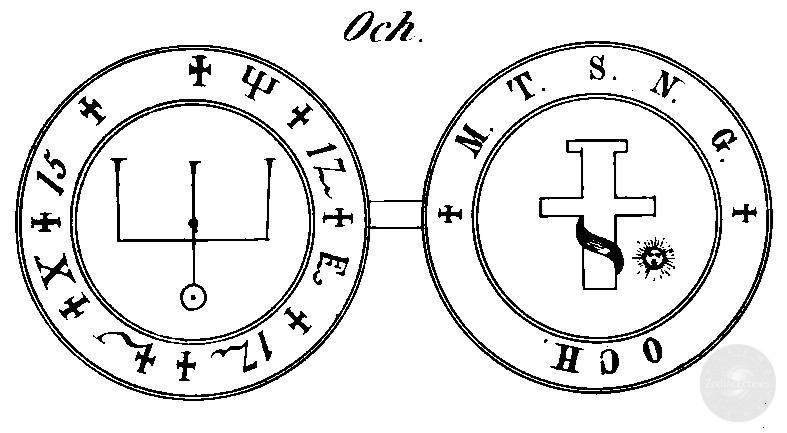
The magical character of Och, one of the seven Olympic spirits, preserved in historical editions of the Arbatel. The symbol appears in Aphorism 17 alongside the description of his powers.
The seal should not be confused with a modern solar sigil or a decorative pentagram. It is a specific historical character belonging to the Arbatel tradition. Aphorism 17 explains that spirits may be called by their names, offices, and characters during the appropriate planetary periods. It also discusses the importance of using a character at the planetary time associated with its revelation.
The later invocation in Aphorism 21, however, does not explicitly require drawing Och’s seal. The surviving text therefore supports its historical association with the spirit without making it a compulsory object in every performance of the ritual.
The Sunday Sunrise Ritual: How Och Was Summoned
The central instruction appears in Aphorism 21, which describes how to call an Olympic spirit. The magician must first identify the planetary nature of the intended spirit and observe sunrise on the appropriate day. For Och, this means Sunday, the day traditionally governed by the Sun. The first planetary hour begins at sunrise, providing the corresponding period for the operation.
The grimoire does not require an elaborate magical circle, a consecrated sword, animal sacrifice, or a midnight cemetery. Its principal ritual instrument is a spoken prayer. The procedure can be reconstructed from the surviving text:
1. Select the appropriate planetary day. For Och, the relevant day is Sunday. The invocation is associated with sunrise and the corresponding planetary hour.
2. Identify the spirit and the desired knowledge. Och belongs to the solar order. The practitioner approaches him for matters traditionally associated with his office, especially wisdom and knowledge.
3. Recite the invocation from Aphorism 21. The prayer addresses Almighty God and requests that the appropriate spirit be sent to instruct the practitioner.
4. State the intended request. The original formula provides a place for the spirit’s name and the matter about which the practitioner seeks instruction.
5. Conclude with the prescribed dismissal. The text requires the spirit to be released peacefully rather than retained indefinitely.
This sequence is notably restrained compared with the elaborate ceremonial operations found in other grimoires. The extraordinary supernatural encounter is framed almost entirely through prayer, timing, and spiritual authority.
The Original Invocation of the Solar Spirit
The Arbatel provides a formal prayer beginning with an address to the eternal God. Its central request asks that a spirit of the solar order be sent to instruct the magician in matters they wish to understand.
The original formula contains the placeholder N.N., indicating where the intended spirit’s name may be supplied. In an invocation specifically addressed to Och, this would be the name used.
The prayer also includes an example concerning a remedy for dropsy, an older medical term for fluid accumulation. This reflects the grimoire’s belief that spiritual beings could reveal medical knowledge. The invocation ends by subordinating the practitioner’s wishes to divine authority through Jesus Christ.
The religious language is essential to understanding the ceremony. The magician is not instructed to worship Och or make a pact with him. Instead, the spirit is summoned as a subordinate being whose authority supposedly derives from God. This is one of the defining features of the Arbatel: supernatural knowledge is presented as something granted through divine permission rather than seized through a demonic bargain.
Why the Spirit Could Not Remain Longer Than One Hour
Immediately after the invocation, the grimoire introduces a striking restriction. The practitioner is instructed not to detain the spirit for more than one full hour, unless the entity has already entered into a familiar relationship with them. This rule suggests that the author regarded prolonged encounters as inappropriate or potentially disruptive.
The ritual therefore includes a formal dismissal. The magician thanks God for the spirit’s peaceful arrival and assistance, then releases the entity to return to its proper order. The wording also leaves open the possibility of another encounter, provided the spirit is called again through its name, order, or office.
The dismissal is not an optional courtesy. It is part of the original ceremonial structure. Unlike grimoires that emphasize threats and coercive commands, the Arbatel presents the departure as peaceful and orderly. The encounter is supposed to begin under divine authority and end with gratitude.
What Did the Magician Expect to Receive?
The most immediate purpose of the ritual was instruction. A practitioner might seek knowledge of natural philosophy, medicine, or another subject associated with the solar spirit. The larger description of Och promises far more dramatic results, including gold, longevity, and supernatural servants. However, Aphorism 21 itself concentrates on the act of requesting information or assistance.
This distinction matters. The text describes Och’s legendary powers separately from the specific words used to summon him. The ritual does not provide a detailed demonstration of gold production or explain how a spirit would physically deliver precious stones.
Instead, it assumes that an appropriate spiritual being can appear or communicate and respond to the practitioner’s petition. Whether such encounters occurred cannot be established from the grimoire. What survives is the author’s account of the intended ceremony and the extraordinary powers attributed to its subject.
Why the Arbatel Was Different From Other Grimoires
The Arbatel occupies an unusual position in Renaissance occult literature. Its planetary spirits possess abilities that would be familiar to readers of ceremonial magic, yet its instructions repeatedly reject the idea that magical power should be exercised independently of divine authority.
The magician is expected to cultivate honesty, patience, faith, and restraint. Aphorism 20 warns against instability, drunkenness, uncontrolled desire, and disobedience to God. The text presents moral discipline as more important than complicated ritual equipment.
This approach helps explain why the invocation of Och is so simple. The practitioner does not need an elaborate collection of objects to establish authority. The ceremony depends on the relationship between prayer, celestial timing, and the office of the spirit.
That combination made the Arbatel distinctive among the grimoires circulating in early modern Europe. Its influence also extended beyond its original Latin publication. Robert Turner’s English translation, printed in London in 1655, helped preserve and transmit its system of Olympic spirits to later readers.
The Spirit Who Promised the Secrets of the Sun
The invocation of Och remains one of the most intriguing ceremonies in Renaissance magical literature. A book printed in 1575 described a supernatural governor capable of granting extraordinary wisdom, revealing medical secrets, and transforming matter into gold. Yet the ritual for approaching him required little more than the correct planetary moment, a formal prayer, and a peaceful dismissal.
The contrast between the simplicity of the ceremony and the enormity of its promises is what makes the Arbatel remarkable. Och represented the Sun not merely as a celestial body but as an invisible source of authority, knowledge, vitality, and transformation. For the Renaissance magician, the hope was extraordinary: at sunrise on the proper day, the powers of the Sun might answer a human voice.
Cosmic Highlights

FAQ
Who is Och in the Arbatel?
Och is one of the seven Olympic spirits described in the Arbatel de magia veterum. He governs solar matters and is associated with wisdom, medicine, gold, longevity, and supernatural servants.
When was the Arbatel first published?
The Arbatel de magia veterum was first published anonymously in Basel in 1575. Robert Turner later translated it into English in 1655.
What day was used to summon Och?
Sunday is the planetary day associated with the Sun. Aphorism 21 instructs the practitioner to observe sunrise on the day corresponding to the desired Olympic spirit.
Does the ritual require a magical circle?
Aphorism 21 does not prescribe a magical circle. Its central requirements concern the appropriate planetary time, invocation, and dismissal.
What is the magical seal of Och?
It is the distinctive character printed alongside Och’s description in Aphorism 17. The grimoire associates such characters with the identities and offices of the Olympic spirits.
Why must Och be dismissed within an hour?
Aphorism 21 instructs the magician not to detain an Olympic spirit beyond one hour unless a familiar relationship already exists. It also provides a formal dismissal.
Is there evidence that Och actually appeared?
The historical text documents the belief and ritual procedure, but it provides no independently verifiable evidence of supernatural manifestations.
Where can I read the original ritual?
The complete invocation appears in Aphorism 21 of the Arbatel. The PDF linked above contains Robert Turner’s 1655 English translation, including the descriptions of Och and the seven Olympic spirits.